


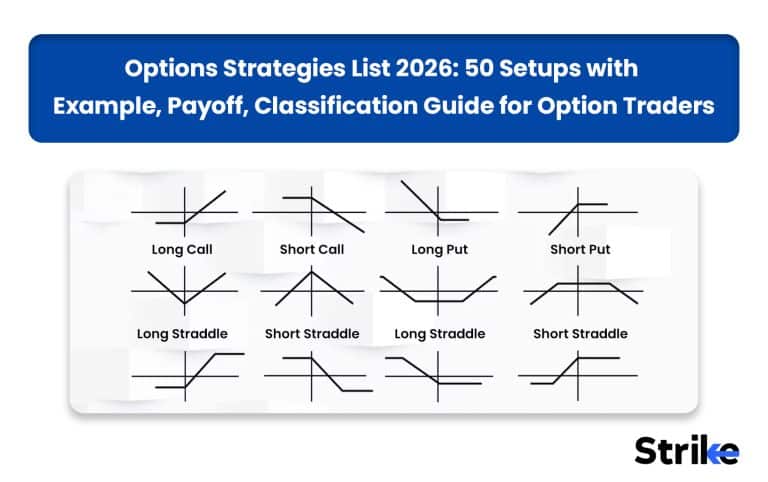


Options strategies are structured combinations of option contracts, and sometimes the underlying asset, designed to achieve specific trading objectives under different market conditions. Options strategies enable traders to express bullish, bearish, neutral, or volatility-based views while defining potential profit, limiting risk, generating income, or hedging existing positions.
From simple single-leg trades to advanced multi-leg combinations, each strategy is built for a particular market outlook and risk profile. Understanding when and why to use a strategy is often more important than simply knowing how it works. This guide explains 50 options strategies with simple examples, payoff structures, and a practical classification framework, making it easier for beginners and experienced traders to select the most suitable setup for their trading goals.
What Are Option Strategies?
Options strategies are the combination of buying and selling of call and put options designed to achieve a specific investment goal, such as generating income, protecting a portfolio, or speculating on price movements with defined risk.
Options Basics You Need First
You need to know the basic terms of options first, before we continue to option strategies.
- Call Option: Call option is a contract that gives the buyer the right, but not the obligation, to buy an underlying asset at a predetermined price (strike price) before or on the expiry date.
- Put Option: Put option is a contract that gives the buyer the right, but not the obligation, to sell an underlying asset at a predetermined price (strike price) before or on the expiry date.
- Strike Price: The strike price is the fixed price at which the underlying asset can be bought (call) or sold (put).
- Premium: The price you pay to buy options contracts. The premium is the price paid by the option buyer to purchase the option contract. It is also the income received by the option seller (writer).
- Expiry Date: Every option contract has a fixed expiry date. If the option is not exercised or closed before expiry, it expires.
- ITM, ATM and OTM: The terms In-the-Money (ITM), At-the-Money (ATM), and Out-of-the-Money (OTM) are used by traders to describe the relationship between the strike price and the current market price. Understanding whether a contract is In-the-Money (ITM), At-the-Money (ATM), or Out-of-the-Money (OTM) is crucial for assessing its intrinsic value and overall premium.
| Term | Call Option | Put Option |
| In-the-Money (ITM) | Stock price is above strike price | Stock price is below strike price |
| At-the-Money (ATM) | Stock price is approximately equal to strike price | Stock price is approximately equal to strike price |
| Out-of-the-Money (OTM) | Stock price is below strike price | Stock price is above strike price |
- Intrinsic Value vs. Time Value: Intrinsic value and time value are two components of
option premium. Intrinsic value is the amount by which an option is already profitable if exercised immediately whereas, time value is the extra value buyers pay because the option still has time before expiry and may become more profitable. - Assignment: Assignment occurs when an option seller (writer) is required to fulfill the contract because the option holder exercises their right.
The above- mentioned terms are used very often in the options market, hence understanding these terms is essential.
All Option Strategies List with Explanation
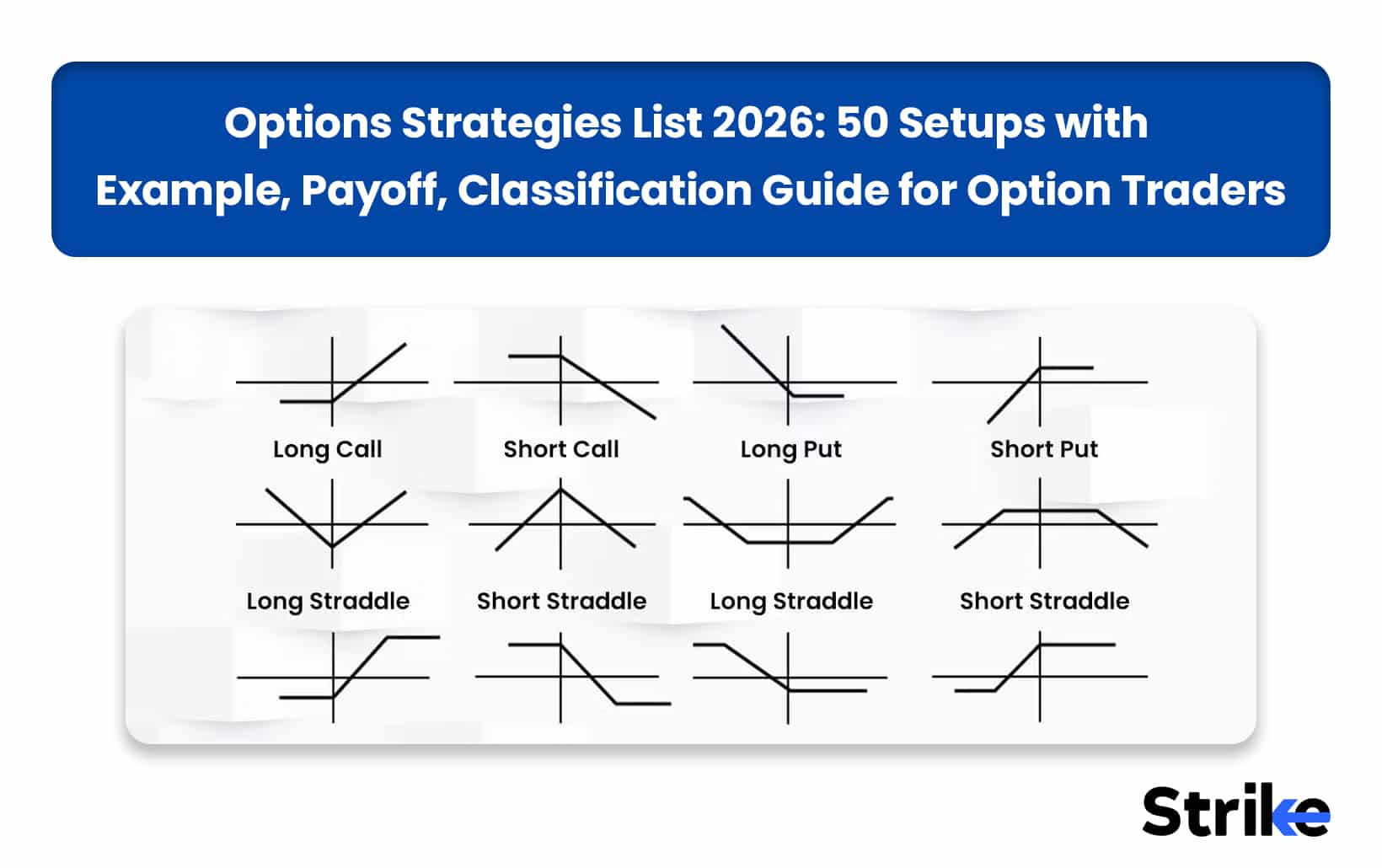
We have briefly discussed all the 50 different options trading strategies below with a payoff chart.
1. Long Call
Long call option strategy involves buying a call option to make profit from a rising price of the underlying by keeping the maximum loss to the premium paid. You can use Long call strategy when you expect the underlying to rise significantly before its expiry.
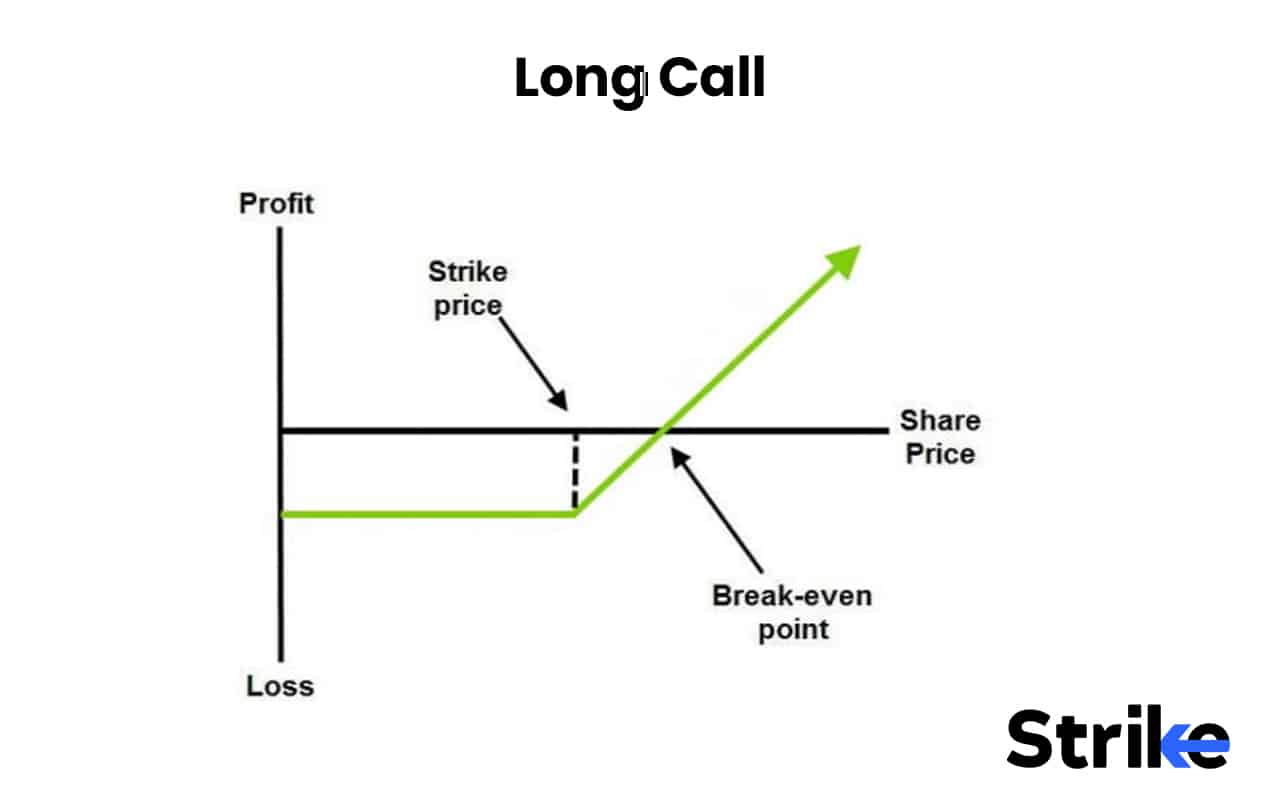
As this strategy is constructed by just buying a call option at a chosen strike price, this strategy is considered as a single-legged option strategy.
| Parameter | Details |
| Maximum Profit | Unlimited |
| Maximum Loss | Limited to the premium paid |
| Breakeven | Strike Price + Premium Paid |
| Best When | Bullish outlook, rising implied volatility (IV), and sufficient time to expiry |
| Risk-Reward | Limited Risk, Unlimited Reward |
| Classification | Bullish Debit Strategy |
As per data published on zerropay, a long call has a relatively low win rate around 40-50%, compared to sold option strategies, which has a 70-80% win rate.
2. Bull Call Spread
Bull call spread is a bullish outlook strategy where you buy one lower strike price call option and simultaneously sell a higher strike call option of the same expiry to reduce the cost of trading and max loss.
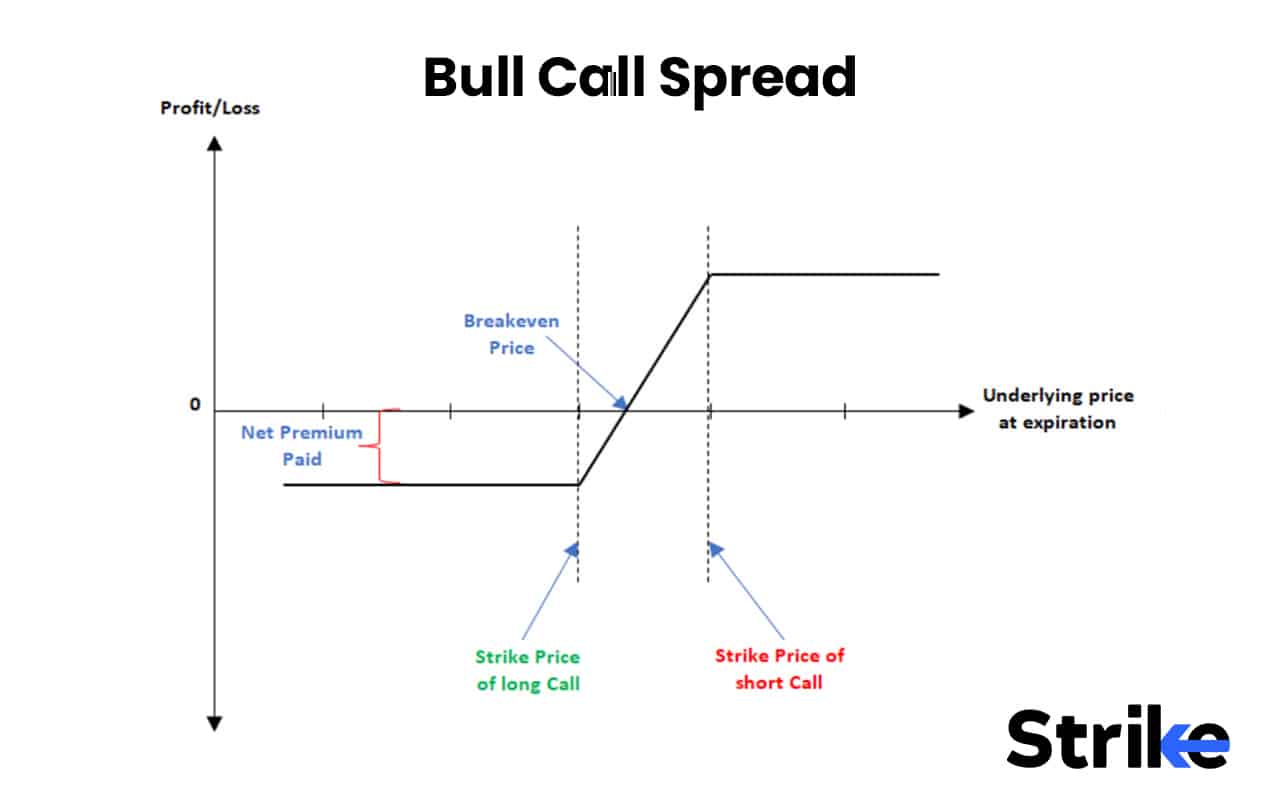
It is a two-legged option strategy, constructed by buying a lower strike call option and selling a higher strike call option of the same expiry.
| Action | Option Type | Strike Price | Expiry |
| Buy | 1 Call Option | Lower Strike (ATM or ITM) | Same expiry |
| Sell | 1 Call Option | Higher Strike (OTM) | Same expiry |
You can create Bull Call Spread strategy when you expect the market to stay moderately bullish instead of sharp momentum.
| Bull Call Spread Strategy Summary Table | |
| Maximum Profit | Difference between strike prices − Net Premium Paid |
| Maximum Loss | Net Premium Paid |
| Breakeven | Lower Strike + Net Premium Paid |
| Best When | Moderately bullish outlook, low to moderate implied volatility (IV) |
| Risk-Reward | Limited Risk, Limited Reward |
| Classification | Bullish Debit Strategy |
It also has a less win-rate but the loss and profit in this strategy is less due to hedges.
3. Bull Put Spread
Bull Put spread is also a bullish outlook strategy, but instead of call, you create it using put. Sell the put option of higher strike price and simultaneously buy a put option of lower strike price of the same expiry to limit the risk and reduces overall cost of trading.
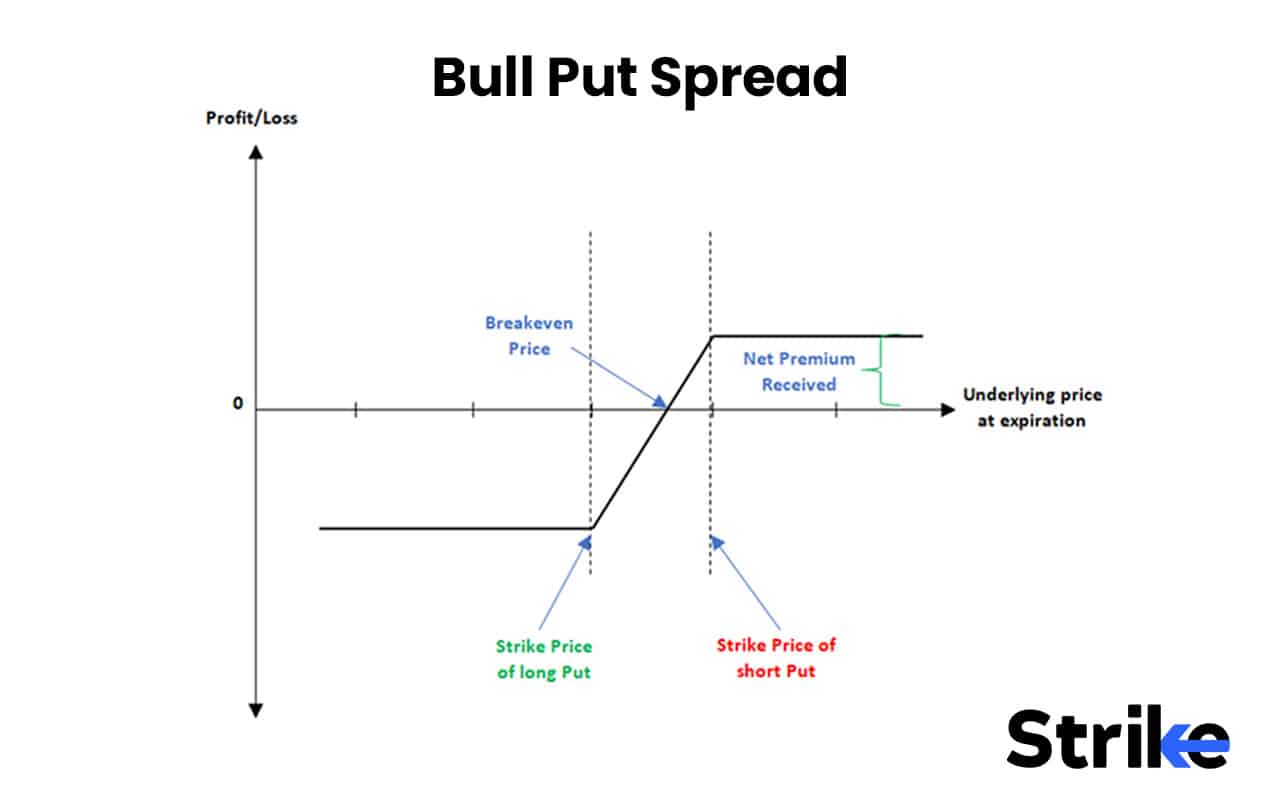
As we sell higher strike put options and buy a lower strike put option, hence it is a net credit two legged option strategy.
| Action | Option Type | Strike Price | Expiry |
| Sell | 1 Put Option | Higher Strike (ATM or Slightly OTM) | Same Expiry |
| Buy | 1 Put Option | Lower Strike (OTM) | Same Expiry |
You can create Bull Put Spread strategy when you expect the market to remain moderately bullish or to stay above a specific price level.
| Bull Put Spread Strategy Summary Table | |
| Maximum Profit | Net Premium Received |
| Maximum Loss | Difference between strike prices − Net Premium Received |
| Breakeven | Higher Strike − Net Premium Received |
| Best When | Moderately bullish outlook, neutral to high implied volatility (IV) |
| Risk-Reward | Limited Risk, Limited Reward |
| Classification | Bullish Credit Strategy |
4. Covered Call
Covered call is a regular income generation option strategy where you sell the OTM call option of a stock that you already own to earn a regular premium.
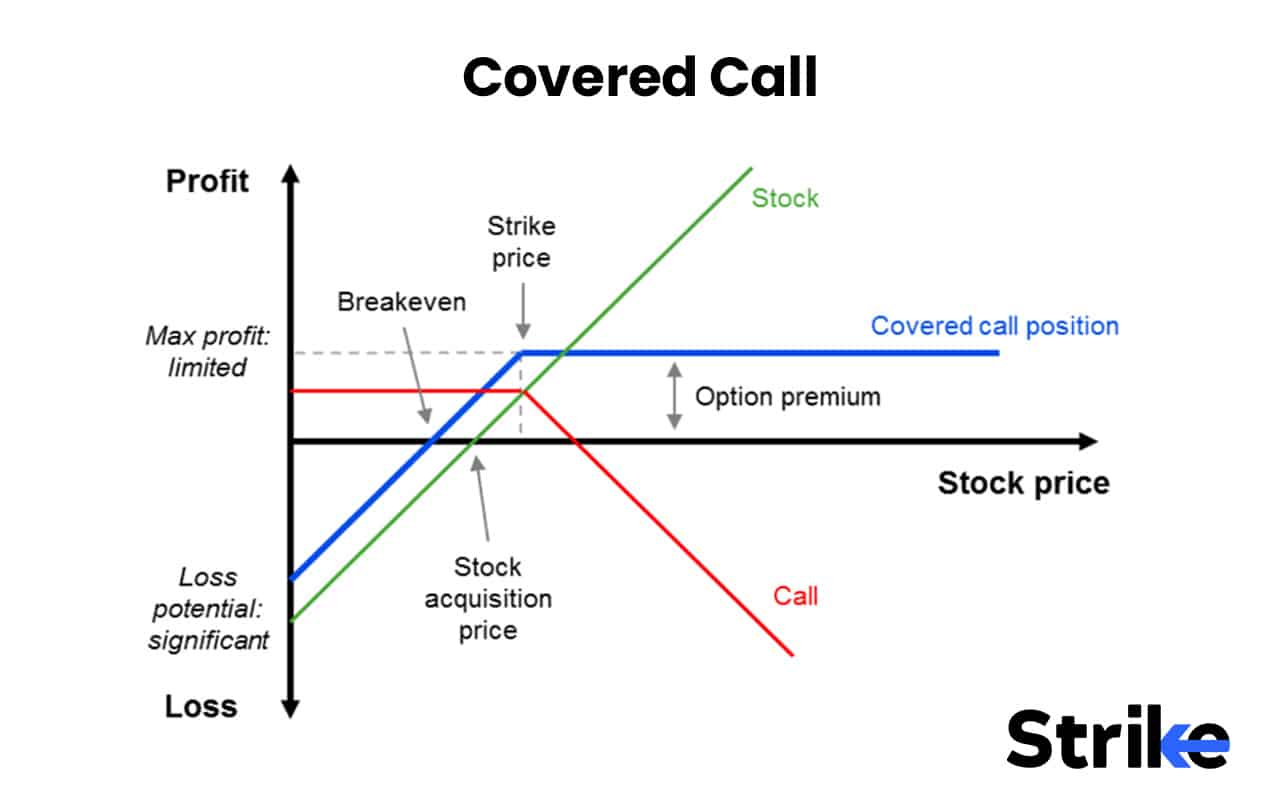
As you sell OTM call option against your holding stocks, the strategy is a net credit two legged option strategy.
| Action | Instrument | Strike Price | Expiry |
| Buy/Hold | 100 Shares (or 1 Lot) of the Underlying Asset | — | — |
| Sell | 1 Call Option | OTM (Above Current Market Price) | Same Expiry |
You can create Covered Call strategy when you expect your owned stock to remain neutral, moderately bullish, or go down.
| Parameter | Details |
| Strategy Type | Net Credit Strategy |
| Maximum Profit | Premium Received + (Strike Price − Stock Purchase Price) |
| Maximum Loss | Similar to owning the stock (if the stock falls to zero, offset by the premium received) |
| Breakeven | Stock Purchase Price − Premium Received |
| Best When | Neutral to moderately bullish outlook, high implied volatility (IV) |
| Risk-Reward | Limited Reward, Significant Downside Risk |
| Classification | Bullish Income Strategy |
5. Cash-Secured Put
Cash-Secured put is also a regular income strategy where you sell an OTM put option to earn regular premium while keeping enough cash to buy underlying shares if assigned. This option strategy is mostly used by investors to buy the stock at a discount price while earning regular premium while waiting to acquire the stock at a lower price.
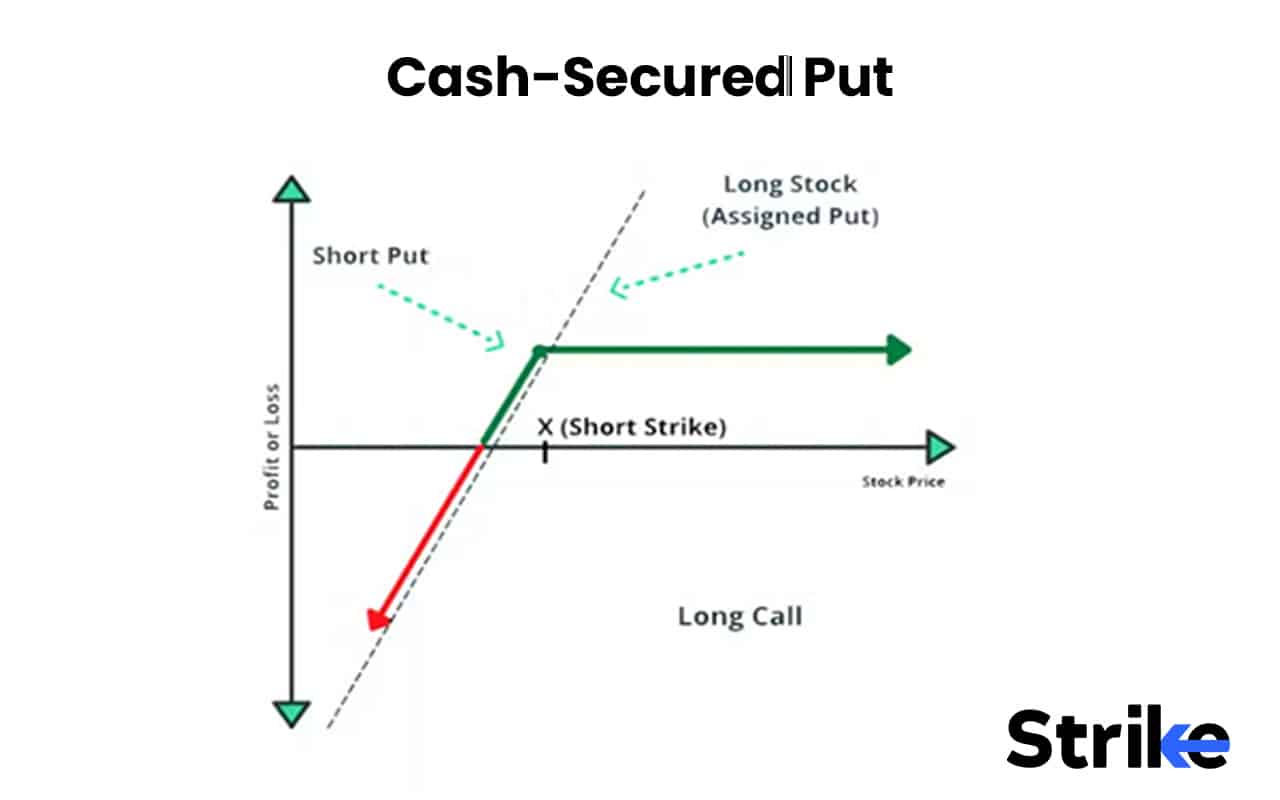
As we receive a premium by selling puts, this strategy is a net-credit strategy and involves two legs.
| Action | Instrument | Strike Price | Expiry |
| Sell | 1 Put Option | ATM or Slightly OTM | Same Expiry |
| Reserve | Cash Equal to Strike Price × Lot Size | — | Until Expiry |
Cash-Secured strategy works best when you expect stock to remain neutral or bullish, but you want to buy a stock at a discounted price so you sell the OTM put option of desired price and earn premium until it gets assigned.
| Parameter | Details |
| Strategy Type | Net Credit Strategy |
| Maximum Profit | Net Premium Received |
| Maximum Loss | Strike Price − Premium Received (if the stock falls to zero) |
| Breakeven | Strike Price − Premium Received |
| Best When | Neutral to moderately bullish outlook, high implied volatility (IV) |
| Risk-Reward | Limited Reward, Significant Downside Risk |
| Classification | Bullish Income Strategy |
6. Call Ratio Backspread
Call ratio backspread is a bullish option strategy where you buy two higher strike call options to profit from a sharp upward price move and simultaneously sell a lower strike call option to limit downside risk.
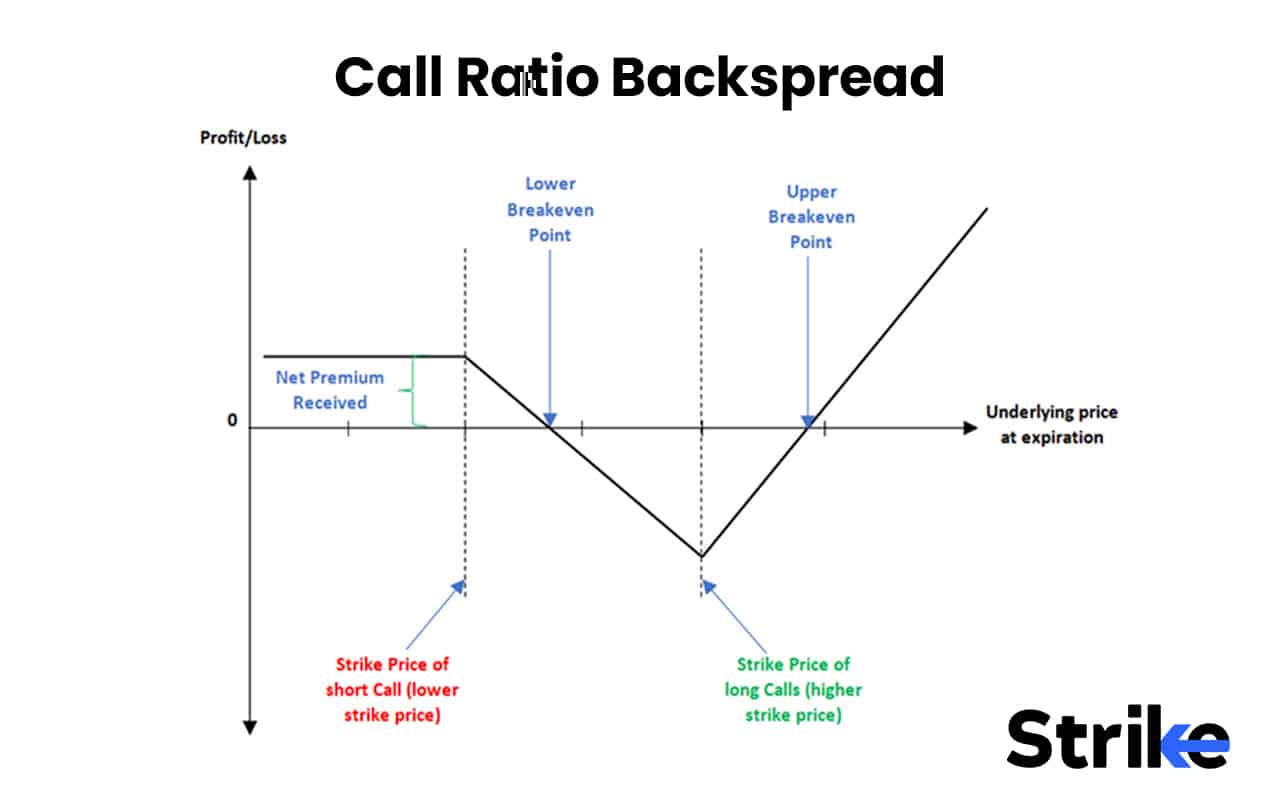
This strategy is a three-legged option strategy, because we construct this strategy by selling one lower strike and buying 2 upper strikes.
| Action | Option Type | Strike Price | Quantity | Expiry |
| Sell | Call Option | Lower Strike (ATM or ITM) | 1 | Same Expiry |
| Buy | Call Option | Higher Strike (OTM) | 2 | Same Expiry |
You can create Call ratio backspread strategy, if you expect the market to move strongly upward with momentum, but at the same time you also want to reduce the maximum loss.
| Parameter | Details |
| Strategy Type | Usually Net Debit (Can also be Net Credit) |
| Maximum Profit | Unlimited |
| Maximum Loss | Limited (Generally Net Premium Paid or Defined Risk Zone) |
| Breakeven | Two Breakeven Points at Expiry |
| Best When | Strong bullish outlook with rising implied volatility (IV) |
| Risk-Reward | Limited Risk, Unlimited Reward |
| Classification | Bullish Volatility Strategy |
7. Risk Reversal
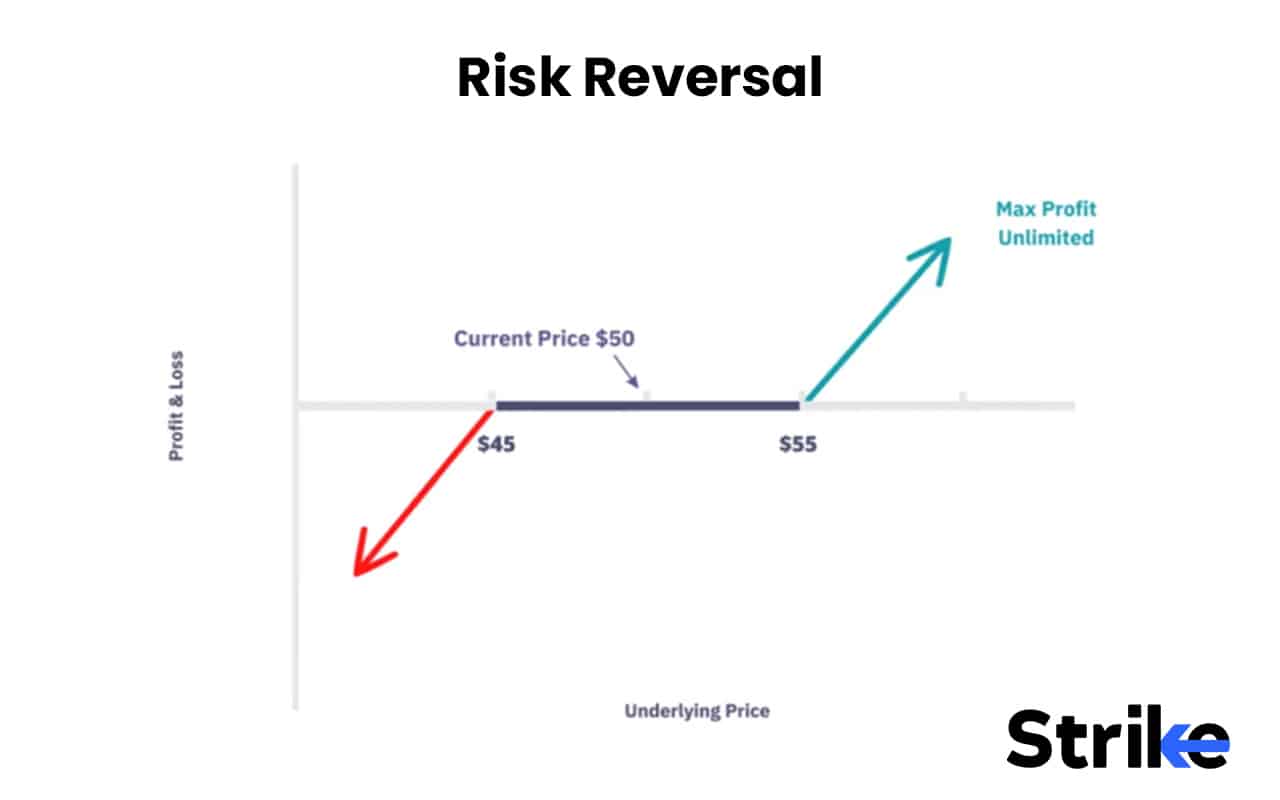
Risk reversal option strategy is a direction biased option strategy that involves buying one OTM option and simultaneously selling one OTM option. You can create Risk Reversal strategy for either bullish or bearish directional bias depending on your market views.
Bullish Risk Reversal
| Action | Option Type | Strike Price | Expiry |
| Buy | 1 Call Option | Higher Strike (OTM) | Same Expiry |
| Sell | 1 Put Option | Lower Strike (OTM) | Same Expiry |
Bearish Risk Reversal
| Action | Option Type | Strike Price | Expiry |
| Buy | 1 Put Option | Lower Strike (OTM) | Same Expiry |
| Sell | 1 Call Option | Higher Strike (OTM) | Same Expiry |
For bullish, buy one OTM call option and sell one OTM put option, while for bearish bias, buy one OTM put option and sell one OTM call option.
| Parameter | Details |
| Strategy Type | Net Debit, Net Credit, or Zero-Cost (Most commonly Zero-Cost) |
| Maximum Profit | Unlimited |
| Maximum Loss | Substantial (Similar to owning the underlying below the put strike) |
| Breakeven | Depends on Net Premium and Strike Prices |
| Best When | Directional outlook with low to moderate implied volatility (IV) |
| Risk-Reward | Unlimited Reward, Significant Downside Risk |
| Classification | Directional Synthetic Strategy |
8. Long Put
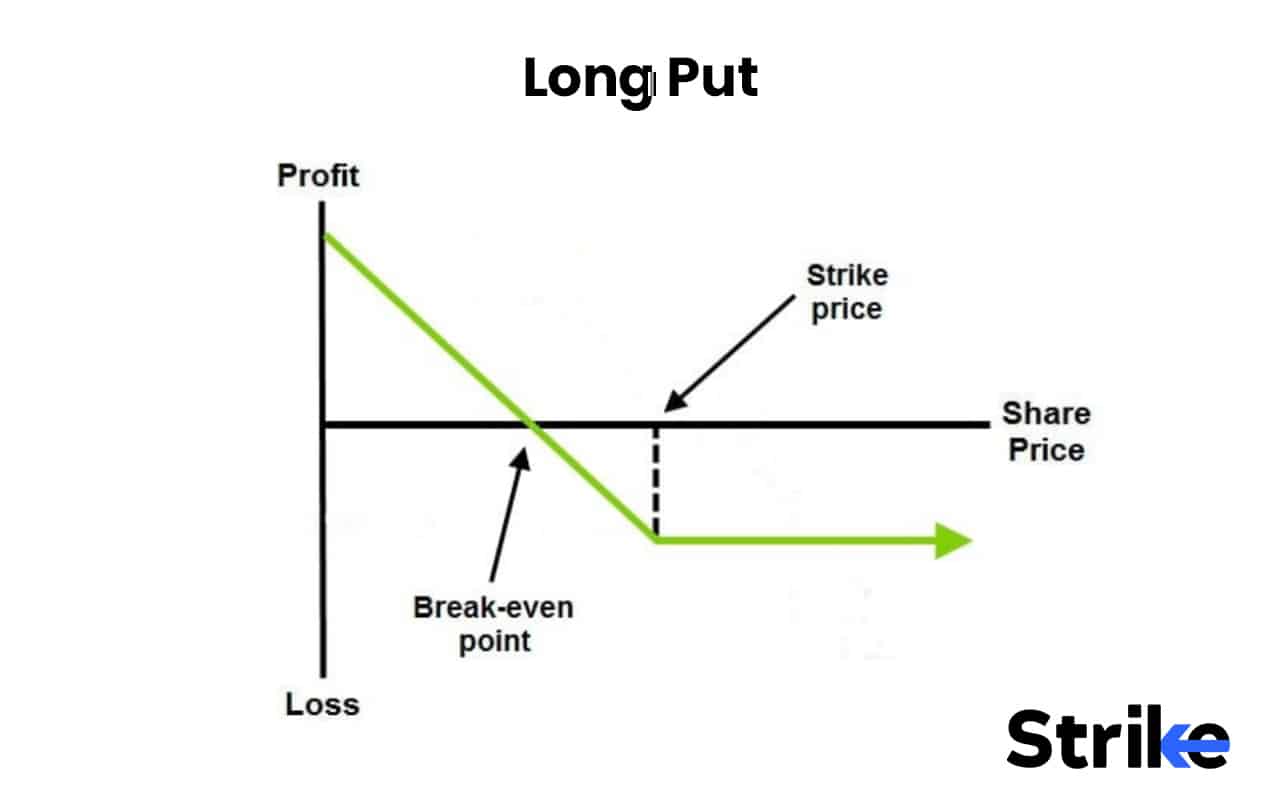
A long put option strategy involves buying a put option to make profit from a falling price of the underlying by keeping the maximum loss to the premium paid. You can use this strategy when you expect the underlying to fall significantly before its expiry.
| Action | Option Type | Strike Price | Expiry |
| Buy | 1 Put Option | ATM or Slightly OTM | Same Expiry |
As Long Put strategy is constructed by just buying a put option at a chosen strike price, it is a single-legged net debit option strategy.
| Parameter | Details |
| Strategy Type | Net Debit Strategy |
| Maximum Profit | Large (Limited to Strike Price − Premium, as the asset price cannot fall below zero) |
| Maximum Loss | Net Premium Paid |
| Breakeven | Strike Price − Premium Paid |
| Best When | Bearish outlook, rising implied volatility (IV) |
| Risk-Reward | Limited Risk, High Reward |
| Classification | Bearish Debit Strategy |
9. Bear Put Spread
Bear put spread is a bearish outlook strategy where you buy one higher strike price put option and simultaneously sell a lower strike price put option of the same expiry to reduce the cost of trading and max loss.
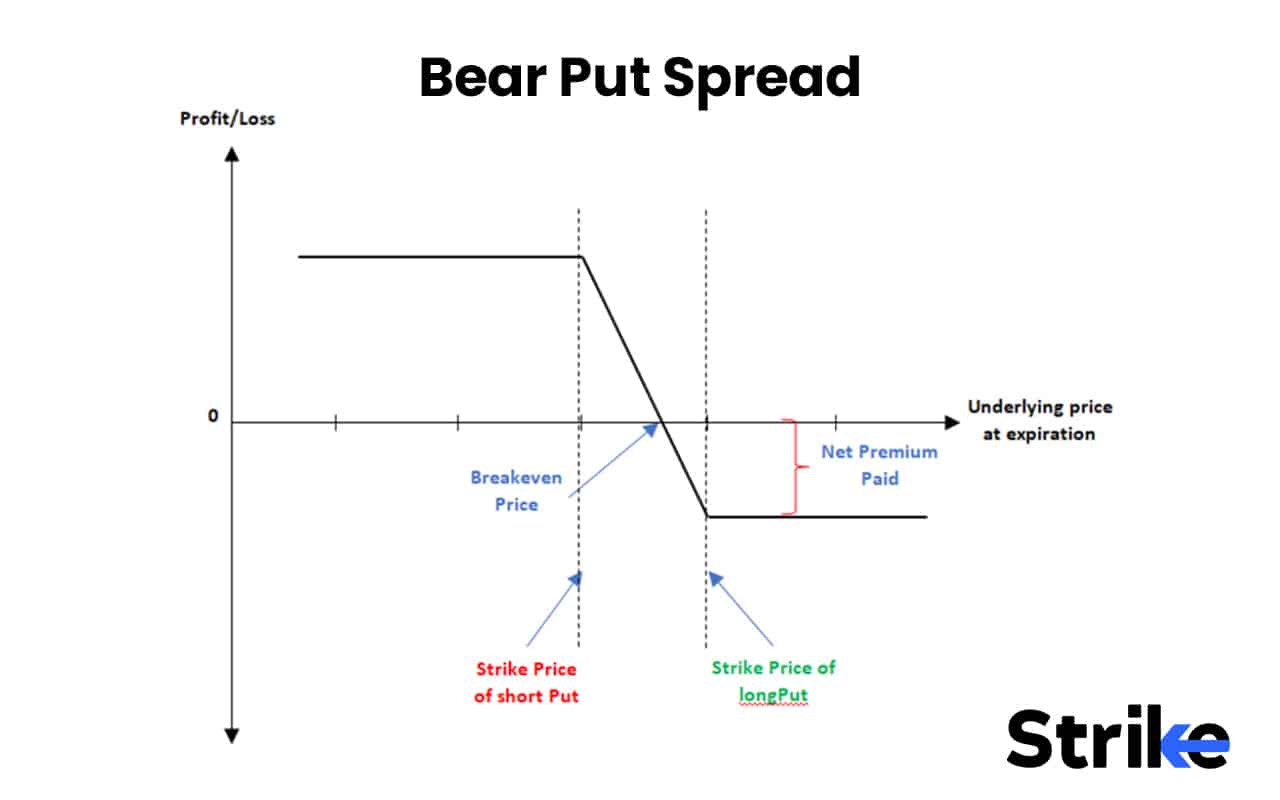
As we construct Bear Put Spread strategy by buying a higher strike price put option and selling a lower strike put option of the same expiry, it is a two legged net debit option strategy.
| Action | Option Type | Strike Price | Expiry |
| Buy | 1 Put Option | Higher Strike (ATM or ITM) | Same Expiry |
| Sell | 1 Put Option | Lower Strike (OTM) | Same Expiry |
You can create this strategy when you expect the market to stay moderately bearish instead of sharp downwards momentum.
| Parameter | Details |
| Strategy Type | Net Debit Strategy |
| Maximum Profit | Difference between strike prices − Net Premium Paid |
| Maximum Loss | Net Premium Paid |
| Breakeven | Higher Strike − Net Premium Paid |
| Best When | Moderately bearish outlook, low to moderate implied volatility (IV) |
| Risk-Reward | Limited Risk, Limited Reward |
| Classification | Bearish Debit Strategy |
10. Bear Call Spread
It is a bearish option strategy where you sell a lower strike call option and simultaneously buy a higher strike call option of the same expiry to earn premium while limiting your risk.
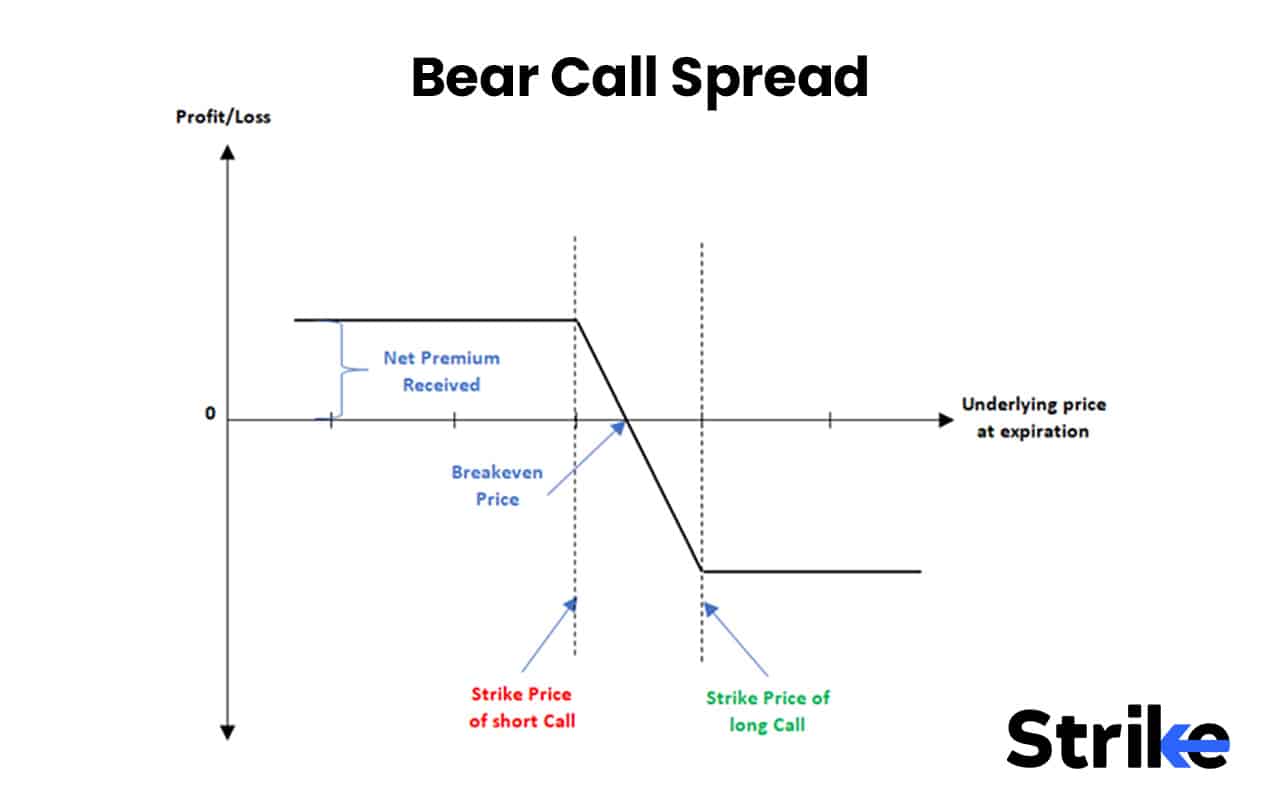
It is a net credit two legged option trading strategy where you receive a premium from a sold call option as a profit.
| Action | Option Type | Strike Price | Expiry |
| Sell | 1 Call Option | Lower Strike (ATM or Slightly OTM) | Same Expiry |
| Buy | 1 Call Option | Higher Strike (OTM) | Same Expiry |
You can create Bear Call Spread strategy, if you expect the market to stay moderately bearish or neutral below your selected strike price.
| Parameter | Details |
| Strategy Type | Net Credit Strategy |
| Maximum Profit | Net Premium Received |
| Maximum Loss | Difference between strike prices − Net Premium Received |
| Breakeven | Lower Strike + Net Premium Received |
| Best When | Moderately bearish outlook, neutral to high implied volatility (IV) |
| Risk-Reward | Limited Risk, Limited Reward |
| Classification | Bearish Credit Strategy |
11. Protective Put
Protective put is a risk management strategy where traders or investors buy an OTM put option of an underlying they already hold to protect the position from sudden decline while having a potential of getting unlimited upside profit moves.
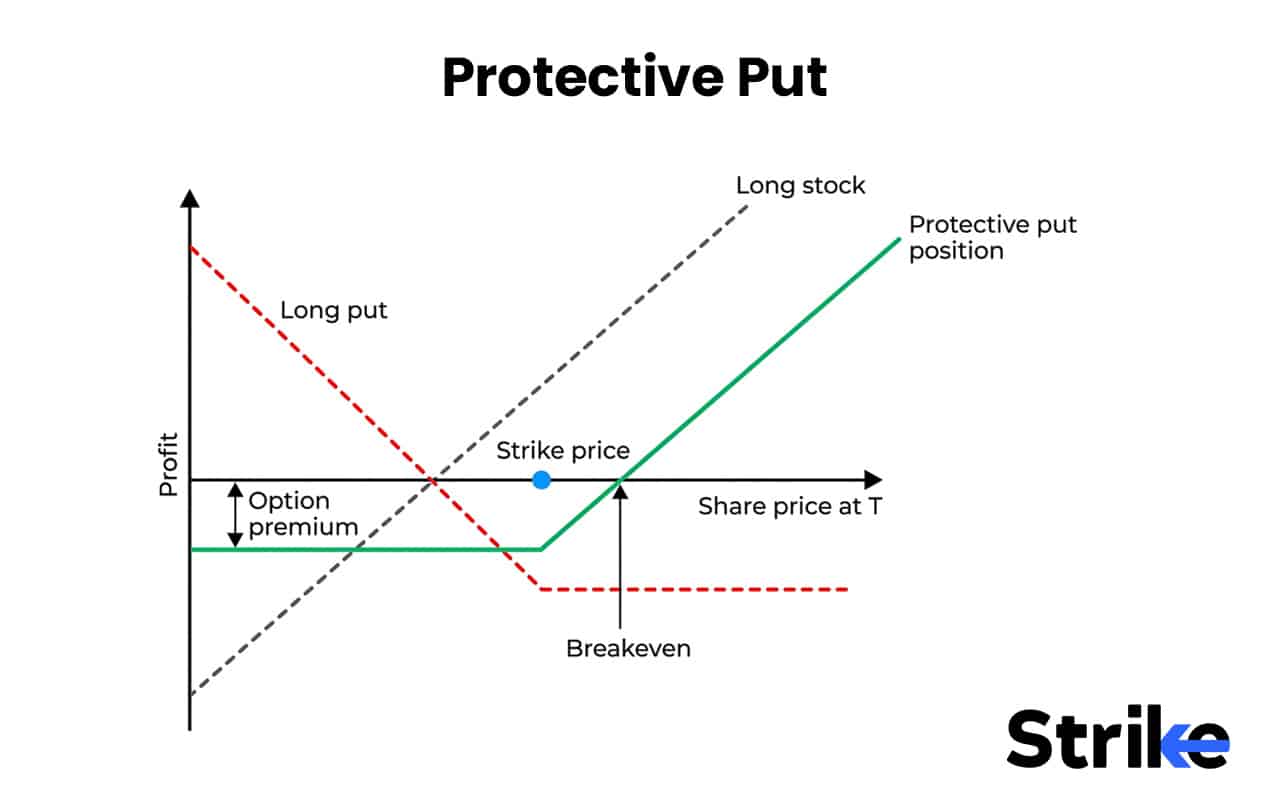
Since you pay a premium to purchase a put option as insurance, it is a two legged net debit strategy.
| Action | Instrument | Strike Price | Expiry |
| Buy/Hold | 100 Shares (or 1 Lot) of the Underlying Asset | — | — |
| Buy | 1 Put Option | ATM or Slightly OTM | Same Expiry |
Protective Put strategy is very commonly used by investors who want to protect their capital from a correction without selling the stocks.
| Parameter | Details |
| Strategy Type | Net Debit Strategy |
| Maximum Profit | Unlimited |
| Maximum Loss | Stock Purchase Price − Put Strike + Premium Paid |
| Breakeven | Stock Purchase Price + Premium Paid |
| Best When | Bullish outlook with concerns about short-term downside risk; low implied volatility (IV) |
| Risk-Reward | Limited Risk, Unlimited Reward |
| Classification | Bullish Hedging Strategy |
12. Put Ratio Backspread
A put ratio backspread is a bearish outlook options strategy where you buy two lower strike put options and sell one higher strike put option of the same expiry to reduce the maximum loss.
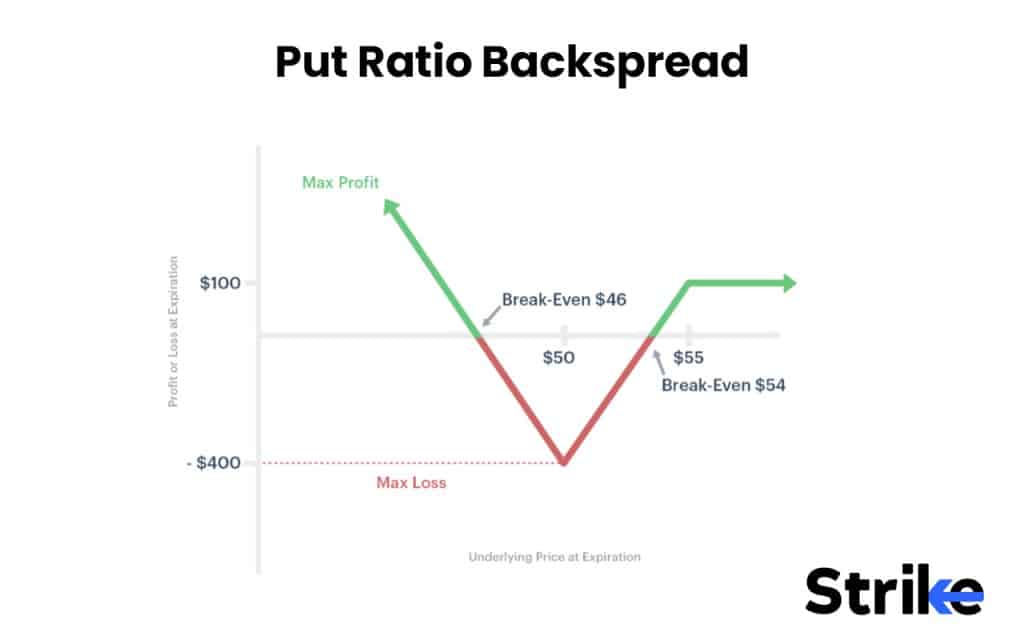
It is a three legged option strategy and is neither a net debit or net credit strategy, but it is considered as a small net debit.
| Action | Option Type | Strike Price | Quantity | Expiry |
| Sell | Put Option | Higher Strike (ATM or ITM) | 1 | Same Expiry |
| Buy | Put Option | Lower Strike (OTM) | 2 | Same Expiry |
This strategy can be created when you expect a strong downtrend. Unlike a long put strategy, where you just buy a naked put option where your maximum loss is exposed to the total premium paid, in Put Ratio Backspread, you reduce the risk by selling on a higher strike put option.
| Parameter | Details |
| Strategy Type | Usually Net Debit (Can also be Net Credit) |
| Maximum Profit | Large (Theoretically limited as the underlying cannot fall below zero) |
| Maximum Loss | Limited (Generally Net Premium Paid or Defined Risk Zone) |
| Breakeven | Two Breakeven Points at Expiry |
| Best When | Strong bearish outlook with rising implied volatility (IV) |
| Risk-Reward | Limited Risk, High Reward |
| Classification | Bearish Volatility Strategy |
13. Collar
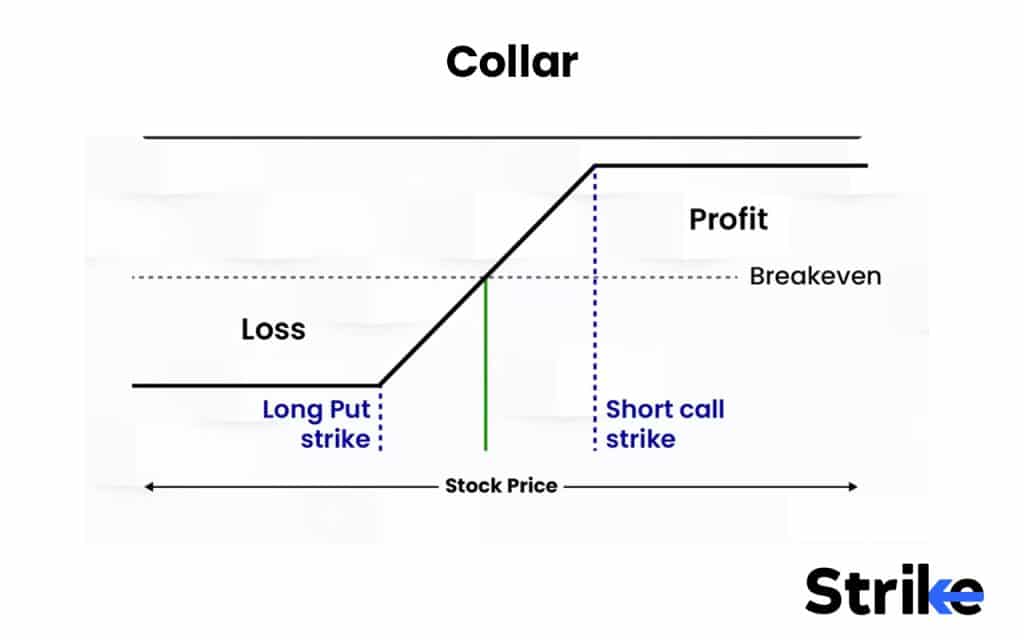
A collar is a bullish hedging strategy where you hedge your both side risk on already holding stock by selling a covered call and buying a protective put option. As we buy one put, sell one call and own a stock, this strategy is a three legged option strategy.
| Action | Instrument | Strike Price | Expiry |
| Buy/Hold | Underlying Stock | — | — |
| Buy | 1 Put Option | OTM or ATM | Same Expiry |
| Sell | 1 Call Option | OTM (Above Stock Price) | Same Expiry |
You can create Collar strategy when the underlying is in sideways move or you want to protect an existing stock position while reducing the cost of buying a protective put.
| Parameter | Details |
| Strategy Type | Usually Net Debit Strategy (can be Zero-Cost or Net Credit) |
| Maximum Profit | Limited |
| Maximum Loss | Limited |
| Breakeven | Stock Purchase Price + Net Cost of the Collar |
| Best When | Moderately bullish outlook with concern about downside risk |
| Risk-Reward | Limited Risk, Limited Reward |
| Classification | Bullish Hedging Strategy |
14. Short Straddle
Short straddle is a market neutral option strategy where you sell ATM call and ATM put options of the same expiry. Short Straddle strategy is mostly used when the market is expected to stay in a sideways range till expiry and expire near the selected ATM strike.
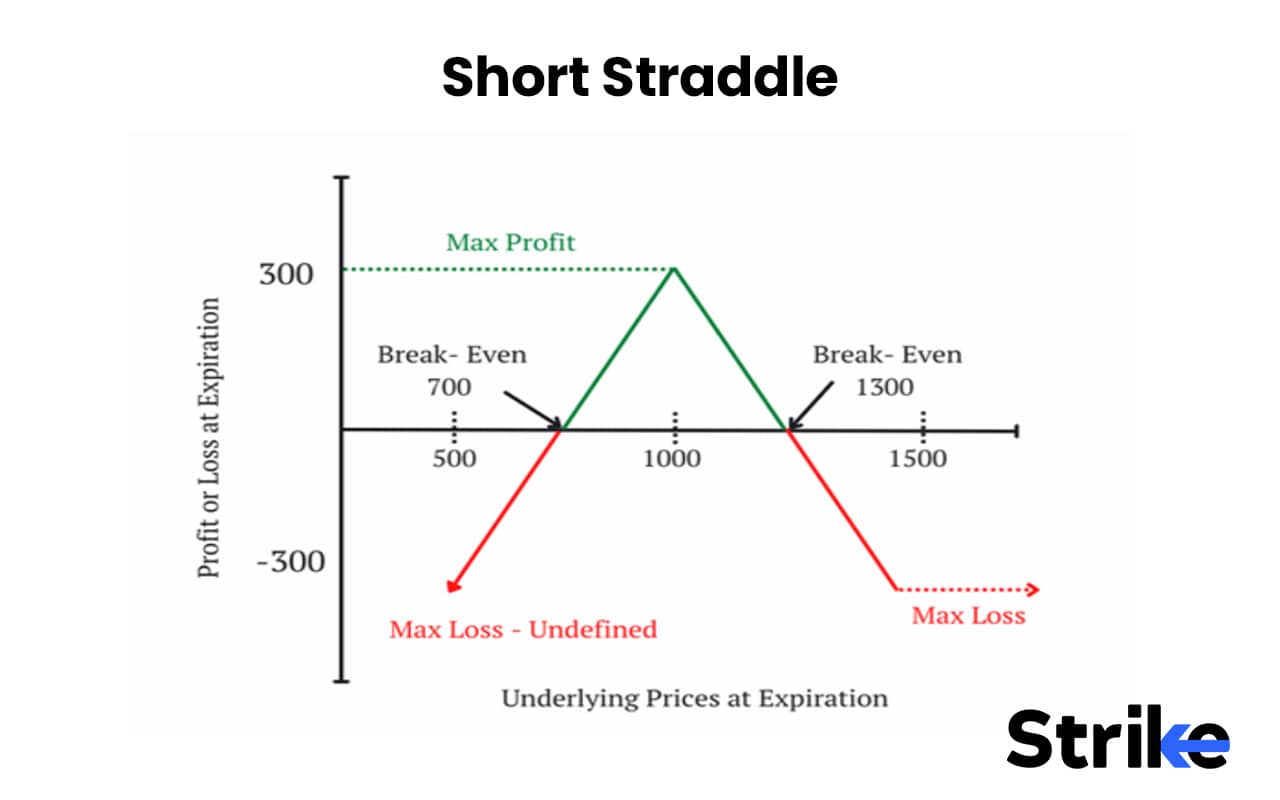
As we sell ATM call and put options, it is a two legged net credit option strategy.
| Action | Option Type | Strike Price | Expiry |
| Sell | 1 Call Option | ATM | Same Expiry |
| Sell | 1 Put Option | ATM | Same Expiry |
You will earn maximum profit when the market closes exactly at the sold strike price, because both the sold options will expire worthless, giving you all the premiums.
| Parameter | Details |
| Strategy Type | Net Credit Strategy |
| Maximum Profit | Total Premium Received |
| Maximum Loss | Unlimited (Upside) and Substantial (Downside, limited by stock reaching zero) |
| Breakeven | Upper: Strike Price + Total Premium ReceivedLower: Strike Price − Total Premium Received |
| Best When | Neutral outlook, low expected volatility, high implied volatility at entry |
| Risk-Reward | Unlimited Risk, Limited Reward |
| Classification | Neutral Income Strategy |
15. Short Strangle
Short strangle is also a market neutral option strategy, but instead of selling ATM call and put option, here we sell slightly OTM call and put option. This gives us more space for profit compared to short straddles.
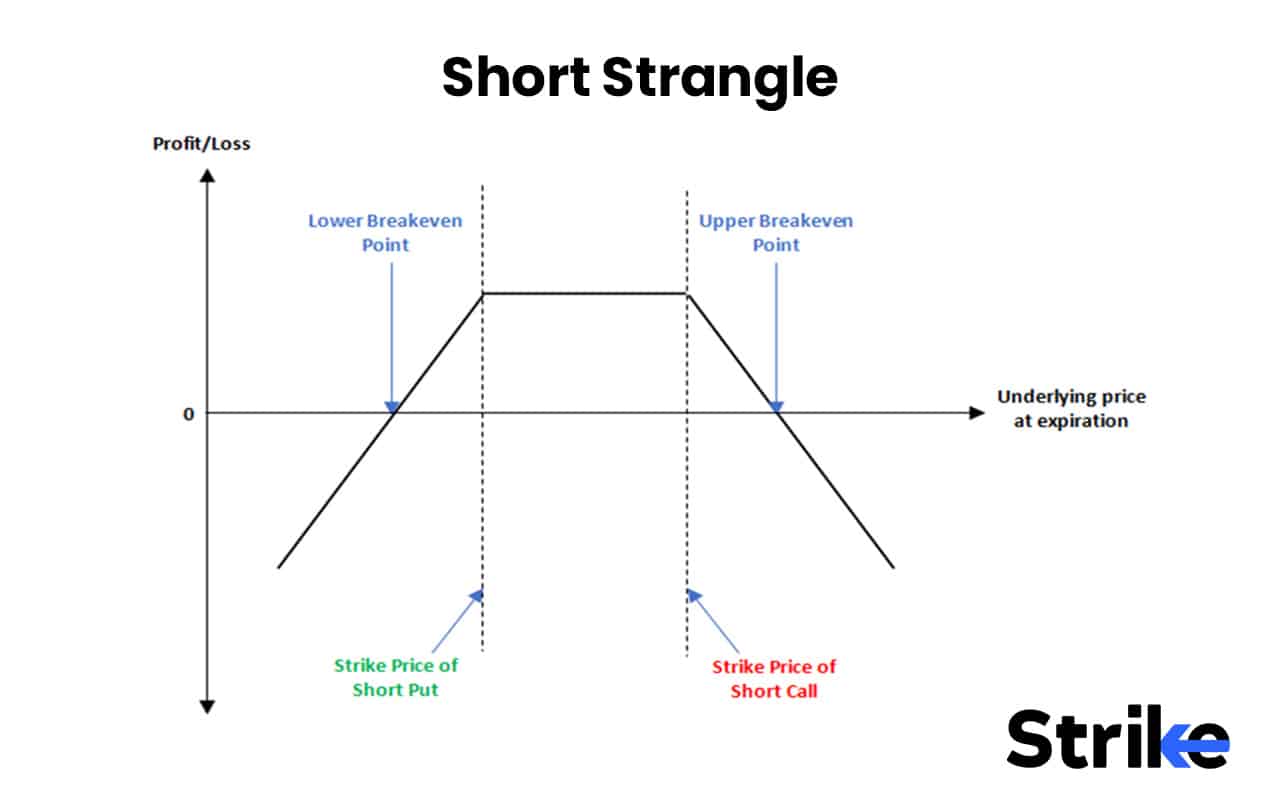
Short straddle is also a two legged net credit option selling strategy as we sell both call and put options.
| Action | Option Type | Strike Price | Expiry |
| Sell | 1 Call Option | Higher Strike (OTM) | Same Expiry |
| Sell | 1 Put Option | Lower Strike (OTM) | Same Expiry |
This strategy works best in a range-bound market, where stock is expected to move and expire within a fixed range. Unlike short straddle, which gives max profit if stock expires exactly at ATM, in short strangle, it gives maximum profit throughout the range.
| Parameter | Details |
| Strategy Type | Net Credit Strategy |
| Maximum Profit | Total Premium Received |
| Maximum Loss | Unlimited (Upside) and Substantial (Downside, limited by stock reaching zero) |
| Breakeven | Upper: Call Strike + Total Premium ReceivedLower: Put Strike − Total Premium Received |
| Best When | Neutral outlook, low expected volatility, high implied volatility at entry |
| Risk-Reward | Unlimited Risk, Limited Reward |
| Classification | Neutral Income Strategy |
16. Iron Condor
Iron condor is a market neutral strategy where we combine an OTM Bull Put Spread and a OTM Bear Call Spread to collect premium from both the legs and simultaneously limit our unlimited loss in the market. You can also consider it as a strangle with hedges.
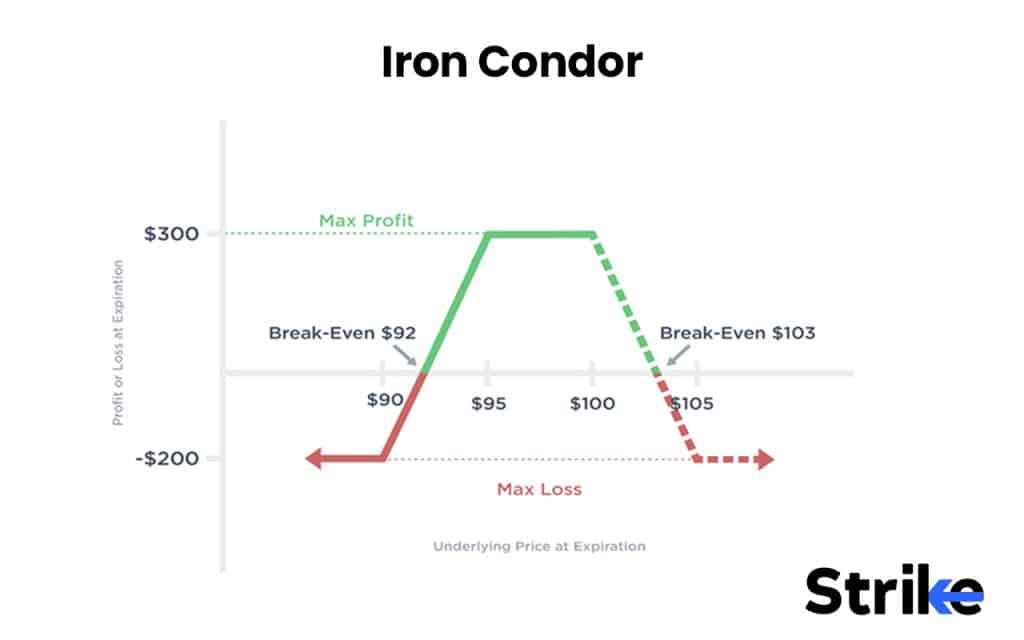
Iron condor is a four-legged strategy, which involves selling of one OTM Call and Put option and buying of one far OTM call and put option.
| Action | Option Type | Strike Price | Expiry |
| Buy | 1 Put Option | Lower Strike (OTM) | Same Expiry |
| Sell | 1 Put Option | Higher Strike (OTM) | Same Expiry |
| Sell | 1 Call Option | Lower Strike (OTM) | Same Expiry |
| Buy | 1 Call Option | Higher Strike (OTM) | Same Expiry |
You can create this strategy if you expect the market to remain sideways and expire within the expected range, so you receive the net premium as profit.
| Parameter | Details |
| Strategy Type | Net Credit Strategy |
| Maximum Profit | Net Premium Received |
| Maximum Loss | Width of One Spread − Net Premium Received |
| Breakeven | Upper: Short Call Strike + Net Premium ReceivedLower: Short Put Strike − Net Premium Received |
| Best When | Neutral outlook, high implied volatility at entry followed by falling IV |
| Risk-Reward | Limited Risk, Limited Reward |
| Classification | Neutral Income Strategy |
17. Iron Butterfly
Iron Butterfly is a market neutral strategy where we combine an ATM Bull Put Spread and an ATM Bear Call Spread to collect premium from both the legs and simultaneously limit our unlimited loss in the market. You can also consider it as straddle with hedges.
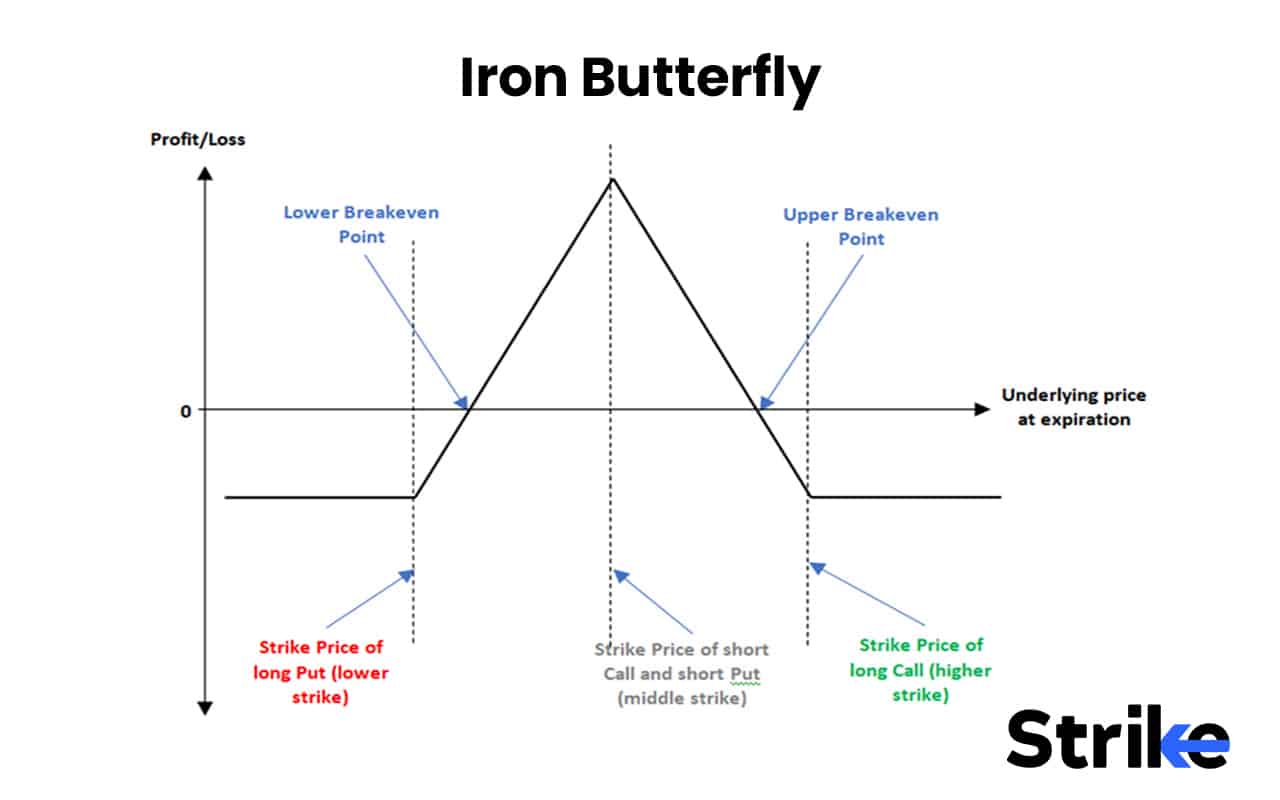
Iron butterfly is also a four-legged strategy, which involves selling one ATM Call and Put option and buying one OTM call and put option.
| Action | Option Type | Strike Price | Expiry |
| Buy | 1 Put Option | Lower Strike (OTM) | Same Expiry |
| Sell | 1 Put Option | Middle Strike (ATM) | Same Expiry |
| Sell | 1 Call Option | Middle Strike (ATM) | Same Expiry |
| Buy | 1 Call Option | Higher Strike (OTM) | Same Expiry |
You can create this strategy, when you expect the market to remain sideways and expire near the sold options to maximum premium as profit.
| Parameter | Details |
| Strategy Type | Net Credit Strategy |
| Maximum Profit | Net Premium Received |
| Maximum Loss | Width of One Spread − Net Premium Received |
| Breakeven | Upper: Middle Strike + Net Premium ReceivedLower: Middle Strike − Net Premium Received |
| Best When | Neutral outlook, high implied volatility at entry followed by falling IV |
| Risk-Reward | Limited Risk, Limited Reward |
| Classification | Neutral Income Strategy |
18. Long Butterfly Spread
Long Butterfly spread is also a market neutral option strategy where you make profit when underlying expires near the middle strike or ATM strike price.
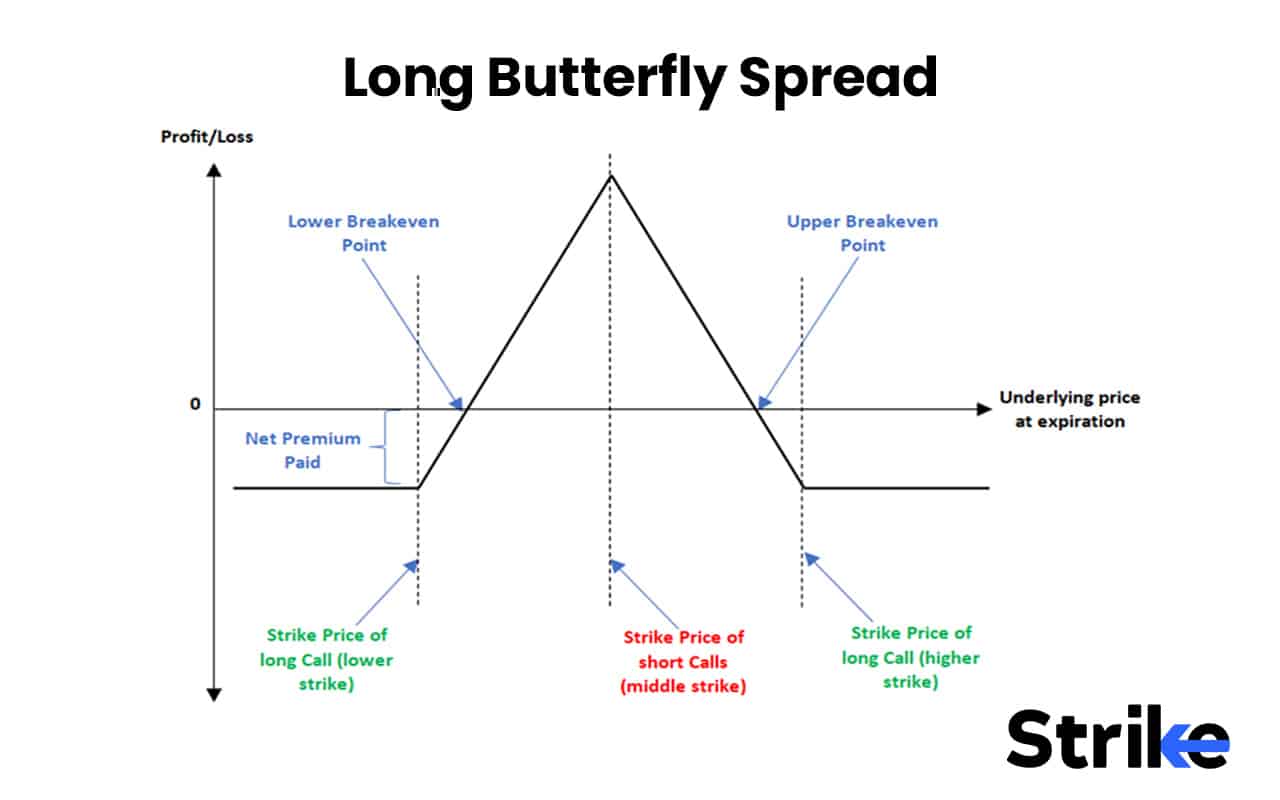
The long butterfly spread is a four-legged option strategy where you buy one lower strike call, sell two middle strike calls, and buy one higher strike call, all of the same expiry.
| Action | Option Type | Strike Price | Quantity | Expiry |
| Buy | Call Option | Lower Strike (ITM) | 1 | Same Expiry |
| Sell | Call Option | Middle Strike (ATM) | 2 | Same Expiry |
| Buy | Call Option | Higher Strike (OTM) | 1 | Same Expiry |
Since the premium paid for the long calls is greater than the premium received from the short calls, a Long Butterfly Spread is a Net Debit Strategy.
| Parameter | Details |
| Strategy Type | Net Debit Strategy |
| Maximum Profit | Difference between adjacent strikes − Net Premium Paid |
| Maximum Loss | Net Premium Paid |
| Breakeven | Lower Strike + Net Premium PaidHigher Strike − Net Premium Paid |
| Best When | Neutral outlook, low implied volatility (IV), expecting the underlying to expire near the middle strike |
| Risk-Reward | Limited Risk, Limited Reward |
| Classification | Neutral Debit Strategy |
19. Calendar Spread
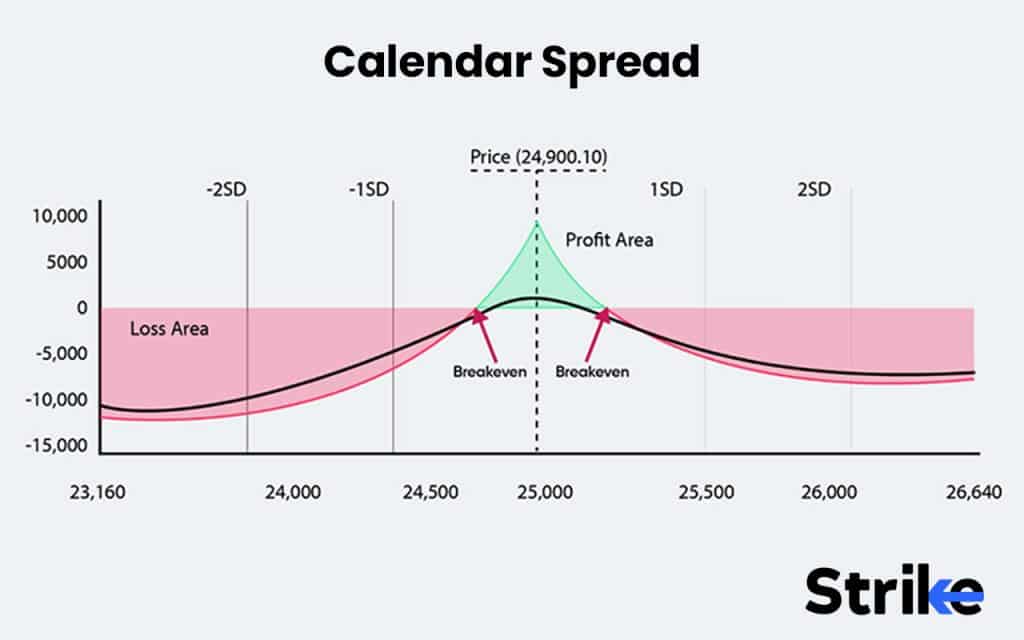
A calendar spread is a market neutral option strategy where you simultaneously buy and sell options of the same strike price but of a different expiry. Calendar spread is a two legged option strategy, constructed by selling a near-term call or put option and buying long-term call or put option, both of different expiry.
| Action | Option Type | Strike Price | Expiry |
| Sell | Call/Put Option | Same Strike (Usually ATM) | Near-Term Expiry |
| Buy | Call/Put Option | Same Strike | Longer-Term Expiry |
The logic behind a Calendar Spread is to profit from the faster time decay of a short-term option while retaining the value of a longer-term option, ideally with the underlying staying near the strike price and implied volatility increasing. Since the longer-term option costs more than the premium received from the shorter-term option, a Calendar Spread is a Net Debit Strategy.
| Parameter | Details |
| Strategy Type | Net Debit Strategy |
| Maximum Profit | Limited (Depends on time decay and implied volatility; not fixed before expiry) |
| Maximum Loss | Net Premium Paid |
| Breakeven | No single fixed breakeven; depends on expiry, implied volatility, and underlying price |
| Best When | Neutral outlook, low short-term volatility, rising implied volatility |
| Risk-Reward | Limited Risk, Limited Reward |
| Classification | Neutral Time-Decay Strategy |
20. Jade Lizard
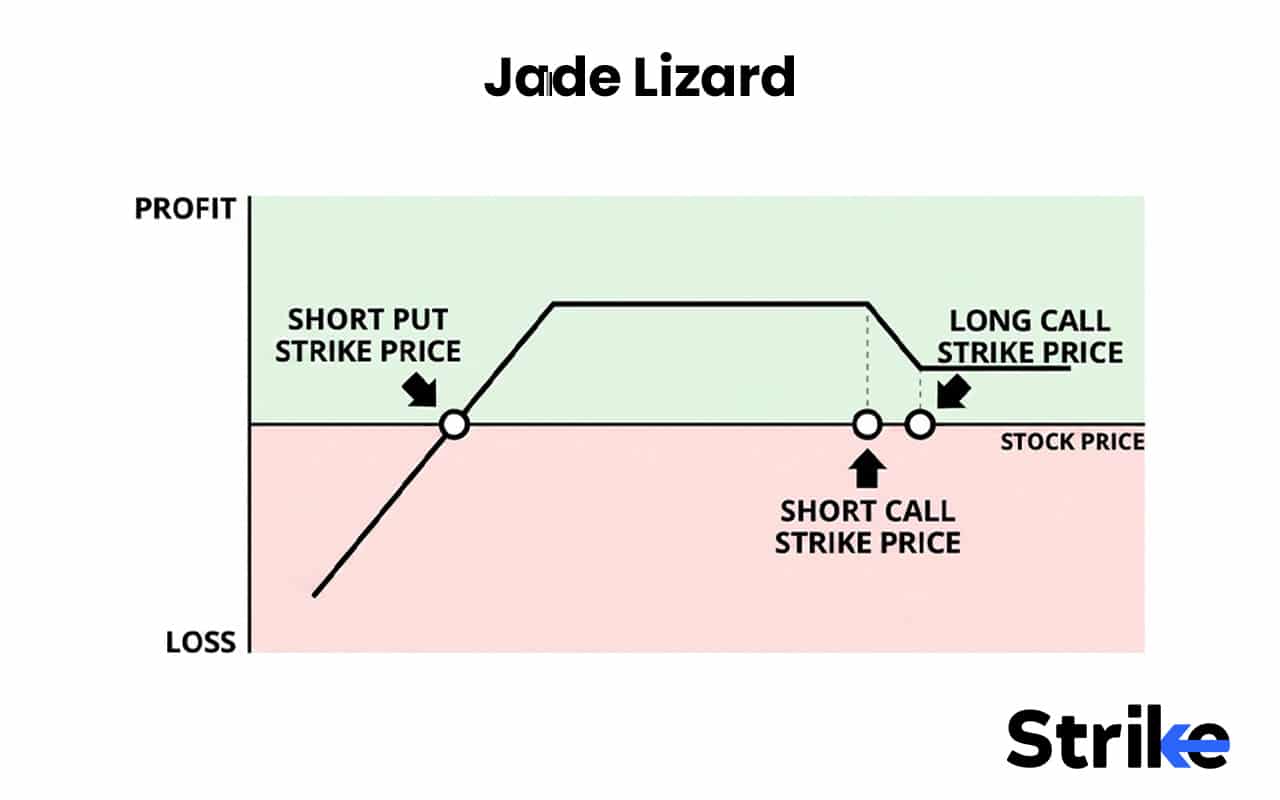
A Jade Lizard is an advanced options trading strategy designed to generate premium income with zero upside risk. It is a three legged option strategy that combines a short (naked) put with a short call spread (bear call spread).
| Action | Option Type | Strike Price | Expiry |
| Sell | 1 Put Option | Lower Strike (OTM) | Same Expiry |
| Sell | 1 Call Option | Higher Strike (OTM) | Same Expiry |
| Buy | 1 Call Option | Further Higher Strike (OTM) | Same Expiry |
You can create this strategy when you expect the market to stay moderately bullish or to stay above a particular strike price till expiry. Since you receive more premium than you pay, a Jade Lizard is a Net Credit Strategy.
| Parameter | Details |
| Strategy Type | Net Credit Strategy |
| Maximum Profit | Net Premium Received |
| Maximum Loss | Substantial on the downside (similar to a Cash-Secured Put, offset by premium) |
| Breakeven | Short Put Strike − Net Premium Received |
| Best When | Neutral to moderately bullish outlook, high implied volatility (IV) |
| Risk-Reward | Limited Reward, Significant Downside Risk |
| Classification | Bullish Income Strategy |
21. Long Straddle
Long straddle is a market neutral strategy where you buy ATM call and ATM put options of the same expiry, where you make profit if the market moves suddenly in either direction.
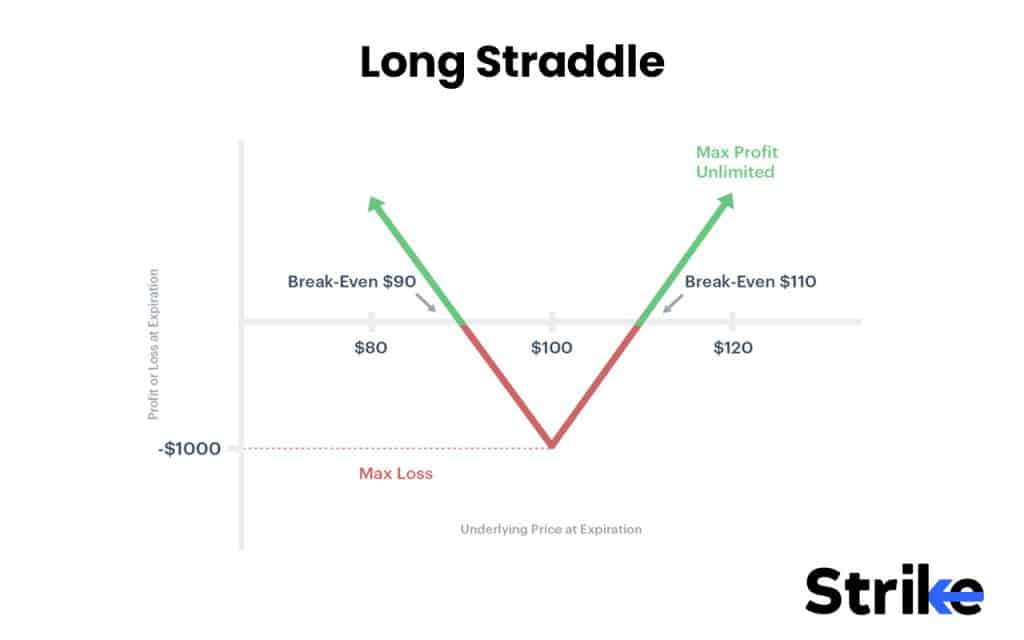
It is a two legged strategy where we buy ATM calls and put options of same strike and same expiry.
| Action | Option Type | Strike Price | Expiry |
| Buy | 1 Call Option | ATM | Same Expiry |
| Buy | 1 Put Option | ATM | Same Expiry |
You can create Long Straddle strategy when you expect a major price movement due to events like earnings announcements, budget speeches, or important economic data releases.
| Parameter | Details |
| Strategy Type | Net Debit Strategy |
| Maximum Profit | Unlimited (Upside); Substantial on the downside (limited by the asset reaching zero) |
| Maximum Loss | Total Premium Paid |
| Breakeven | Upper: Strike Price + Total Premium PaidLower: Strike Price − Total Premium Paid |
| Best When | Expecting high volatility, low implied volatility (IV) before a major event |
| Risk-Reward | Limited Risk, Unlimited/High Reward |
| Classification | Neutral Volatility Strategy |
22. Long Strangle
Long strangle is a high volatility options trading strategy where you buy an OTM call and put an option of the same expiry to profit from sharp price movement on either side.
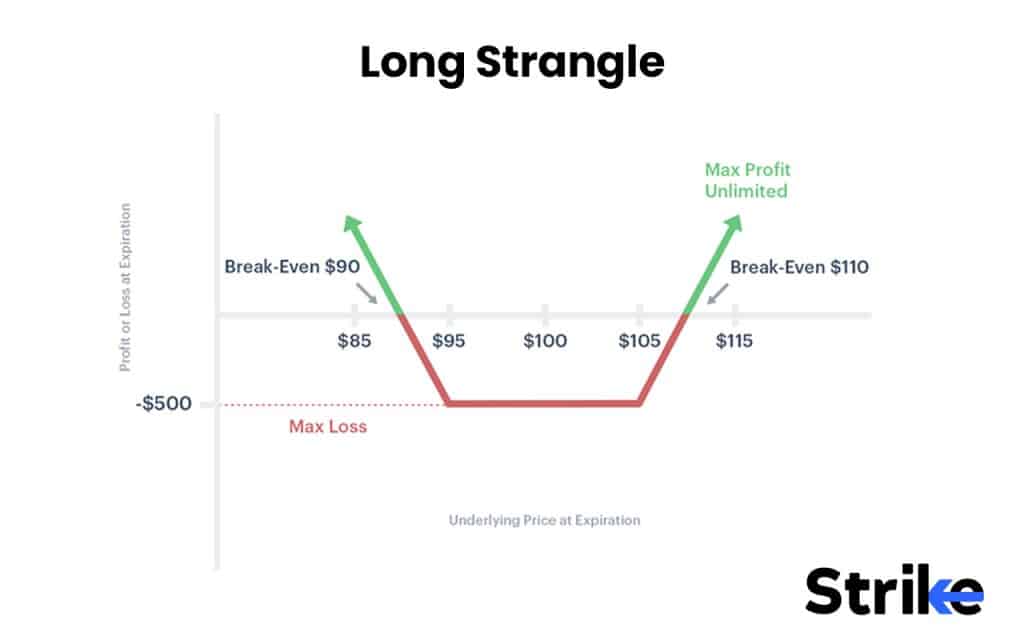
Long Strangle is a two legged strategy where we buy OTM calls and put options of different strike and same expiry.
| Action | Option Type | Strike Price | Expiry |
| Buy | 1 Call Option | Higher Strike (OTM) | Same Expiry |
| Buy | 1 Put Option | Lower Strike (OTM) | Same Expiry |
You can create this strategy when you expect a major price movement due to events like earnings announcements, budget speeches, or important economic data releases, but actually don’t know the direction of move.
| Parameter | Details |
| Strategy Type | Net Debit Strategy |
| Maximum Profit | Unlimited (Upside); Substantial on the downside (limited by the asset reaching zero) |
| Maximum Loss | Total Premium Paid |
| Breakeven | Upper: Call Strike + Total Premium PaidLower: Put Strike − Total Premium Paid |
| Best When | Expecting high volatility, low implied volatility (IV) before a major event |
| Risk-Reward | Limited Risk, Unlimited/High Reward |
| Classification | Neutral Volatility Strategy |
23. Reverse Iron Condor
A Reverse Iron Condor is a volatility-based option strategy where you buy an out-of-the-money (OTM) call spread and buy an out-of-the-money (OTM) put spread simultaneously to profit from a large price move in either direction. Unlike a regular Iron Condor, this strategy benefits when the underlying makes a significant move away from the middle strike, regardless of whether the move is upward or downward.
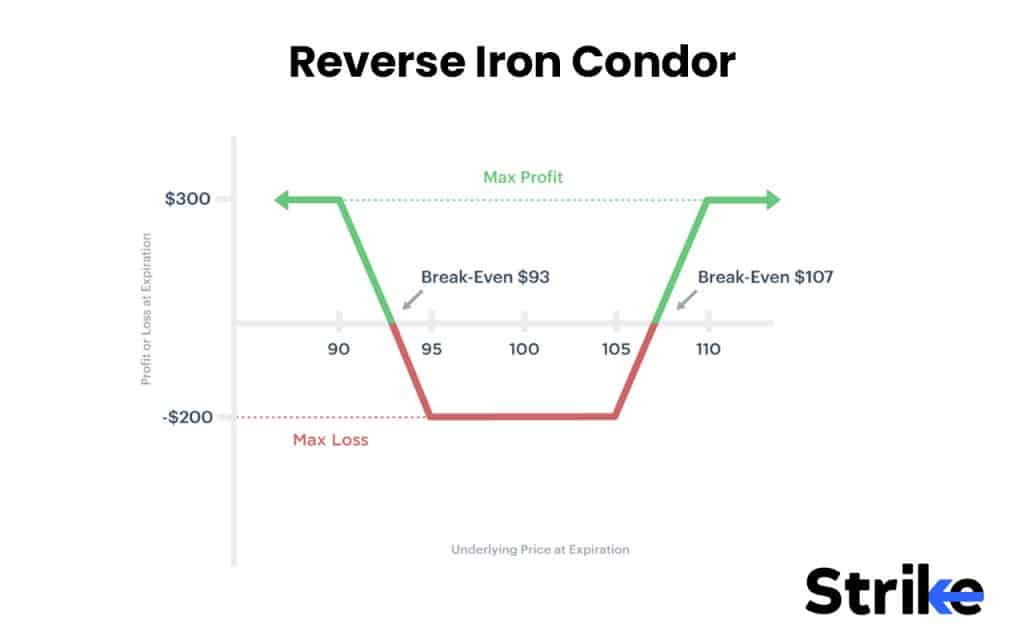
This strategy is a four-legged option buying strategy because you buy one call option, sell one higher strike call option, buy one put option, and sell one lower strike put option.
| Action | Option Type | Strike Price | Quantity | Expiry |
| Buy | Put Option | OTM | 1 | Same Expiry |
| Sell | Put Option | Lower OTM | 1 | Same Expiry |
| Buy | Call Option | OTM | 1 | Same Expiry |
| Sell | Call Option | Higher OTM | 1 | Same Expiry |
This strategy is best used when you expect the underlying to experience a strong breakout or breakdown, but you are uncertain about the direction. Since you pay a net premium to enter the trade, a Reverse Iron Condor is a Net Debit Strategy.
| Parameter | Details |
| Strategy Type | Net Debit Strategy |
| Maximum Profit | Limited to the width of either spread minus the net premium paid |
| Maximum Loss | Total Net Premium Paid |
| Breakeven | One Upper Breakeven and One Lower Breakeven (based on the net premium paid) |
| Best When | Expecting high volatility, a major breakout or breakdown, and low implied volatility (IV) before entry |
| Risk-Reward | Limited Risk, Limited Reward |
| Classification | Volatility Strategy (Direction Neutral) |
24. Strip
A strip is a volatility-based option strategy where you buy one call option and two put options of the same strike to profit from a sharp move in either direction, with more profit if the market falls.
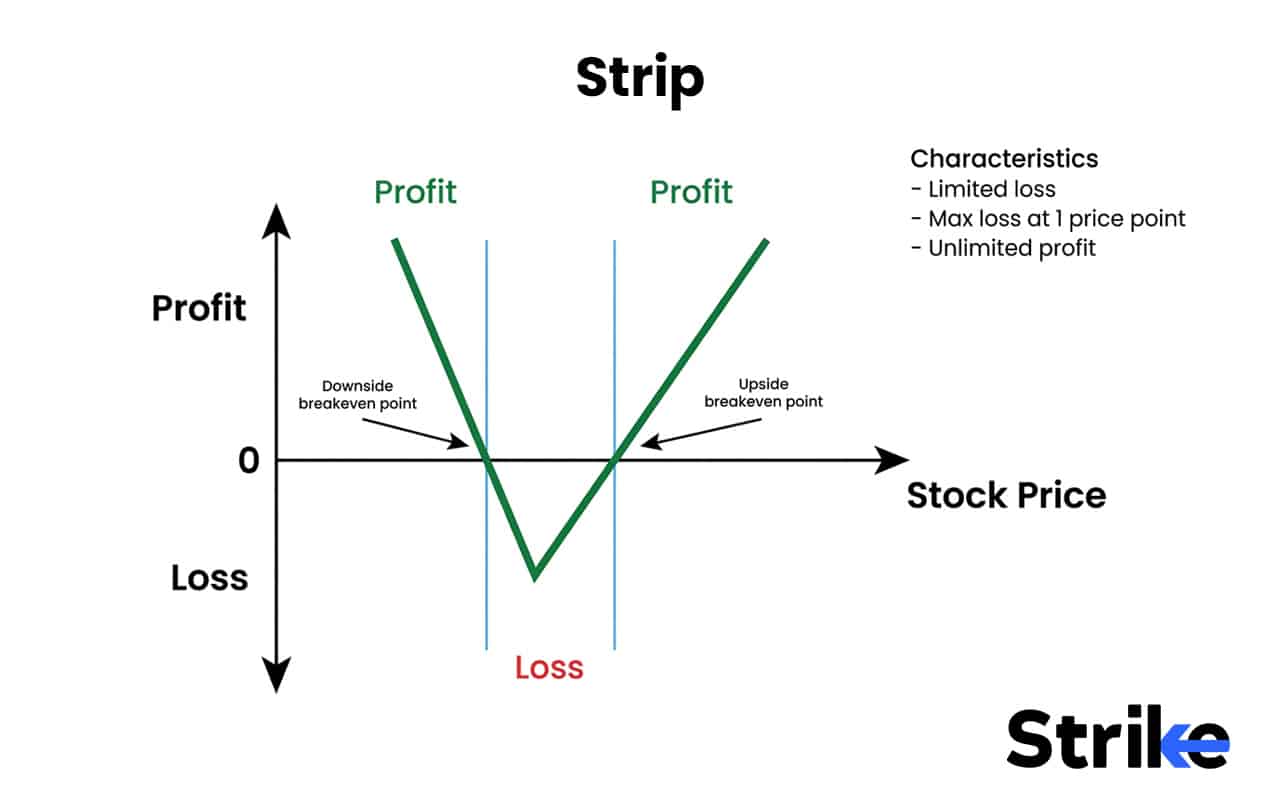
Strip strategy is a three legged option buying strategy as we buy two put and one call option.
| Action | Option Type | Strike Price | Quantity | Expiry |
| Buy | Call Option | ATM | 1 | Same Expiry |
| Buy | Put Option | ATM | 2 | Same Expiry |
This strategy is best to use when you expect price to move strongly in either direction, but you believe a downside move is more likely. Since you pay premiums for all three options, a Strip is a Net Debit Strategy.
| Parameter | Details |
| Strategy Type | Net Debit Strategy |
| Maximum Profit | Unlimited on the Upside; Larger but Limited on the Downside (as the underlying cannot fall below zero) |
| Maximum Loss | Total Premium Paid |
| Breakeven | One Upper Breakeven and One Lower Breakeven (calculated using total premium paid) |
| Best When | Expecting high volatility with a bearish bias; low implied volatility (IV) before entry |
| Risk-Reward | Limited Risk, High Reward |
| Classification | Volatility Strategy (Bearish Bias) |
25. Strap
A strap is a volatility based option strategy where you buy two call options and one put options of the same strike to profit from a sharp move in either direction, with more profit if the market rises.
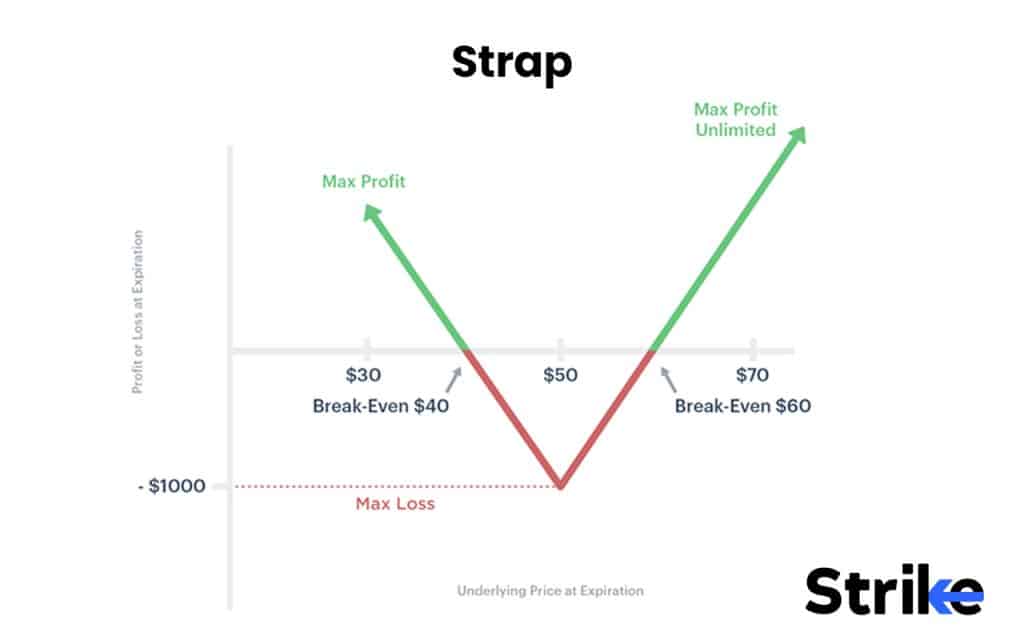
This strategy is a three legged option buying strategy as we buy two call and one put option.
| Action | Option Type | Strike Price | Quantity | Expiry |
| Buy | Call Option | ATM | 2 | Same Expiry |
| Buy | Put Option | ATM | 1 | Same Expiry |
Strap strategy is best to use when you expect price to move strongly in either direction, but you believe an upside move is more likely. Since you pay premiums for all three options, a Strap is a Net Debit Strategy.
| Parameter | Details |
| Strategy Type | Net Debit Strategy |
| Maximum Profit | Unlimited on the Upside; Limited on the Downside (as the underlying cannot fall below zero) |
| Maximum Loss | Total Premium Paid |
| Breakeven | One Upper Breakeven and One Lower Breakeven (based on total premium paid) |
| Best When | Expecting high volatility with a bullish bias; low implied volatility (IV) before entry |
| Risk-Reward | Limited Risk, High Reward |
| Classification | Volatility Strategy (Bullish Bias) |
26. Married Put
Married put is a bullish hedging strategy where you buy the underlying and simultaneously buy a put option to hedge the position from loss of sudden decline in price, having potential to make unlimited upside profit.
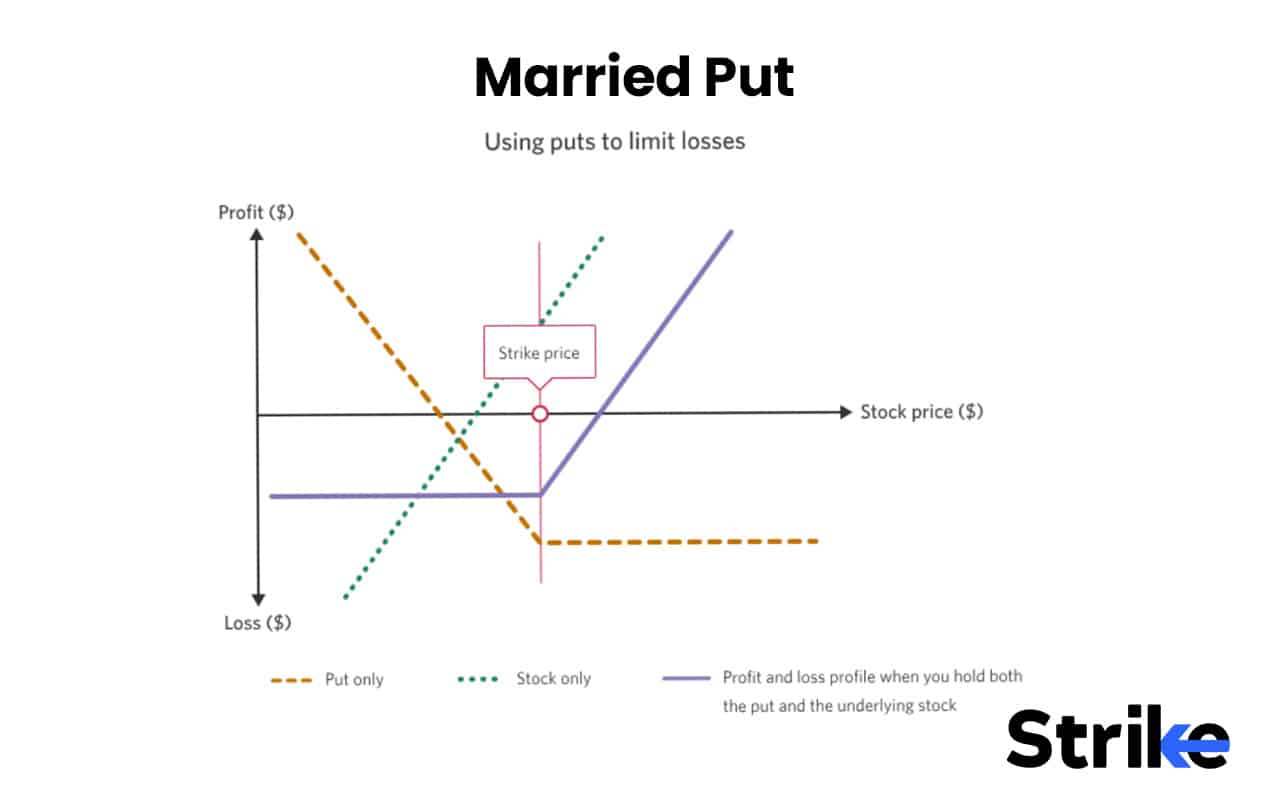
It is a two legged option strategy because you buy the underlying and buy the put option for hedging.
| Action | Instrument | Strike Price | Expiry |
| Buy | 100 Shares (or 1 Lot) of the Underlying Asset | — | — |
| Buy | 1 Put Option | ATM or Slightly OTM | Same Expiry |
Create Married Put strategy when you expect underlying to rise over the long-term but short-term downside risk exists. Since you pay for both the shares and the put option, a Married Put is a Net Debit Strategy.
| Parameter | Details |
| Strategy Type | Net Debit Strategy |
| Maximum Profit | Unlimited |
| Maximum Loss | Stock Purchase Price − Put Strike + Premium Paid |
| Breakeven | Stock Purchase Price + Premium Paid |
| Best When | Bullish outlook with concern about short-term downside risk; low implied volatility (IV) |
| Risk-Reward | Limited Risk, Unlimited Reward |
| Classification | Bullish Hedging Strategy |
27. Diagonal Spread
Diagonal spread is a directional option strategy where you buy and sell options with different strike prices and different expiry dates to benefit from time decay while maintaining directional exposure.
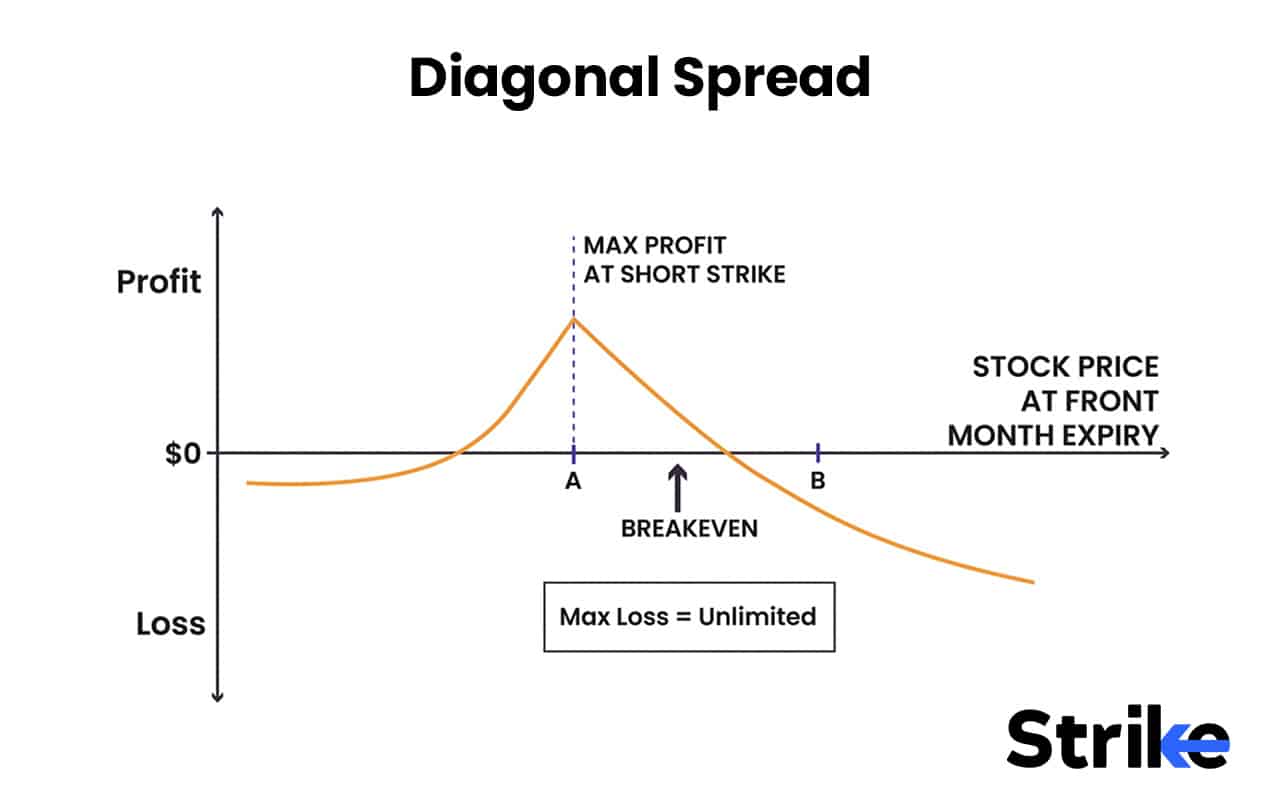
Diagonal Spread is a two legged options strategy created by selling a near-term option and buying a long-term option, both of different strike prices and different expiry.
| Strategy | Legs |
| Call Diagonal Spread | Buy 1 Longer-Term Call (Lower Strike) + Sell 1 Near-Term Call (Higher Strike) |
| Put Diagonal Spread | Buy 1 Longer-Term Put (Higher Strike) + Sell 1 Near-Term Put (Lower Strike) |
You can create this strategy using either call or put when you expect a moderate directional move. Since the longer-term option costs more than the premium received from the shorter-term option, a Diagonal Spread is usually a Net Debit Strategy.
| Parameter | Details |
| Strategy Type | Usually Net Debit Strategy |
| Maximum Profit | Limited (depends on strike prices, expiry, and premiums) |
| Maximum Loss | Net Premium Paid |
| Breakeven | No Fixed Breakeven (depends on the underlying price at the near-term expiry) |
| Best When | Moderately bullish (Call) or moderately bearish (Put) outlook with low to moderate implied volatility (IV) |
| Risk-Reward | Limited Risk, Moderate Reward |
| Classification | Directional Time Decay Strategy |
28. Double Diagonal Spread
A Double Diagonal Spread is a market neutral to mildly directional option strategy that combines a call diagonal spread and a put diagonal spread. It involves selling a near-term call and put option while buying longer-term call and put options at different strike prices. The strategy aims to benefit from time decay of the short options while maintaining exposure through the longer-dated options.
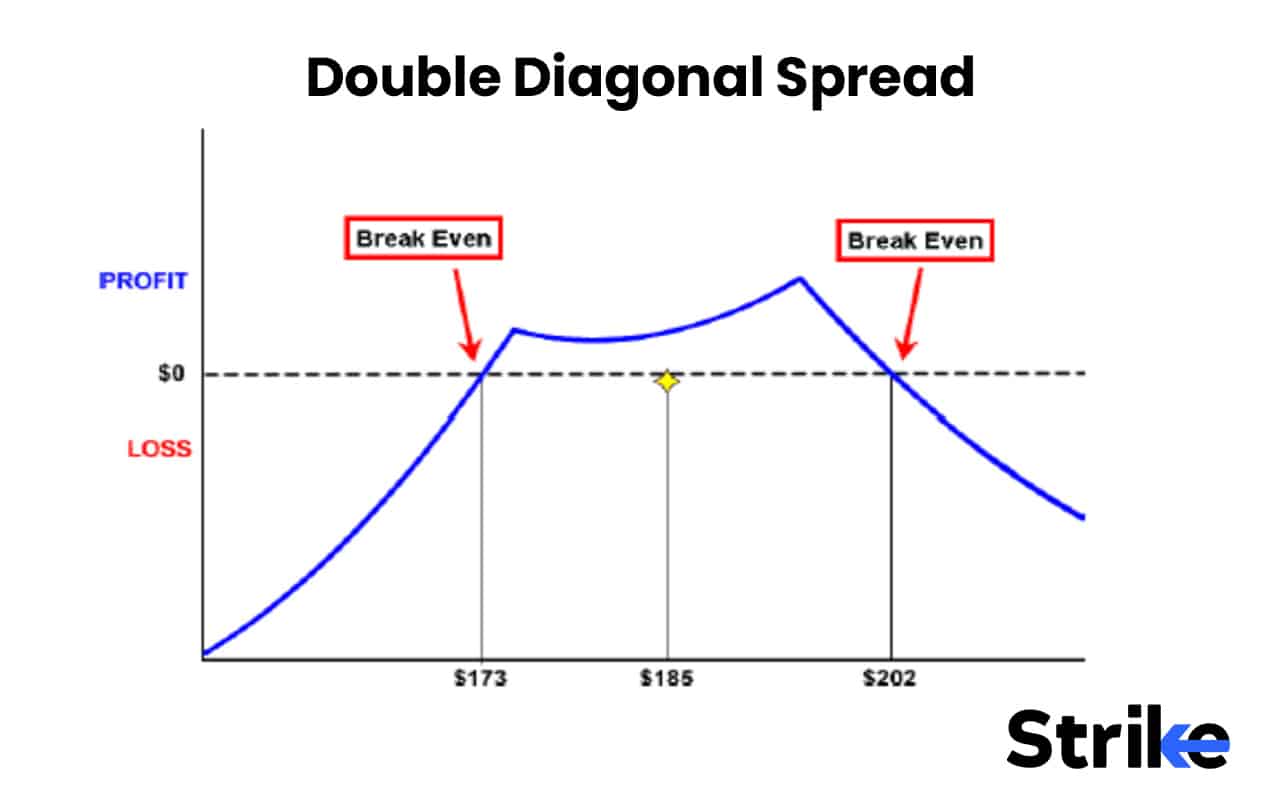
| Action | Option Type | Strike Price | Expiry |
| Sell | Call Option | Higher Strike (OTM) | Near-Term Expiry |
| Buy | Call Option | Higher Strike (Further OTM or Different Strike) | Longer-Term Expiry |
| Sell | Put Option | Lower Strike (OTM) | Near-Term Expiry |
| Buy | Put Option | Lower Strike (Further OTM or Different Strike) | Longer-Term Expiry |
The logic behind a Double Diagonal Spread is to generate income from the faster time decay of the short-term options while holding longer-term options that retain value. The strategy performs best when the underlying remains within a broad price range and implied volatility rises. Since the longer-term options are more expensive than the premiums received from the short-term options, it is generally a Net Debit Strategy.
| Parameter | Details |
| Strategy Type | Net Debit Strategy |
| Maximum Profit | Limited (Depends on time decay, implied volatility, and underlying price movement) |
| Maximum Loss | Net Premium Paid |
| Breakeven | No single fixed breakeven; depends on strike prices, expiry, and implied volatility |
| Best When | Neutral to mildly bullish or bearish outlook with rising implied volatility |
| Risk-Reward | Limited Risk, Limited Reward |
| Classification | Neutral Volatility & Time-Decay Strategy |
29. Christmas Tree (Call/Put)
A Christmas Tree Spread is a moderately directional option strategy where it profits from a moderate bullish (Call) or bearish (Put) move. It is a multilegged option strategy that uses a total of six call and put options with the same expiry designed to reduce the overall cost while maintaining limited risk.
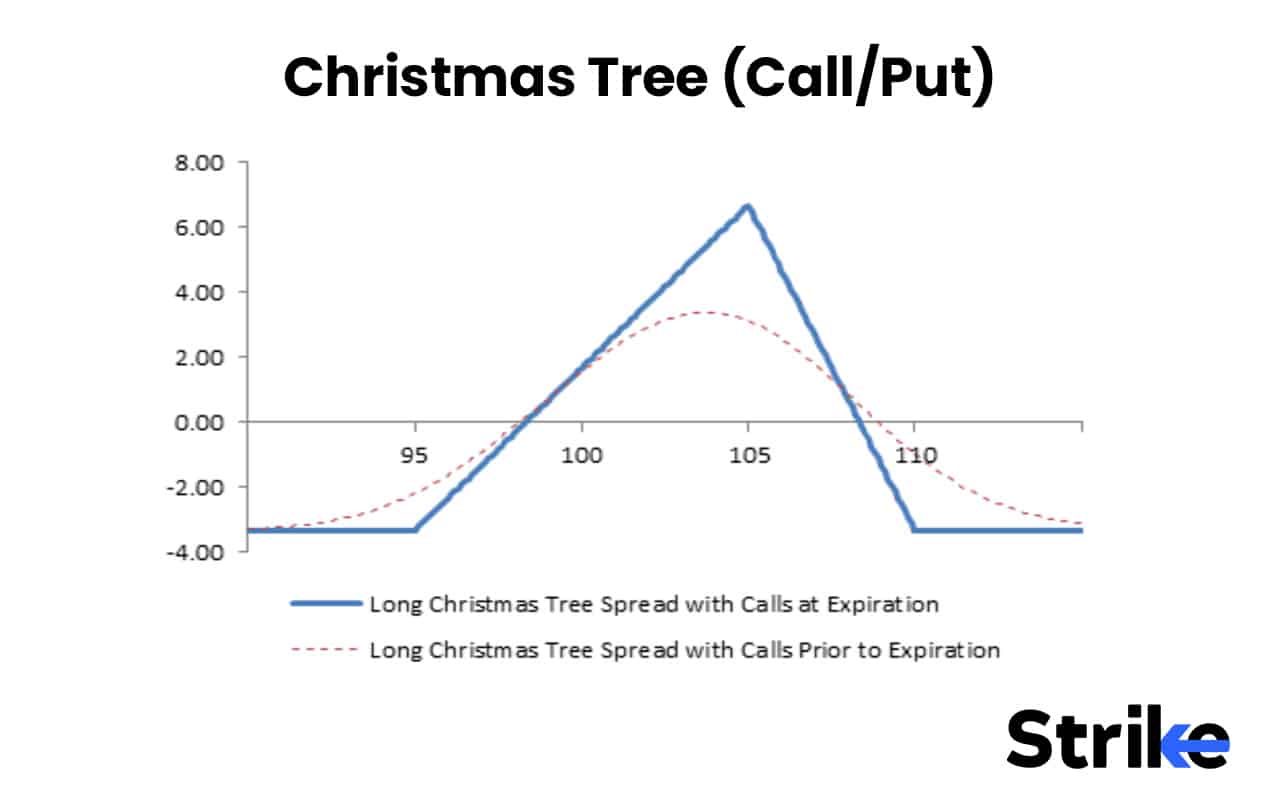
| Action | Option Type | Strike Price | Expiry |
| Buy | Call/Put | Lower Strike | Same Expiry |
| Sell | Call/Put | Middle Strike (3 Lots) | Same Expiry |
| Buy | Call/Put | Higher Strike (2 Lots) | Same Expiry |
Christmas Tree strategy helps to reduce the cost of entering in a directional trade and benefiting from a moderate move in the expected direction. Since we create this strategy by paying a premium, hence it is a net debit strategy.
| Parameter | Details |
| Strategy Type | Net Debit Strategy |
| Maximum Profit | Limited |
| Maximum Loss | Net Premium Paid |
| Breakeven | Depends on strike prices |
| Best When | Moderately Bullish (Call) or Moderately Bearish (Put) |
| Risk-Reward | Limited Risk, Limited Reward |
| Classification | Directional Spread Strategy |
30. Broken Wing Butterfly
A Broken Wing Butterfly is a modified version of a standard butterfly where the spread on one side is wider than the other side. This creates an asymmetric or uneven payoff chart reducing the cost of the strategy while keeping the risk limited.
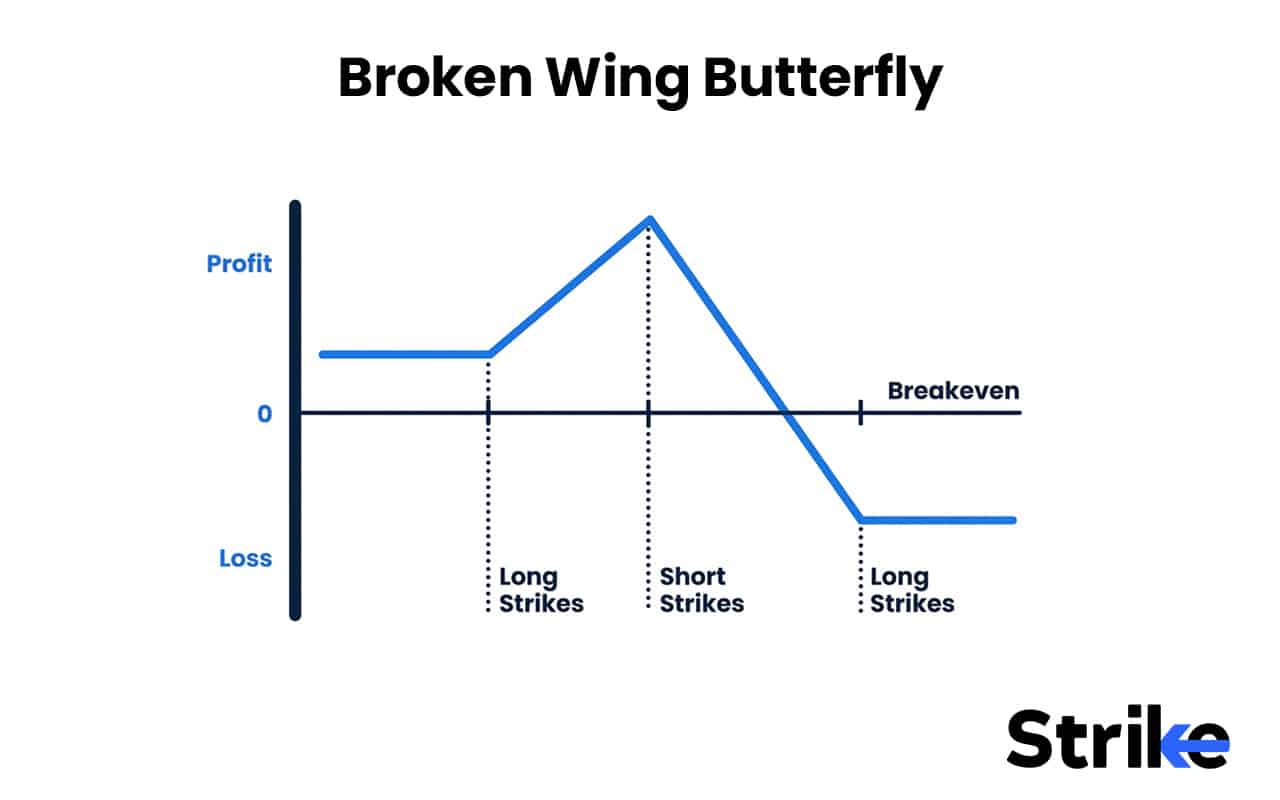
Broken Wing Butterfly is a four-legged option strategy created by buying one option at the lower strike, selling two options at the middle strike, and buying one option at a farther strike, creating unequal wing widths.
| Action | Option Type | Strike Price | Expiry |
| Buy | Call/Put | Lower Strike | Same Expiry |
| Sell | Call/Put | Middle Strike (2 Lots) | Same Expiry |
| Buy | Call/Put | Wider Higher Strike | Same Expiry |
You can create this strategy when the market moves in a moderate direction, either bullish or bearish. A Broken Wing Butterfly can be established as a Net Debit or Net Credit Strategy, depending on the strike selection and option premiums.
| Parameter | Details |
| Strategy Type | Net Debit or Net Credit Strategy |
| Maximum Profit | Limited |
| Maximum Loss | Limited |
| Breakeven | Depends on strike prices |
| Best When | Moderately Bullish or Bearish |
| Risk-Reward | Limited Risk, Limited Reward |
| Classification | Directional Spread Strategy |
31. Skip Strike Butterfly
A Skip Strike Butterfly is a variation of standard butterfly strategy where one strike price is skipped between option legs to create a wider profit zone with a slight directional bias.
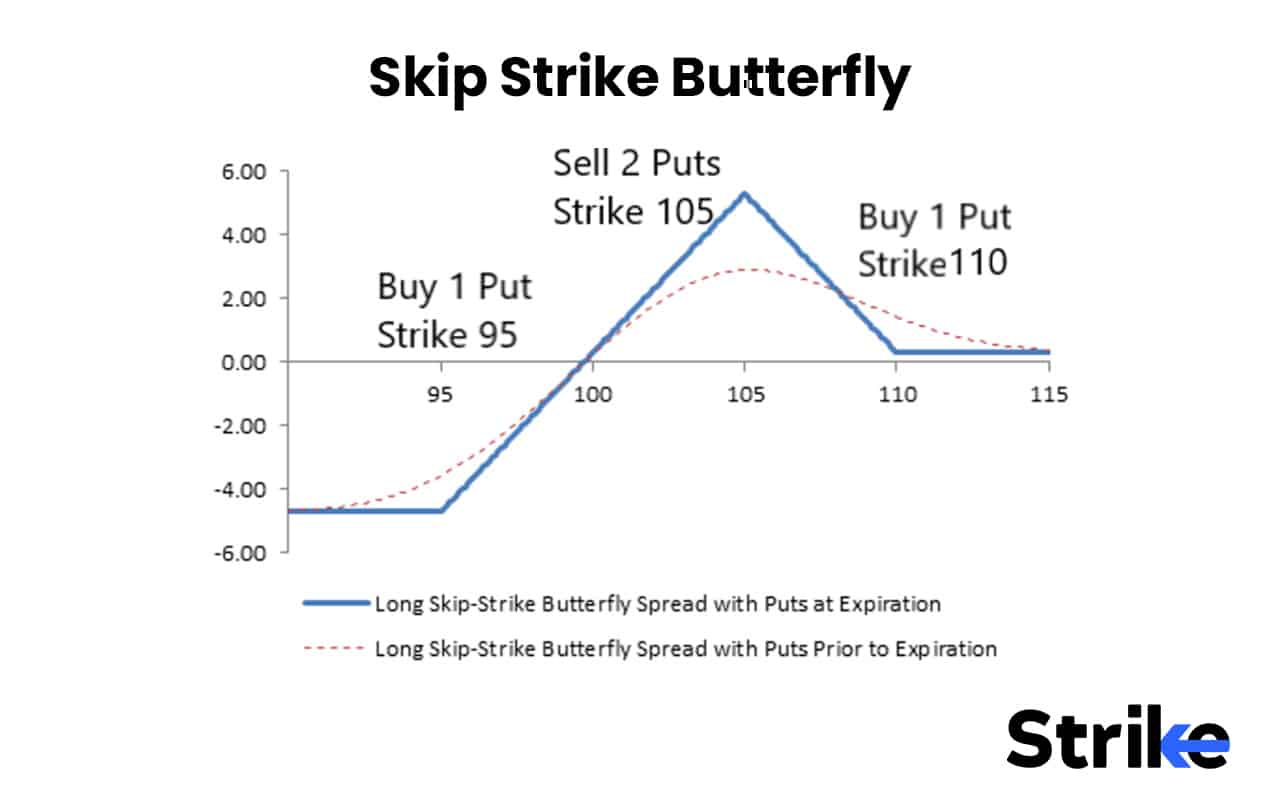
A Skip Strike Butterfly is a four-legged option strategy. It is constructed by buying one option at the lower strike, selling two options at a higher strike while skipping one strike level, and buying one option at the highest strike.
| Action | Option Type | Strike Price | Expiry |
| Buy | Call/Put | Lower Strike | Same Expiry |
| Sell | Call/Put | Middle Strike (2 Lots) | Same Expiry |
| Buy | Call/Put | Higher Strike (Skipped Strike) | Same Expiry |
The logic behind a Skip Strike Butterfly is to widen the profit range while maintaining limited risk. Since the strategy requires an upfront premium, it is generally a Net Debit Strategy.
| Parameter | Details |
| Strategy Type | Net Debit Strategy |
| Maximum Profit | Limited |
| Maximum Loss | Net Premium Paid |
| Breakeven | Depends on strike prices |
| Best When | Mildly Bullish or Bearish |
| Risk-Reward | Limited Risk, Limited Reward |
| Classification | Modified Butterfly Strategy |
32. Ratio Spread (Call/Put)
A Ratio Spread is a moderately directional option strategy where you buy fewer options but sell more options of different strike prices. It aims to generate premium income while expecting the underlying to move only moderately.
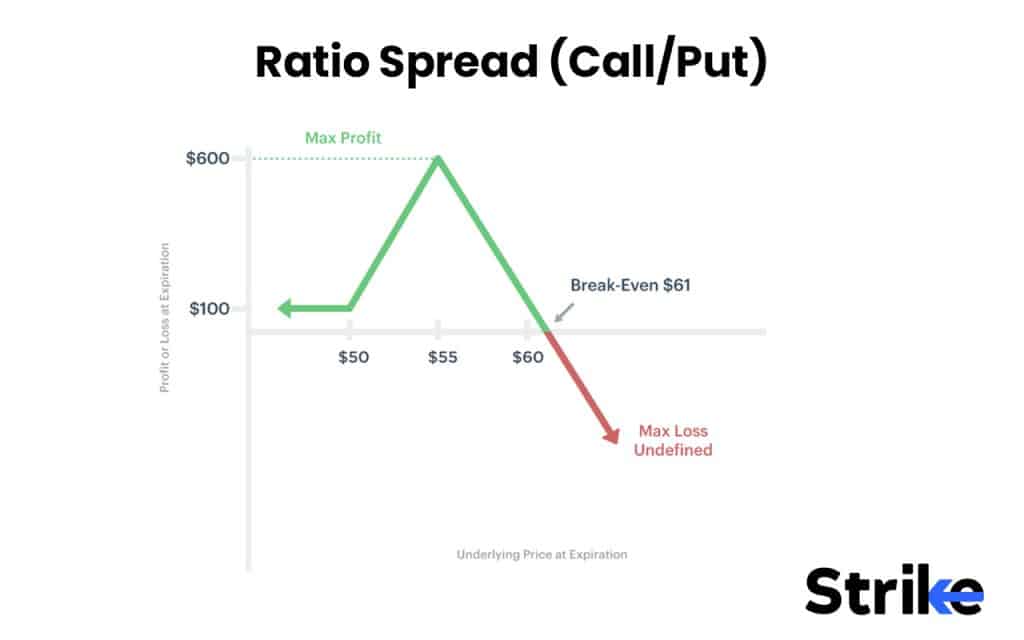
You can construct this strategy by buying one call or put option and selling 2 call or put options of the same type with the same expiry but different strike prices.
| Action | Option Type | Strike Price | Expiry |
| Buy | Call/Put | Lower Strike | Same Expiry |
| Sell | Call/Put | Higher Strike (2 Lots) | Same Expiry |
The logic behind a Ratio Spread is to earn from premium decay while expecting the underlying to stay near the short strike. Depending on the premiums, it may be entered as a Net Credit or Net Debit Strategy.
| Parameter | Details |
| Strategy Type | Net Credit or Net Debit Strategy |
| Maximum Profit | Limited |
| Maximum Loss | Can Be Unlimited |
| Breakeven | Multiple Breakeven Points |
| Best When | Moderately Bullish (Call) or Moderately Bearish (Put) |
| Risk-Reward | High Risk, Limited Reward |
| Classification | Ratio Strategy |
33. Front Spread
In this option strategy you buy more options and sell few options to profit from sharp movement in underlying price while limiting maximum risk.
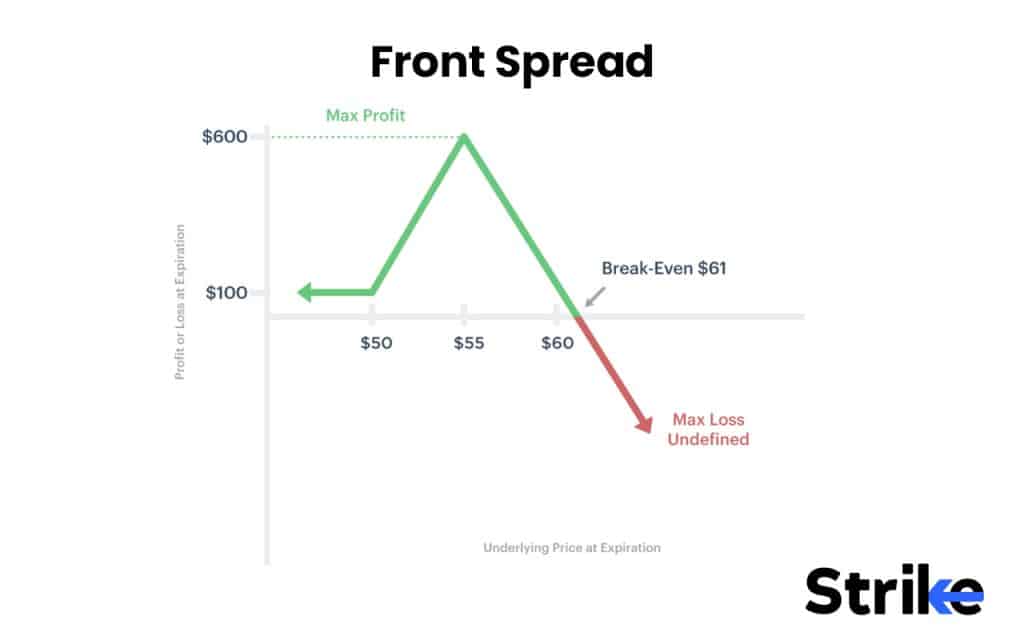
It is a multi-legged strategy with minimum selling of one option and buying minimum of two options of the same strike.
| Action | Option Type | Strike Price | Expiry |
| Sell | Call/Put | Lower Strike | Same Expiry |
| Buy | Call/Put | Higher Strike (2 Lots) | Same Expiry |
You can create this strategy when you expect the market to give a trending move. It is generally a Net Debit Strategy.
| Parameter | Details |
| Strategy Type | Net Debit Strategy |
| Maximum Profit | High (Can be Unlimited) |
| Maximum Loss | Net Premium Paid |
| Breakeven | Multiple Breakeven Points |
| Best When | High Volatility Expected |
| Risk-Reward | Limited Risk, High Reward |
| Classification | Volatility Strategy |
34. Christmas Tree Butterfly
A Christmas Tree Butterfly is a modified butterfly spread that uses uneven option quantities and strike spacing to create a wider profit zone with a slight directional bias.
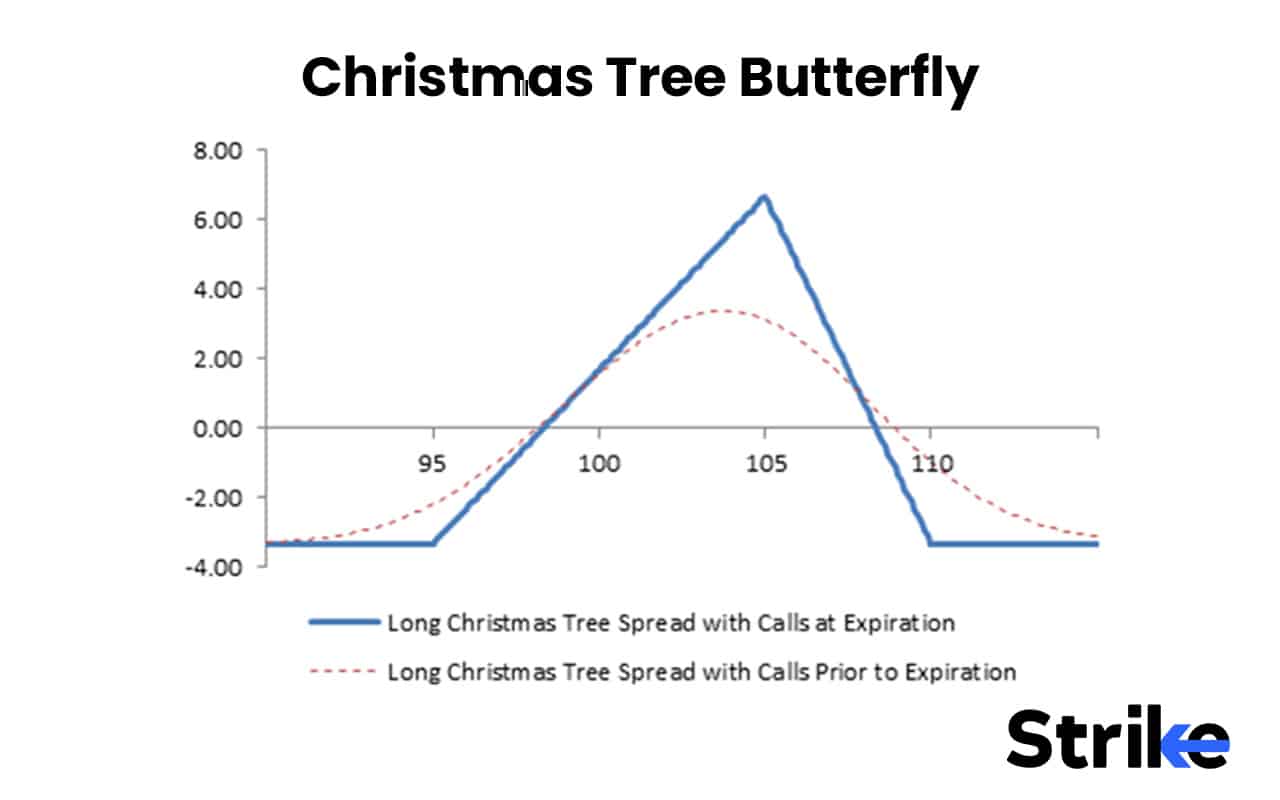
| Action | Option Type | Strike Price | Expiry |
| Buy | Call/Put | Lower Strike | Same Expiry |
| Sell | Call/Put | Middle Strike (3 Lots) | Same Expiry |
| Buy | Call/Put | Higher Strike (2 Lots) | Same Expiry |
The logic behind a Christmas Tree Butterfly is to reduce the cost of the spread while increasing the profit range around the expected price movement. It is generally a Net Debit Strategy.
| Parameter | Details |
| Strategy Type | Net Debit Strategy |
| Maximum Profit | Limited |
| Maximum Loss | Net Premium Paid |
| Breakeven | Depends on strike prices |
| Best When | Moderately Directional Market |
| Risk-Reward | Limited Risk, Limited Reward |
| Classification | Modified Butterfly Strategy |
35. Guts
It is a volatility based strategy where you either buy or sell ITM call and ITM put option of same expiry to profit from sharp price move or to earn premium in the sideways market. It is similar to straddle but uses ITM options instead of ATM.
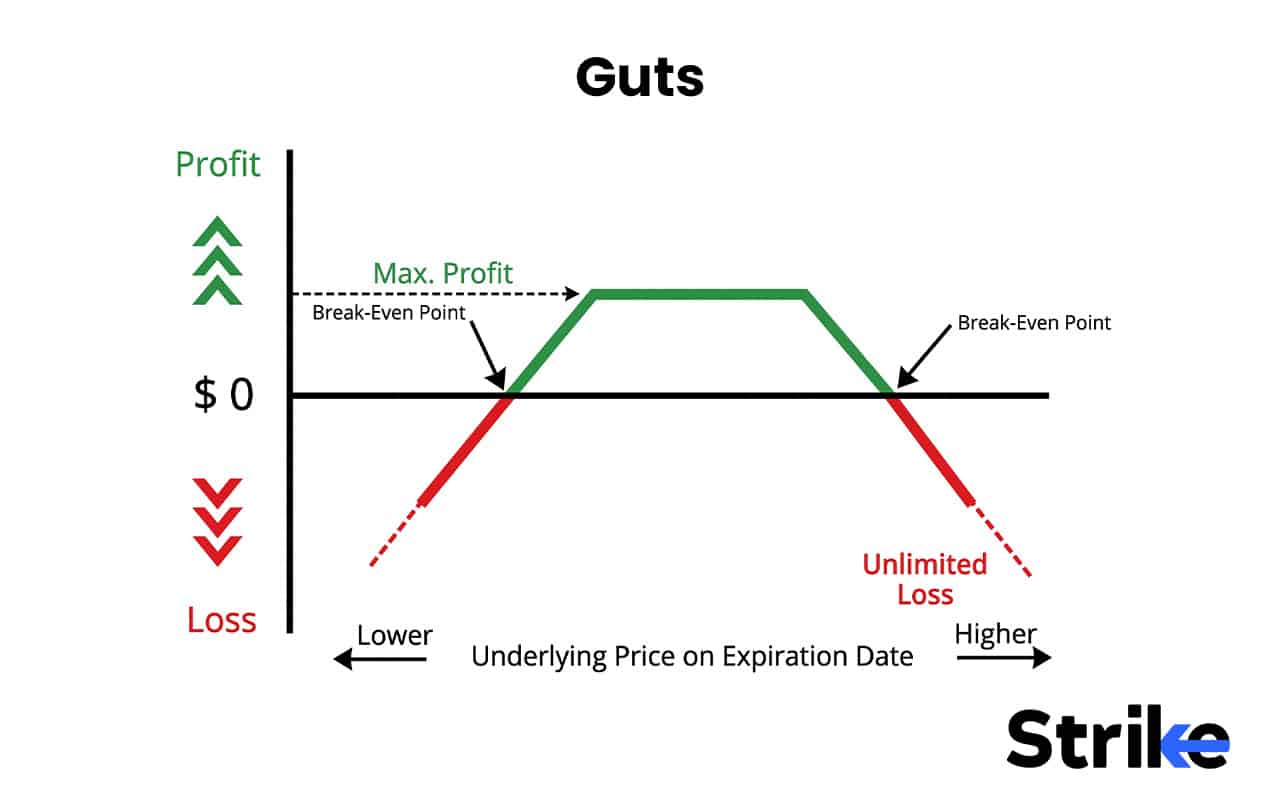
A guts is a two legged options strategy as we either buy or sell ITM call and put options.
| Action | Option Type | Strike Price | Expiry |
| Buy/Sell | ITM Call | Different Strikes | Same Expiry |
| Buy/Sell | ITM Put | Different Strikes | Same Expiry |
When you expect the market to give a sharp price move in either direction, you can create guts by buying options (long guts), whereas when expecting the market to remain rangebound, you can create guts by selling ITM calls and put options (short guts). A long guts is a net debit strategy, while short guts is a net credit strategy.
| Parameter | Details |
| Strategy Type | Net Debit or Net Credit Strategy |
| Maximum Profit | Unlimited (Long) / Limited (Short) |
| Maximum Loss | Limited (Long) / Unlimited (Short) |
| Breakeven | Upper & Lower Breakeven |
| Best When | High Volatility (Long) or Low Volatility (Short) |
| Risk-Reward | Varies |
| Classification | Volatility Strategy |
36. Strangle Swap
A strangle swap strategy is an adjustment strategy, where you close your existing strangle position on the expiry day and again create a strangle with a different strike or expiry to adjust risk and profit from changing market conditions.
| Action | Option Type | Strike Price | Expiry |
| Close | Existing OTM Call & OTM Put | Original Strikes | Current Position |
| Open | New OTM Call & OTM Put | New Strikes (or New Expiry) | Same or Different Expiry |
If you want to adjust your strangle after the market or implied volatility changes, you can definitely follow this strategy. Depending on the new position, a Strangle Swap can result in a Net Debit or Net Credit.
| Parameter | Details |
| Strategy Type | Net Debit or Net Credit (depends on adjustment) |
| Maximum Profit | Depends on the new strangle |
| Maximum Loss | Depends on the new strangle |
| Breakeven | Based on the new strike prices and premiums |
| Best When | Adjusting an existing strangle due to changing market conditions or volatility |
| Risk-Reward | Depends on the new position |
| Classification | Options Adjustment Strategy |
37. Iron Albatross
An Iron Albatross also known as a wide Iron Condor is a neutral options trading strategy. Unlike standard iron condors, Iron Albatross uses a much wider strike width, giving you a broader profit range.
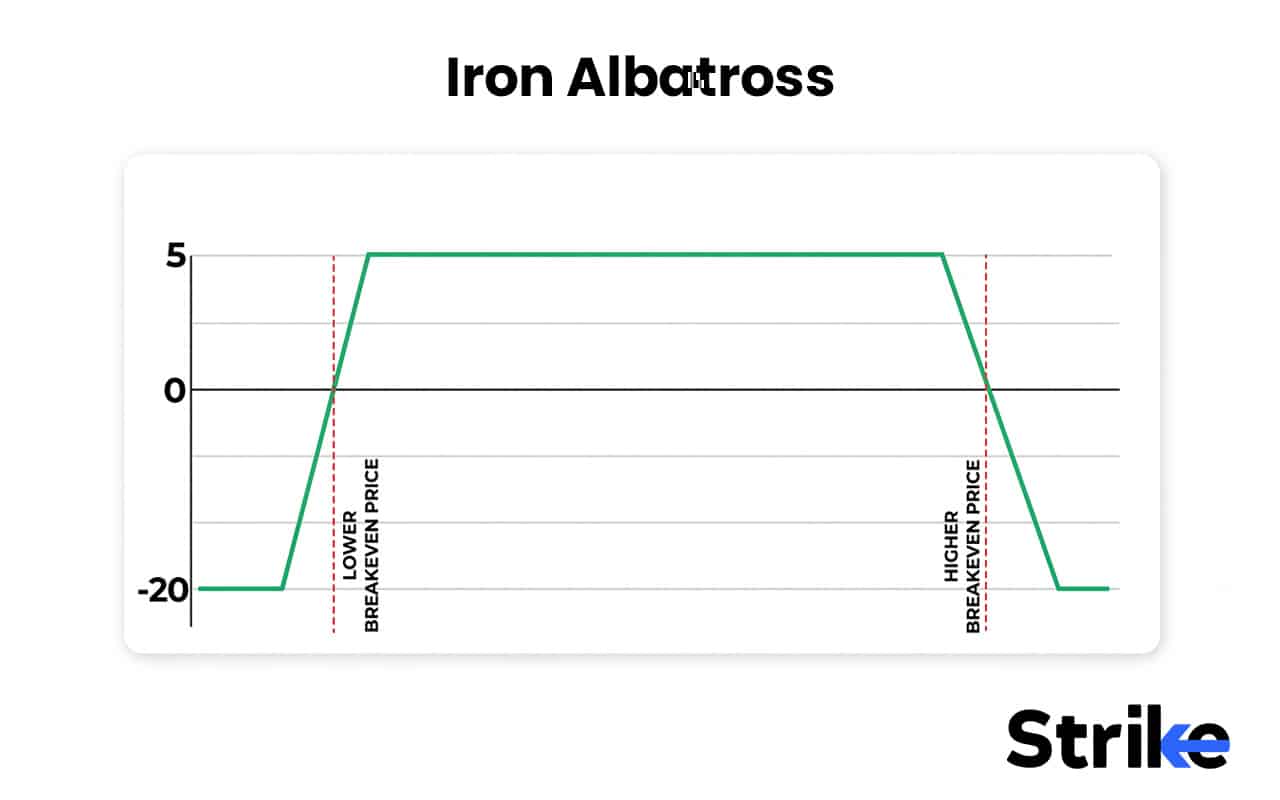
It is also a four-legged option strategy, where we sell an out-of-the-money (OTM) call and put, and buy even further OTM call and put options to cap risk.
| Action | Option Type | Strike Price | Expiry |
| Buy | OTM Put | Lower Strike | Same Expiry |
| Sell | Put | Inner Strike | Same Expiry |
| Sell | Call | Inner Strike | Same Expiry |
| Buy | OTM Call | Higher Strike | Same Expiry |
| Additional Legs (if used) | Call/Put | Further OTM Strikes | Same Expiry |
If you expect the market to stay range-bound in a broader range, you can use this strategy. As we receive more premium than we pay, it is a net credit strategy.
| Parameter | Details |
| Strategy Type | Usually Net Credit Strategy |
| Maximum Profit | Net Premium Received |
| Maximum Loss | Limited (depends on strike widths) |
| Breakeven | Upper and Lower Breakeven based on strikes and net credit |
| Best When | Neutral outlook with high implied volatility (IV) |
| Risk-Reward | Limited Risk, Limited Reward |
| Classification | Neutral Income Strategy |
38. Synthetic Long Stock
Synthetic long stock is a bullish option strategy where you try to replicate the payoff of owning the underlying stock by buying a call option and selling a put option with the same strike price and expiry.
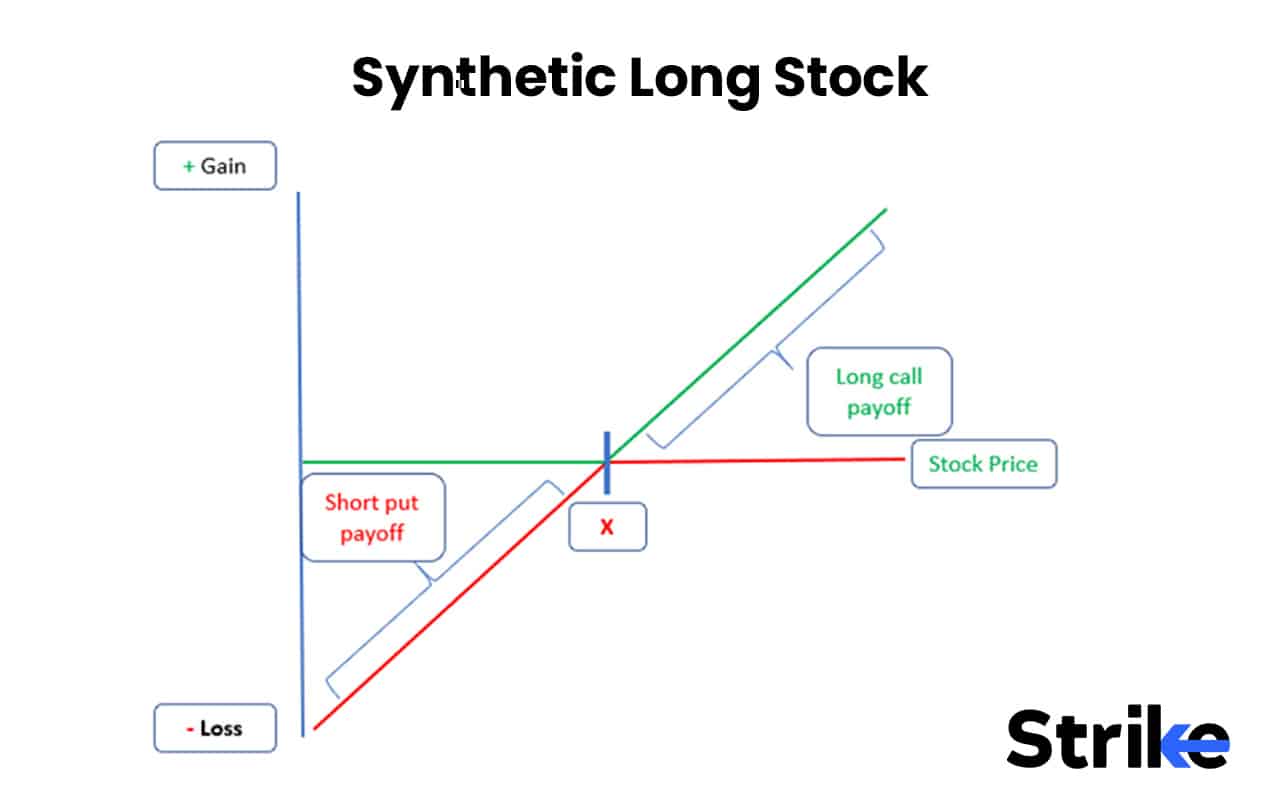
As we buy call options and sell put options, this strategy is a two legged option strategy.
| Action | Option Type | Strike Price | Expiry |
| Buy | 1 Call Option | ATM | Same Expiry |
| Sell | 1 Put Option | ATM | Same Expiry |
If you expect the underlying to give a strong upward move and want stock-like exposure without buying the actual shares, you can create this strategy. This strategy may result in a small Net Debit, Net Credit, or near-zero cost.
| Parameter | Details |
| Strategy Type | Net Debit, Net Credit, or Near Zero Cost |
| Maximum Profit | Unlimited |
| Maximum Loss | Significant (similar to owning the underlying, limited only if the asset falls to zero) |
| Breakeven | Strike Price ± Net Premium (Paid/Received) |
| Best When | Bullish outlook with moderate to high implied volatility (IV) |
| Risk-Reward | High Risk, Unlimited Reward |
| Classification | Synthetic Directional Strategy |
39. Synthetic Short Stock
Synthetic short stock is a bearish option strategy where you try to mimic short selling an underlying stock, by buying a put option and selling a call option with the same strike price and expiry.
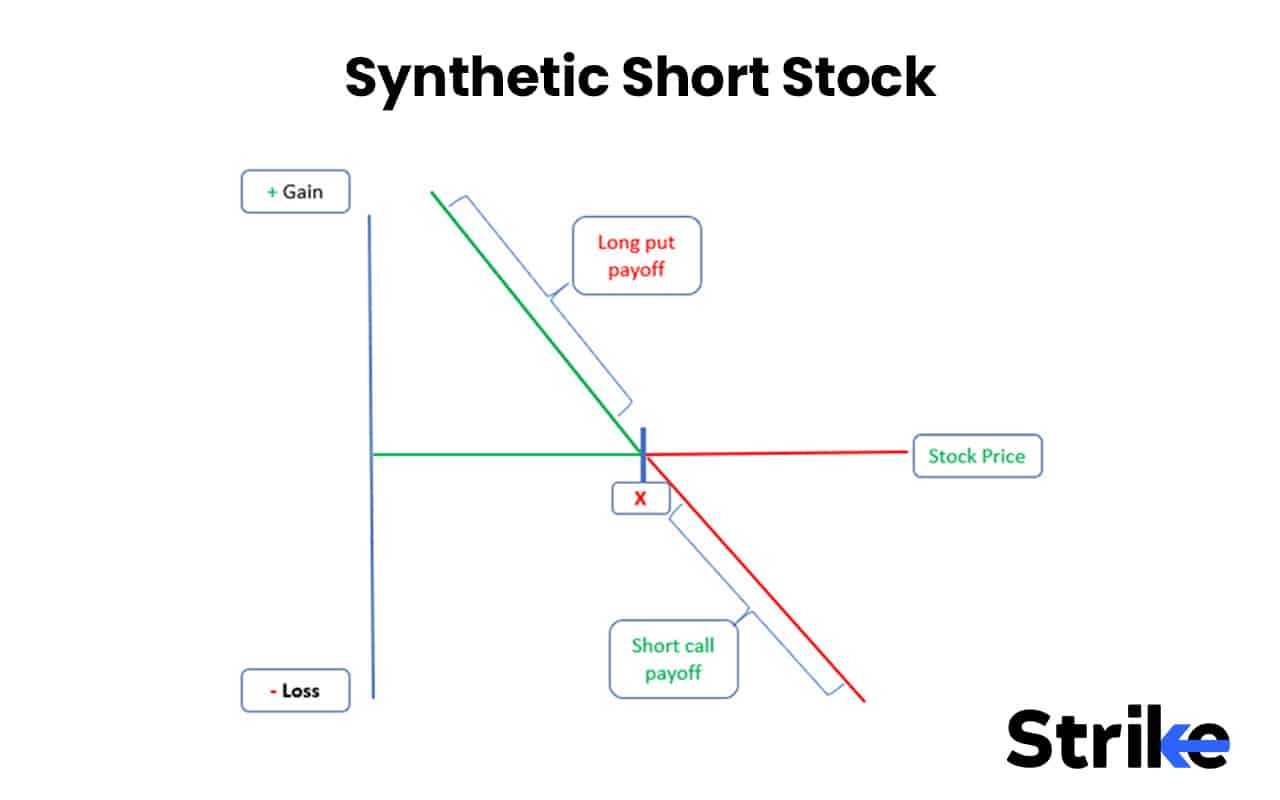
As we buy put options and sell call options, this strategy is a two legged option strategy.
| Action | Option Type | Strike Price | Expiry |
| Buy | 1 Put Option | ATM | Same Expiry |
| Sell | 1 Call Option | ATM | Same Expiry |
If you expect the underlying to give a strong downwards move and want stock-like exposure without shorting the actual shares, you can create this strategy. This strategy may result in a small Net Debit, Net Credit, or near-zero cost.
| Parameter | Details |
| Strategy Type | Net Debit, Net Credit, or Near Zero Cost |
| Maximum Profit | Significant (Limited by the underlying falling to zero) |
| Maximum Loss | Unlimited |
| Breakeven | Strike Price ± Net Premium (Paid/Received) |
| Best When | Bearish outlook with moderate to high implied volatility (IV) |
| Risk-Reward | Unlimited Risk, High Reward |
| Classification | Synthetic Directional Strategy |
40. Synthetic Call
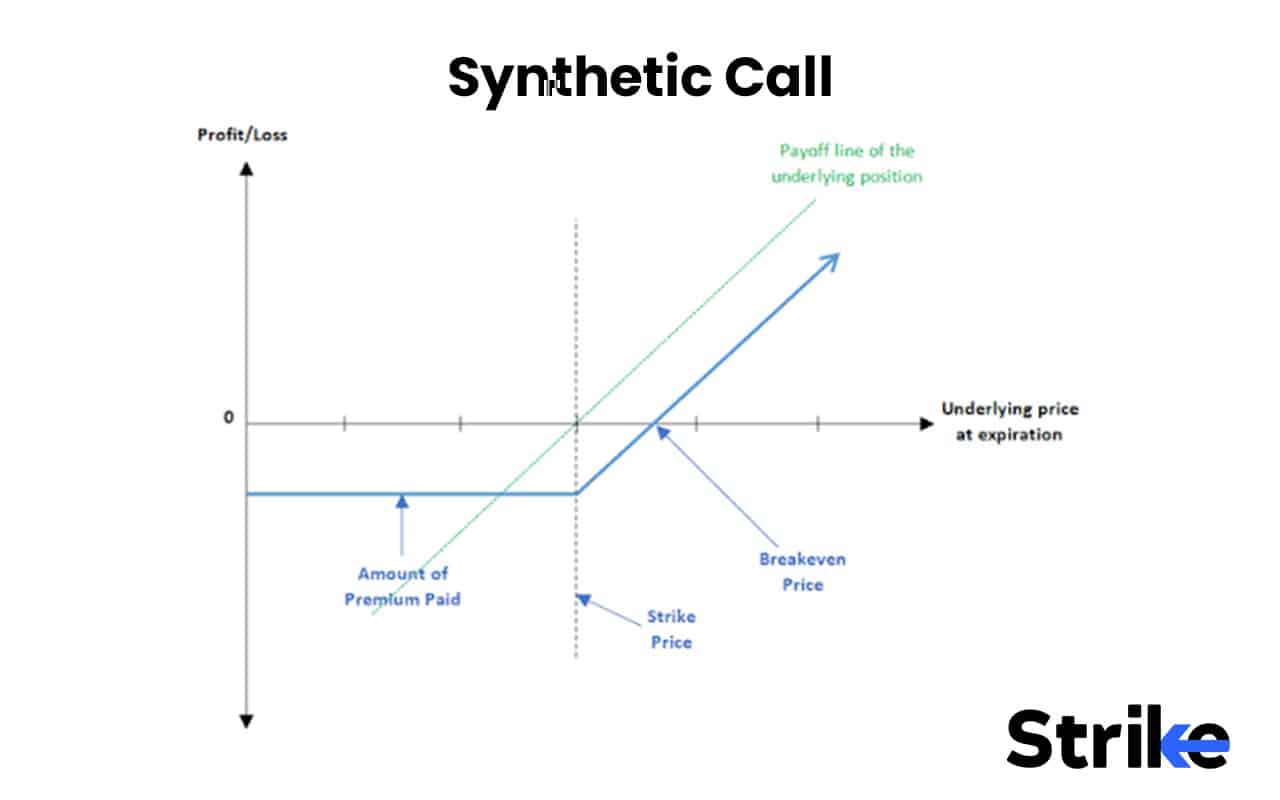
In synthetic call strategy, we try to mimic long call options by buying underlying and simultaneously buying ATM put options. As we buy the underlying and a put option, it is a two legged option strategy.
| Action | Instrument | Strike Price | Expiry |
| Buy | Underlying Stock | — | — |
| Buy | 1 Put Option | ATM or Near ATM | Same Expiry |
Synthetic Call strategy works best when you expect the market to stay moderately to strong bullish and want to own stock with limited downside risk. Since you pay for both the stock and the put option, a Synthetic Call is a Net Debit Strategy.
| Parameter | Details |
| Strategy Type | Net Debit Strategy |
| Maximum Profit | Unlimited |
| Maximum Loss | Stock Purchase Price − Put Strike + Premium Paid |
| Breakeven | Stock Purchase Price + Premium Paid |
| Best When | Bullish outlook with downside protection |
| Risk-Reward | Limited Risk, Unlimited Reward |
| Classification | Synthetic Bullish Strategy |
41. Synthetic Put
In synthetic put strategy, we try to mimic long put options by short-selling the underlying and simultaneously buying ATM call options. As we short-sell the underlying and buy a call option, it is a two legged option strategy.
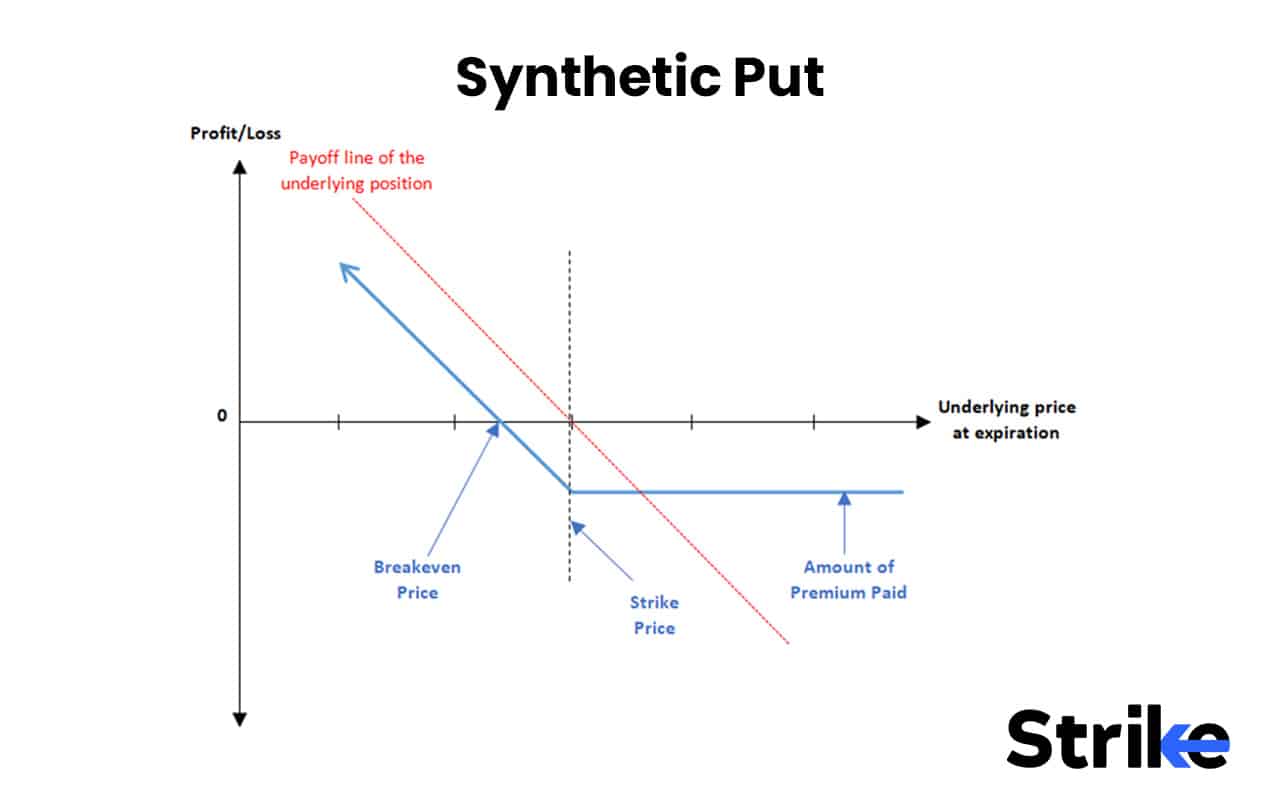
| Action | Instrument | Strike Price | Expiry |
| Sell | Underlying Stock | — | — |
| Buy | 1 Call Option | ATM or Near ATM | Same Expiry |
Synthetic Put strategy works best when you expect the market to stay moderately to strong bearish and want downside exposure while limiting the risk of a short stock position. Since you receive cash from short-selling the stock but pay a premium for the call option, a Synthetic Put can result in a Net Credit or Net Debit, depending on the stock value and option premium.
| Parameter | Details |
| Strategy Type | Net Credit or Net Debit Strategy |
| Maximum Profit | Significant (Limited by the underlying falling to zero) |
| Maximum Loss | Strike Price − Short Sale Price + Call Premium (Limited) |
| Breakeven | Short Sale Price − Call Premium |
| Best When | Bearish outlook with upside risk protection |
| Risk-Reward | Limited Risk, High Reward |
| Classification | Synthetic Bearish Strategy |
42. Box Spread
Box spread is an four-legged option arbitrage strategy where you combine bull call spread and bear put spread of the same strike and same expiry to lock in a fixed payoff at expiration, regardless of market.
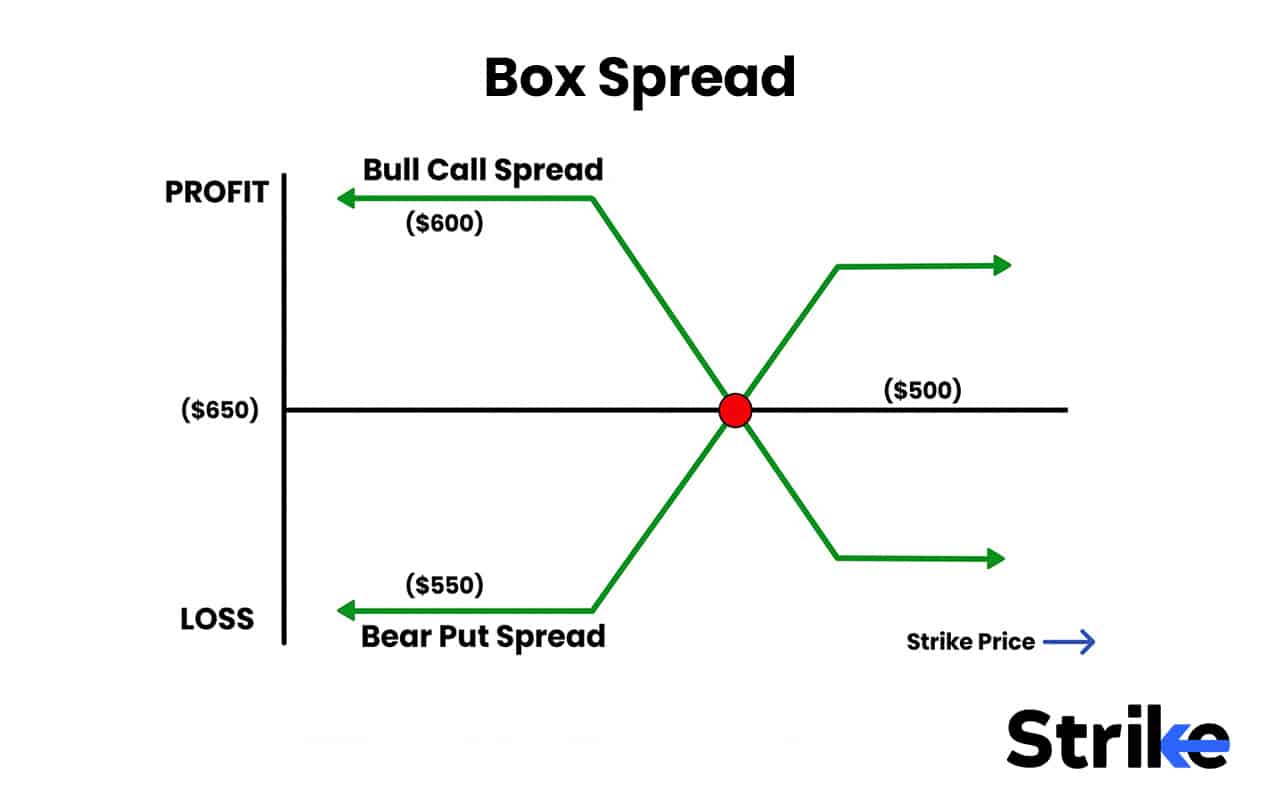
| Action | Option Type | Strike Price | Expiry |
| Buy | 1 Call Option | Lower Strike | Same Expiry |
| Sell | 1 Call Option | Higher Strike | Same Expiry |
| Buy | 1 Put Option | Higher Strike | Same Expiry |
| Sell | 1 Put Option | Lower Strike | Same Expiry |
You can use Box Spread strategy when you have no view on market directions and want to exploit the price inefficiency in the options. This strategy can be either net credit or net debit depending on whether you create short box spread or long box spread.
| Parameter | Details |
| Strategy Type | Net Debit (Long Box) / Net Credit (Short Box) |
| Maximum Profit | Fixed and Limited |
| Maximum Loss | Limited |
| Breakeven | Not Applicable (Fixed Payoff) |
| Best When | Exploiting option mispricing or arbitrage opportunities |
| Risk-Reward | Limited Risk, Limited Reward |
| Classification | Arbitrage Strategy |
43. Conversion
Conversion strategy is also an option arbitrage strategy where we try to lock in the price discrepancies in the market by buying a physical share and taking synthetic short positions in its options.
It is a three legged options strategy constructed by buying the underlying stock, buying one ATM put option, and selling one ATM call option with the same strike price and expiry.
| Action | Instrument | Strike Price | Expiry |
| Buy | Underlying Stock | — | — |
| Buy | 1 Put Option | ATM | Same Expiry |
| Sell | 1 Call Option | ATM | Same Expiry |
You can use this strategy when you have no view on market directions and want to exploit the price inefficiency in the options. A Conversion is typically established as a Net Debit Strategy because purchasing the stock requires significant capital.
| Parameter | Details |
| Strategy Type | Net Debit Strategy |
| Maximum Profit | Fixed and Limited (Arbitrage Profit) |
| Maximum Loss | Limited (Primarily transaction costs and execution risk) |
| Breakeven | Not Applicable (Fixed Payoff) |
| Best When | Options are underpriced relative to the underlying asset |
| Risk-Reward | Limited Risk, Limited Reward |
| Classification | Arbitrage Strategy |
44. Reversal
A reversal strategy is an option arbitrage strategy where we capture profit from overpriced put options relative to call options by short selling the underlying and creating a synthetic long position.
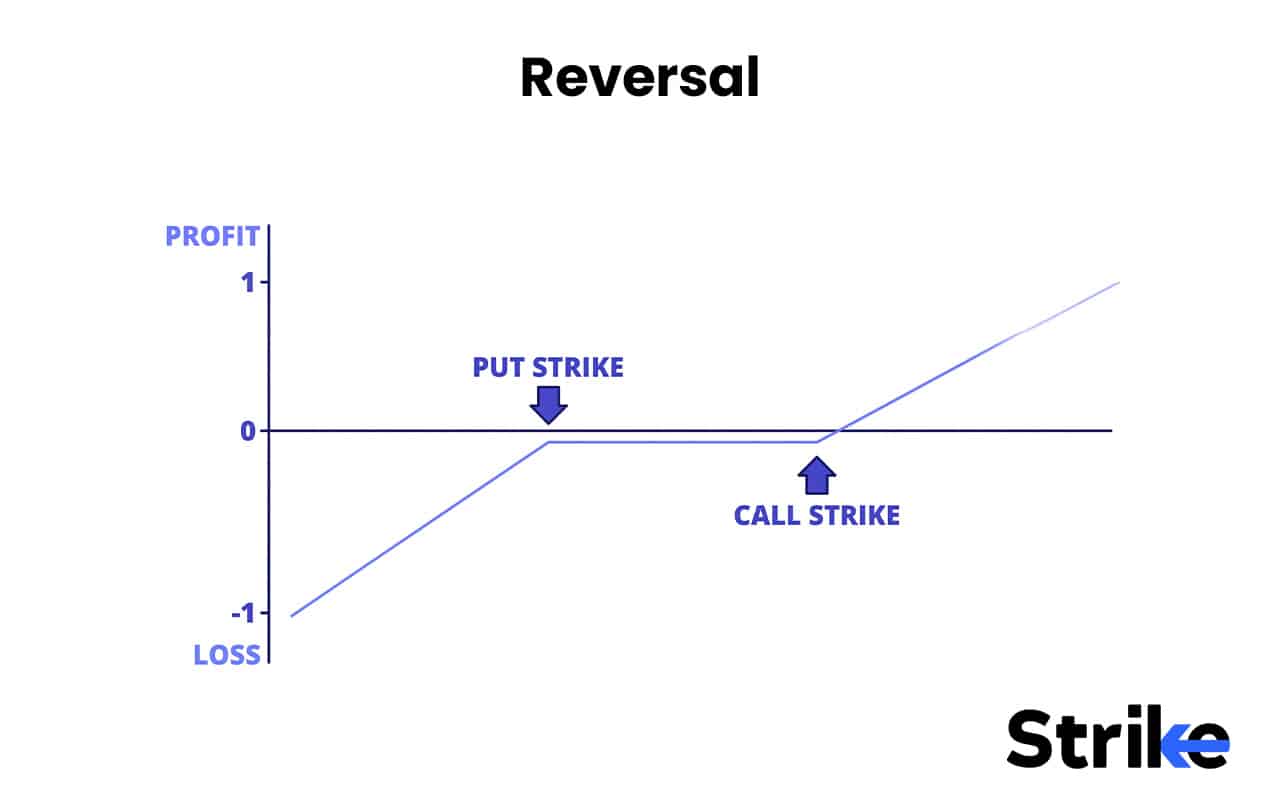
It is a three legged options strategy constructed by short selling the underlying stock, selling one put option, and buying one call option with the same strike price and expiry.
| Action | Instrument | Strike Price | Expiry |
| Sell | Underlying Stock | — | — |
| Sell | 1 Put Option | ATM | Same Expiry |
| Buy | 1 Call Option | ATM | Same Expiry |
You can use this strategy when you have no view on market directions and want to exploit the price inefficiency in put options. A Reversal is typically established as a Net Credit Strategy because the proceeds from the short stock sale and the put premium generally exceed the call premium paid.
| Parameter | Details |
| Strategy Type | Net Credit Strategy |
| Maximum Profit | Fixed and Limited (Arbitrage Profit) |
| Maximum Loss | Limited (Primarily transaction costs and execution risk) |
| Breakeven | Not Applicable (Fixed Payoff) |
| Best When | Options are overpriced relative to the underlying asset |
| Risk-Reward | Limited Risk, Limited Reward |
| Classification | Arbitrage Strategy |
45. Put Calendar Spread
Put calendar spread is a two legged options strategy used in moderately bearish to neutral markets. In a calendar spread, you sell near-term put options and buy long-term put options of the same strike to profit from time decay and changing implied volatility.
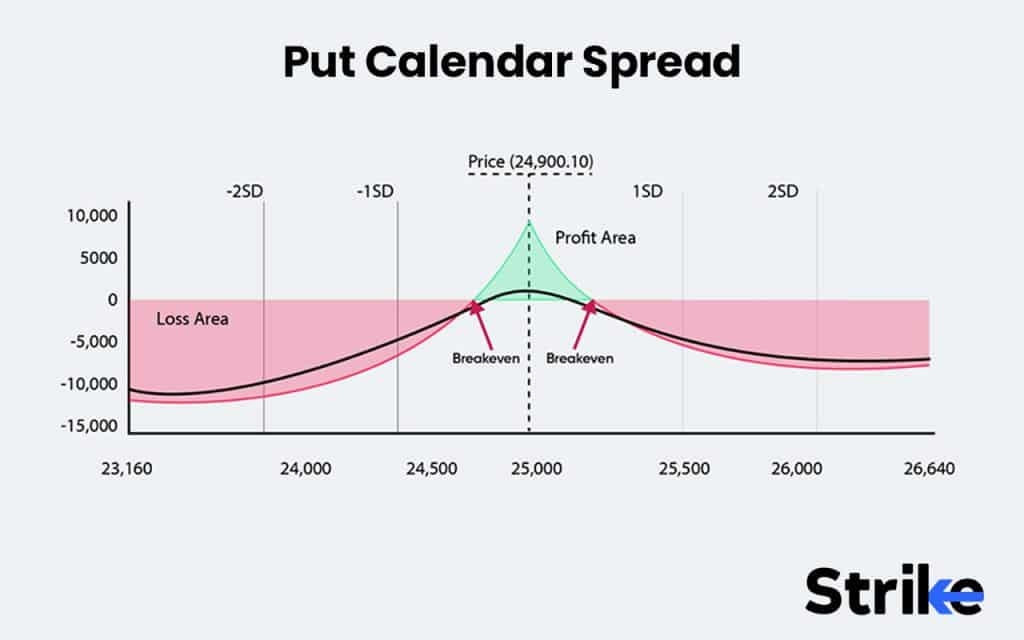
| Action | Option Type | Strike Price | Expiry |
| Sell | 1 Put Option | ATM (typically) | Near-Term Expiry |
| Buy | 1 Put Option | Same Strike | Longer-Term Expiry |
Put Calendar Spread strategy works best when the underlying is expected to give limited price move in near-term with a gradual downside bias. Since you pay more premium to buy a long-term put option and receive less premium by selling a short-term put option, this strategy is a net debit strategy.
| Parameter | Details |
| Strategy Type | Net Debit Strategy |
| Maximum Profit | Limited (depends on time decay and implied volatility) |
| Maximum Loss | Net Premium Paid |
| Breakeven | No Fixed Breakeven (depends on expiry and implied volatility) |
| Best When | Neutral to moderately bearish outlook with low implied volatility expected to rise |
| Risk-Reward | Limited Risk, Moderate Reward |
| Classification | Time Decay Strategy |
46. Reverse Calendar Spread
As the name suggests, reversal calendar spread is opposite to standard calendar spread option strategy, where we buy near-term options instead of selling them and we sell long-term options instead of buying them.
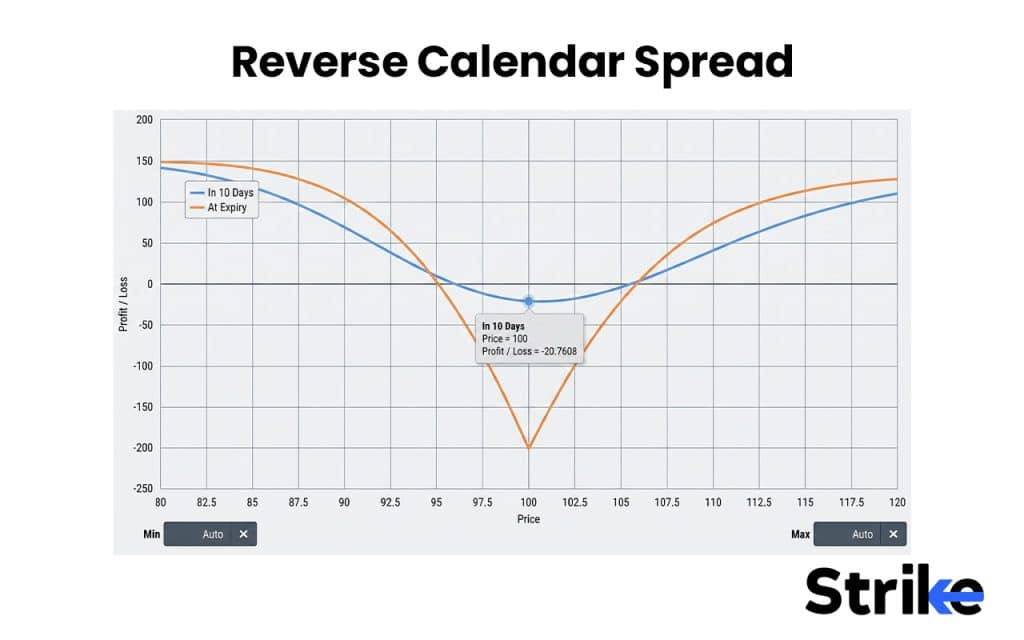
It is a two legged option strategy, where we buy near-term options and sell longer term options of the same strike.
| Action | Option Type | Strike Price | Expiry |
| Buy | 1 Call/Put Option | ATM (typically) | Near-Term Expiry |
| Sell | 1 Call/Put Option | Same Strike | Longer-Term Expiry |
You can create this strategy when you expect volatility in the near-term but a stable move later. As we pay less premium for near-term option buying and receive higher by selling long-term options, this strategy is net credit strategy.
| Parameter | Details |
| Strategy Type | Usually Net Credit Strategy |
| Maximum Profit | Limited (depends on price movement and volatility) |
| Maximum Loss | Limited |
| Breakeven | No Fixed Breakeven |
| Best When | Expecting high short-term volatility and a sharp price move |
| Risk-Reward | Limited Risk, Limited Reward |
| Classification | Volatility & Time Decay Strategy |
47. Wheel Strategy
Wheel strategy is a regular income generating option strategy where you use cash secured put and covered call option strategy and keep shifting between them to earn regular premium from both the strategy.
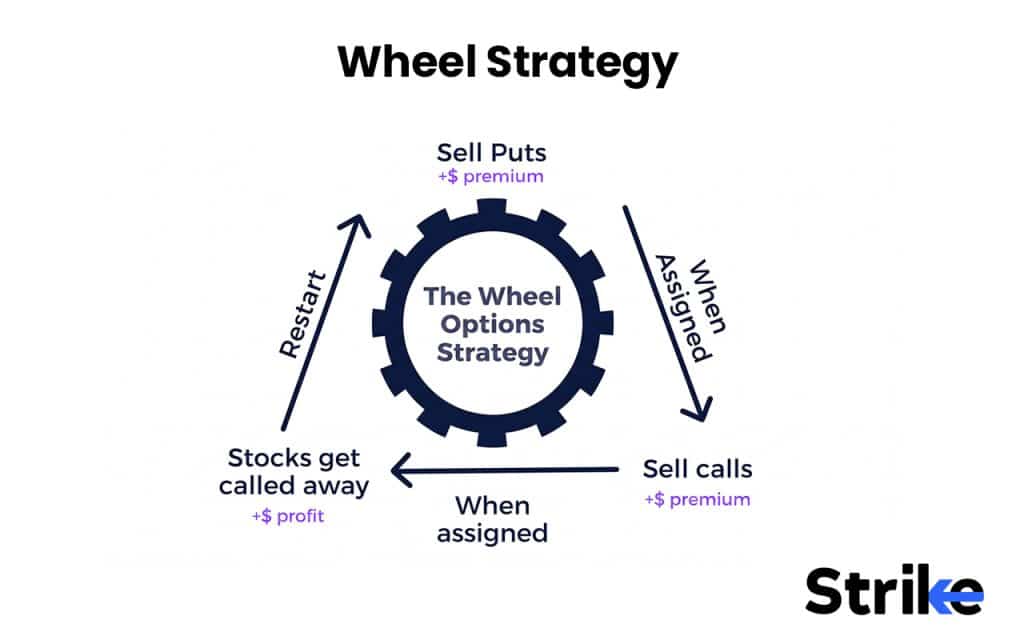
Wheel strategy is a multilegged option strategy where you sell cash-secured puts to acquire a stock and then sell covered calls on the shares.
Step 1: Sell a Cash-Secured Put
| Action | Instrument | Strike Price | Expiry |
| Sell | 1 Put Option | ATM or Slightly OTM | Same Expiry |
| Keep | Cash to Buy Shares if Assigned | Equal to Strike × Lot Size | — |
Step 2: If Assigned, Sell a Covered Call
| Action | Instrument | Strike Price | Expiry |
| Buy/Receive | Underlying Shares (via Assignment) | Strike Price | — |
| Sell | 1 Call Option | ATM or Slightly OTM | Same Expiry |
This strategy is suitable for investors who want to earn regular income while comfortably holding the stocks. The cash-secured put is a net credit strategy and covered call is a net credit strategy.
| Parameter | Details |
| Strategy Type | Net Credit Strategy |
| Maximum Profit | Limited per cycle (Premium + Capital Gain if Shares Are Called Away) |
| Maximum Loss | Significant (If the Stock Price Falls Sharply) |
| Breakeven | Stock Purchase Price − Total Premium Received |
| Best When | Moderately bullish or neutral outlook with high implied volatility (IV) |
| Risk-Reward | Moderate Risk, Moderate Reward |
| Classification | Income Generation Strategy |
48. Poor Man’s Covered Call (PMCC)
Poor Man’s Covered Call (PMCC) is a capital efficient option strategy where you can create a covered call strategy with low capital, where you try to mimic owning actual stock using options.
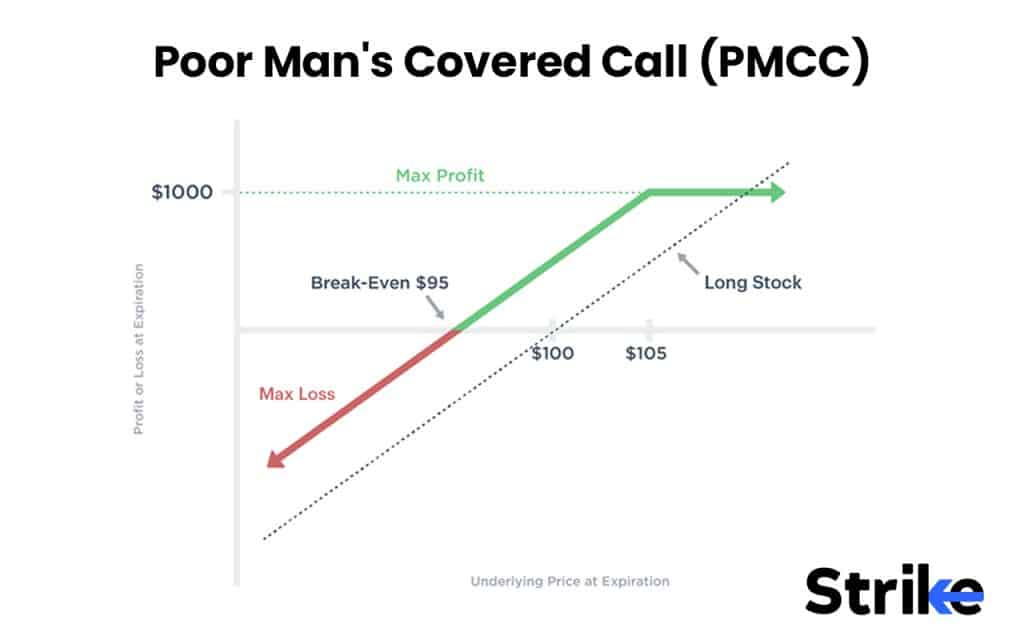
It is a two legged option strategy where you buy a long-term deep ITM call option (LEAPS) and sell a short-term OTM call option.
| Action | Option Type | Strike Price | Expiry |
| Buy | 1 Call Option | Deep ITM | Long-Term (LEAPS) |
| Sell | 1 Call Option | OTM | Near-Term Expiry |
You can use PMCC strategy when you expect market moves to be bullish and want to generate covered call-like income. Since buying long-term call costs more than the premium received, the strategy is net debit strategy.
| Parameter | Details |
| Strategy Type | Net Debit Strategy |
| Maximum Profit | Limited (Depends on the strike prices and premium received) |
| Maximum Loss | Net Premium Paid |
| Breakeven | Long Call Strike + Net Premium Paid |
| Best When | Moderately bullish outlook with low to moderate implied volatility (IV) |
| Risk-Reward | Limited Risk, Moderate Reward |
| Classification | Bullish Income Strategy |
49. Condor (Call/Put)
Condor is a market neutral option strategy. Unlike iron condors where we use both a call and a put option, in condors we create strategy either using call or put option. The payoff diagram of the condor looks similar to an iron condor.
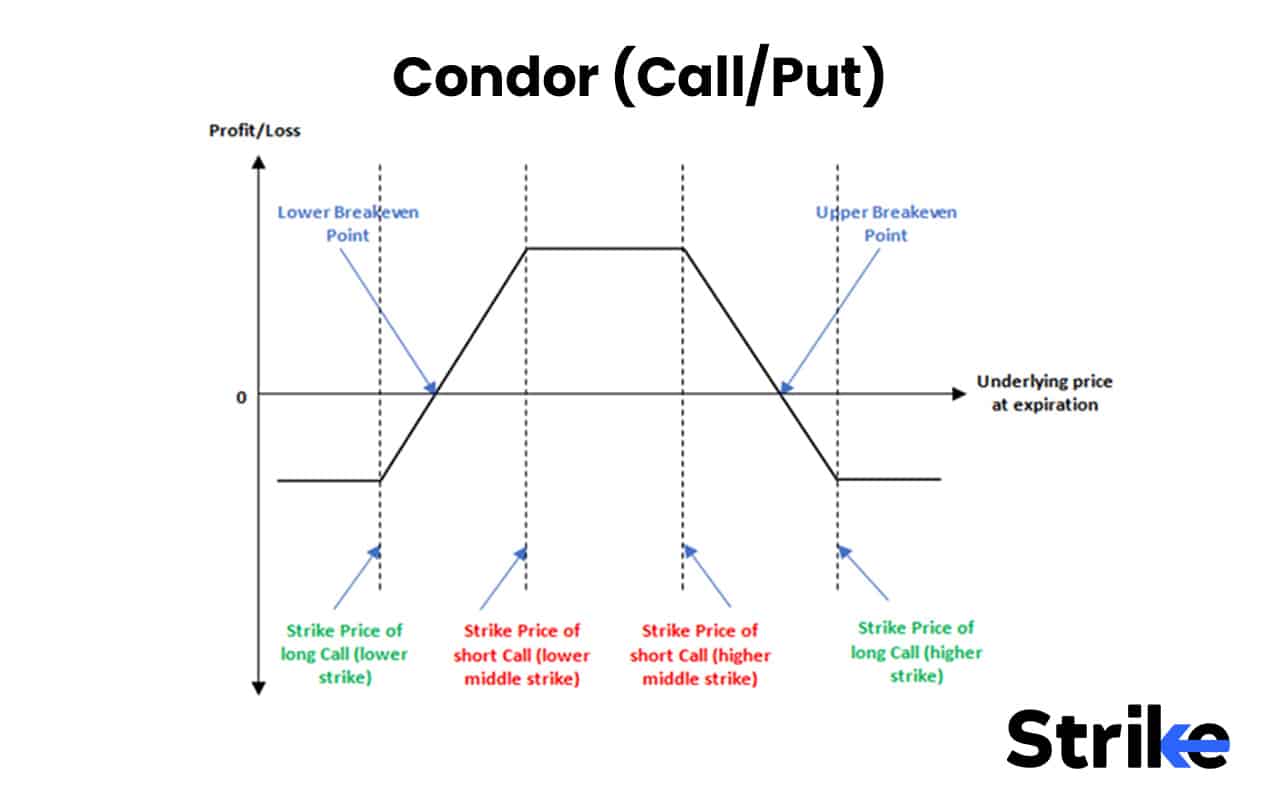
It is also a four-legged option strategy where you buy one lower strike call or put option, sell one lower middle strike call or put option, sell one upper middle call or put option and buy one higher strike call option.
| Strategy | Legs |
| Call Condor | Buy 1 Lower Strike Call → Sell 1 Lower Middle Strike Call → Sell 1 Upper Middle Strike Call → Buy 1 Higher Strike Call |
| Put Condor | Buy 1 Higher Strike Put → Sell 1 Upper Middle Strike Put → Sell 1 Lower Middle Strike Put → Buy 1 Lower Strike Put |
You can create this strategy when you expect the market to stay neutral and expire without major moves.
| Parameter | Details |
| Strategy Type | Net Debit Strategy |
| Maximum Profit | Limited |
| Maximum Loss | Net Premium Paid |
| Breakeven | Two Breakeven Points |
| Best When | Neutral outlook with low implied volatility (IV) |
| Risk-Reward | Limited Risk, Limited Reward |
| Classification | Neutral Range-Bound Strategy |
50. Batman Strategy
A Batman strategy is a market-neutral options strategy designed to profit when the underlying asset expires within a specific price range. It gets its name because the payoff graph resembles the Batman logo, with two profit peaks and a dip in the middle.
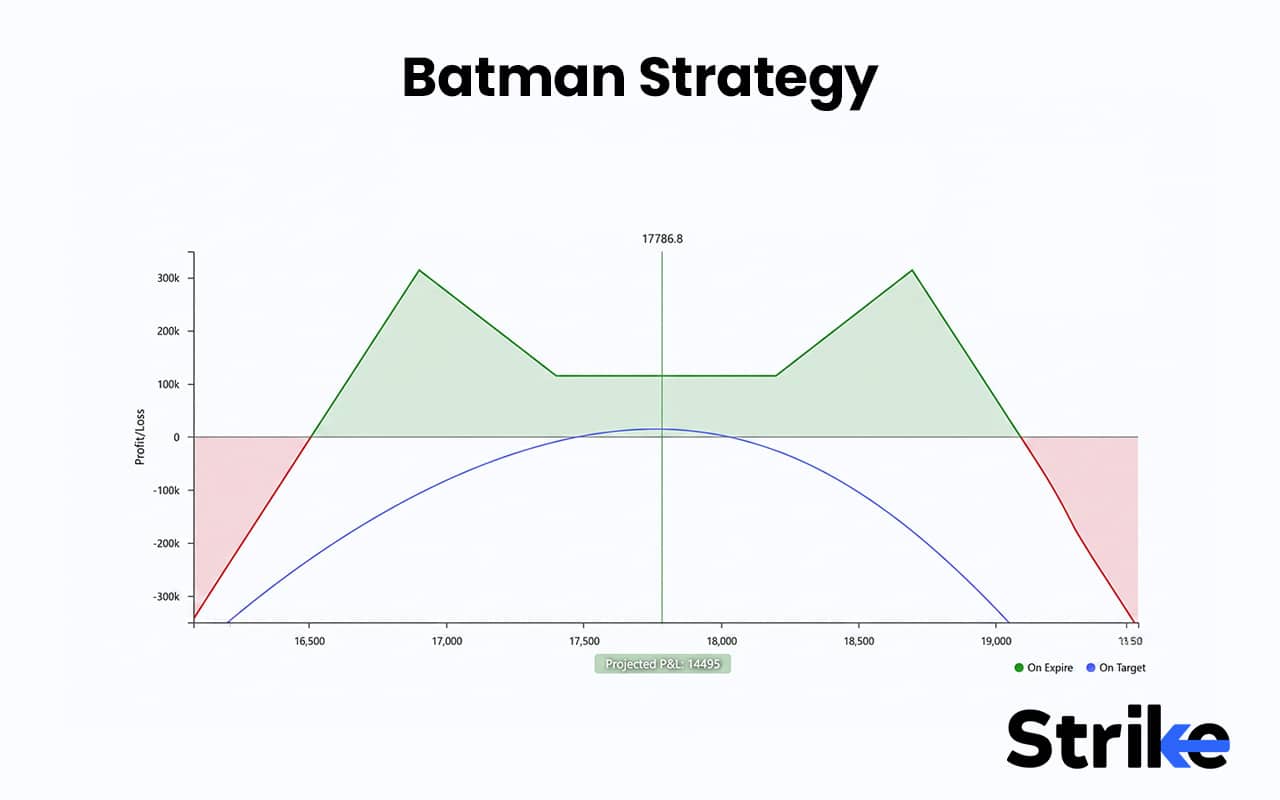
It is a four-legged option strategy created by combining two vertical spreads on the same option type (either all calls or all puts). The maximum profit occurs when the price expires near either of the two middle strike prices, while losses are limited because of the long options at the outer strikes.
| Action | Option Type | Strike Price | Expiry |
| Buy | 1 Call/Put Option | Lower Strike | Same Expiry |
| Sell | 1 Call/Put Option | Lower Middle Strike | Same Expiry |
| Sell | 1 Call/Put Option | Upper Middle Strike | Same Expiry |
| Buy | 1 Call/Put Option | Higher Strike | Same Expiry |
You can create this strategy when you expect the market to remain range-bound but believe it has a higher probability of expiring near one of two predefined price levels rather than exactly at the center of the range.
| Parameter | Details |
| Strategy Type | Net Debit or Net Credit (depends on strike selection) |
| Maximum Profit | Limited |
| Maximum Loss | Limited |
| Breakeven | Multiple Breakeven Points (typically four) |
| Best When | Neutral outlook with expected expiry near one of two target price levels |
| Risk-Reward | Limited Risk, Limited Reward |
| Classification | Neutral Range-Bound Strategy |
How Option Greeks Can Help You Select a Strategy?
By understanding option greeks and how it affects the option pricing in different market conditions, you can be able to pick up the best suitable options strategy for the particular market condition.
- Delta (Δ): It measures the change in the price of an option contract with respect to change in an underlying price. Delta helps you select a strategy between bullish and bearish. Look for bullish strategies like Long Call, Bull Call Spread, and Synthetic Long Stock when the delta is positive, whereas, use bearish strategies like Long Put, Bear Put Spread, and Synthetic Short stock, when the delta is negative.
- Gamma (Γ): It measures how fast a delta changes with respect to change in an underlying price. This will help you to identify whether to create momentum strategy or range-bound strategy. If the gamma is high, look for a momentum strategy like Long Call, Long Put, Long Straddle, Long Strangle, Ratio Backspreads because high gamma means more sensitive delta, and more sensitive delta means more sensitive option premiums. If the gamma is low, look for neutral strategies like Iron Condor, Iron Butterfly, Short Straddle, Short Strangle, Covered Call, because low gamma means less sensitive delta, meaning option premium will move slow compared to underlying price.
- Theta (Θ): It shows how much an option loses its value each day as expiry approaches. This will help you to decide whether to buy or sell the options. If the theta is positive look for net credit strategies like Covered Call, Cash-Secured Put, Iron Condor, Short Straddle, because positive theta means option losses its value fast giving option sellers premium. If the theta is negative, look for a net debit strategy like Long Call, Long Put, Long Straddle, Long Strangle, because negative theta affects option premium less, reducing the chance of losses in option buying because of theta decay.
- Vega (V): It measures the impact of volatility on option premium. High vega means the option price is more sensitive to changes in implied volatility, which means high movement in option premium, hence look for option buying strategies like Long Straddle, Long Strangle, Calendar Spread. Low vega means low volatility and stable option premium. This stable option premium erodes gradually without fluctuation, beneficial for option sellers. Hence look for net credit options strategy like Iron Condor, Covered Call, Short Straddle, Short Strangle.
Role of Implied Volatility in Buy vs Sell Decisions
Implied Volatility (IV) measures the impact of volatility on option premium. Depending on whether the IV is high or low, you can select what strategy to create.
- High IV: High vega means high volatility, which means high movement in option premium, hence look for option buying strategies like Long Straddle, Long Strangle, Calendar Spread.
- Low IV: Low vega means low volatility and stable option premium. This stable option premium erodes gradually without fluctuation, beneficial for option sellers. Hence look for net credit options strategy like Iron Condor, Covered Call, Short Straddle, Short Strangle.
However, professionals look to create a net credit strategy when the IV is high and it is expected to fall.
How to Choose the Right Option Strategy
There are five major steps to follow in order to identify the right option strategy. These steps are briefly discussed below.
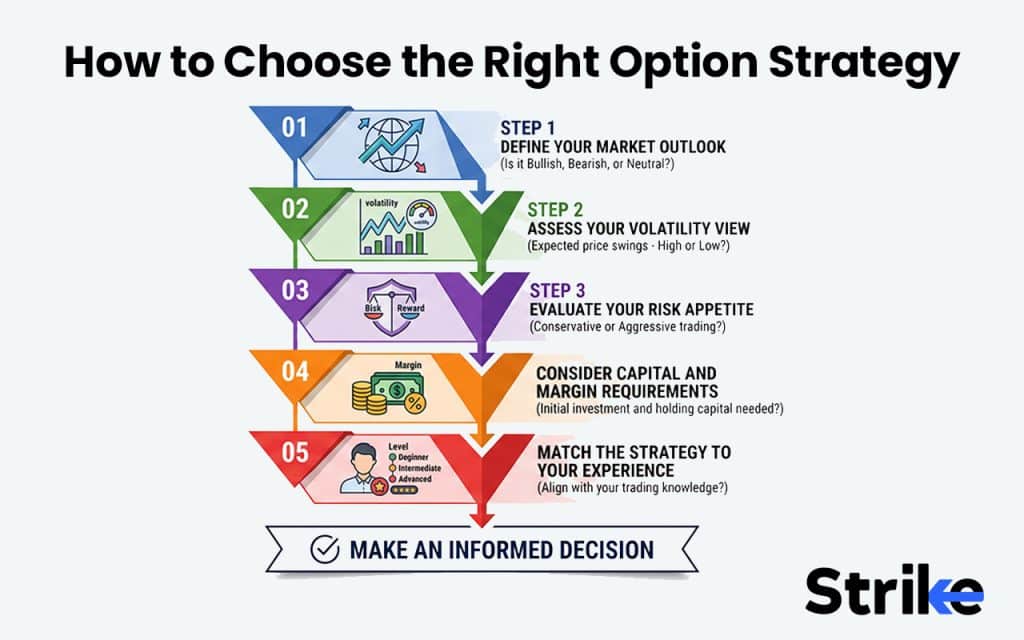
- Define Your Market Outlook: Start by identifying where you expect the underlying asset to move.
| Market Outlook | Suitable Strategies |
| Strongly Bullish | Long Call, Bull Call Spread, Bull Put Spread |
| Moderately Bullish | Covered Call, Cash-Secured Put |
| Neutral | Iron Condor, Short Strangle, Butterfly |
| Moderately Bearish | Bear Put Spread, Bear Call Spread |
| Strongly Bearish | Long Put, Protective Put, Synthetic Short Stock |
- Assess Your Volatility View: Your expectation of implied volatility (IV) is just as important as your price outlook.
| Volatility Expectation | Preferred Strategies |
| Volatility Rising | Long Straddle, Long Strangle, Long Call, Long Put |
| Volatility Falling | Iron Condor, Short Straddle, Covered Call, Credit Spreads |
| Volatility Stable | Debit Spreads, Calendar Spread, Butterfly |
- Evaluate Your Risk Appetite: Choose a strategy that matches the maximum loss you are willing to accept.
| Risk Profile | Suitable Strategies |
| Low Risk | Covered Call, Collar, Debit Spreads |
| Medium Risk | Credit Spreads, Calendar Spread |
| High Risk | Naked Call, Naked Put, Short Straddle |
- Consider Capital and Margin Requirements: Some strategies require significantly more capital or margin than others.
| Capital Available | Suitable Strategies |
| Low | Long Call, Long Put, Debit Spreads |
| Medium | Covered Call, Calendar Spread |
| High | Iron Condor, Short Strangle, Naked Options |
- Match the Strategy to Your Experience: Avoid strategies that are more complex than your current skill level.
| Experience | Suitable Strategies |
| Beginner | Long Call, Long Put, Covered Call, Protective Put |
| Intermediate | Vertical Spreads, Calendar Spread, Iron Condor |
| Advanced | Ratio Spread, Backspread, Broken Wing Butterfly, Synthetic Strategies |
What Tools You Need to Execute a Successful Option Strategy?
Executing an option strategy successfully requires more than just selecting the right strategy. You need a combination of market analysis tools, options analytics, execution platforms, risk management tools, and research resources to make informed decisions. Each tool serves a different purpose, from identifying trading opportunities to managing open positions.
- Trading & Execution Platform that allows you to execute multilegged strategy quickly with advanced order type.
- Charting and technical analysis tools to identify market trends, support/resistance, entry and exit points along with indicators like Moving Averages, RSI, MACD, VWAP, and Bollinger Bands can improve trade timing.
- Option chain & open interest analysis to find out strike prices, premiums, Open Interest (OI), volume, and Put-Call Ratio (PCR).
- Option Greeks & Implied Volatility (IV) Tools to understand how an option value will change with price, time, volatility, and interest rates.
- Strategy builder & payoff calculator to create and to calculate the max profit, max loss, breakeven point, margin requirements, and payoff diagram of overall trade.
- Market sentiment tools like Market breadth, India VIX, sector performance, FII/DII activity, and advance-decline ratios to understand overall market environment.
- Risk management tools like position size calculators, stop-loss planning, margin calculator, and portfolio risk analyzer help control downside risk and avoid excessive leverage.
Books Suggestions for Learning Options Strategies
Top 10 books to learn options strategies are briefly discussed below in the table.
| Book | Author | Level | Best For |
| Options as a Strategic Investment | Lawrence G. McMillan | Beginner–Advanced | Complete reference on option strategies |
| Options Trading For Dummies | Joe Duarte | Beginner | Learning the basics of options trading |
| Trading Option Greeks | Dan Passarelli | Intermediate | Understanding the Greeks and risk |
| Option Volatility and Pricing | Sheldon Natenberg | Intermediate–Advanced | Volatility and option pricing |
| The Options Playbook | Brian Overby | Beginner–Intermediate | Visual guide to popular strategies |
| Options Trading Crash Course | Frank Richmond | Beginner | Quick introduction for new traders |
| Mastering Options Strategies | CBOE | Beginner–Intermediate | Free guide with practical examples |
| The Options Course | George A. Fontanills | Intermediate | Strategy and risk management |
| Option Volatility Trading Strategies | Sheldon Natenberg | Advanced | Advanced volatility trading |
| Profiting with Iron Condor Options | Michael Benklifa | Intermediate–Advanced | Mastering Iron Condor strategies |
However, reading these stock market books is not enough to master the options strategy. Try to practice on the live market with paper trading simultaneously while reading these books.


 Previous Article

![15 Investing.com Alternatives [Free+Paid] You Should Use in 2026](https://www.strike.money/wp-content/uploads/2026/04/Investing.com-Alternatives.jpg "15 Investing.com Alternatives [Free+Paid] You Should Use in 2026 200")
![15 TradeStation Alternatives [Free+Paid] You Should Use in 2026](https://www.strike.money/wp-content/uploads/2026/04/TradeStation-Alternatives.jpg "15 TradeStation Alternatives [Free+Paid] You Should Use in 2026 201")
![15 Chartink Alternatives [Free+Paid] You Should Use in 2026](https://www.strike.money/wp-content/uploads/2026/04/Chartlink-Alternatives.jpg "15 Chartink Alternatives [Free+Paid] You Should Use in 2026 202")

No Comments Yet.