
Stocks & Indices
Track Performance with Real-Time Data
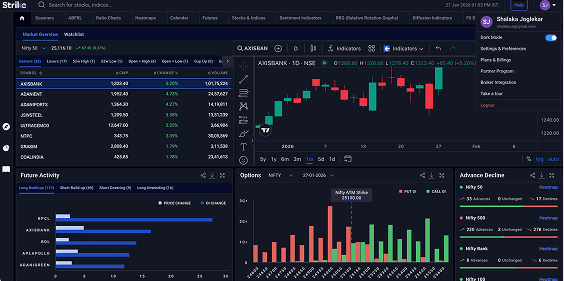
Stocks & Indices show price movement, financial data, and market activity in one place. You can track how a stock or index is behaving, what’s driving it, and how it compares across timeframes.
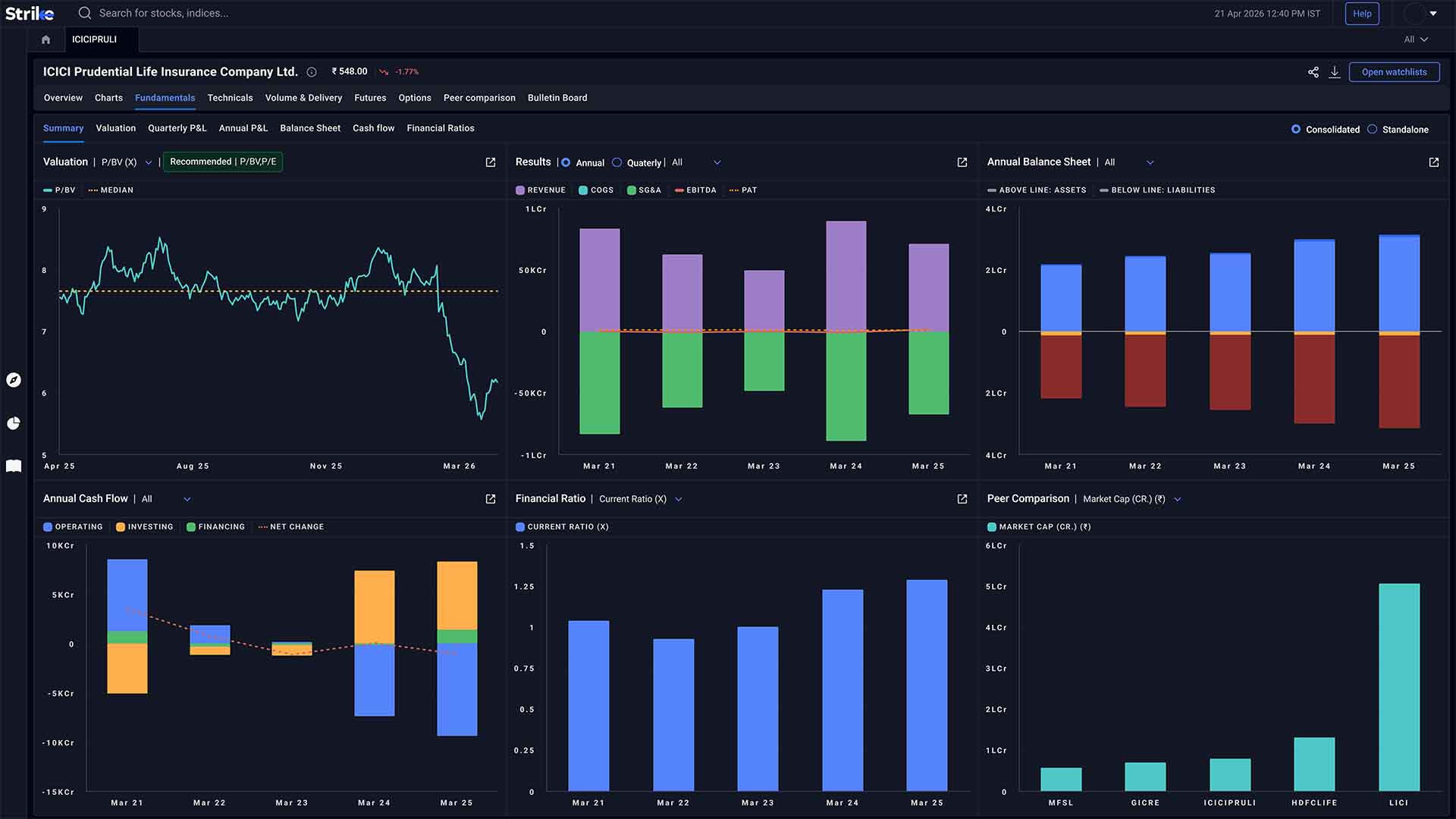


Powerful Stock Analysis Capabilities
Everything you need to analyse price, data, and positioning in one place

Price & Data Integration
View price movement alongside financials, volume, and derivatives data without switching screens.

Multi-Layer Analysis
Combine technicals, fundamentals, and positioning to get a more complete view of a stock or index.

Cross-Comparison Views
Compare stocks, sectors, and indices to understand relative performance and positioning.
Complete View of Stocks and Indices
Understand price movement, financial strength, and positioning in one place
 Price Analysis
Interactive Charts
Interactive Charts provide customizable charting for stocks and indices, featuring Rohit Setup and Strike Valuation Setup to enhance your market analysis.
-
 Custom timeframes
-
Indicator overlays
-
Price structure
 Financial Data
Fundamentals of Stocks
Fundamentals of Stocks looks at earnings, key ratios, and balance sheet strength to understand how the business is performing and whether the valuation is supported by that performance.
-
Profit growth trends
-
Return ratios (ROE, ROCE)
-
Debt vs equity structure
 Market Updates
Technicals of Stocks
Technicals of Stocks deals with price behaviour - moving averages, RSI, MACD, support and resistance. It’s more about reading momentum and trend shifts than just looking at price moves in isolation.
-
Trend indicators
-
Momentum signals
-
Support & resistance
 Market Updates
Volume & Delivery of Stocks
Volume & Delivery of Stocks shows traded volume along with delivery percentage. When delivery stays high with price movement, it often points to stronger participation rather than short-term activity.
-
Volume trends
-
Delivery percentage
-
Participation strength
 Market Updates
Futures & Options Analysis
Futures & Options Analysis gives data on open interest, volume buildup, and long-short positioning. It helps in reading how positions are forming in derivatives.
-
Open interest data
-
Position buildup
-
Long-short trends
 Market Updates
Peer Comparisons
Peer Comparisons puts a stock side by side with others in the same sector across metrics like returns, margins, and valuation. It helps you see relative strength instead of looking at a stock in isolation.
-
Relative performance
-
Sector comparison
-
Valuation context

How Strike Stocks & Indices Work
From raw data to structured analysis in three simple steps
View Data
Open a stock or index to see price, financials, volume, and derivatives data in one place.
Break It Down
Move between charts, fundamentals, and technicals to understand what’s actually driving the move.
Compare & Decide
Use peer comparison and multi-timeframe data to judge relative strength and positioning
Explore All Features
Professional-grade tools built to analyze market movements and trading opportunities in real time

Advanced Scanners
Filter stocks using price, volume, technical indicators, and patterns. Returns setups that match defined conditions without manual chart checks.
Explore Advanced scanners →

Futures & Options
Access open interest, volume, and long-short data across indices and stocks. Helps read position buildup and derivative activity.
Explore Futures & Options →

Sentiment Indicators
Analyse market positioning using breadth data, derivatives activity, and momentum signals across stocks and indices.
Explore Sentiment Indicators →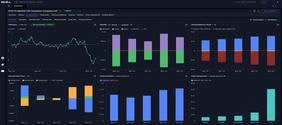

Stocks & Indices
View price trends, financial data, and technical indicators together. Compare performance across timeframes and track index movement.
Explore Stocks & Indices →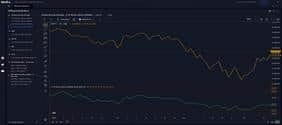

Diffusion Indicators
Measure percentage of stocks aligned with trend or momentum signals. Shows whether market moves have broad participation.
Explore Diffusion Indicators →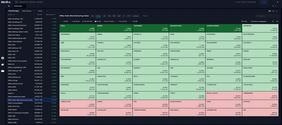

Interactive Heatmaps
Visualise sector and stock movement using percentage change and market cap weight. Highlights where gains or declines are concentrated.
Explore Interactive Heatmaps →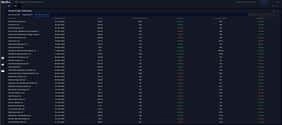

IPO Tracker
Track upcoming and active IPOs with issue dates, price bands, lot sizes, and subscription data across investor categories.
Explore IPO Tracker →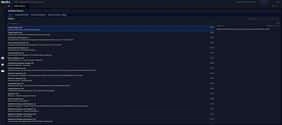

Bulletin Board
View news, announcements, corporate actions, and deal activity together. Helps link market events with price movement.
Explore Bulletin Board →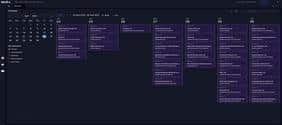

Market Calendar
Track earnings, IPOs, and economic events by date. Useful for planning trades around scheduled market triggers.
Explore Market Calendar →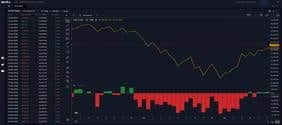

FII DII Data
Track institutional buying and selling across cash and derivatives segments. Shows changes in exposure by FIIs and DIIs.
Explore FII DII Data →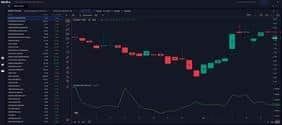

Ratio Charts
Compare stocks or sectors using price ratios. Helps identify relative strength and shifts in outperformance over time.
Explore Ratio Charts →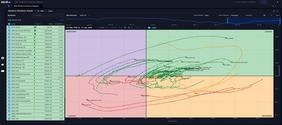

RRG
Plots relative strength and momentum against each other; shows clockwise rotation between leading, weakening, lagging, and improving quadrants.
Explore RRG →Frequently Asked Questions
It shows how a stock or index has been moving - price, returns across different periods, and a quick summary of the business. Usually enough to get a first read before you decide if it’s worth digging into.
You can check charts along with past returns across timeframes. A stock might look strong on a short-term chart but flat over a year, or the other way around - so looking at a few periods together gives a better sense of how it’s actually behaved.
With Interactive Charts, you can move across timeframes, add indicators, and look at specific price zones more closely. It’s mostly used to study how price has behaved, not just where it is.
They show what’s happening behind the price - revenue, profit, debt, margins. Sometimes price runs ahead of fundamentals, sometimes it lags. This helps you see which side it’s on.
You’ll see indicators like moving averages, RSI, MACD, along with support and resistance levels. These are used to read trend strength and momentum though how you interpret them can differ a bit.
You can check total volume along with how much of it turns into delivery. When delivery stays high with price movement, it usually means positions are being carried forward, not just intraday trades.
It includes open interest, volume buildup, and long-short positioning. Basically shows how traders are placing bets in derivatives, which sometimes gives early hints compared to spot moves.
Peer Comparisons let you compare a stock with others in the same sector based on performance, valuation, and growth. It helps you see relative strength instead of looking at a stock in isolation.
What Our Traders Say

Mr. Ayush
5.0
Working Professional


Vinit Baro
5.0
Working Professional


Nitin Prajapati
5.0
Working Professional


Manish Setia
5.0
Investor
Why Traders Love Our Stocks & Indices

Everything in One Place
You don’t really need to jump between tools. Price, charts, data, even positioning - it’s all there, so analysis feels a bit more connected.

Clearer View Behind Price Moves
Sometimes prices move but the reason isn’t obvious. When you see volume, delivery, or positioning alongside it, things start to click.

Better Comparison Across Stocks
Looking at one stock alone doesn’t always tell much. When you compare it with peers, you start noticing who’s actually leading.

Flexible for Different Styles
Whether you’re tracking short-term setups or looking at longer-term data, the same view works. You just read it differently.
Strike
PROFESSIONAL TRADING PLATFORM
Join thousands of traders worldwide
Join 50K+ traders receiving our exclusive newsletter with market analysis, trading strategies, and actionable insights.

Expert insights on market trends and opportunities
Proven techniques from professional traders
Comprehensive beginner to advanced trading guide
Be the first to read our latest articles
"Strike's newsletter completely transformed my trading approach. The insights are invaluable!"
— Amit Sharma, Active Trader50K+
Active Traders
$2.5B+
Trading Volume
150+
Markets Covered
24/7
Support Available