Wheel Options Trading Strategy: The Complete Guide with Example


 Author

 Editor
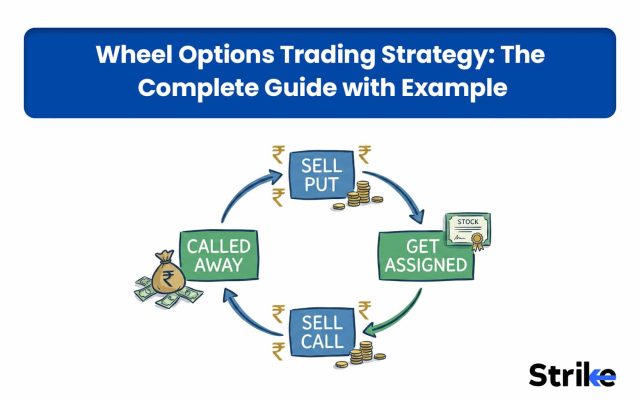
Wheel option trading strategy is very popular amongst investors for its systematic approach of execution and consistent income generation. Wheel option strategy profits from option premium of cash-secured puts and covered calls while managing the risks with sufficient cash and fundamentally strong stock.
The wheel strategy works by selling put, selling puts, buying shares if assigned, then selling covered calls until shares are called away, and repeating that in a loop. If performed properly, it delivers an average annual return of 7-20% while limiting the risks using cash collateral. Understanding this strategy will give you a safe edge towards the market to make stable profits.
What Is the Wheel Options Trading Strategy?
Wheel options trading strategy is a systematic option selling strategy where traders repeatedly sell cash-secured puts and covered calls of fundamentally strong stocks in a cyclic manner to generate consistent premium income.
This strategy is called a wheel strategy because it continuously moves in a cycle of selling cash secured put and a covered call. Many traders often call this strategy a triple income strategy because it generates profit from sold cash secured put, sold covered call, and a price appreciation of the stock.
How the Wheel Options Strategy Works
The wheel option strategy works by cycling through three phases using the same underlying stocks. These phases are briefly discussed below.
- Phase 1 is selling a cash secured put: You sell a cash secured put of stock you want to buy at discounted price and hold it in your portfolio. This allows you to earn a regular premium from the sold put option until the stock price comes down to your desired price. Once the price moves down to your desired price, exit the sold put option and buy the stock in the same quantity.
- Phase 2 is selling a covered call: Now as you hold the stocks that you have bought during phase one, you sell covered calls against them. If your stock closes below your sold call strike, you earn a premium. Keep selling covered calls until stock moves beyond sold covered call strike. Once stock moves beyond the sold covered call strike, sell the stocks and move to phase three.
- Phase 3 is going back to cash secured put: After selling the stocks, you are back to the cash secured put . Sell the cash secured put option until stock again falls down. Repeat the process in cycle .
This method of collecting Option Premium is especially effective for generating steady income from blue-chip stocks or ETFs that you are comfortable owning. By consistently capturing the Option Premium, an investor can lower their overall cost basis and improve the total return on their long-term holdings.
Why Use the Wheel Options Strategy?
The main reason to use the wheel option strategy is to earn a regular option premium while trading and investing in fundamentally strong stock. Apart from this
- Consistent Premium Income: This strategy will allow you to earn regular premium from selling cash-secured put and covered call while investing in fundamentally strong stock.
- Better Entry and Exit: Cash secured puts helps you to buy a stock at discounted price while earning premium income as they wait. Similarly it allows you to sell or exit the stock at a higher price while continuing to earn a premium until the shares are sold.
- Additional Income on Existing Shares: While you hold the shares, covered call helps generate extra return on the holdings along with capital appreciation.
- Reduces Emotional Trading: As this strategy follows a structured process, it removes emotional decision making.
- Suitable for Long-Term Investors: Investors who are comfortable in holding stocks for a long period of time usually use this strategy to improve the return on their portfolio.
- Lower Risk Compared to Naked Options Selling: This strategy has lower risk because the sold put option is always backed by cash and calls are always backed by owned shares. This makes it a comparatively safe strategy.
By always using cash for Put assignments, traders avoid leverage risks, and if the Put is exercised, they can then sell a Call against the shares. The Wheel is also less stressful than day trading, often involving the repeated writing of a Call after a stock is assigned. It’s common to use the strategy on large, stable stocks such as those in the NIFTY 50 in India, which offer high liquidity and reliable options markets.
When to Use the Wheel Options Strategy
There are three best market conditions where you can use the wheel option strategy. These market conditions involve a sideways market, mildly bullish market, and high IV environment.
- Sideways or range-bound market: As this strategy makes regular profits by selling the call and put options, the sideways market is best suited for this.
- Mildly Bullish Market: During the mildly bullish market, the sold covered call expires worthless most of the time. Even if the stock gets assigned, the stock recovers and covered calls get filled profitably.
- High IV (Implied Volatility): During the period of high IV, option premium gets elevated which gives traders an opportunity to earn more premium. You can use indicators like IV Rank (IVR) or IV Percentile to identify the volatility.
Within the realm of Options Trading, it is less effective during high volatility events, sharp bear markets, or on speculative stocks with unpredictable price swings. The best time to use the Wheel in your Options Trading journey is when you are confident in a stock’s medium-term prospects and comfortable owning it through market cycles. Avoid using the Wheel on illiquid stocks or in environments where a large, sudden drop is likely.
How Option Greeks Affect the Wheel Strategy?
Option greeks have a direct impact on wheel strategy because they affect option premium, probability of assignment, and overall profitability. Since strategy involves selling of options, like cash secured put and covered call, it becomes important to learn how option greeks affect the wheel strategy.
- Theta (Time Decay): It is the most important option greek that measures how fast an option will lose its premium as expiry approaches. As we sell options in a wheel strategy, theta decay is heavily beneficial for us. Option loses its premium due to theta decay everyday and you collect this decay as a profit. The process of theta decay is slower during initial days but accelerates as expiry approaches. Generally 30–45 DTE (days to expiration) options are considered optimal for wheel strategy because they have a decent premium and good theta decay.
- Delta: Delta measures how much the premium will change relative to its underlying stock price and the probability of options expiring in the money. If the delta of a particular option or strike price is high, the probability of it expiring in the money is high. A put option having high delta has a higher chance of share assignment. Whereas, a put with low delta has a lower change of assignment but provides a smaller premium. Similarly, in covered calls, call options with higher premium have a higher chance of shares getting called away. Whereas, the call option with a lower delta has a lower chance of assignment. Selling a put or call with delta 0.20 – 0.30 (20–30 delta) is considered the sweet spot because it has a high enough premium and low enough assignment probability.
- Vega: Vega measures the change in option price with the change in implied volatility. Higher IV increases the option premium and allows traders to collect more profit, while lower IV reduces the premium income. IV Rank (IVR) above 30–50% is considered good to maximize premium collected.
- Gamma: Gamma affects how quickly option delta changes when the stock price moves sharply. The gamma risk becomes high near expiry (< 7 DTE), especially when the underlying price comes close to the selected strike price. During such conditions a small stock move can rapidly increase assignment risk, covered calls can suddenly move deep ITM during sharp rallies, and cash-secured puts can quickly become risky during sudden declines. Wheel traders manage this risk by rolling the positions.
- Rho: Rho measures the impact of interest rate changes on option prices. Rho has very little practical impact and becomes more relevant in long-dated options.
| Option Greek Summary Table | ||
| Greek | Role in Wheel | Target |
| Delta | Strike selection & assignment probability | 0.20–0.30 |
| Theta | Core profit engine (time decay) | Maximize at 30–45 DTE |
| Vega | IV exposure — sell high IV | IVR > 30–50% |
| Gamma | Risk at expiration — avoid near-term spikes | Stay > 21 DTE |
| Rho | Interest rate sensitivity | Minor; monitor on longer-dated trades |
While Theta drives profits, Delta, Vega, and Gamma help balance risk and reward, making the Wheel Strategy more effective and consistent.
How to Trade the Wheel Options Strategy (With Example)
Trading wheel option strategy follows a repeating cycle of selling cash-secured puts and covered calls to generate regular income from option premiums. There are three main phases in trading wheel option strategy. Lets understand these phases using stock XYZ trading at ₹1000.
- Phase 1 is selling cash secured put: Sell the 1 lot (500 quantity) of ₹900 put option of stock XYZ at ₹20. So the total premium to be received would be ₹10,000 (₹20 × 500). If stock stays above ₹900 till expiry, option expires worthless and you keep the premium of ₹10,000 as profit. Repeat the process again next month. If the stock falls below ₹900 at expiry, buy or assign 500 shares at ₹900. Here, the actual cost of buying a share would be ₹880 not ₹900 because you have already earned ₹20 premium from the sold put option.
- Phase 2 is selling a covered call: Now you hold the 500 stocks of XYZ at ₹880 cost basis, you sell 1 lot of ₹900 call option at ₹15. The total premium to be received would be ₹7,500 (₹15 × 500). If stock stays below ₹900 till expiry, call option expires worthless and you keep the premium of ₹7,500 as profit. Repeat the process again next month. If stock price rises above ₹900 at expiry, shares are called away at ₹900. Here the profit is ₹17,500 ((₹900 − ₹865) × 500). Now go to phase one.
- Phase 3 is repeating the phase 1: Once the shares are called away through the covered call, the wheel cycle starts again. The trader returns to selling cash-secured puts to collect premium income and potentially acquire shares at a lower price. By continuously repeating this process, the strategy aims to generate regular income from option premiums over time.
The Wheel is a steady premium collection cycle. The real edge is in stock selection, position sizing, and patience during Phase 2 when you are holding shares below your original target price. Done on liquid, fundamentally strong stocks with full capital backing, it generates consistent 2–4% monthly returns in favorable conditions.
What Are the Returns & Breakevens of Wheel Strategy?
The return in wheel strategy is not fixed and depends entirely on IV, strike selection, expiry duration, and market condition. Also, the returns in wheel strategy mainly comes from three different sources, which are cash secured put option premium, covered call option premium, and a capital appreciation.
However a typical return expectation in wheel strategy based on different market volatility is given below.
| Condition | Monthly Return (on capital) | Annual Return (estimated) |
| Conservative (low IV, wide strikes) | 0.5% – 1.5% | 6% – 18% |
| Moderate (average IV, standard setup) | 1.5% – 3% | 18% – 36% |
| Aggressive (high IV, closer strikes) | 3% – 5%+ | 36% – 60%+ |
The high return comes with a high risk of stock assignment and drawdown potential.
Breakeven point for cash secured put is calculated by subtracting the premium received from the strike price.
- Breakeven = Strike Price − Premium Received
Supposes a stock XYZ is trading at ₹50 and you sold ₹48 put for ₹1.50 premium
- Breakeven = ₹48 − ₹1.50 = ₹46.50
You’re protected down to ₹46.50 before incurring a real loss. The stock must fall more than 7% from the current price before you lose money.
Whereas, breakeven point of covered call is calculated by subtracting the call premium received from the stock buying price.
- Breakeven = Assignment Price (stock purchase price) − Total Premiums Collected
Suppose you assigned a stock ABC at ₹48 strike and paid ₹4,800 for 100 shares.
- Already collected ₹1.50 from the put
- Now sell a ₹48 call for ₹1.20
- Total premiums = ₹1.50 + ₹1.20 = ₹2.70
- Breakeven = ₹48 − ₹2.70 = ₹45.30
Each covered call cycle further reduces your breakeven, building a larger and larger cushion.
What Are the Risks of the Wheel Options Strategy?
There are five major risks in trading wheel options strategy. Risks such as collapse in stock price, capped upside on covered call, capital lockup, getting stuck in losing positions, and a volatility risk.
- Collapse in stock price: If the stock crashes by 20%-30% due to bad earnings, fraud, or sector meltdown the loss will be huge compared to the premium you are going to get from the covered call option.
- Capped Upside on Covered Calls: When you own the stock and sell the call option, your profit gets capped on upside. If the stock moves beyond your selected call strike, you miss the entire rally while still being fully exposed to the downside. This creates an asymmetric risk to reward ratio.
- Capital Lockup: In a covered call strategy the capital gets locked for 30–45 days per cycle.
- Getting stuck in losing positions: If you assign the shares at higher price and stock fall further, then you will have to sell covered calls near or below your cost basis just to collect any premium. If the stock eventually recovers, those calls get exercised and you miss the recovery.
- Volatility Risk: As wheel strategy involves option selling, which means we are short vega. If implied volatility spikes mid-trade due to market panic or news, the short options value will increase and create unrealized losses and make rolling expensive, even if the stock hasn’t moved much.
The Wheel Strategy can generate regular income, but it carries stock ownership and market risks. Success largely depends on selecting quality stocks, managing risk, and having the patience to hold positions through market fluctuations.
What are The Alternatives of Wheel Options Trading?
There are four alternatives of wheel option trading strategy which includes cash secured put, poor man’s covered call, covered call and diagonal spread.
- Covered Call: In a Covered Call setup, you just buy the stock and sell a call against it to earn the regular premium, skipping the put leg entirely. This Covered Call strategy is suitable for investors who already own the stock and want to earn some extra income without taking on additional directional risk.
- Cash Secured Put: Sell the put option as a Cash Secured Put with a sufficient amount of cash in hand to buy the stocks at a lower price. This Cash Secured Put strategy is suitable for investors who are looking to accumulate stocks at discounted prices while earning income in the process.
- Poor Man’s Covered Call: The Poor Man’s Covered Call utilizes a deep in the money call option to mimic the behavior of actual stock while reducing the overall capital requirement. By choosing a long-term contract, the Poor Man’s Covered Call allows traders to generate income through short calls with a much smaller initial investment.
- Diagonal Spread: A Diagonal Spread is an options strategy where traders buy and sell options of the same underlying stock with different strike prices and different expiry dates. It combines features of both a calendar spread and a vertical spread.
The choice of alternative depends on the trader’s goal. Covered Calls focus on income, Cash-Secured Puts on stock accumulation, Poor Man’s Covered Calls on capital efficiency, and Diagonal Spreads on flexibility and risk management.

 5 mins