Options Arbitrage: Overview, 5 Strategies, Benefits & Risks, Profitability

 Author

 Editor
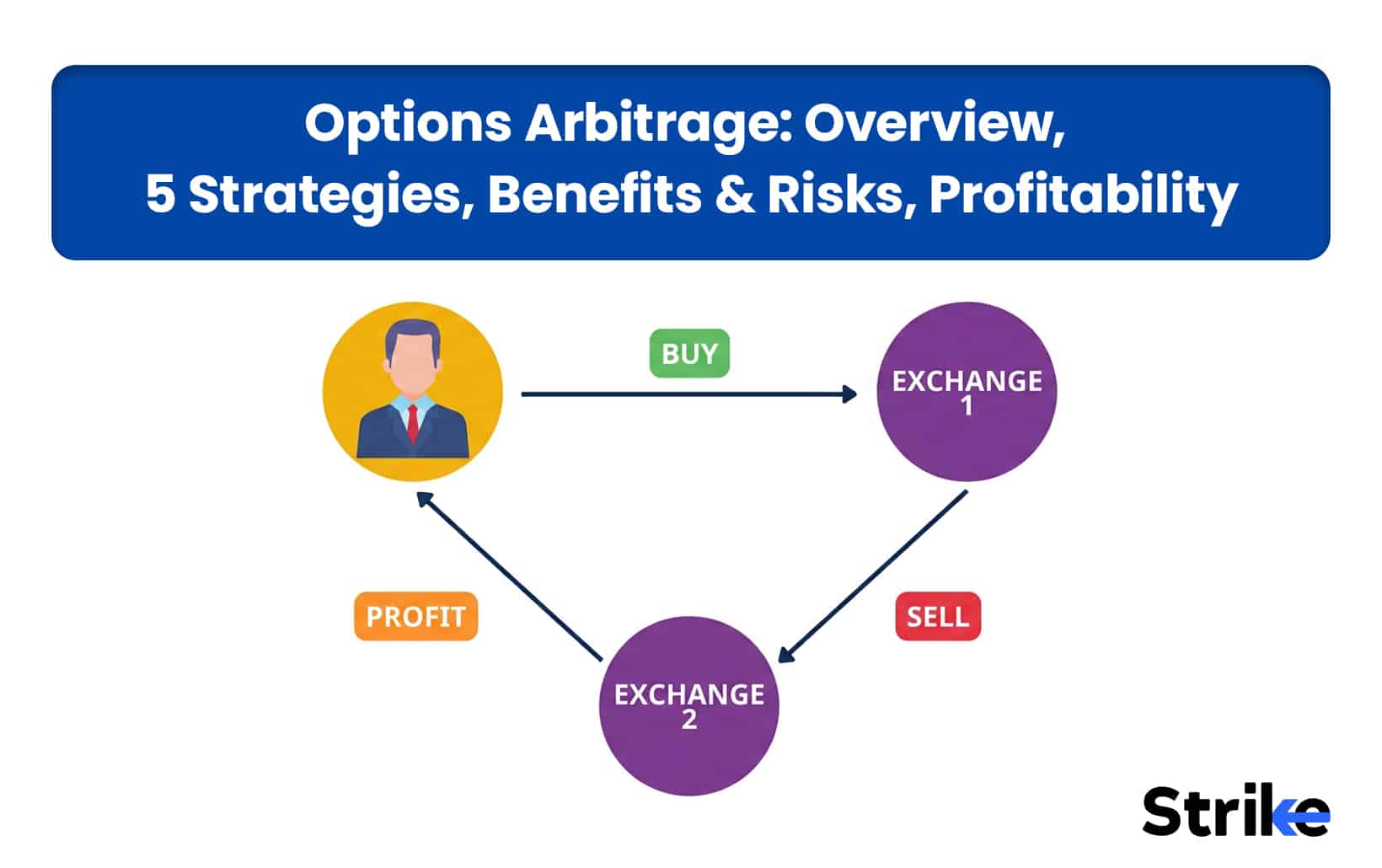
Option arbitrage is one of the popular strategies amongst professionals and institutions because it offers a low risk trading opportunity that arises from the temporary market inefficiencies. Option arbitrage was in use since development of modern option pricing models in the early 1970s, particularly after the introduction of the Black-Scholes model in 1973.
Such opportunities are often short-lived, but provide valuable insights into how options are priced and how markets function. Understanding option arbitrage can help traders explore advanced trading concepts and develop a deeper perspective on options trading.
What Is Options Arbitrage?
Option arbitrage is a trading strategy where traders try to make profit from mispricing between related option contracts or between the option and the actual stock/index. This strategy is considered to be the risk-free or very low risk trading strategy because it focuses on trading mathematical imbalance which sooner or later gets balanced.
Basically, it involves buying the underpriced side and selling the overpriced side to lock in the guaranteed profit with zero or minimal net risk. This strategy is mostly traded by professionals, institutions, and market makers through algorithms because the opportunities last only for a few seconds or minutes.
Why Does Options Arbitrage Exist?
Opinion arbitrage exists because financial markets are not always perfectly efficient. Even though the option pricing is derived from mathematical models, the market move is driven by human emotions, demand and supply, sudden news, volatility spikes, and liquidity differences.
Due to this, option prices can temporarily move away from their “fair value,” creating arbitrage opportunities.
What are the Best Options Arbitrage Strategies?
There are three best option arbitrage strategies which include put-call parity arbitrage, strike arbitrage, calendar arbitrage, box spread, and volatility arbitrage.
1.Put‑Call Parity Arbitrage
Put-call parity arbitrage strategy involves taking the advantage of temporary breakdown in a Put-call parity relation. Put-call parity is a fundamental option pricing law that defines the mathematical relationship between call options, put options, the underlying stock price, strike price, interest rate, and time to expiry.
For European option on non-dividend paying stocks, the relation is given below
C−P = S−PV(K)
Where:
- CCC = Call option price
- PPP = Put option price
- SSS = Current stock price
- PV(K)PV(K)PV(K) = Present value of strike price
According to this law, if two portfolios have the identical payoff at expiry, they should have the same value today. When this equation breaks,the arbitrage opportunity in the market appears.
- C−P > S−PV(K), the call side is overpriced
- C−P < S−PV(K), the call side is underpriced
If this happens, traders buy the cheaper side and sell the overpriced side, and hedge the remaining exposure.
Let’s understand this put-call parity arbitrage using an example.
- Stock price = ₹500
- Strike price = ₹500
- Call option premium = ₹30
- Put option premium = ₹20
- Present value of strike price = ₹492.75
Now calculate both sides:
- Left side = C−P = 30−20 = 10
- Right side = S−PV(K) = 500−492.75 = 7.25
Since, the left side is greater than the right side, the call side is overpriced by ₹2.75, the put-call parity is temporarily broken, creating an arbitrage opportunity.
To trade this arbitrage, execute the trade in a manner discussed below in the table.
| Position | Cash Flow |
|---|---|
| Sell Call | +₹30 |
| Buy Put | -₹20 |
| Buy Stock | -₹500 |
| Borrow Money | +₹492.75 |
| Net Profit Today | +₹2.75 |
After expiry, the payoff becomes zero and the entire profit is locked in at the beginning.
2.Strike Arbitrage
Strike arbitrage option strategy involves identifying the inefficiencies in the pricing of different strike prices of the option having the same expiry. According to basic option pricing logic, the premium of every strike price should move in a structured and systematic way based on the distance from the current market price.
When this system of option pricing breaks due to sudden volatility, liquidity imbalance, aggressive buying or selling, the premium of one strike becomes temporarily overpriced or underpriced relative to another strike. This gives an arbitrage trading opportunity.
Lets understand the strike arbitrage with an example. Consider the stock is trading at ₹1000.
- 1000 CE is trading at ₹48
- 1050 CE is trading at ₹50
This is an abnormal situation because lower call strike should usually have higher premium than the higher call strike due to more intrinsic value, but in this case the higher call strike is more expensive than the lower call strike.
This creates an arbitrage opportunity where traders would buy undervalued 1000 CE and sell overpriced 1050 CE. As soon as option price normalizes, the spread returns to its fair value, allowing traders to earn the difference of ₹2.
3.Calendar (Time) Arbitrage
Calendar arbitrage also known as time arbitrage involves identifying and trading the price inefficiency option of the same strike price but of a different expiry. According to basic option pricing logic, shorter-period options have a low premium compared to longer-period options due to less time value.
When this logic breaks due to volatility changes, liquidity imbalance, or market inefficiencies, the premium of short-term expiry becomes more expensive than the premium of long-term expiry. This creates an arbitrage opportunity.
Let’s understand calendar arbitrage using an example. Suppose the stock is trading at ₹1000.
| Strike | Expiry | Premium |
|---|---|---|
| 1000 CE | Current Month | ₹40 |
| 1000 CE | Next Month | ₹35 |
Here, the current month 1000 CE is expensive compared to next month 1000 CE, which is logically incorrect. Here a trader would arbitrage by selling the current month 1000 CE at ₹40 and buy the 1000CE at ₹35. This will immediately give the trader a credit of ₹5.
4.Box Spread
Box spread is an advanced four legged option arbitrage trading strategy that combines the bull call spread and a bear put spread of the same strike price and expiry to create a risk free payoff chart.
| Leg | Action | Option |
|---|---|---|
| 1 | Buy | Lower Strike Call (K1) |
| 2 | Sell | Higher Strike Call (K2) |
| 3 | Buy | Higher Strike Put (K2) |
| 4 | Sell | Lower Strike Put (K1) |
Now, the payoff of this strategy will be fixed. Suppose if K1 is ₹18,000 and K2 is ₹19,000, the payoff is fixed to ₹1000.
If Market Closes Above ₹19,000
- Bull call spread makes ₹1,000
- Bear put spread expires worthless
Total payoff = ₹1,000
If Market Closes Below ₹18,000
- Bear put spread makes ₹1,000
- Bull call spread expires worthless
Total payoff = ₹1,000
If you can get a chance to create this box spread for ₹990, instead of ₹1000, you get an arbitrage opportunity to lock in the risk free profit of ₹10 at expiry. This strategy works best when options become inefficient across the strike, allowing traders to lock in the profits regardless of the market direction.
5.Volatility Arbitrage
Volatility option arbitrage trading strategy profits from the difference between implied volatility (IV) and realized (actual) volatility of an underlying asset. In this strategy, traders bet on mispricing of markets’ future expected volatility, instead of direction.
- IV > Expected RV = Options are overpriced = Sell Volatility
- IV < Expected RV = Options are underpriced = Buy Volatility
As volatility arbitrage is a non-directional strategy, traders buy or sell the underlying asset or futures based on delta to hedge the position. As underlying price shifts these hedges are continuously shifted.
Lets understand volatility arbitrage using simple examples. Supposed a stock is trading at ₹100 before its result. The market expects a very big move after the result, so premium becomes expensive.
A call option is trading at ₹10 due to high volatility, but as per your analysis the stock will move gradually, so you consider ₹10 overly priced and sell the call option. To reduce the risk from sudden rise in stock price, hedge your positions by buying shares or futures.
After results the stock moved gradually as expected, the volatility fell and option premium drops sharply from ₹10 to ₹4. Hence the profit will be ₹6.
Who Can Execute Options Arbitrage?
Option arbitrage can be executed by both retailers and institutions technically, but practically the pure option arbitrage is only done by professionals or institutions because it requires high speed algorithms, automated trading systems, low-latency execution, co-location servers, and lower transaction costs. This gives institutions the advantage to execute trade within millisecond before price inefficiency disappears.
Retail traders on the other hand can execute basic option arbitrage strategies like calendar spread and strike arbitrage, but they face major limitations like higher brokerage, wider bid-ask spreads, slower execution, margin requirements, and slippage.
How to Identify Arbitrage Opportunities
Option arbitrage opportunities can be identified when the options contracts temporarily violate the basic pricing rules. There are five major ways to identify option arbitrage opportunities, which are briefly discussed below.
- Put-Call Parity Violation: When the mathematical Put-Call relationship between call options, put options, stock price, and strike price breaks temporarily, it suggests an inefficiency. This disruption in the Put-Call parity indicates a moment where the pricing equilibrium between these financial instruments has shifted.
- Strike Price Mispricing: When higher Strike Price call options trade at higher premiums than lower Strike Price calls with the same expiry, it indicates that option spreads have become inconsistent. This anomaly suggests a market inefficiency where the pricing relative to each Strike Price has deviated from historical norms.
- Calendar Mispricing: Calendar Mispricing occurs when longer-expiry options trade cheaper than shorter-expiry options despite having higher time value. Identifying such instances of Calendar Mispricing allows traders to capitalize on temporal inconsistencies in option premiums across different expiration dates.
- Volatility Mispricing: When implied volatility becomes excessively high or low compared to expected future volatility.
- Box Spread Mispricing: Box Spread Mispricing is evident when the cost of creating a box spread differs significantly from its guaranteed payoff at expiry. Traders who spot this Box Spread Mispricing can potentially secure a risk-free profit by exploiting the gap between the spread’s cost and its final value.
Hence, option arbitrage opportunities are short lived and between me in class short list required time to accuracy and work transaction cost speed, accuracy, and low transaction costs to take advantage of these opportunities before they disappear.
What are the Benefits of Options Arbitrage?
There are five major benefits of option arbitrage which include low directional risk, consistent profits, high probability, and improved market efficiency.
- Lower Directional Risk: Option arbitrage strategy focuses on trading the option premium inefficiency rather than direction of the market. Hence it does not matter where price moves.
- Consistent Profit Potential: As option arbitrage strategy focuses on capturing small but regular efficiencies, this strategy is more focused on consistency rather than relying on large market moves.
- High Probability Setup: As option arbitrage strategy is based on mathematical pricing relationship, it provides high probability compared to traditional direction option trading strategy.
- Improves Market Efficiency: Arbitrage traders help correct pricing imbalances in the market, which ultimately keeps option pricing more efficient and aligned with theoretical values.
Although arbitrage is theoretically considered low-risk, real-world factors like brokerage, slippage, liquidity, and execution delays can still affect profitability.
What are the Risks and Costs of Options Arbitrage?
Option arbitrage looks risk free only theoretically, but in the real market it has practical costs and hidden risk that can affect the profitability and execution. Let’s discuss four major risks and costs of option arbitrage briefly.
- Execution Cost and Slippage: As most of the option arbitrage trade involves execution of multiple legs simultaneously, even a small delay in execution can change option premium and reduce the expected spread. If trade executes at a price different than expected price, a slippage occurs. Slippage occurs due to rapid market movement or low liquidity.
For instance, if the traders found ₹5 arbitrage opportunity, but trade execution got delayed and he lost ₹2 – ₹3 as slippage, he will no longer be profitable.
- Early Exercise Risk (American Options): American type option contracts can be exercised any time before expiry, which creates trouble for option sellers who have planned arbitrage trade to hold till expiry. This risk is more common in deep in-the-money options, dividend-paying stocks,contracts close to expiry.
- Margin Requirements and Capital Tie-Up: Although the option arbitrage is a risk-free or low risk strategy, the brokers still require high margin to execute multilegged option selling trades. Strategies like box spread, conversion arbitrage, and reverse arbitrage often block significant amounts of capital due to SPAN and exposure margin requirements. This reduces ROI and blocks major capital just for a small profit.
- Interest Rate and Dividend Assumptions: Many options strategies are based on theoretical pricing relationships such as put-call parity. Since the options are priced based on assumptions about interest rates and stock dividends. If interest rates or dividends suddenly change, it can change the pricing relationship between options and its underlying, reducing your arbitrage profits.
Academic research consistently shows that once transaction costs, slippage, and margin requirements are factored in, most theoretical options arbitrage opportunities disappear before they can be profitably executed.
Is Options Arbitrage Profitable?
Yes options arbitrage is a profitable option strategy, but the profits in this strategy is usually less and heavily depends on execution speed, capital, and transaction costs. These profits are only captured by institutional traders, market makers, and hedge funds who use high frequency trading.
A research by Singapore management university on option market makers found that professional market makers make profits on nearly 74% of trading days while maintaining high risk-adjusted returns. For retail traders brokerage, slippage, bid-ask spreads, and slower execution often eliminate the small theoretical profit.
What are the Alternatives to Arbitrage Strategies?
There are five alternatives to arbitrage strategy. This alternatives are directional trading, spread trading, covered call, cash-secured put and iron condor.
- Directional Trading: Buying and selling of stocks, futures or options based on their expected market direction. Traders make profit when price moves in their favour.
- Spread Trading: Trading the price difference between related options and its security by simultaneously buying and selling them, to profit from changes in their price relationship while reducing directional risk.
- Covered Call: A Covered Call involves selling a call option against a share that you already hold to collect a premium as a profit during sideways to mildly bullish markets. By utilizing a Covered Call strategy, an investor can enhance their overall returns while potentially offsetting small price declines in the underlying stock.
- Cash-Secured Put: Selling the option while having cash to buy the shares at lower price if assigned.
- Iron Condor: In an Iron Condor, traders sell ATM calls and put options while buying further OTM options to profit from a sideways market with limited risk. This Iron Condor strategy is ideal for range-bound environments where the goal is to capture time decay while maintaining a defined maximum loss.
These strategies generally involve higher risk and greater dependence on market movement compared to arbitrage, which aims to profit from pricing inefficiencies.
 47 mins