Trend Trading: Overview, Indicators, Strategies, Timeframe, Risk Management

 Author

 Editor
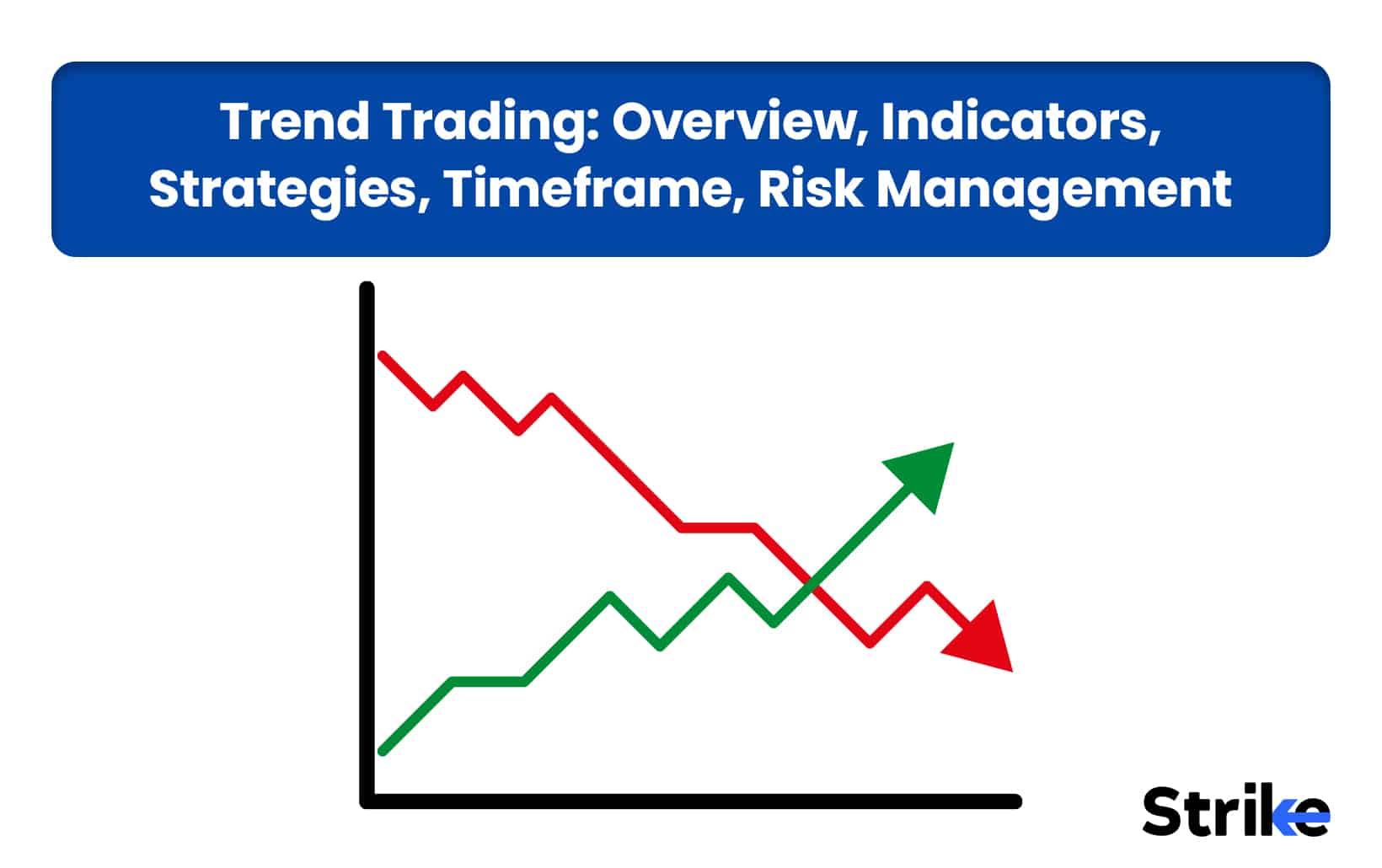
Trend trading is one of most widely followed trading methods because financial markets often move in directional phases driven by momentum and investor psychology. Trend trading works on the simple principle “trend is your friend” which means trading in the direction of trend is more beneficial instead of fighting them.
Many traders fail in trading not because of poor analysis, but because trading against the broader trend. Whether you apply trend trading in short-term or long-term investing, understanding market trends helps simplify decision-making and reduce emotional training. Whether you apply trend trading in short-term or long-term investing.
What is Trend Trading?
Trend trading is a style of trading where traders align their trade along with the main trend of the market and stay in the trade until the trend reverses. This style of trading increases the probability of winning and has a great risk-reward ratio.
How Trend Trading Works?
Trend trading works by identifying the direction and the strength of the trend and positioning the trade in the same direction after breakout or pullback.
- Uptrend: In an uptrend, traders plan to enter long after pullback or a bullish breakout and stay in the trade until trend reverses to bearish.
- Downtrend: In a downtrend, traders plan to enter short after pullback or a bearish breakout and stay in the trade until the trend reverses to bullish.
To identify the trend of the market, traders often use dow theory concepts (higher highs/lows and lower highs/lows) or trend following indicators like moving averages (price trading above or below moving averages).
Key Principles of Trend Trading
There are five core principles for trend trading that helps traders to avoid unnecessary trade during uncertain markets.
- Trend is Your Friend: It is the most important and commonly used phrase in trend trading. Always align your trade with the dominant (primary) trend of the market until there is a clear sign of reversal. Trading with the dominant trend will dramatically improve your odds of winning.
- Use Pullbacks and Breakout to Enter: Avoid entering randomly anywhere just because the market is trending. Enter only at pullbacks in a trending market or after a break of any trend continuation chart pattern. Use tools like fibonacci retracement, moving averages or trendline to identify potential pullback level to enter the trade.
- Use Stop-loss and Risk Management: Although trend trading has more odds of winning, it is important to use stop-loss and proper position sizing to control the risk from sudden trend reversals. Stoploss can be placed beyond swing points or beyond moving averages. Try to keep your risk per trade within 1-2% of your entire capital.
- Let Profit Run and Cut the Loss Early: It is the most important psychological part of trend trading. Cut your losses immediately once it hits your stop-loss, but stay in the trade until the trend reverses. This will maximize your gain and improve your risk-reward ratio. By following this principle, you will be a profitable trader even though your winrate is 40%.
- Use Confirmation Tools: The odds of winning increases even further when the trend is confirmed with indicators like volume, moving averages, RSI, MACD, etc. For instance, if the stock price is rising along with good volume, it signals a strong trend supported by institutions.
In trend trading, the biggest profits often come not from predicting reversals, but from patiently riding a strong trend with discipline and proper risk management.
Types of Market Trends
There are three major types of market trends based on buyers and sellers activity. These types are uptrend, downtrend, and sideways trend.
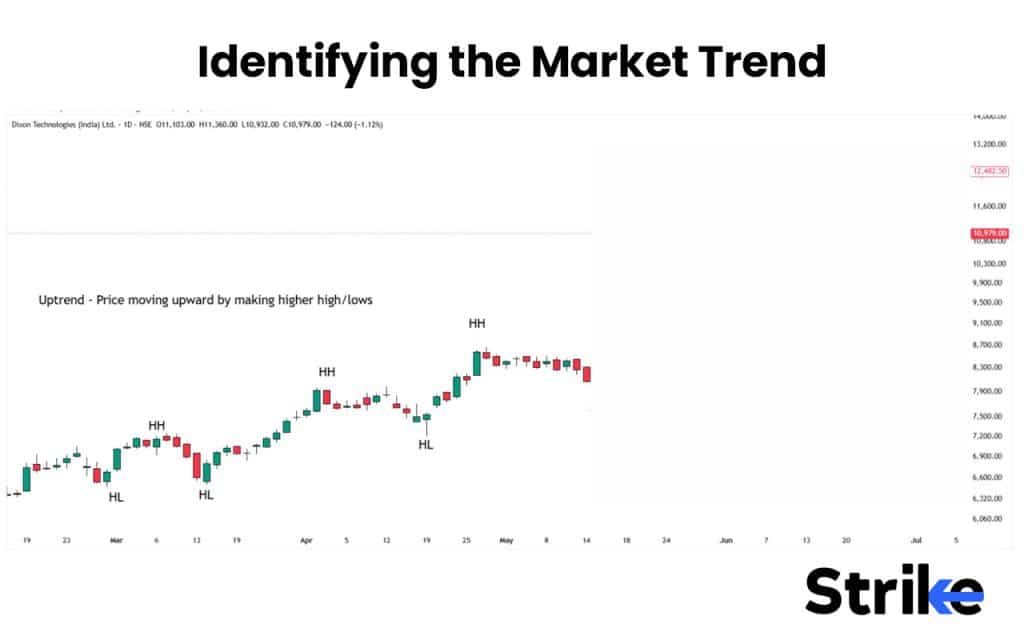
- Uptrend: When the price moves upward by making a series of higher highs and higher lows, the market is considered to be in uptrend. Uptrend suggests that the buyers are in control where demand is taking over on supply. During this phase each pullback finds support higher than the previous one. Traders usually buy during these pullbacks in strong uptrend.
- Downtrend: When the price moves downward by making a series of lower highs and lower lows, the market is considered to be in downtrend. Downtrend suggests that the sellers are in control where supply is taking over on demand. During this phase each pullback finds resistance lower than the previous one. Traders usually sell during these pullbacks in strong downtrend.
- Sideways: When the price does not move upward or downward, but stays within the tight range, the market is considered to be in the sideways or consolidation range. During this phase neither buyers nor sellers are dominant which results in no clear direction in the market. Trend traders should avoid this phase of the market but should keep watching this range because breakout of this range often gives trending moves.
Understanding these market trends is essential for trend traders because identifying the prevailing market direction helps in selecting higher-probability trading opportunities and avoiding trades against momentum.
What Indicators are Used for Trend Trading?
There are five major indicators commonly used in trend trading to identify trend, momentum, and volatility. These indicators are moving average, relative strength index, bollinger bands, average direction range, and parabolic SAR.
1. Moving Averages (MA)
Moving averages are the most commonly used indicator for trend identification, because it smooths out the price fluctuation by calculating its average price and plots a smooth average price line.
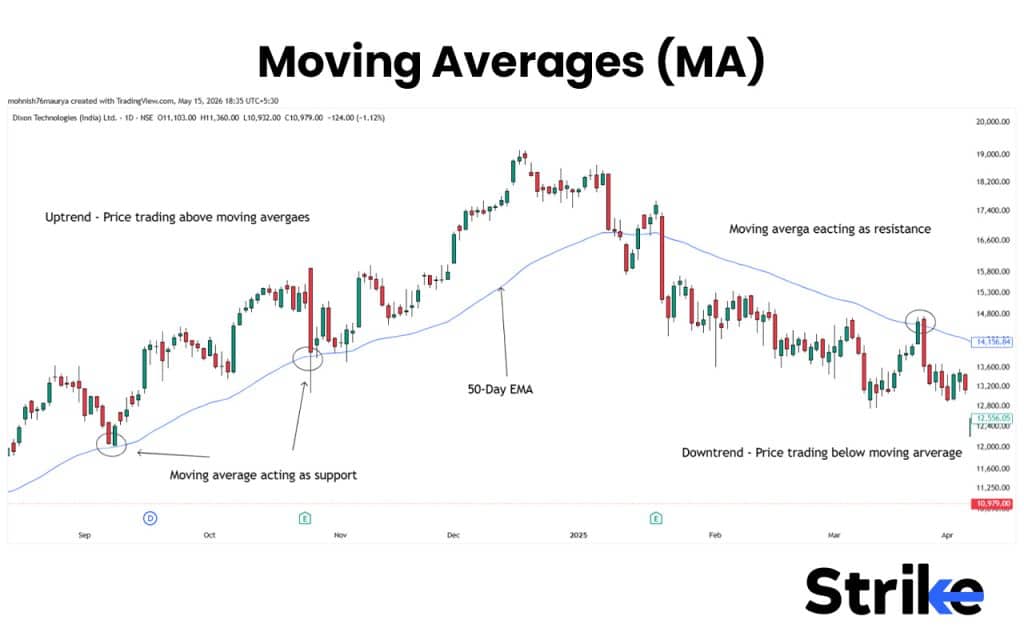
- Uptrend: When the market trades above moving average, it suggests uptrend.
- Downtrend: When market trades below moving average, it suggests downtrend.
- Sideways: When the market keeps trading around the moving average, it suggests a sideways trend.
The moving average used in trend identification can be simple moving average (SMA), exponential moving average (EMA), or weighted moving average (WMA).
However, to identify the market trend on different time frames, the same moving average won’t work. You will need a different period moving average for different trends in the market which are briefly mentioned below in the table.
| MA Period | Usage |
|---|---|
| 20-day MA | Identifies short-term trend and pullback entry opportunities |
| 50-day MA | Helps determine the intermediate trend direction |
| 100-day MA | Used for medium- to long-term trend analysis |
| 200-day MA | Acts as the dominant long-term trend filter |
Trend traders enter the trade after price pulls back to the moving average in a trending market and forms a reversal pattern or when price forms trend continuation pattern in the direction of the trade.
2. Relative Strength Index (RSI)
Relative Strength Index (RSI) is a strength indicator which helps traders not only to identify trends of the market but also the strength and magnitude of the price move. RSI measures speed and magnitude of price between the oscillating scale of 0 to 100, where each level shows different market conditions.
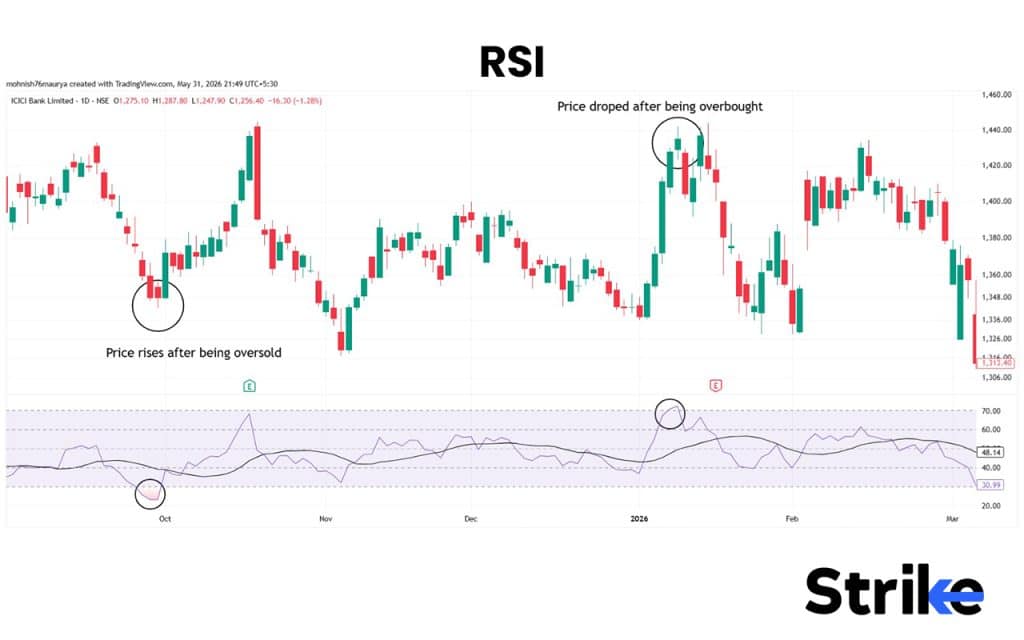
- RSI above 50: It suggests a bullish trend strength in the market
- RSI below 50: It suggests a bearish trend strength in the market.
- RSI above 70: It suggests either a very strong bullish momentum or overbought condition
- RSI below 30: It suggests either a very strong bearish momentum or oversold condition
In a strong bullish trend, RSI stays above 50, where RSI level 40 to 50 acts as a buying zone for trend traders. Whereas, in a strong bearish trend, RSI stays below 50, where RSI 50 to 60 acts as a selling zone.
3. Bollinger Bands
Bollinger band is a volatility indicator that calculates the volatility of assets based on standard deviation and shows the market trend driven by volatility. The standard deviation used in bollinger band is +2 and -2 SD of 20-period moving average of the price.
So, the bollinger band as an indicator consists of three major components, which is the 20-period moving average, upper bollinger band (+2 SD) and lower bollinger band (-2SD). Price moving within this band suggests a different phase of the market.
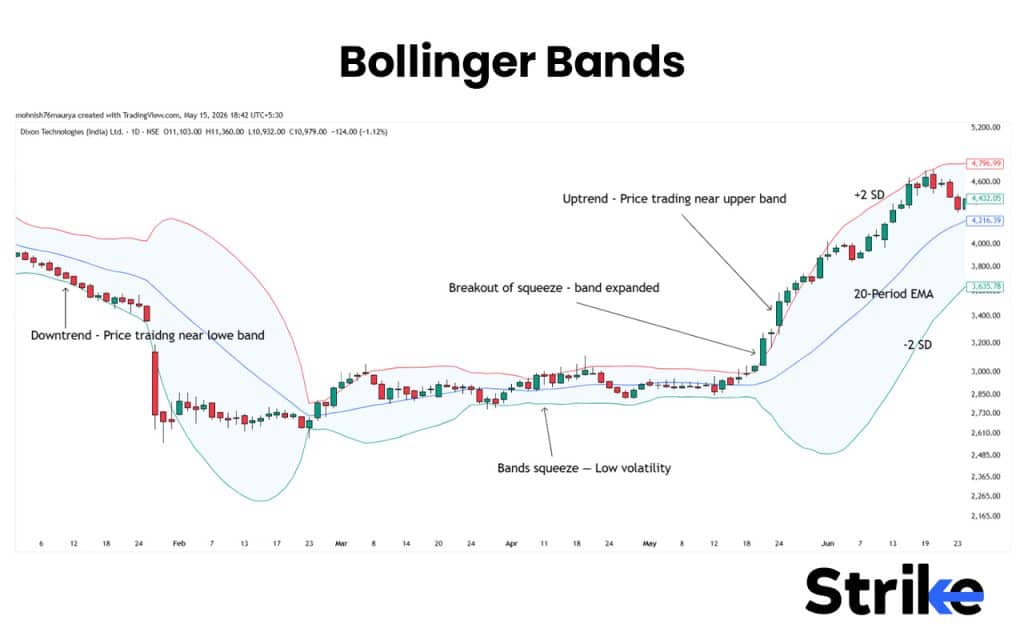
- Uptrend: When price rises along with the upper bollinger band, it suggests a very strong upward trend.
- Downtrend: When price drops along with lower bollinger band, it suggests a very strong downward trend.
- Bands squeeze (narrow): When volatility starts dropping, upper band (+2 SD) and lower band (-2 SD) starts coming closer and band becomes narrow. This shows that the market is currently taking pause and preparing for the next volatile trending move.
- Bands expand (widen): When price breaks the narrow range of bollinger band, the volatility expands and bands start widening. This band expansion leads to a strong volatile trending move.
The middle band in bollinger band often acts as dynamic support and resistance, which traders closely watch to plan their pullback entry. In a trending market, when price moves towards the middle band after touching the upper or lower band, it signals potential entry points for traders.
4. Average Directional Index (ADX)
Average directional index (ADX) measures the strength of the trend, whether the market is trending or sideways. However, unlike the other trend following indicator, ADX does not tell the direction of the trend. ADX values higher than 20 are generally considered a trending market.
Although ADX only tells us the strength of the trend, but does not tell the direction, the trend can be determined by Directional Movement Indicators (DMI) which comes along with ADX.
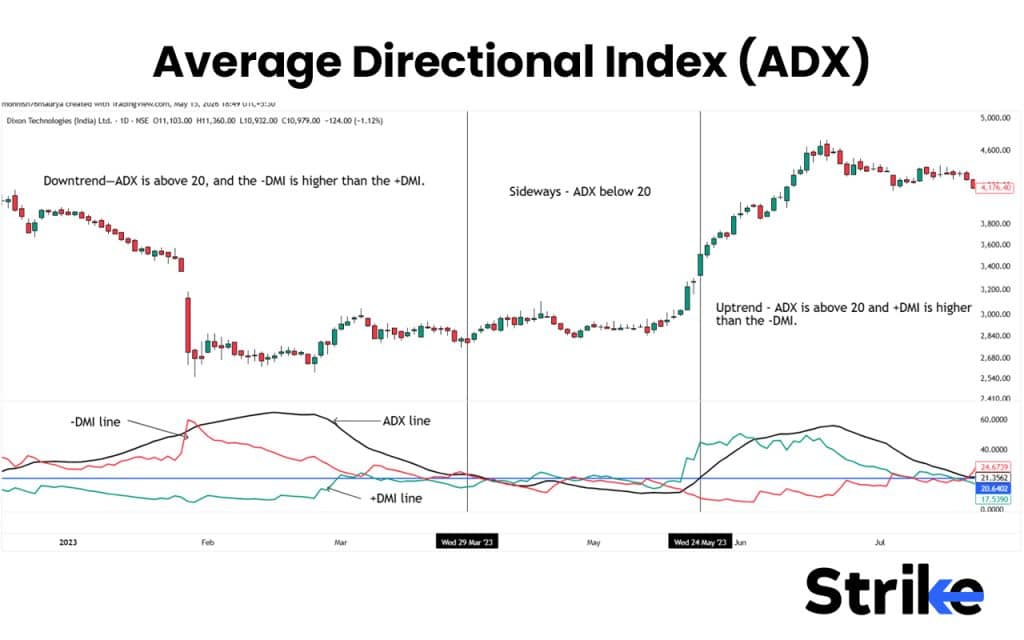
- Uptrend: When +DMI line is greater than -DMI line and ADX is above 20, it suggests a strong uptrend.
- Downtrend: When the +DMI is lower than the -DMI and ADX is below 20, it suggests a strong downtrend.
- Sideways Trend: When the ADX is below 20, it signals a sideways market.
The different values of ADX signals different strengths in the trend of the market. The table given below briefly explains the market trends based on different ADX values.
| ADX Value | Trend Strength Interpretation |
|---|---|
| Below 20 | The market is weak or moving sideways with no clear trend. |
| 20 – 25 | A trend may be developing, so traders should watch closely. |
| 25 – 50 | The market is in a strong trend and suitable for trend trading. |
| 50 – 75 | The trend is very strong with high momentum. |
| Above 75 | The trend is extremely strong and may approach exhaustion. |
Many traders consider ADX value should be more than 25 to signal a strong trending market.
5. Parabolic SAR
Parabolic SAR indicator plots dots above and below the price chart which keeps moving along with price. Movement of these dots allows traders to identify the trend of the market and trend reversals in the market.
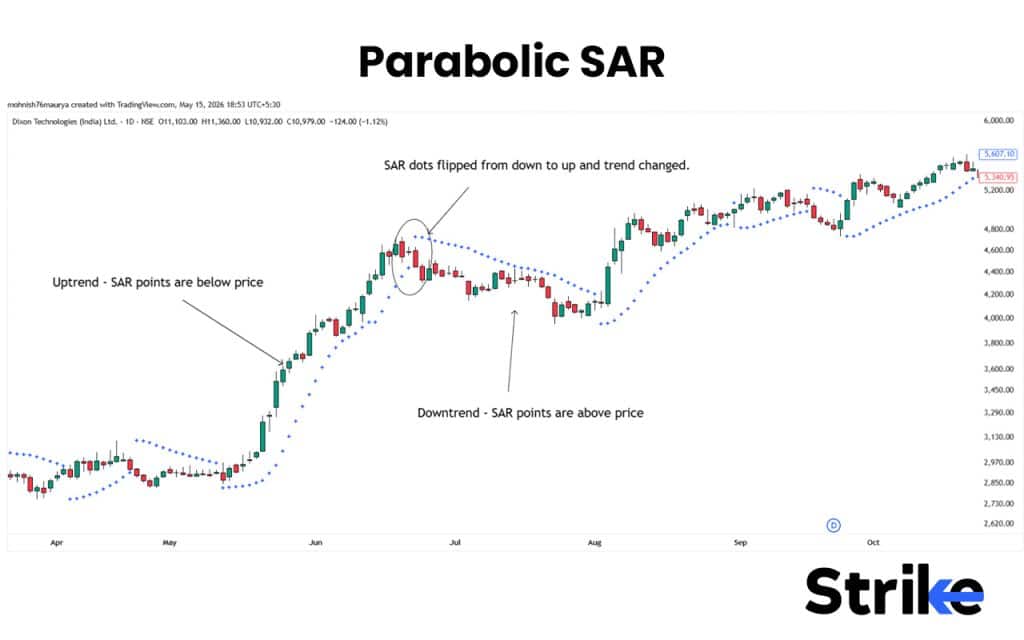
- Dots Below Price: If the parabolic SAR dots are forming below the price, it suggests uptrend.
- Dots Above Price: If the parabolic SAR dots are forming above the price, it suggests downtrend.
- Dots Flip from Up to Down: It indicates a potential change in trend from downtrend to uptrend, where trades can create new long positions or cover the short position.
- Dots Flip from Down to Up: It indicates a potential change in trend from uptrend to downtrend, where traders can create short positions or exit the long trade.
Like many other Trading indicators, the parabolic SAR reveals momentum shifts; if the gaps between dots are larger, it means the market is moving with a strong momentum. Traders also rely on these Trading indicators to set trailing stop-loss levels, allowing them to lock in profits as the trend progresses.
Popular Trend Trading Strategies
There are many trend trading strategies available in the market but the five major trend trading strategies are briefly discussed below.
1. Moving Average Crossover Strategy
Moving average crossover strategy is one of the simplest trend trading strategies which involves the use of two moving averages of different periods, a short period moving average and a long period moving average.
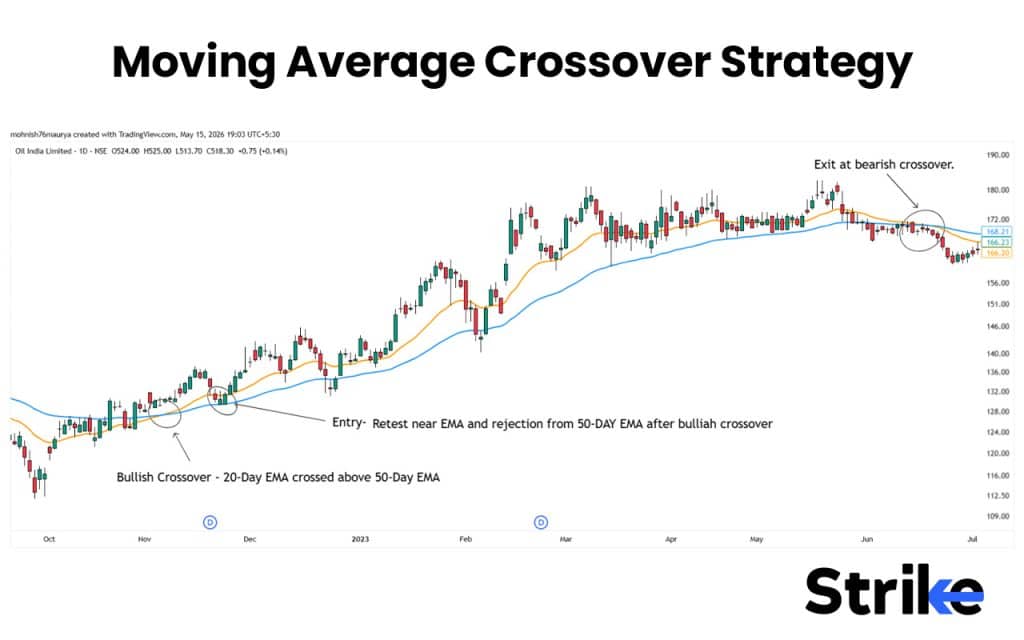
- Long Trade: When the short-term moving average crosses above long-term moving average, it generates bullish crossover signals and suggests a potential start of the uptrend.
- Short Trade: When the short-term moving average crosses below the long-term moving average, it generates bearish crossover signals and suggests a potential start of a bearish trend.
Enter the long position or short position based on crossover and aim to ride the trend until it reverses or gives opposite side crossover. The stop-loss is typically placed beyond the swing points.
Given below in the table is a common moving average pair suitable for different trading style.
| Moving Average Pair | Timeframe | Best Suitable For |
|---|---|---|
| 9 EMA / 21 EMA | Short-term | Best suited for intraday traders and short-term swing traders looking for quick trend changes. |
| 20 EMA / 50 EMA | Medium-term | Commonly used by swing traders to identify medium-term trend direction and pullbacks. |
| 50 SMA / 200 SMA | Long-term | Mostly used by positional traders and long-term investors to identify major market trends. |
| 10 EMA / 30 EMA | Medium-short term | Suitable for active swing traders who want faster trend signals with moderate confirmation. |
Although the Moving Average Crossover is simple and easy to use, it is lagging in nature and often triggers after the trend has already started. This lag means a Moving Average Crossover can generate false signals in sideways markets, requiring traders to seek additional confirmation.
2. Breakout Strategy
Breakout strategy involves trading a breakout of consolidation or chart patterns in order to make profit from the trending move after the breakout. This trending move after the breakout is generally fueled by institutional participation.
- Long Trade: When price breaks above the resistance of the consolidation pattern or any bullish chart pattern, it mostly leads to strong trending moves to the upside.
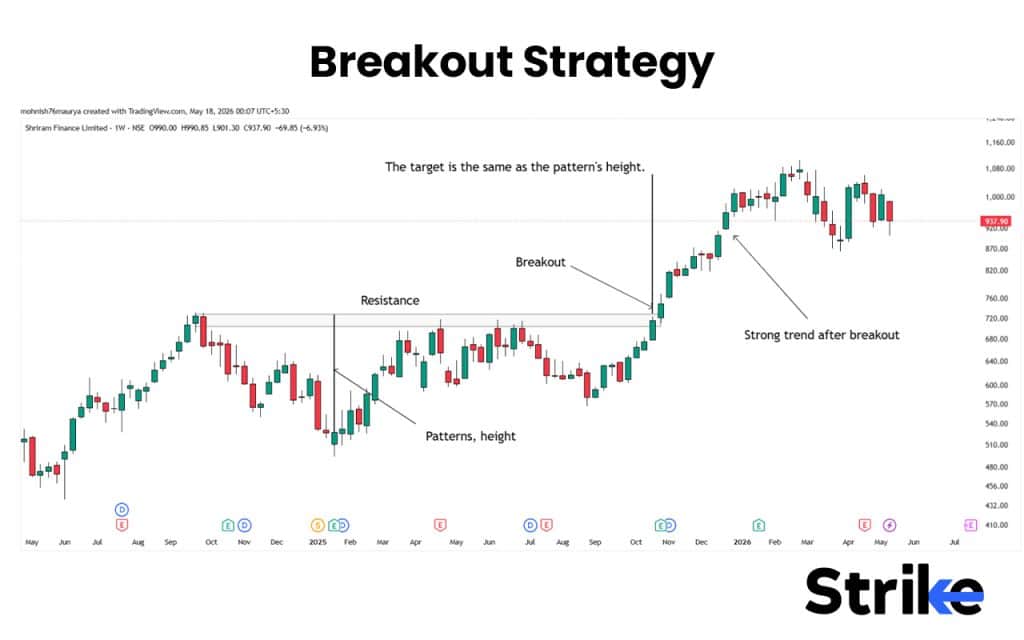
- Short Trade: When price breaks above the support of the consolidation pattern or any bearish chart pattern, it mostly leads to strong trending moves to the downside.
Enter the trade in the direction of breakout with the stop-loss just below the recent swing low and look for a target based on the measured height method. However, it is important to check whether the breakout is genuine or fake. A breakout with high volume is typically genuine.
3. Pullback Strategy
Pullback trading strategy helps you to enter in the trending market at a better price with a small stoploss. In this strategy traders usually wait for price to correct temporarily within the major trend directions and enter after price again starts moving in the main trend.
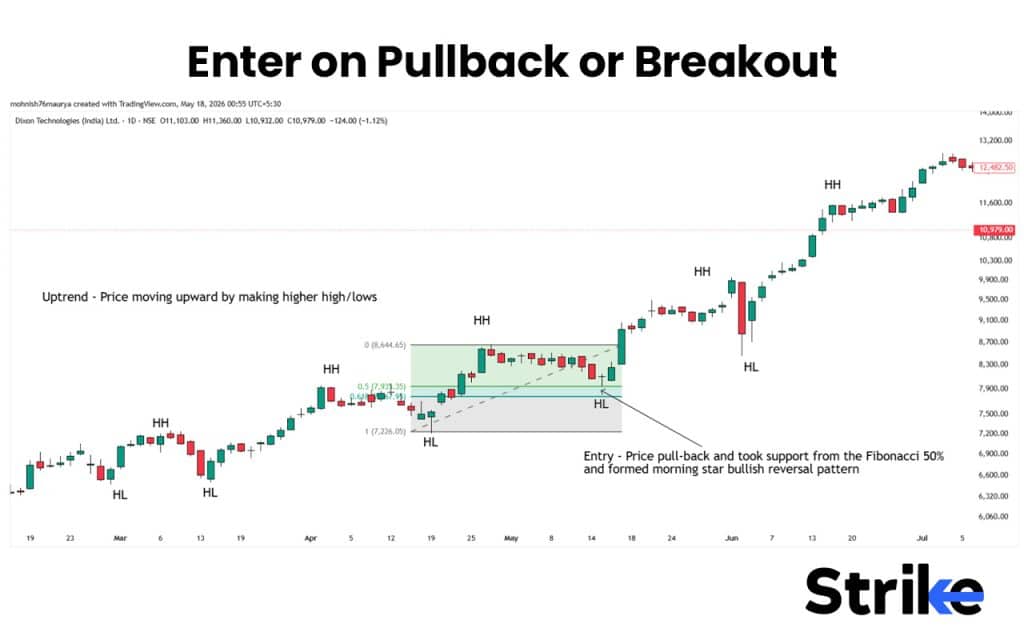
- Long Trade: During uptrend, wait for price to pull back and form a bullish reversal pattern near fibonacci, trendline, or moving average support. Enter the trade once pullback is over and place the stop-loss below swing low.
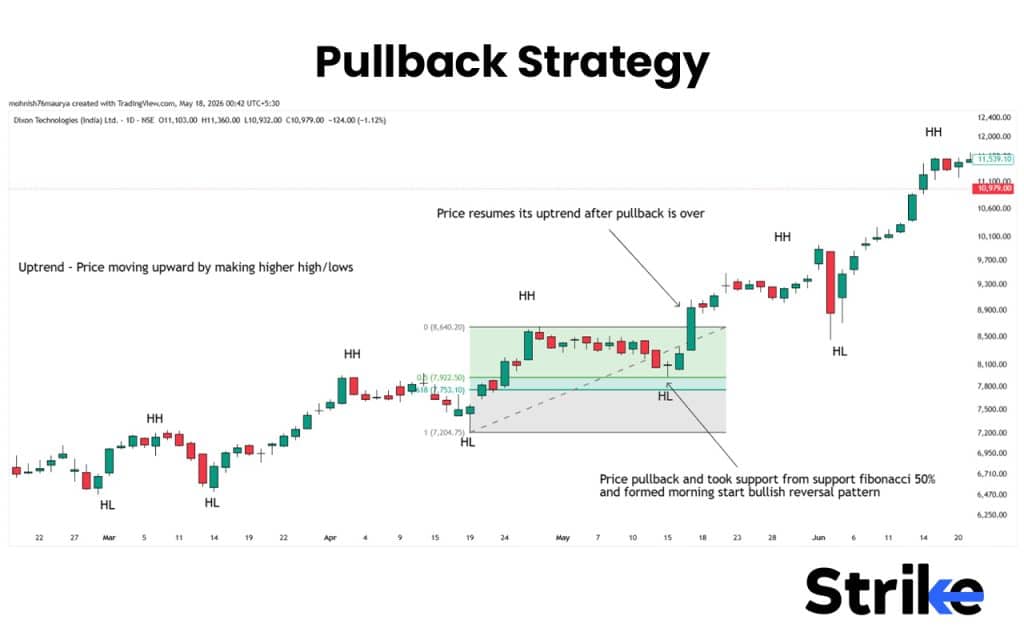
- Short Trade: During downtrend, wait for price to pull back and form a bearish reversal pattern near fibonacci, trendline, or moving average resistance. Enter the trade once pullback is over and place the stop-loss below swing high.
It is important to confirm the pullback before entering the trade. Confirm the pullback using Relative Strength Index, moving averages, Fibonacci retracement, and candlestick patterns.
4. Trendline Bounce
Trendline bounce strategy helps traders to enter a trade in the direction of the market using trendline. Trendline is a dynamic support and resistance that can be drawn by connecting higher lows for uptrend and lower highs for the downtrend. When price reacts to this level, it often bounces back to continue its original trend.
- Long Trade: When price reaches an upward support trendline in an uptrend, enter a long trade after support is being confirmed.
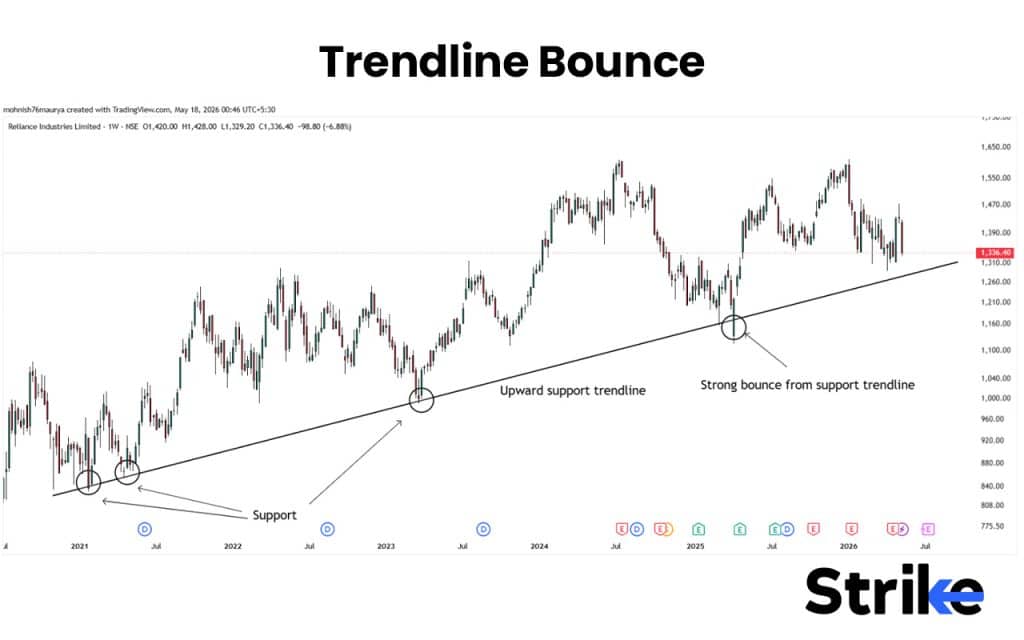
- Short Trade: When price reaches a downward resistance trendline in a downtrend, enter a short trade after resistance is being confirmed.
When the price approaches Trend Lines, it is essential to confirm the bounce using a candlestick pattern, chart pattern, or volume before entering the trade. Validating these Trend Lines with additional technical signals helps traders avoid false breakouts and enter with higher conviction.
How to Enter a Trade using a Trend-following Strategy?
There are four simple steps to enter a trade using a trend following strategy. These steps are briefly discussed below.
- Identifying the Market Trend: First identify the trend of the market to align your trade in the same direction. You can use indicators like moving averages or price action like trendline or dow trend concept to identify market trends.
- Enter on Pullback or Breakout: Enter the trade only when price corrects temporarily within the main trend or price breaks key support or resistance of the pattern in the direction of trend. Pullback entries are more preferable than breakout trading because it gives tight stop loss.
- Place Proper Stop-loss: Place stoploss below swing low in a downtrend and place stoploss above swing high in an uptrend. You can also use ATR 2x to place stoploss based on volatility. Avoid placing very tight stoploss to avoid unnecessary stoploss hunting.
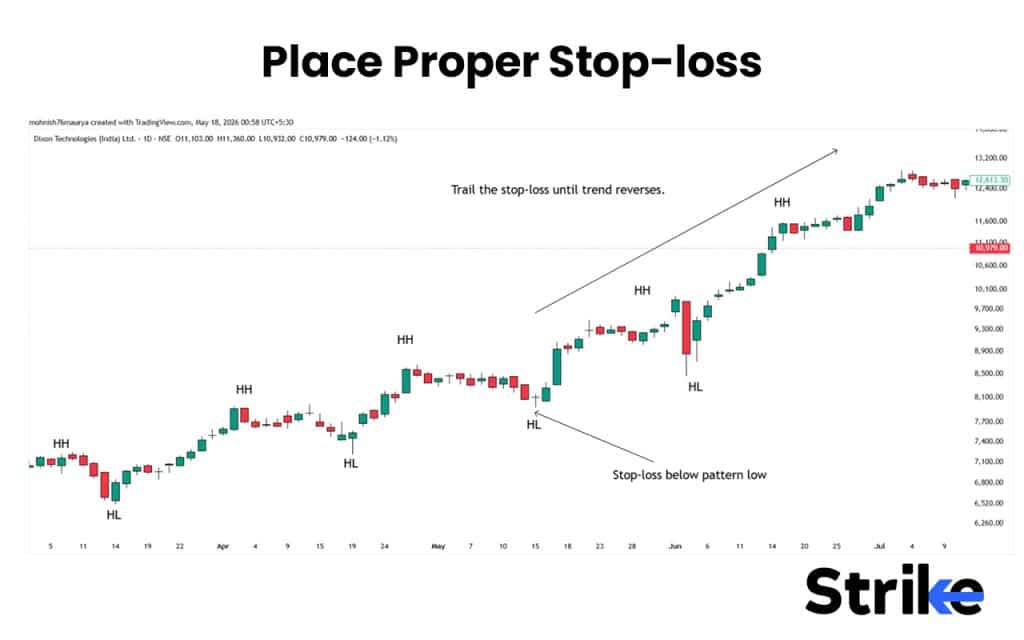
- Decide the Profit Target: In trend trading profit targets are usually trailed until the trend reverses. Profit trailing is typically done by trendlines or indicators like moving averages, supertrend, or parabolic SAR. However, you can also set your profit target to the next key level or 1:2 risk:reward ratio.
Hence, entering in trend trading is not about catching every move, it is about waiting for the right setup, entering at the right price, protecting your capital with a proper stop-loss, and letting the trend do the work.
How to Set a Stop-loss for Trend Trading?
There are five major methods to set stop-loss based on technical parameters. These methods are briefly discussed below.
- Based on Swing Points: It is the most commonly used stop-loss method, where you place your stop-loss beyond swing points. In an uptrend, place the stop-loss below recent swing low and in a downtrend, place the stop-loss above recent swing high.
- Based on Moving Average: Moving averages are popularly used as dynamic support and resistance, apart from trend identification indicator. Price breaking moving average serves as an exit signal. You can also use moving average cross-overs to generate exit signals. However, the setting of moving average cross will defer with the trading style.
- Based on ATR: Average true range (ATR) helps to put stop-loss based on market volatility, so that you don’t get stopped out of trade due to fluctuations. To get the stop-loss level using ATR, multiply the ATR value of the stock with a multiplier (1.5 or 2), this will give you stop-loss distance.
- Based on Trendlines: Trendline helps in determining trend of the market by connecting swing points. Break of trendline signals potential trend reversal where you can plan to exit. If price breaks below support trendline in uptrend, exit the long positions and if price breaks above resistance trendline in an downtrend, exit the short position.
- Based on Percentage: It is not popularly used but few trades put stop-loss based on fixed percentage of price move. This focuses less on technical structure and more on statistical probability.
No single stop-loss method mentioned above is best. The best stop-loss method is one that aligns with your trading style and that you can follow with discipline.
How do Trend Traders Make Money?
Trend traders make money by identifying and capturing the large directional trend of the market with a controlled stop-loss. This allows their winning trades to run until the main trend reverses. When trend traders make profit, they make big profits otherwise they cut the loss immediately once price hits stop-loss or trailing stop-loss.
This creates an asymmetric risk/reward structure, where trend traders will still be in profit even if their win rate is less than 50%. However, doing trend trading requires discipline and patience to ride the entire market trend.
What is the Best Timeframe for Trend Trading?
There is no single timeframe that can be considered best for trend trading, because it entirely depends on your trading style, holding period, and risk tolerance. However, higher time frames such as 4 hrs, daily and weekly are comparatively more reliable due to clear structure and less noise.
| Trading Style | Common Timeframe |
|---|---|
| Short-Term Trend Trading | 1 Hour to 4 Hour |
| Swing Trend Trading | Daily Chart |
| Long-Term Trend Trading | Weekly Chart |
Most traders also use multi-timeframe analysis, where they use a higher timeframe to confirm the market trend and lower timeframe to take entry.
How to Manage Risks in Trend Trading
There are five major ways to manage risk in trend trading which includes use of proper stop-loss, position sizing, diversification, averaging, and use of trailing stop-loss.
- Use Proper Stop-loss: No proper stop-loss will disturb the risk-reward ratio of trend trading. Decide the logical stop-loss before you enter the trade either based on technical levels or indicators like ATR or moving average.
- Position Sizing: Avoid risking more than 2-3% of your capital in a single trade to stay safe from heavy drawdowns. In trend trading, the point is to risk limited and earn big.
- Diversification: Do not allocate an entire or major chunk of the capital in a single stock, sector, or asset class. DIversify the positions across different stocks or sectors to avoid stock or sector specific risk.
- Avoid Adding in Losing Trade: The biggest mistake traders make is to average out the losing trade in hope to make profit when the market recovers. Doing this can wipe out the entire profit made in a strong trend. Hence, strictly follow the stop-loss levels.
- Use Trailing Stop-loss: As stock keeps moving in your direction, keep shifting your stoploss along with it. This helps to secure your profits by the time. You can use trendline, moving averages, or parabolic SAR to trail the stop-loss. However, it is important to exit immediately once trailing stop-loss is hit.
By considering the above mentioned points, you will be able to manage your risk and improve your overall risk reward ratio more efficiently. Prioritizing a healthy risk reward ratio on every trade is the key to maintaining long-term profitability in the financial markets.
What are the Advantages and Disadvantages of Trend Trading?
The advantages and disadvantages of trend trading are briefly discussed below in the table.
| Advantages of Trend Trading | Disadvantages of Trend Trading |
|---|---|
| Helps capture large market moves | Performs poorly in sideways markets |
| Reduces overtrading due to fewer setups | Trend reversals can give back profits |
| Simple and rule-based trading approach | Requires patience and emotional discipline |
| Works well in strong trending markets | Late entries can reduce reward potential |
| Allows favorable risk-reward opportunities | False breakouts can trigger stop-losses |
| Less screen time compared to day trading | Holding overnight carries gap risk |
| Can be used across stocks, forex, and commodities | Strong trends do not occur frequently |
| Trailing stop-loss helps maximize profits | Wide stop-loss may increase holding risk |
Trend trading does not give more frequent trades, but when it does, it can give you a big profit.
Famous Trend Traders & Their Strategy
Richard Dennis, Ed Seykota, and Paul Tudor Jones are some famous trend traders known for extraordinary wealth creation across decades of trading. Let’s briefly discuss them and their strategy, which still continues to influence modern traders.
- Richard Dennis: Also known as the “price of the pit” was a commodity trader and is famous for his strategy “the turtle trading strategy” using which he turned $1,600 into an estimated $200 million over the period of ten years (1970s and 1980s). His turtle trading strategy focuses on break outs, position sizing, and strict risk management. Enter the trade once price breaks important levels and stay in the trade until it reverses.
- Ed Seykota: He is also a commodity trader and one of the most famous and the true pioneers of computerized trend following systems. His trading strategy was based on moving average and computerized models to identify and manage the trades. Using this strategy, he famously turned $5,000 into $15 million which is over 250,000% return. His trading philosophy was simple, cut the losers quickly and let winning trade run.
- Paul Tudor Jones: He is one of the most successful macro traders known for combining macroeconomics data with technical patterns for trade. Unlike Dennis and Seykota who operated in the commodity market, Paul is into stocks, bonds, currencies and commodities as well. Paul famously made over $100 million in profit on black Monday, the day when stock market crashed and Dow Jones fell over 22% in a single day in October 1987.
As we can see, the best stock traders focus heavily on trend capturing with strict risk management and discipline. Studying the strategies used by these best stock traders reveals that consistency and emotional control are just as important as the technical setup itself.
Trend Trading vs Swing Trading vs Day Trading
The difference between trend trading, swing trading, and day trading is briefly discussed below in the table.
| Feature | Trend Trading | Swing Trading | Day Trading |
|---|---|---|---|
| Holding Period | Weeks to months | Days to weeks | Minutes to hours |
| Goal | Capture major trend | Capture short-term swings | Capture intraday moves |
| Trade Frequency | Low | Medium | High |
| Screen Time | Low | Moderate | High |
| Overnight Holding | Yes | Yes | No |
| Stress Level | Low | Medium | High |
| Best Market | Strong trends | Volatile swings | High intraday volatility |
| Common Indicators | EMA, ADX | RSI, MACD | VWAP, EMA, RSI |
It is important to know that neither Swing Trading nor Intraday Trading is universally better; the success of your strategy depends on your discipline and risk management. Whether you prefer the slower pace of Swing Trading or the fast action of Day Trading, consistent execution and protecting your capital are the most vital components of long-term profitability.
 24 mins