Master 15 Volume Indicators for Winning Trading Strategy

 Author

 Editor
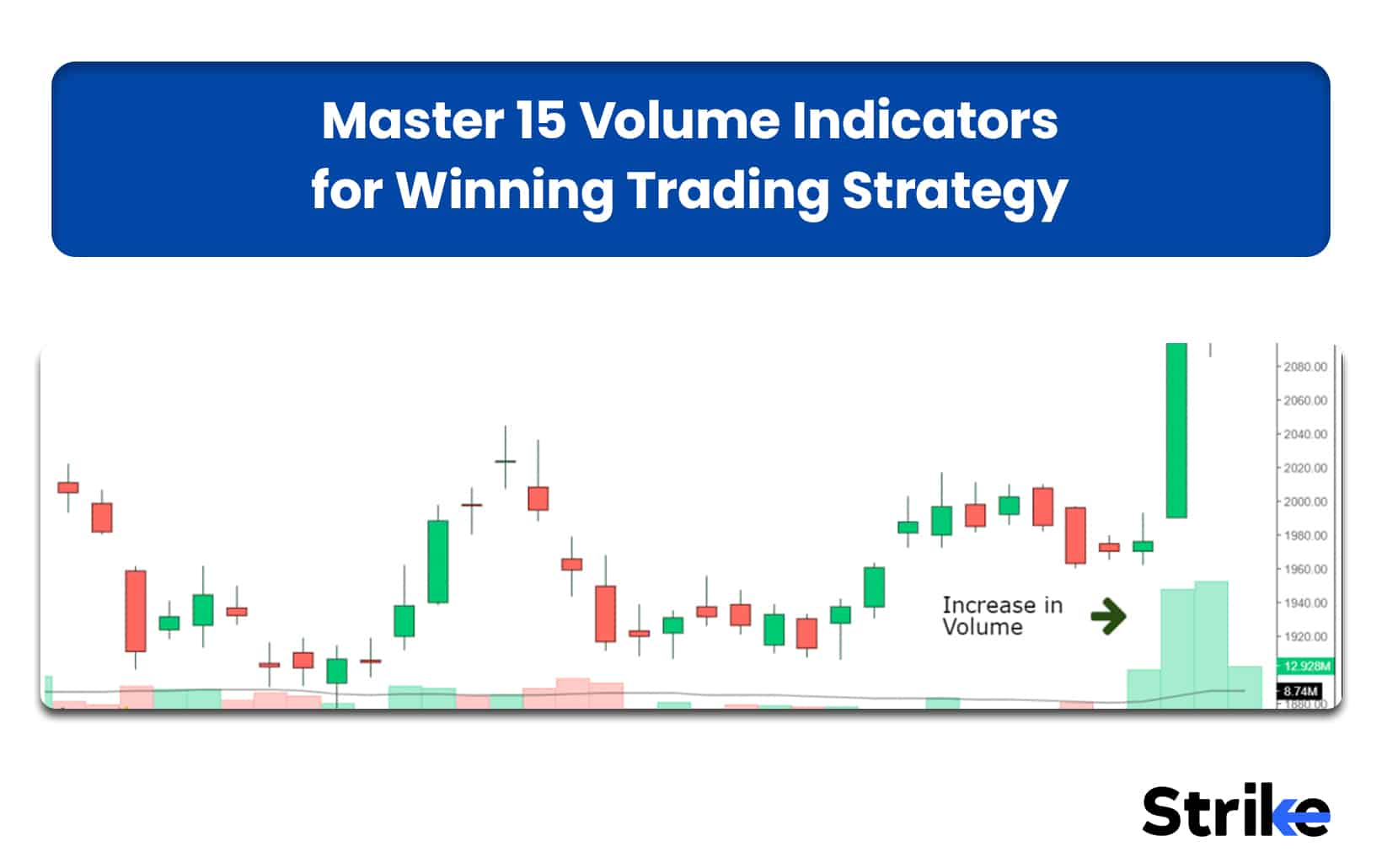
Volume indicators have been used for decades to analyze the strength behind price movements. Volume indicators became widely popular after market analyst Joseph Granville showed how volume can reveal accumulation, distribution, and trend reversals before price movements become obvious. Today, volume analysis remains an important part of technical analysis for traders and investors worldwide.
Volume indicators help traders measure buying and selling pressure by combining price and trading activity. They are widely used for trend confirmation, breakout validation, divergence analysis, and spotting potential reversals. In this blog, we will explore 15 important volume indicators and how traders use them in the market.
1.On-Balance Volume (OBV)
On-Balance Volume (OBV) is a cumulative volume indicator that measures the buying and selling pressure of stock by combining both price and volume. This instantly tells traders whether the volume is supporting the trend or not. OBV was developed by Joseph Granville in the 1960s. OBV indicator works by adding volumes of bullish days and subtracting volumes of bearish days.
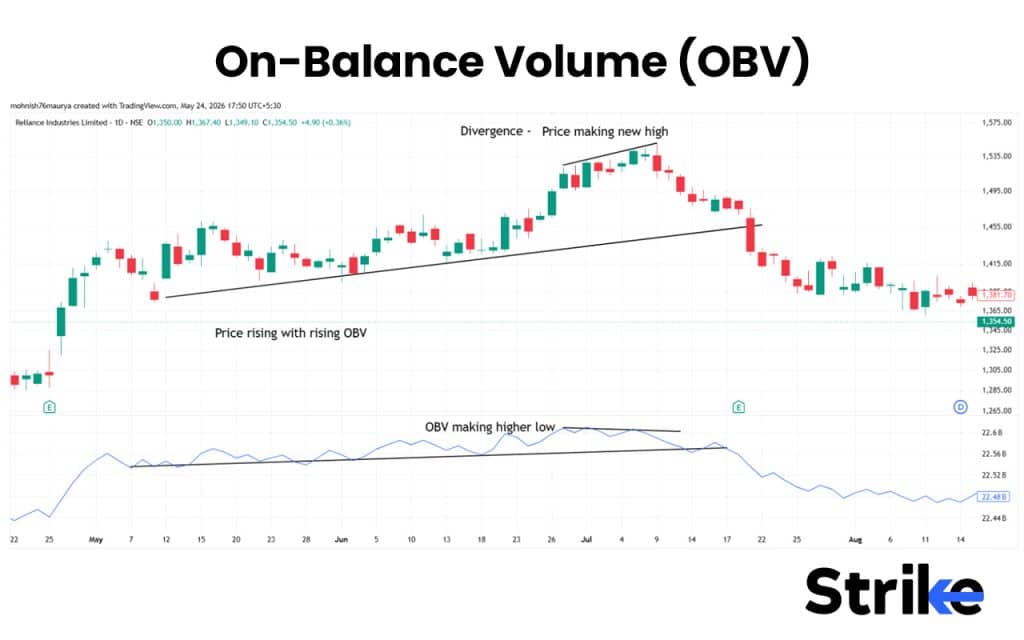
Traders use OBV mainly for trend confirmation, to spot divergence, and to confirm breakout.
- Trend Continuation: When OBV indicator rises along with the price, it confirms a bullish trend driven by a strong participation. Whereas falling OBV along with price confirms the bearish trend.
- Divergence: When price and OBV indicator both move in opposite directions, it forms a divergence which signals weakening and a possible reversal of ongoing trend. For instance, if the price makes a new high but OBV indicator makes a lower high, it signals weakening of bullish momentum and a potential trend change coming soon.
- To Confirm Breakout: When OBV increases after a breakout, it confirms the breakout, whereas when OBV falls after a breakdown, it confirms the breakdown. If breakout happens without support OBV, it’s likely a fakeout.
It is important to know that the absolute value of the indicator does not matter, it’s only the direction. OBV can mislead in the sideways and low volume market.
2.Money Flow Index (MFI):
MFI is also known as volume-weighted RSI is a momentum indicator that measures the buying and selling pressure by combining both price and volume. MFI rises when money flows in and MFI falls when selling pressure increases. Unlike RSI which only uses prices, MFI uses price and volume both to give more reliable signals.
Just like RSI, MFI also moves between 0 and 100. MFI above 80 suggest overbought condition and MFI below 20 suggest oversold condition. Prices coming out of those areas can offer reversal trade opportunities.
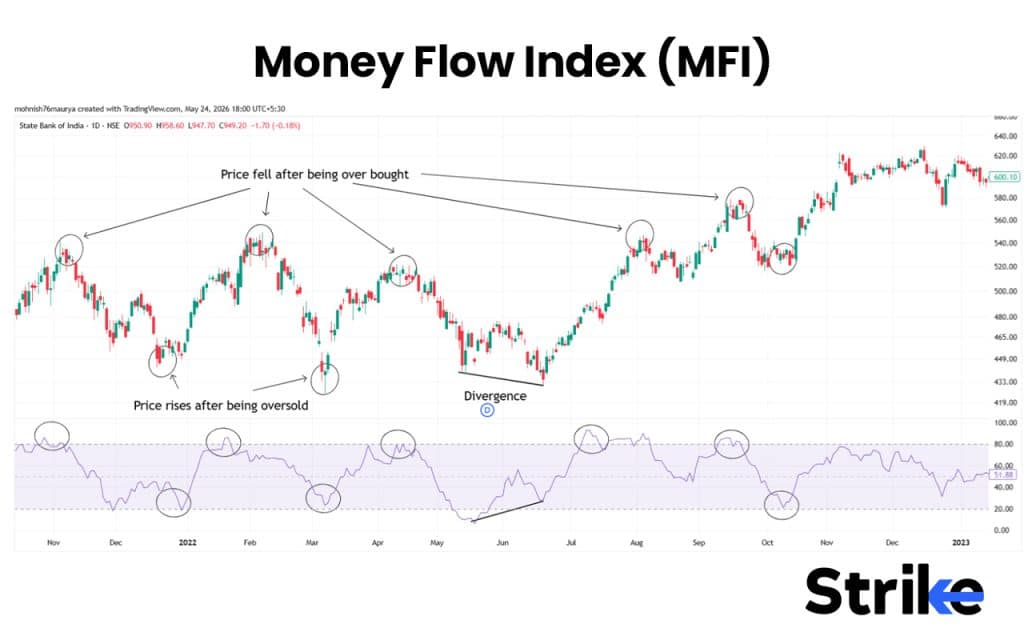
MFIR performs best in range bound markets where traders use it mainly for trend reversal trades using overbought/oversold condition and divergence and for trend confirmation.
- Overbought/Oversold Condition: When MFI value rises above 80, it indicates overbought condition and a possible bearish reversal. Whereas, MFI value below 20 indicates oversold condition and a possible bullish reversal. Enter a reversal trade only if confirmed by the reversal pattern. However, overbought and oversold does not mean immediate buy or sell signal. Enter only after trend reversal confirmation.
- Divergence: Divergences are also used for reversal trading. When both price and indicator moves in different directions, it signals weakening and a possible reversal of ongoing trend.
- Trend Confirmation: A rising MFI in an upward moving market confirms the strong buyers pressure, whereas falling MFI in a downtrend confirms the strong selling pressure.
MFI can sometimes give early reversal signals in strong trending markets. Therefore, trade MFI with price action, divergence, and reversal confirmation instead of standalone signals.
3.Accumulation/Distribution (A/D) Line
Accumulation/Distribution (A/D) line identifies whether the stock is in under accumulation or distribution zone by measuring the cumulative flow of money into and out of a stock or asset. When price closes near the high of the candle with a strong volume, it is considered as accumulation, while price closes near the low of the candle with strong volume, indicating distribution.
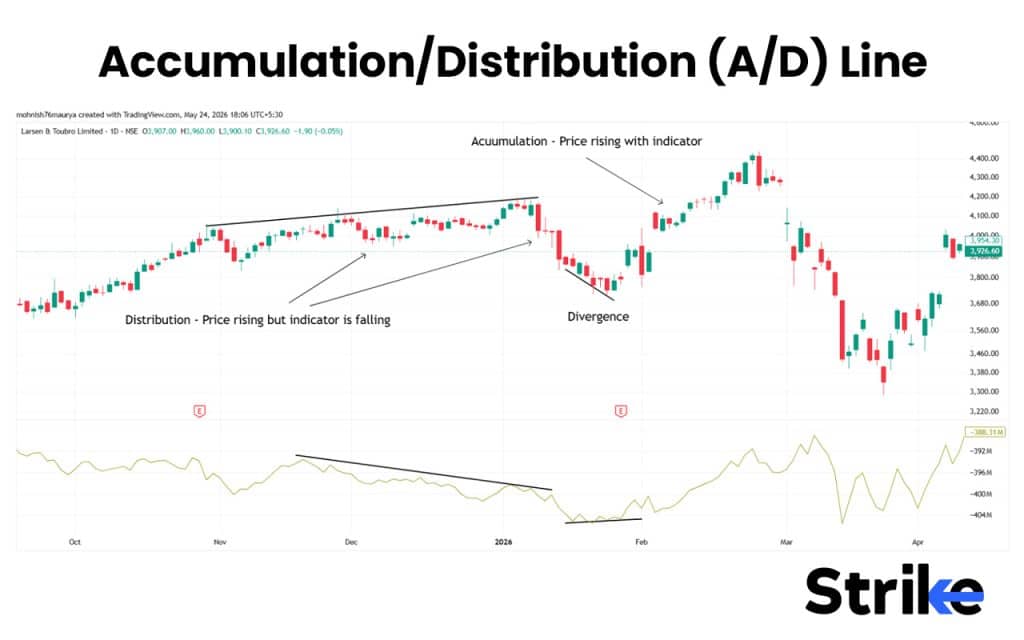
This indicator is used to confirm trends, identify divergence and confirm breakouts.
- Trend Confirmation: A rising AD line suggests accumulation and a strong buying interest confirming the uptrend. While falling AD line suggests distribution and a strong selling interest, confirms downtrend.
- Divergence: When both price and indicator moves in different directions, which signals weakening and a possible reversal of ongoing trend.
- Breakout Confirmation: When price breaks resistance and AD line also increases, it confirms the breakout. Similarly when price breaks below support and AD line falls, it confirms the breakdown.
The most important point to note is that the A/D line shows who is controlling the candle (market), bulls or bears and highlights its strength.
4.Volume-Weighted Average Price (VWAP)
Volume-Weighted Average Price (VWAP) indicator calculates the average price of the stock weighted by volume. Unlike the moving average which measures just the average price over the time period, VWAP measures the average price at which a stock has traded during the day.
Institutions and professionals often use VWAP to identify fair value, trend direction, and intraday trading opportunities.
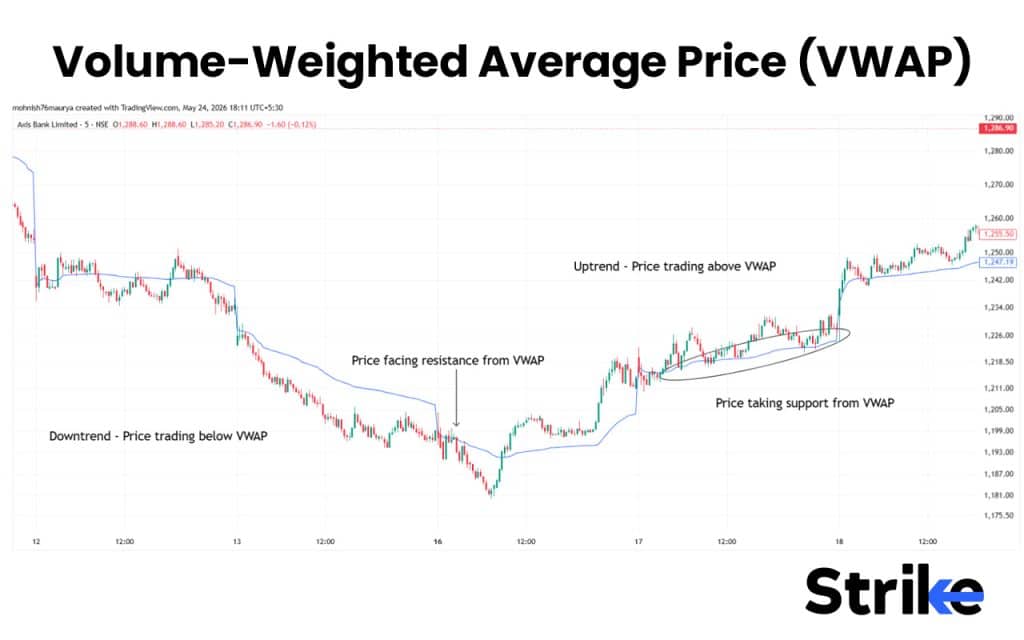
Traders use VWAP for trend identification, to find support and resistance, and for a mean reversion setup.
- Trend Identification setup: Price trading above VWAP suggests uptrend, while price trading below VWAP suggests down trend.
- Support/Resistance: VWAP acts as dynamic support and resistance. In an uptrend VWAP acts as a support and in downtrend VWAP acts as resistance.
- Mean reversion: When price overextends in one direction away from VWAP, it tends to reverse back to VWAP. Traders plan for reversal trade during such conditions.
Institutional traders also use VWAP as a benchmark to evaluate trade execution quality. Buying below VWAP is generally considered a better execution price, whereas selling above VWAP is considered favorable.
VWAP works best in intraday trading because it resets at the beginning of every trading session. However, during highly volatile or sideways markets, prices may frequently cross VWAP and generate false signals. Therefore, traders should combine VWAP with price action, volume analysis, and trend confirmation instead of using it as a standalone indicator.
5.Chaikin Money Flow (CMF)
The Chaikin Money Flow (CMF) indicator identifies buying and selling pressure by measuring the flow of money in and out of the market over a specific period. CMF oscillates between -1 to +1, 0 being crossover level. Indicator above 0 suggests money is flowing into the stock (uptrend) while below 0 suggests money is flowing out of the stock (downtrend).
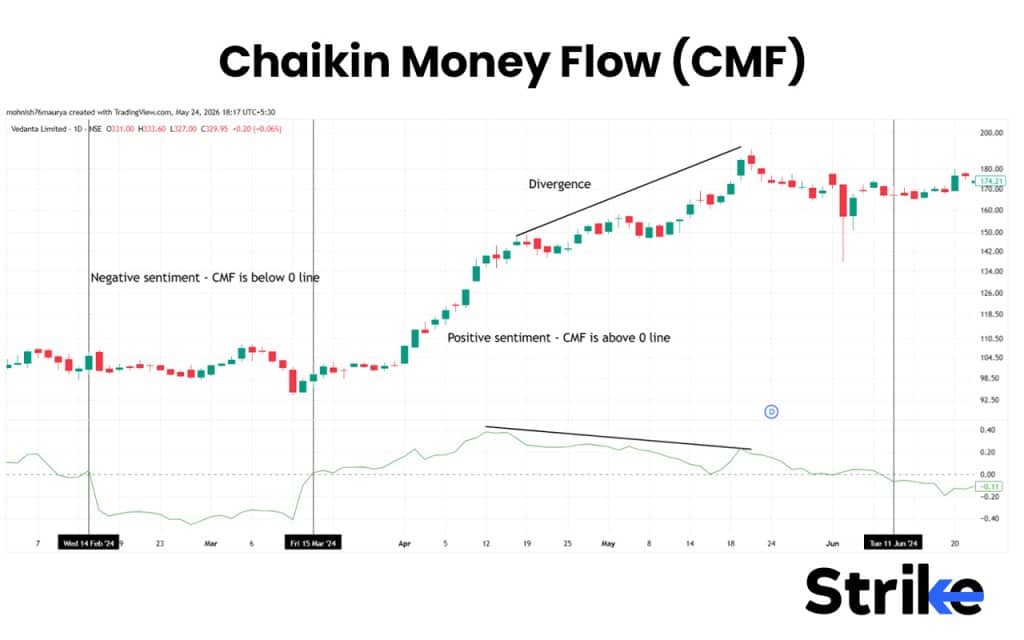
Traders use CMF indicators to gauge market sentiment, trade divergence, and to confirm trends.
- Market Sentiment: CMF above 0 suggests a positive sentiment driven by buyers dominance, while CMF below 0 suggests a negative sentiment driven by sellers dominance.
- Divergence: When both price and indicator moves in different directions, it signals weakening and a possible reversal of ongoing trend. When price forms a new high but indicators form a new higher low, it forms a bearish divergence and signals weakening and possible reversal of uptrend. Whereas, when price marks a new low but indicator forms a new lower high, it forms a bullish divergence and signals weakening and possible reversal of downtrend.
- Trend Confirmation: Rising CMF confirms strong upward momentum, while falling CMF confirms strong downward momentum.
If the indicator is used in isolation, without price action support, like other indicators, will give a weaker strike rate. One should always use an indicator as a supportive tool.
6.Price Volume Trend (PVT)
Price Volume Trend (PVT) is also a momentum based indicator that combines the price and volume to understand the buying and selling pressure in the market. PVT indicator must be sounding similar to OBV indicator, but the key difference is PVT adjusts the volume according to the percentage price change, whereas OBV adds or subtracts the entire volume based on price direction.
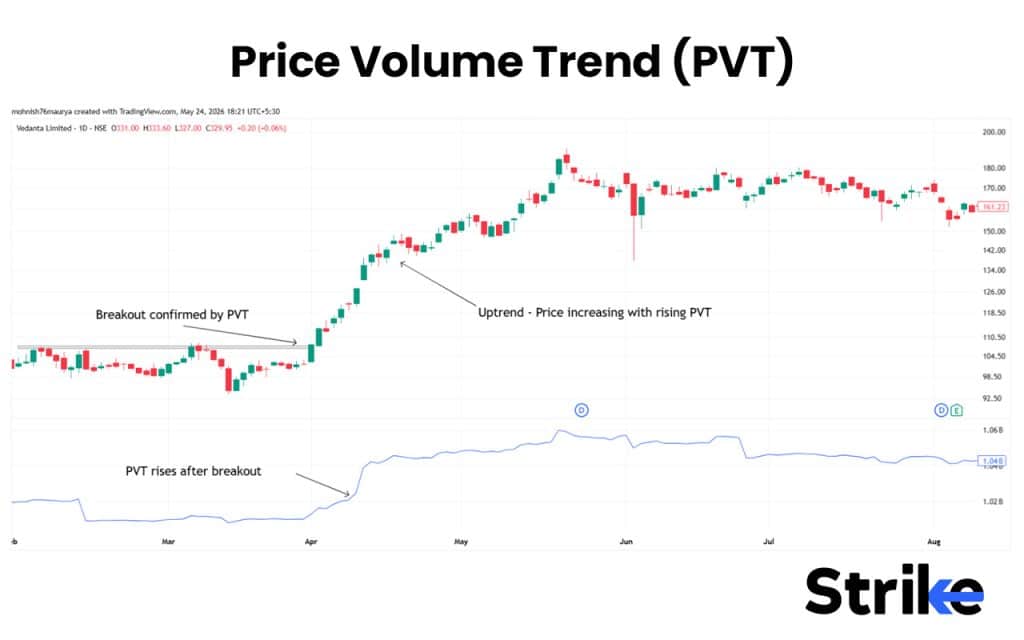
Traders use PVT indicator to confirm market trend, detect divergence, and to validate the breakout.
- Trend Confirmation: Traders use PVT to see whether the volume supports the trend. A rising PVT indicates accumulation and strong buying pressure, confirming the bullish momentum. While a falling PVT indicates distribution and strong selling pressure, confirming downtrend.
- Divergence: When price forms a new higher high but indicator forms a lower high, it indicates the weakening of upward momentum where traders can plan for bearish reversal trade. Conversely, when price forms a new low but indicator forms higher low, it indicates weakening selling pressure and a potential bullish reversal.
- Breakout Confirmation: Strong PVT movement during breakouts increases confidence in the breakout strength.
In the above chart, 20 period MA crossed above 50 period MA and PVT started rising. This trade (on a higher timeframe) lasted for years. Similar trade can be taken even on lower timeframe charts too.
7.Klinger Volume Oscillator (KVO)
KVO is a volume and trend based momentum indicator that captures both long term as well as short term money flow. It does it so by comparing the short-term and long-term volume force using moving averages and then plots the difference as an oscillator.
The indicator has 2 lines, KVO line and signal line which oscillates above and below zero line.
- Above zero indicates bullish money flow.
- Below zero indicates bearish money flow.
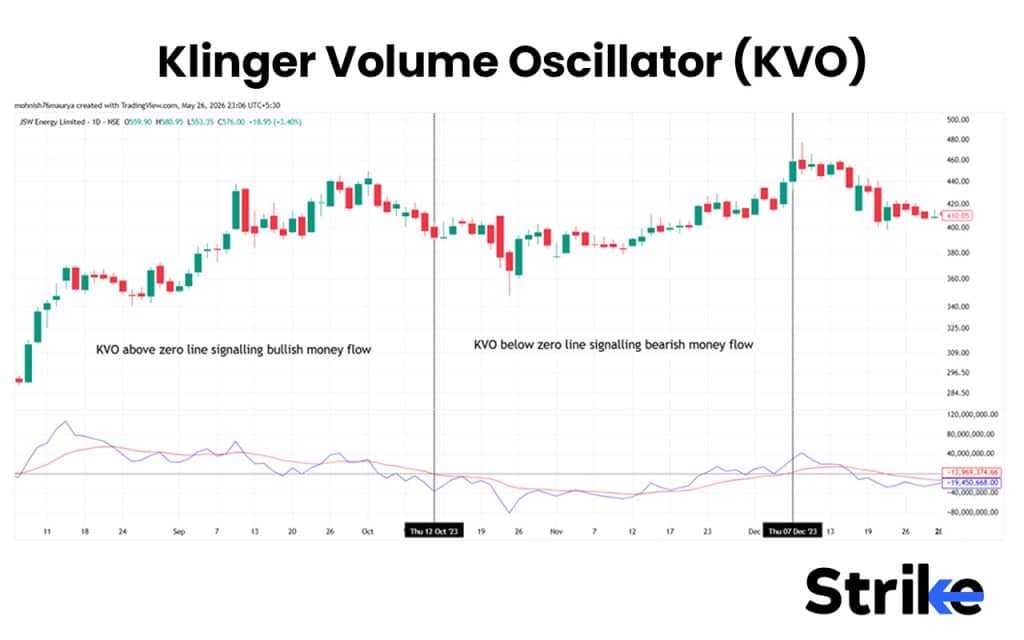
Traders use KVO to confirm trends, detect reversal, and entry/exit signals.
- Trend Confirmation: When the KVO remains above its signal line and continues rising, it indicates increasing buying pressure and confirms bullish momentum. Conversely, when the KVO stays below its signal line and declines, it signals growing selling pressure and confirms a bearish trend.
- Divergence: When price forms a new higher high but the KVO forms a lower high, it suggests weakening buying pressure and a potential bearish reversal. Conversely, when price makes a new lower low while the KVO forms a higher low, it indicates weakening selling pressure and a possible bullish reversal.
- Breakout Confirmation: Strong KVO movement above the signal line during an upside breakout increases confidence in the breakout’s strength. Similarly, a sharp decline in KVO below the signal line during a downside breakout supports the validity of the bearish move.
In the above chart, the KVO crossed above its signal line and continued to move higher, indicating increasing buying pressure. As the indicator remained positive, the uptrend sustained for an extended period. Similar signals can be applied on both higher and lower timeframe charts to identify potential trading opportunities.
8.Volume Profile
Volume profile is a technical tool that measures the amount of trading volume of a stock at different price levels over a specific time period. Unlike other volume indicators, which show volume based on time, volume profile shows volume based on price.
Volume profile plots horizontal histograms on price charts indicating the amount of trading volume at particular prices. This histogram consists of six major components which are briefly discussed below.
- POC (Point of Control): This is the price level with the highest trading volume during a selected period.
- Value Area: The area that contains approximately 70% of the total traded volume. It represents a fair value zone where most of the trading occurs.
- Value Area High: It is the upper boundary of the value area which often acts as a resistance.
- Value Area Low: The lower boundary of the value area which often acts as a support.
- High Volume Nodes (HVN): A price zone with heavy trading activity. These zones usually act as a strong support or resistance level.
- Low Volume Nodes (LVN): A price level with low trading activity. Price often moves quickly through these areas.
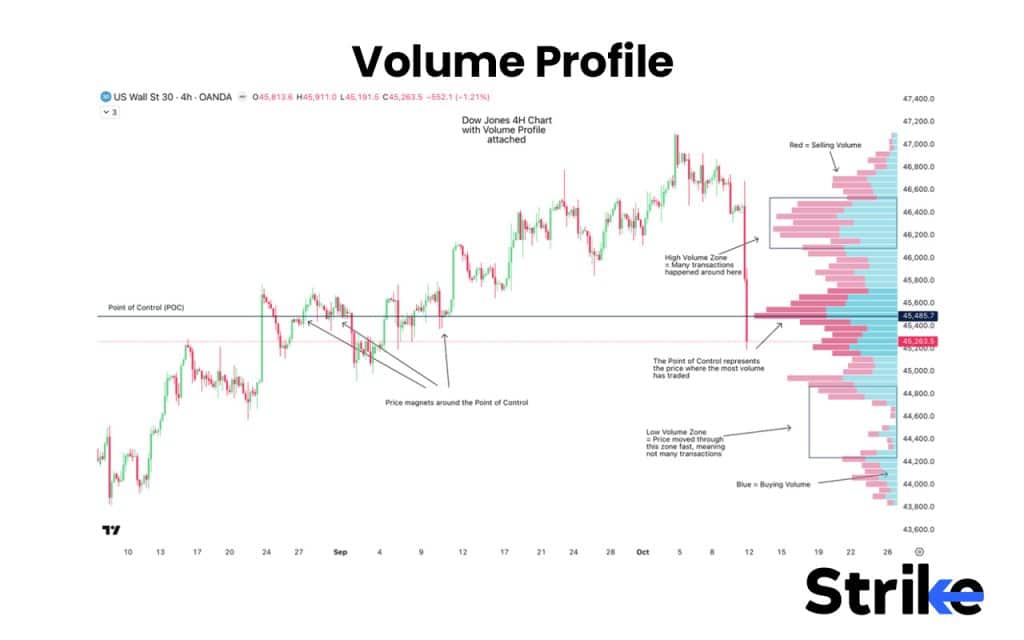
This indicator is widely used by traders to identify support/resistance, finding institutional zones and to trade mean reversion.
- Support and Resistance Identification: High volume nodes often act a s support or resistance.
- Finding Institutional Zones: Heavy volume area may indicate heavy institutional accumulation. Traders watch such levels to align their entry with institutions.
- Mean Reversion: Prices often reverse back toward the POC or value area after extreme moves.
Everyday levels are important as previous day data can be of great help in identifying support / resistance zones for days to come. To increase the strike ratio, one can trade volume profile along with VWAP. This can be an institutional level deadly combination and has potential to increase strike ratio beyond 80%.
9.Ease of movement (EOM)
EOM indicator helps you to understand how easily the price of stock moves in relation to its volume. This indicator was developed by Richard Arms and combines both price movement and volume to show the relationship between market momentum and participation.
EOM moves above and below zero line, where positive EOM means price is rising with relatively low volume resistance, whereas negative value means price is falling easily, reflecting strong bearish pressure.
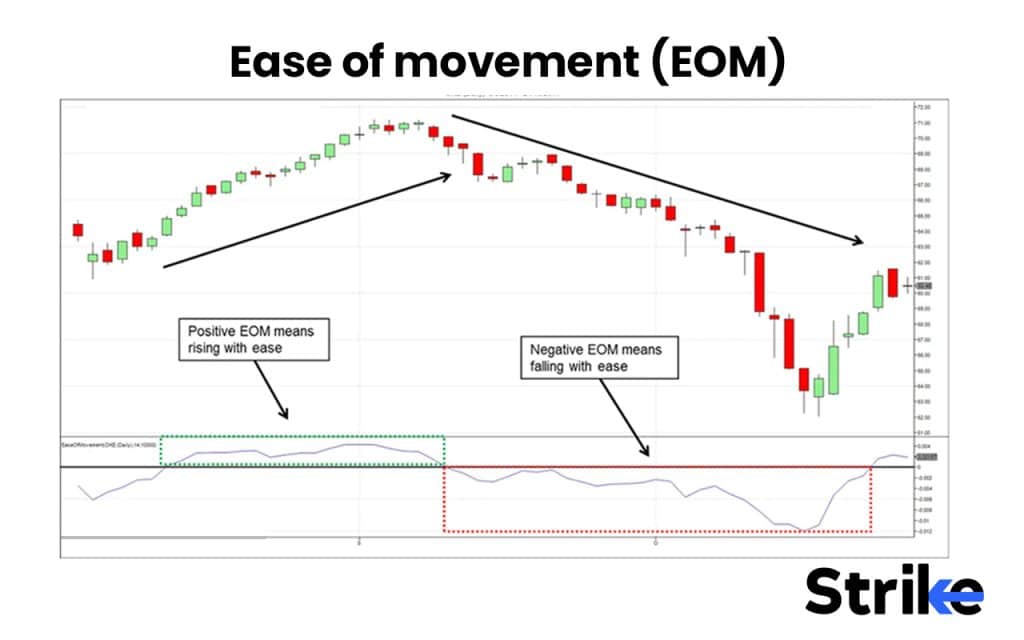
Traders mainly use Ease of Movement for trend confirmation, identifying momentum shifts, and spotting potential reversals.
- Trend Confirmation: When EOM stays above zero line with a rising price, it indicates a buying pressure, whereas EOM staying below zero line with a falling prices confirms strong selling momentum
- Momentum Strength: A sharp rise in EOM indicates that price is moving higher with ease and without heavy resistance, showing strong bullish participation. Similarly, a sharp fall in EOM suggests that sellers are dominating and price is declining easily.
- Divergence: Divergence between price and EOM shows a possible weakening of momentum and trend reversal. If price forms a new high but EOM forms a lower high, it indicates weakening of buying pressure and a potential bearish reversal. Likewise, if price forms a lower low while EOM forms a higher low, it signals weakening selling pressure and a possible bullish reversal.
- Breakout Confirmation: During breakout, when EOM rises strongly into positive territory, it confirms that the breakout is supported by smooth upward movement and strong participation. Similarly, during breakdown, if EOM falls below zero line, it confirms strong bearish pressure.
Ease of Movement works best in trending markets where price moves smoothly with volume support. However, in highly volatile or sideways markets, the indicator may generate inconsistent signals. Therefore, traders should combine EOM with price action, trend analysis, and support-resistance levels instead of relying on it alone.
10.Negative Volume Index (NVI)
Negative Volume Index (NVI) focuses on days where trading volume is lower compared to previous days. It completely ignores the heavy volume days. The core concept of the indicator is identifying silent accumulation / distribution by smart money, because smart money or institutions are more active on low volume days.
As NVI attempts to track the behavior of smart money by analyzing price changes only when volume declines, it gives the following signals.
- Rising NVI & positive MA crossover means accumulation by the smart money
- Declining NVI & negative MA crossover means distribution (selling) by the smart money
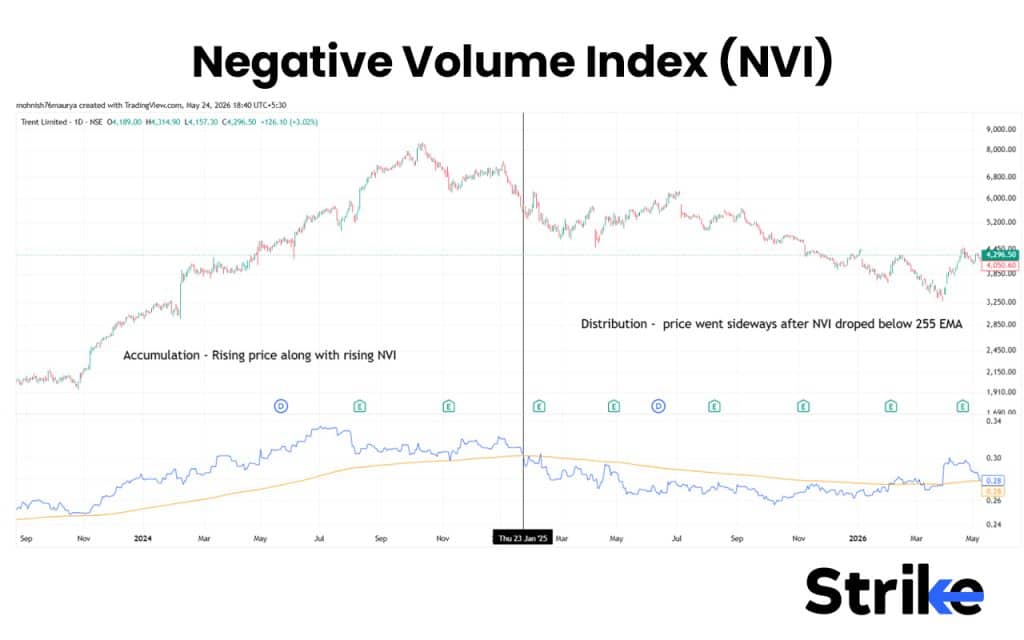
Traders use NVI mainly to identify smart money activity, long-term trend analysis, market breadth confirmation, and a combination with PVI.
- To Identify Smart Money Activity: It tracks the possible institutional participation, whether they are accumulating and distributing.
- Long-Term Trend Analysis: NVI is often used for broader market trend confirmation rather than short-term trading.
- Combining with Positive Volume Index (PVI): NVI is often paired with PVI to compare institutional and retail participation.
The success of the indicator is on a higher timeframe for positional approach. Reliability of the indicator is lower due to biased set up and strike ratio can be approximately 60-65%.
11.Positive Value Index (PVI)
Positive Value Index (PVI) is opposite of Negative value index (NVI). Where NVI focuses on days where trading volume is lower compared to previous days, PVI focuses on days with higher trading volume compared to previous day.
PVI works on idea that retail traders are mostly active during the trading volume days
- Rising PVI & positive MA crossover means bullish sentiment
- Declining PVI & negative MA crossover means bearish sentiment
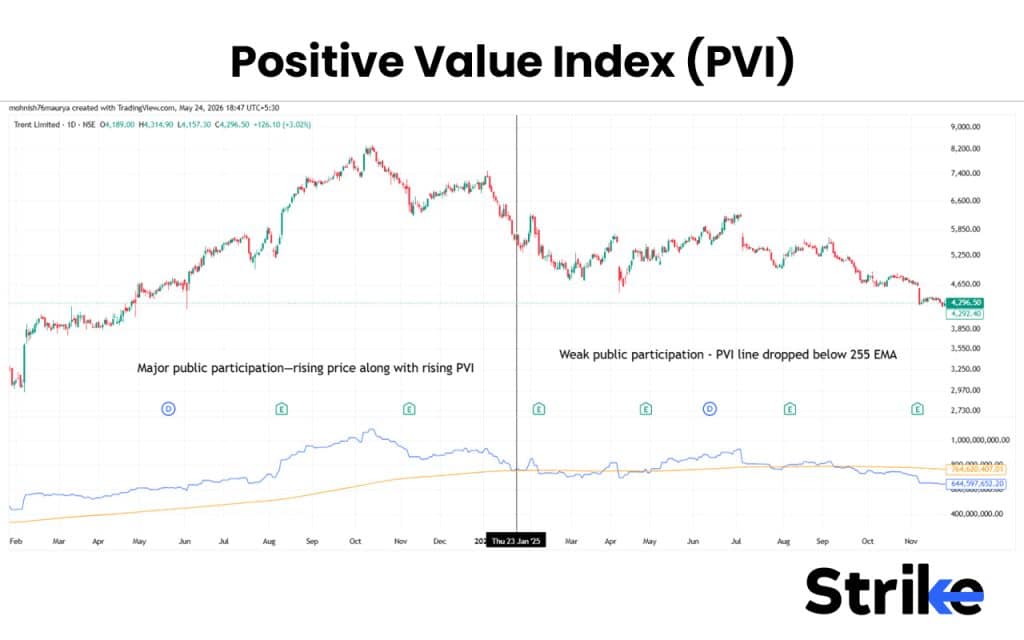
- Measuring Crowd Participation: Traders use PVI to understand how public participation affects market trends.
- Confirming Trend Strength: Strong price moves with rising PVI indicate strong market participation.
- Market Sentiment Analysis: PVI helps evaluate emotional market behavior during high-volume sessions.
If a trader is ready to buy the narrative that retailers get trapped most of the time, then this indicator can give decent signals. Reliability of the indicator is less and ranges between 50-55% but if one uses PVI along with NVI, it can be a deadly combination to generate good positional views.
12.Volume Rate of Change (VROC)
Volume Rate of Change (VROC) measures the percentage change in trading volume over a specific period. This helps understand whether the market participation is increasing or decreasing compared to previous periods.
- If VROC rises, it indicates increasing trading activity and stronger participation.
- If VROC falls, it indicates decreasing market interest and weakening momentum.
Unlike other price based momentum indicators, VROC focuses entirely on the speed and intensity of volume movement.
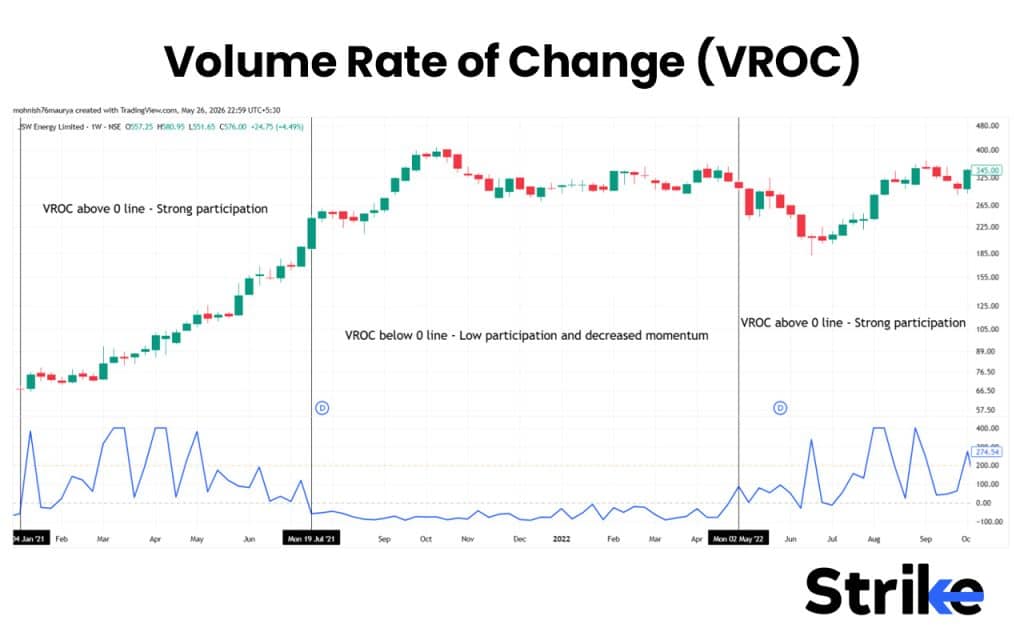
Traders use VROC for breakout confirmation, trend strength analysis, to detect early momentum shift and identify unusual activity.
- Breakout Confirmation: If VROC rises above zero following breakout, it confirms whether the breakout is supported by a strong volume or not.
- Trend Strength Analysis: Raising VROC during trending market increases the conviction.
- Detecting Early Momentum Shifts: Sudden changes in VROC may indicate upcoming volatility or reversals.
- Identifying Unusual Activity: Abnormally high VROC can highlight unusual trading activity before major moves.
VROC helps traders measure the strength of market participation, making it a valuable tool for confirming trends, validating breakouts, and spotting potential momentum shifts early.
13.Twiggs Money Flow (TMF)
Twinggs money flow (TMF) is an improved version of chaikin money flow (CMF) developed by Colin Twiggs. This indicator also measures buying and selling pressure using price and volume. Compared to CMF, TMF reduces the sudden distortion caused by gaps.
TMF indicator oscillates above and below zero line, where positive TMF suggests rising demand and a buying pressure, whereas a negative TMF indicates reducing demand and a selling pressure.
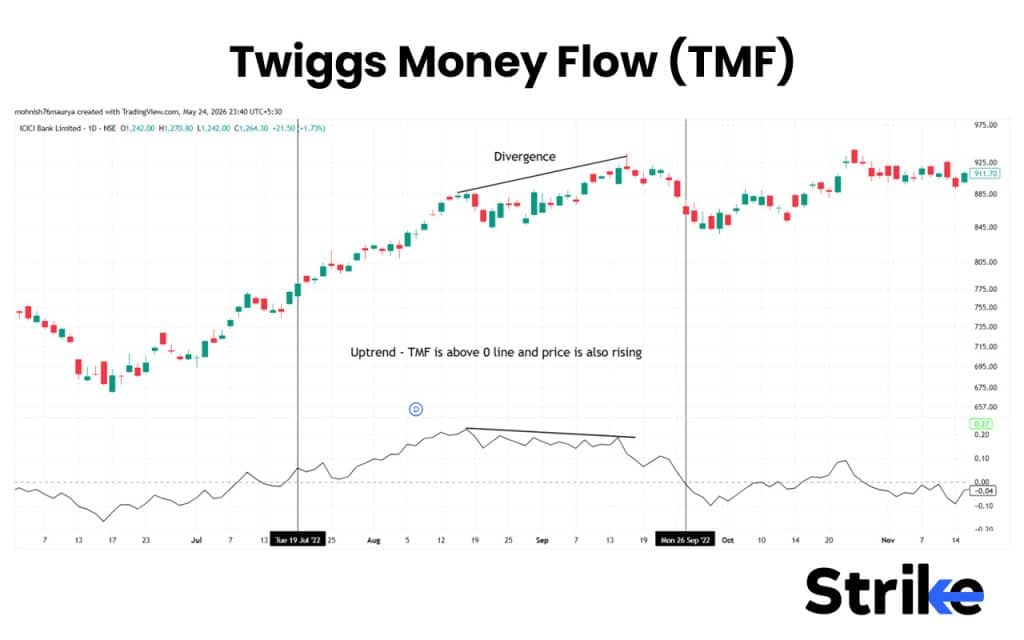
Traders mainly use Twiggs Money Flow for trend confirmation, divergence, and breakout confirmation.
- Trend Confirmation: When price rises with a positive TMI, it confirms strong buying pressure. Whereas, when price falls and with a negative TMI, it confirms selling pressure.
- Divergence: Divergence between price and TMF can signal weakening momentum and a possible reversal of the ongoing trend. For instance, if the price makes a new high but TMF forms a lower high, it indicates weakening buying pressure and a potential bearish reversal.
- Breakout Confirmation: When price gives breakout and TMI also rises above zero line, it suggests that the breakout is driven by a strong buyers participation.
- Accumulation and Distribution: Sustained positive TMF values indicate accumulation by buyers, whereas prolonged negative readings indicate distribution by sellers. This helps traders understand the underlying market sentiment before major price moves.
As this indicator was designed to overcome the market distortion caused due to gaps, TMI is widely used in volatile or gap-heavy markets, where traditional volume indicators may give misleading readings.
14.Net Volume indicator
Net Volume is a simple volume-based indicator that measures the difference between buying volume and selling volume over a specific period. It helps you to understand whether buyers or sellers are dominating the market. If the net volume is positive, the buyers are dominating, if net volume is negative, sellers are dominating.
This indicator oscillates above and below the zero line. If the net volume is positive, the indicator will move above zero and if net volume is negative, the indicator will move below zero.
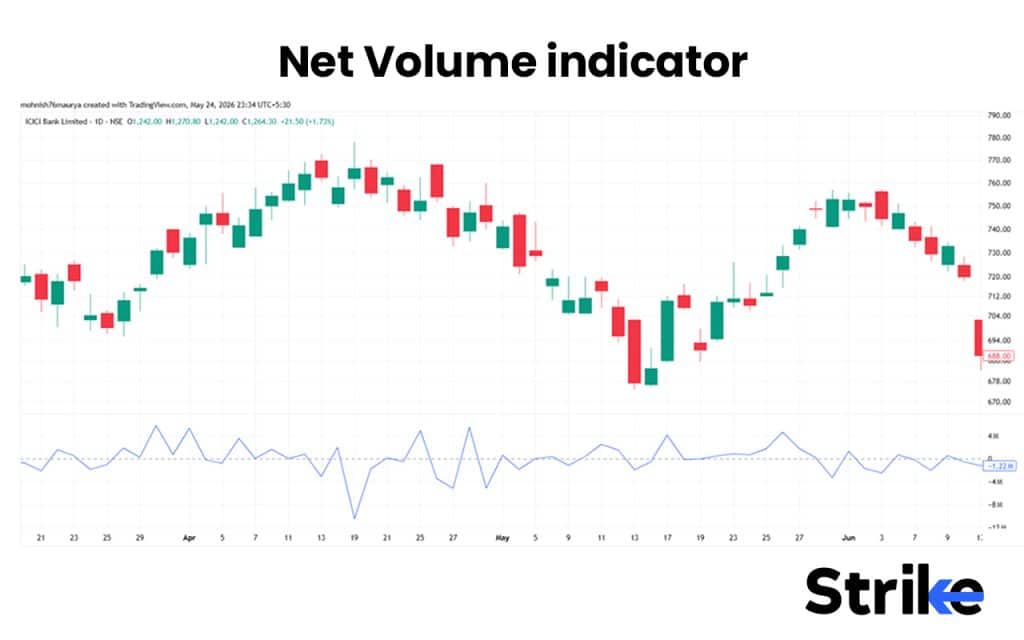
Traders mainly use Net Volume for trend confirmation, identifying accumulation and distribution, and confirming breakouts.
- Trend Confirmation: If net volume is positive along with a rising price, a strong buying is confirmed, whereas if the volume is negative along with falling price, a strong selling is confirmed.
- Accumulation and Distribution: When net volume rises but the price remains sideways, it suggests an accumulation, similarly, when nest volume falls but price stays sideways, it suggests distribution.
- Breakout Confirmation: When price gives breakout with a rise in net volume, the breakout is highly probable. Similarly, when price gives breakdown,with a falling net volume, it confirms the breakdown.
Net Volume works best in trending and breakout markets, because volume participation is important here. While using net volume indicator, combine Net Volume with price action, trend analysis, and support-resistance levels instead of using it as a standalone indicator.
15.Volume Oscillator
Volume oscillator measures the momentum of the stock by measuring the difference between short-term and long-term volume moving average. This will help you to evaluate the strength and sustainability of an ongoing trend. This indicator oscillates above and below zero line, which makes it easier for traders to spot strengthening or weakening participation in a trend.
- When short-term volume moving average crosses above the long-term volume moving average, the volume oscillator turns positive.
- When short-term volume moving average crosses below long-term moving average, it indicator turns negative.
Traders mainly use the Volume Oscillator for trend confirmation, breakout confirmation, and spotting weakening momentum.
- Trend Confirmation: When the price is rising and the volume oscillator is also positive, it suggests the uptrend. Whereas, when the price is falling and the volume oscillator is also below zero, it indicates downtrend.
- Breakout Confirmation: When price breaks out of resistance or breaks below support with a sharp rise or fall in the volume oscillator, it validates the breakout or breakdown.
- Momentum Shift: A rising Volume Oscillator while price is moving sideways can signal increasing accumulation and a possible upcoming breakout. Whereas a falling Volume Oscillator during an uptrend may indicate weakening buying pressure and slowing momentum.
A volume oscillator should be used with a combination of price action, support-resistance and trend confirmation instead of relying solely on it alone.
Are Volume Indicators Leading or Lagging?
Most Volume indicators are lagging in nature as they have volumes of already executed trade.
In the debate over Leading vs Lagging Indicators, the hypothesis of technical analysis and smart money concepts suggests that some volume indicators are actually leading in nature. This distinction is crucial for traders to understand, as the effective use of Leading vs Lagging Indicators allows them to better anticipate market turns rather than simply reacting to past price action.
| Indicator | Type | Primary Function |
|---|---|---|
| On-Balance Volume (OBV) | Leading | Predicts price changes based on cumulative buying/selling pressure. |
| Money Flow Index (MFI) | Leading | Volume-weighted RSI used to spot overbought/oversold reversals. |
| Volume Rate of Change (VROC) | Leading | Identifies sudden surges in volume that often precede big price moves. |
| Chaikin Money Flow (CMF) | Leading | Uses volume to identify changes in buying/selling momentum. |
| Volume Price Trend (VPT) | Leading | Measures cumulative volume to determine the strength of a price change. |
| Klinger Volume Oscillator (KVO) | Leading | Compares volume flow to price to identify long-term money flow trends. |
| Net Volume | Leading | Shows the raw difference between buying and selling volume to gauge immediate pressure. |
| Volume Oscillator | Leading | Measures the difference between two volume moving averages to spot momentum shifts. |
| Accumulation/Distribution (A/D) | Lagging/Confirm. | Tracks cumulative money flow to confirm the strength of an existing trend. |
| VWAP | Lagging | An intraday average that shows where the most volume has traded in the past. |
| Volume Profile | Lagging | Maps historical trading activity at specific price levels. |
| Ease of Movement (EOM) | Lagging | Analyzes the relationship between price change and volume over time. |
| Negative Volume Index (NVI) | Lagging | Focuses on days when volume decreases to track “smart money” trends over time. |
| Positive Volume Index (PVI) | Lagging | Focuses on high-volume days to track “uninformed” crowd movements over time. |
| Twiggs Money Flow (TMF) | Lagging | A smoothed version of CMF that uses moving averages to reduce noise. |
How Reliable are Volume Indicators?
Volume indicators are considered highly reliable because it confirms the smart money activity. They are reliable for identifying the market condition not to determine market direction. According to the 2014 research on the “Effectiveness of Technical Indicators with the Volume” by Gang LI & Jin Zhu, it was found that Volume-Weighted Moving Average (VWMA) outperformed the Simple Moving Average (SMA) in several key metrics:
- Higher Win Rate: 82.9% of stocks were profitable using VWMA, compared to 76.7% using SMA.
- Reduced Risk: VWMA reduced the average drawdown by roughly 17.5% compared to SMA.
- Greater Sensitivity: VWMA identified trends and issued trading signals 6.9% faster than the standard MA.
This study was conducted on 2,139 stocks from 2003 to 2013. Also, reliability of volume indicator increases when it is used with other technical indicators like moving averages.
How do Volume Indicators help Predict Price Movement?
Traders look at volumes to understand strength in the ongoing trend. Rising volumes with uptrend or downtrend confirms strength whereas declining volumes / flat volumes confirm weakness creeping in the trend. Open interest (which is a good complement to volume) can further refine volume. Since market discounts almost every event, volume precedes price action and certainly helps to predict price movement with higher probability.
How to use Volume Indicators for Entry and Exit Signals?
Volume indicators are generally used to confirm the price move before entering or exiting the trade. During entry traders usually look for strong volume after breakout and low volume during pullback, whereas, during exit, traders look for price volume divergence. For instance, if the price is rising but the volume is decreasing, it suggests that the price move is no longer supported by strong buying participation and the trend may be losing momentum.
How to Confirm a Price Breakout using Volume?
There are four major ways to confirm a price breakout using volume. These ways are briefly discussed below.
- Look for Above-Average Volume: A genuine breakout happens with a strong volume. Volume should be greater than the last 20 or 30 day average volume.
- Strong Closing Candle: It is important for a breakout candle to close strong above key level despite strong volume. The key features of genuine breakout candles are large body, small wick, strong closing, and high volume.
- Expanding Volume: Volume should increase as price reaches near resistance and breaks. This shows a high traders participating, institutions entering positions, and strong momentum.
- Check Follow-through Volume: Real breakouts usually continue for the next few candles with healthy volume. If volume immediately dries up after, the breakout becomes doubtful.
A breakout supported by strong volume has a higher probability of sustaining in Breakout Trading because it reflects genuine market participation and conviction from buyers or sellers. Therefore, traders should always combine Breakout Trading analysis with volume confirmation to avoid false signals and improve overall trade accuracy.
How to Spot a False Breakout with a Volume Indicator?
A false breakout or fakeouts often happens when price moves beyond key level, but fails to sustain the break and falls back in the range. This happens because the price moving beyond the key level is not supported by any strong participants.
In a genuine breakout, volume stays strong for the next few candles. Apart from this there are few more signs to spot false breakout using a volume indicator.
- Breakout candle having a long upper wick and high rejection suggests failed buyers. If the volume is also lower, it increases the probability of fakeouts.
- Sudden volume spike but no follow through price action suggests profit booking, smart money selling into retail buying, and distribution near resistance.
Hence, as a swing trader always consider strong volume expansion, strong candle close, follow-through buying, and confirmation from volume indicators.
How to Use Volume Indicators for Swing Trading?
In swing trading volume indicators are generally used to check whether the price move is supported by a strong participation or it is just a spike. Traders use volume indicators to confirm trends, breakouts, pullbacks, and reversals before entering a trade.
- Confirm Breakouts: A breakout supported by a strong volume increases breakout reliability.
- Identify Institutional Buying: Rising volume during silent or sideways markets suggests an institutional accumulation before a major move. Traders can look up to such stocks for swing trading.
- Measure Trend Strength: Traders also validate whether the trend is strong or weak using volume. For instance, if price is rising with volume, it suggests a strong trend, whereas price rising without any major volume suggests a weak trend.
- Analyze Pullbacks: In a trending market a healthy pullback usually has a lower volume, showing a temporary profit booking.
- Avoid False Moves: Low-volume rallies or breakouts are often unreliable and may fail quickly.
In Swing Trading, positions are held for 3–4 days or a few weeks, making volume a critical factor in the strategy’s success. A strong volume participation often decides whether the move continues or fails, which is why monitoring volume is essential for any effective Swing Trading approach.
How does Volume Analysis help Identify Institutional vs. Retail Traders?
Volume analysis helps understanding who is controlling the market, retail traders or institutions. Since institutions trade with large quantities compared to retail traders, their activity leaves different footprints on the price chart.
Where price only tells you about what the market is doing, volume tells you how much is the strength behind that move.
The different Types of traders can often be identified through volume; price moving with large volume usually indicates institutional participation, whereas moves on low volume often involve retail Types of traders and have a higher chance of failure. During the accumulation period, volume starts increasing before a major move becomes visible, supporting the saying that “Price follows volume, and volume follows smart money.”
 24 mins