Cash Secured Put: Overview, Example, Uses, Trading Guide, P&L, Risks


 Author

 Editor
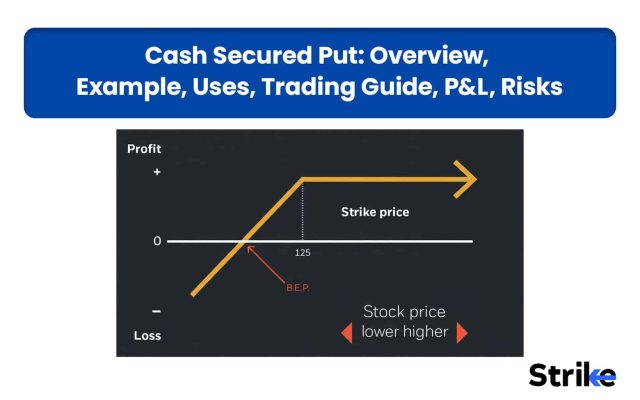
Cash secured put strategy is one of the most popular amongst investors because of its regular income generation. Cash secured puts provide investors to accumulate an extra income while waiting for stocks to buy at a good price.
Whether your goal is portfolio income, disciplined stock accumulation, or improving your stock entry price, this strategy works well in all aspects of investing. To trade this strategy effectively, it is important to learn how this strategy works, how you can execute it, when to execute, and what are the factors that affect this strategy. In this blog we will be learning all about it with real time examples.
What is a Cash Secured Put?
Cash secured put is an options trading strategy where you sell OTM (out of the money) put option of the stock while holding enough cash to buy these stocks at discounted price if assigned. This strategy is mostly used by investors who are looking to buy stock at a lower price. This strategy helps investors to earn a regular premium until stock falls down to investors desired price.
The strategy is called “Cash Secured” because it involves selling of a necked put option whose unlimited loss is secured by cash. Sometimes investors or traders also sell ATM put options depending on their objective.
How Does a Cash Secured Put Work?
Cash secured put work by selling a put option of a selected stock to collect the premium upfront while keeping enough cash to buy the stock at a lower price if assigned. This cash acts as a collateral and ensures the trader can fulfill the obligation of buying the shares at the agreed strike price if the option buyer chooses to exercise the contract.
There are two scenarios while trading cash secured put options trading strategy.
- Scenario 1: If the option expires out of the money (stock price remains above the strike price), the put option becomes worthless and the seller keeps the entire premium as profit and you don’t purchase any stocks.
- Scenario 2: If the option expires in the money (stock price falls below the strike price), the seller may be assigned and required to buy the shares at the strike price.
In Option Trading, although the stock might be purchased above the current market price, the premium received reduces the effective acquisition cost. This advantage in Option Trading helps to offset part of the price decline, effectively lowering the investor’s break-even point.
What is an Example of Cash Secured Put?
Lets understand the cash secured using a real time example from Reliance Industries stock.
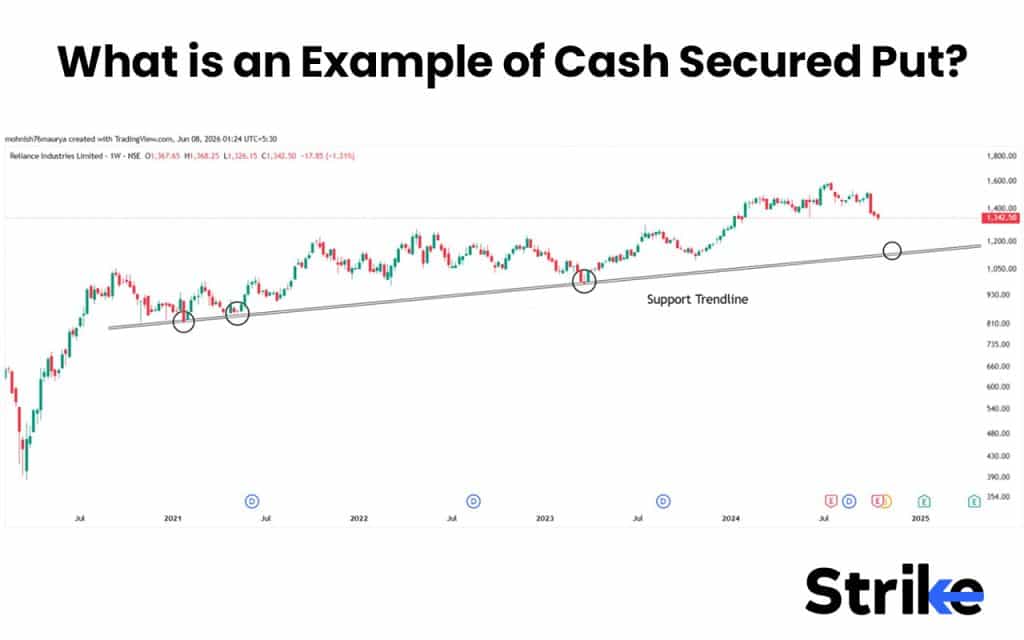
As we can see in the above screen shot, Reliance Industries stock is currently trading at ₹1342.5. Now, you want to buy Reliance Industry stock at the trendline support at ₹1160 level, so you will sell the ₹1160 put option while holding enough cash to buy the stock if it gets assigned.
- Scenario 1: If stock stays above ₹1160, the put option will expire worthless and you will make profit from the sold option. Repeat the process until stock comes down to ₹1160.
- Scenario 2: Once stock reaches ₹1160 level, put gets assigned and shares get purchased automatically at strike price.
Alternatively, investors may choose to close the put position and keep the Option Premium before buying shares directly. By locking in the Option Premium first, they can potentially lower their overall purchase price if the stock continues to trade at a favorable level.
Why Use a Cash Secured Put Strategy?
There are four main reasons to use a cash secured put strategy. The reasons are to generate regular income, allow you to buy stocks at lower price, earn returns on cash reserves, and benefits in the sideways market.
- Generate income from option premiums: As it involves selling OTM put options
- Buy stocks at a lower effective price: When stock gets assigned (stock price falling below the sold OTM put strike), investors or traders get a chance to buy the stock at discounted price. However, the premium received through put selling further reduced the cost of acquiring the shares.
- Earn returns on cash reserves: Instead of keeping cash in hand while waiting for price to get discounted, investors or traders can extra return by selling put options.
- Benefit in neutral to moderately bullish markets: This strategy performs best in sideways to moderately bullish markets where trend traders struggle to make profits.
It allows investors to earn option premiums through strategies like the Covered Call and the Naked Put while potentially acquiring quality stocks at a lower effective price. Utilizing a Covered Call or a Naked Put is particularly useful in neutral to moderately bullish market conditions, where the primary goal is income generation and disciplined stock acquisition.
When to Use a Cash-Secured Put?
There are six scenarios to use cash-secured put options which are briefly discussed below.
- When you are moderately bullish on a stock: When you expect stock to remain sideways to slightly bullish, you sell the OTM put option to collect premium.
- When you want to buy a stock at a lower price: When you want to buy a share at desired price, instead of waiting, you keep selling put options to earn regular premium until price comes to your desired entry price.
- When implied volatility is relatively high: Higher volatility increases option premium, and higher option premium increases the income received, which improves the strategy risk-reward ratio profile.
- When you have sufficient cash available: Since you need to buy the shares if they get assigned, it is best used when the sufficient cash is available aside.
- When starting the Wheel Strategy: Traders often use a cash-secured put as the first step to acquire shares before transitioning to covered call writing.
- Near Strong Support Zone: Near major support zone, probability of assignment is lower and premium collection opportunities are higher.
A cash-secured put is most effective when you are willing to own the underlying stock at the chosen Strike Price, have sufficient cash available, and want to generate income. By selecting a specific Strike Price, you can ensure you are waiting for an attractive buying opportunity while simultaneously earning a premium for your commitment.
How to Trade using Cash Secured Put?
There are four important steps to trade cash secured put option trading strategy. The steps involve identifying the right stock and right strike price, selling selected put strike, managing the position and exit.
1.Select the Right Stock and Strike Price
Select fundamentally strong and stable stock that you can hold comfortably if assigned. Now select a put option of a strike price where you are willing to buy the selected stock, which is ideally below the current market price.
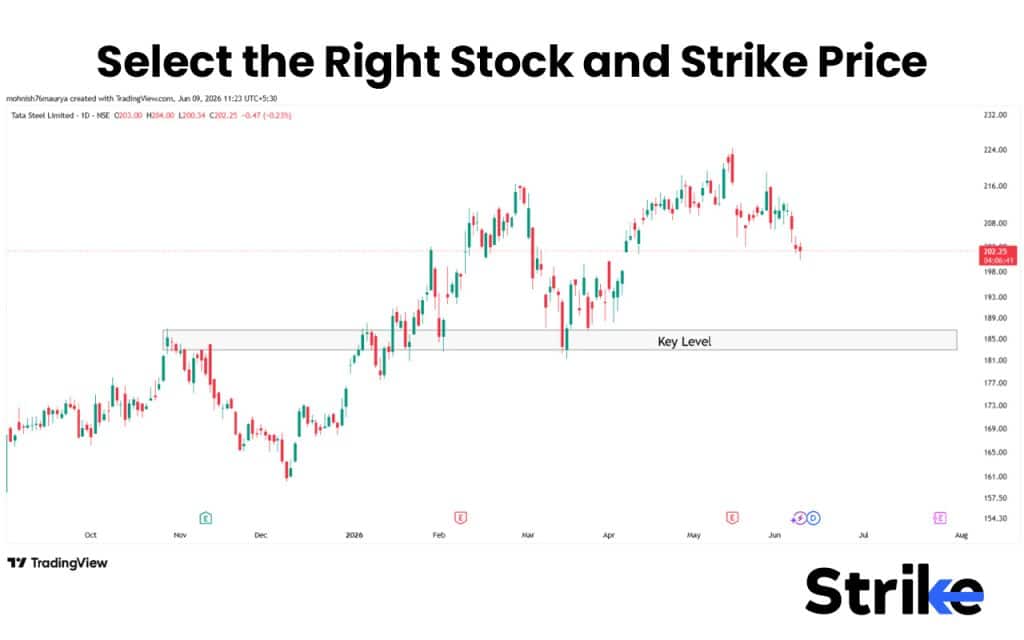
For example, assume Tata Steel is trading at ₹202.28. After analyzing the chart, I identified a strong support zone near ₹185 and would prefer to buy the stock only if it falls to that level.
2.Sell the Put Option
Sell the selected put option ( near ₹185) to collect the option premium upfront. Select 30-45 DTE expiry for better theta decay and better risk-reward. At the same time keep enough cash aside to buy the stock if the stock price reaches to your sold strike.
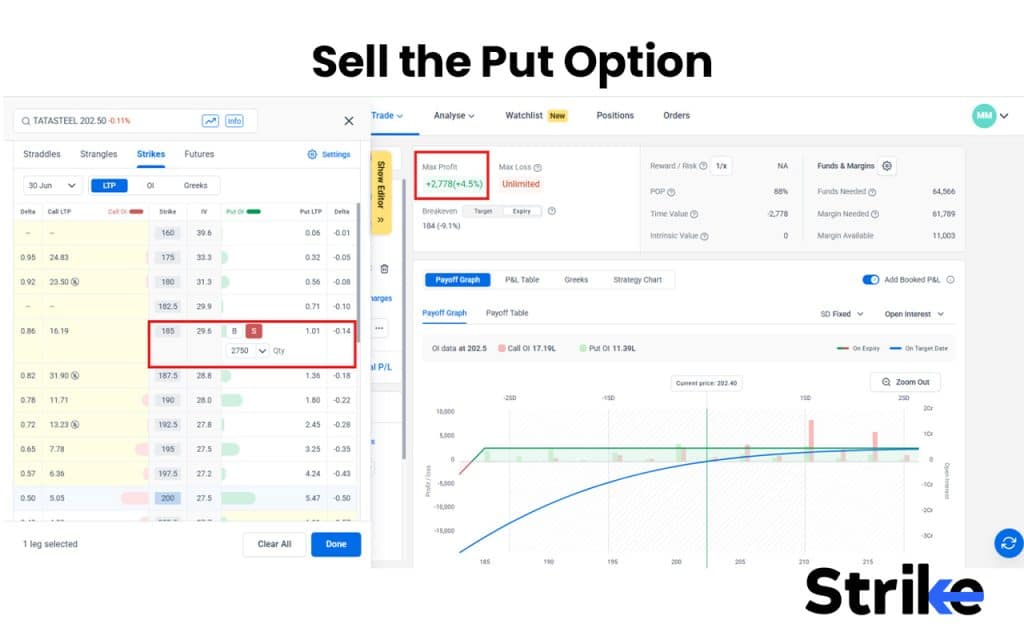
As I want to buy Tata Steel stock at ₹185, I have sold one lot of a Put Option with a strike price of 185. Here, I am getting ₹2,778 as a profit if Tata Steel remains above ₹185 until expiry, at which point the Put Option expires worthless and allows me to keep the entire premium as profit.
3.Manage the Position
After executing a trade, you have to keep observing the trade from time to time and manage positions accordingly.
- If the stock price stays above the selected price after the expiry, it gives profit through theta decay.
- If the stock falls significantly, consider rolling the option to a later expiry or a different strike price to manage risk.
In my case, if Tata Steel remains above ₹185 at expiry, I earn ₹2,778 from the sold put option. I can then repeat the strategy by selling another same put and continue collecting premiums until stock reaches my desired buying level. If the stock eventually falls to ₹185, I purchase the shares at the predetermined price and become a shareholder, effectively using the strategy to acquire the stock while earning income along the way.
4. Exit the Trade
There are three common ways to exit the positions which are briefly discussed below.
- Let the option expire worthless and collect all the premium as profit, if the stock stays above the selected strike price.
- Buy back the put options before expiry to avoid the risks of Gamma spiking and to lock in the major portion of premium as profit.
- Accept the assignment, means exit the sold put option and purchase the stock or take a physical delivery of stocks after stock price hits the sold put option.
As part of their Option Strategies, many traders buy back the option once 50%–75% of the premium has been captured rather than waiting until expiry. This disciplined approach to Option Strategies helps to lock in profits and reduce the risk of late-stage price swings affecting the position.
What are the Maximum Profit & Loss on a Cash Secured Put?
The maximum profit in cash secured put is limited to the premium received after selling the put option. So, the formula for the maximum profit would be.
Maximum profit = Total premium received
For instance, you sold a put option of strike ₹950, where premium received per share is ₹20.
Maximum profit = ₹20 X 100 (Lot size) = ₹2,000 per contract
This ₹2,000 premium will be received as a profit if the market stays above ₹950 level.
Maximum loss theoretically is equal to the amount of cash you are holding to buy the shares if assigned, but this maximum loss will only happen if stock goes to zero, which partially is not possible in fundamentally strong stock.
- Maximum Loss = (Strike Price − Premium Received) × Lot Size
- Maximum Loss = (₹950 − ₹20) × 100 = ₹93,000 per contract
Although, premium provides a small cushion, the trader still faces substantial downside risk because they are obligated to buy the shares at the strike price.
What are the Risks of Cash Secured Put?
There are four major risks in trading cash secured puts, which includes risk of sharp fall, limited profit potential, locked capital, and end up owning a weak stock.
- Downside risk if the stock falls sharply: If stock price falls sharply, you may have to buy the shares at a sold put strike price, even though the stock is trading much lower in market.
- Limited profit potential: Profit in this strategy is limited to total premium received, even though stock rises sharply.
- Capital is tied up: As you need to keep enough cash available to buy the shares if assigned, it limits your use of cash in other trades, due to which you may miss other investment or trading opportunities that offer better returns.
- Owning a weak stock: If the fundamentals of stock deteriorates or market conditions change, you could end up owning weak shares that continue to lose value.
Even though a cash secured put option strategy is considered a lower-risk strategy, it is important to carefully select fundamentally strong stocks and be comfortable owning them if assignment occurs.
How Option Greeks Affects Cash Secured Put?
Option greeks directly affect the cash secured put strategy because it involves selling of a put option to collect premium. As we sell options, the profitability and risks are directly influenced by option Greeks. Understanding the effect of these Greeks will help you to identify favorable entry conditions and manage risk more effectively.
- Theta: Theta is the most beneficial Greek for this strategy. Theta reduces option premium which directly benefits the option sellers. The process of theta decay is slower during initial days but accelerates as expiry approaches. Generally 30–45 DTE (days to expiration) options are considered optimal because they have a decent premium and good theta decay.
- Delta: Delta tells the probability of shares getting assigned and how much the option value will react to stock price movement. Lower delta (below 0.4)suggests low chance of share assignment and high chance of probability, while higher delta (above 0.4) have lower probability of profit and higher chance of share assignment.
- Vega (Implied Volatility): Vega measures the effect of volatility on option price. Higher volatility rises the option premium, which can hurt existing cash secured put positions. However, most trades prefer selling puts during high volatility to capture more premium when volatility drops.
- Gamma: Gamma measures the rate of change of delta when the stock moves. Hence, if gamma rises sharply due to sharp fall in stock price, it will affect delta. A high Gamma causes Delta to change more rapidly, increasing the risk of assignment. The gamma risk is usually seen near expiry.
Hence a cash secured put strategy only benefits when time passes (Theta Decay), stable or rising stock prices (Delta), and falling volatility (Vega).
Is Cash Secured Put Strategy Profitable?
Yes, a cash secured put is a profitable trading strategy when used in a neutral to moderately bullish market on a fundamentally strong stock. The profitability of this strategy further increases when traded during the period of high volatility, which allows traders to capture more premium.
The CBOE S&P 500 PutWrite Index (PUT), which tracks a systematic cash-secured put-selling approach, generated an annualized return of approximately 9.4% from 1986 to 2023, with lower volatility and smaller drawdowns than the S&P 500. However, avoid selling put option of a weak and highly speculative stock, or stock with upcoming major-events to maintain the profitability
Is Cash Secured Put Bullish or Bearish?
Cash secured put is generally considered as a bullish trading strategy, because in this strategy, traders or investors sell the put option and expect the market to stay sideways or bullish to earn premium. If the market turns bearish, it can lead to assignment and potentially large losses. Instead, it is best suited for investors who are positive on the stock and are willing to own it at a lower price if assigned.
What are Alternatives to Cash Secured Put Strategy?
There are four alternatives to cash secured put strategy, offering a limited risk and high winning probability. The strategies are covered call, limit order, bull put spread and a wheel strategy.
- Covered Call: Covered Call involves selling a call option instead of a put option while already owning the stock. It is mostly used when cas secured put results in stock assignment.
- Limit Order: Instead of taking any kind of options obligation, you can use limit order to buy a stock at a desired price.
- Bull Put Spread: Bull Put Spread strategy is created for bullish view by selling a put option and buying a lower strike put option for hedging.
- The Wheel Strategy: Wheel Strategy is a systematic strategy that combines selling cash-secured puts and covered calls in a cyclic manner to create a recurring income cycle.
Each alternative serves a different purpose, so choose the one that best matches your risk tolerance, income goals, and market outlook.
 47 mins