Best NBFC Companies Stocks to Invest in Oct, 2026
India's Non-Banking Financial Companies (NBFCs) are very important for filling in credit gaps in markets that don't get enough of it. NBFCs are an important part of the financial ecosystem because they give loans to MSMEs, infrastructure, vehicles, housing, and consumers. NBFCs are growing steadily because of supportive regulatory frameworks and more people getting credit. This makes them appealing to investors who want high-return, high-growth opportunities. Companies that have a wide range of investments, digital lending models, and smart asset quality management are in the lead. People like NBFC stocks because they have the potential to do better than banks in certain types of lending, which means they can offer better returns and grow faster. These NBFC Company Stocks are compared against their Share Price, change %, Dow Trend, 52 Week Range, Returns, P/E Ratio, P/BV Ratio, Market Cap. This list of NBFC Company Stocks Company stocks is constructed based on Strike’s analysis with the help of our market analyst Mr. Sunder Subramaniam. Let’s analyze the top 10 NBFC Company Stocks Company stocks in detail.
 Author:
 Editor:
 Updated on: October 21, 2026
NBFC Companies Stocks Performance Analysis
Showing top performers in NBFC Companies Stocks

Indiacharts
SEBI Registered Research Analyst
| BUY/SELL | TREND | VOLUME | 52 WEEK RANGE | 1M RETURN | 3M RETURN | 6M RETURN | 1Y RETURN | ||
|---|---|---|---|---|---|---|---|---|---|
| UYFINCORP | 23.00CHG: -3.93% | SELL | Sell | 10,17,436 | 11.5026.73 LH | 18.68% | 34.19% | 60.28% | 56.14% |
| CAPTRUST | 21.35CHG: -1.16% | SELL | Sell | 17,513 | 10.9829.50 LH | 12.84% | 45.54% | 55.61% | -19.13% |
| VIJIFIN | 16.66CHG: -1.94% | SELL | Sell | 1,97,119 | 2.0117.24 LH | 8.89% | 90.40% | 376.00% | 449.83% |
| USHAFIN | 54.60CHG: -4.96% | SELL | Sell | 9,600 | 26.7559.80 LH | 7.06% | 51.67% | 61.78% | 26.10% |
| MANBA | 143.88CHG: 0.13% | BUY | Buy | 95,499 | 98.00154.00 LH | 5.23% | 2.90% | 34.85% | 5.98% |
| ASSAMENT | 819.00CHG: 0.00% | BUY | Buy | 0 | 705.00857.75 LH | 5.00% | - | - | - |
| HBSL | 55.85CHG: -2.75% | SELL | Sell | 2,614 | 42.63108.80 LH | 4.88% | 17.83% | -9.30% | -31.06% |
| FEDFINA | 155.58CHG: -3.21% | SELL | Sell | 8,77,513 | 119.07178.48 LH | 2.53% | -1.47% | 5.06% | 2.46% |
| STARTECK | 257.45CHG: 2.47% | BUY | Buy | 178 | 215.10350.00 LH | 2.22% | -3.27% | 3.32% | -14.20% |
| MUFIN | 134.98CHG: -4.90% | SELL | Sell | 20,34,015 | 94.11143.90 LH | 2.13% | 5.08% | 16.28% | 34.51% |
| IBLFL | 62.00CHG: 4.20% | BUY | Buy | 8,000 | 43.9572.80 LH | 1.64% | 1.64% | 26.02% | -10.14% |
| VGCL | 47.77CHG: -4.46% | SELL | Sell | 2,783 | 45.0062.95 LH | 1.34% | - | - | - |
| OPTIFIN | 14.09CHG: -2.76% | SELL | Sell | 22,340 | 11.2517.00 LH | 1.15% | - | - | - |
| SGFIN | 628.50CHG: -4.27% | SELL | Sell | 3,72,412 | 323.00727.45 LH | 0.84% | -7.23% | 16.09% | 57.76% |
| GRANDOAK | 33.27CHG: 0.79% | BUY | Buy | 3,317 | 24.0055.76 LH | 0.60% | -19.56% | 11.83% | - |
| SAHLIBHFI | 76.81CHG: 1.65% | BUY | Buy | 7,023 | 66.6091.95 LH | 0.33% | -0.25% | -5.81% | - |
| ALFREDHE | 2,736.80CHG: 0.00% | BUY | Buy | 0 | 2,650.003,599.00 LH | 0.07% | - | - | - |
| YOGI | 162.00CHG: 0.78% | BUY | Buy | 186 | 130.01180.00 LH | 0.00% | - | - | - |
| TEAMGTY | 241.01CHG: -2.91% | SELL | Sell | 714 | 210.00332.55 LH | -0.37% | 7.99% | -7.26% | -3.40% |
| AKCAPIT | 1,744.40CHG: -0.06% | SELL | Sell | 879 | 1,484.901,875.00 LH | -0.78% | -2.57% | 13.08% | - |
| ADVIKCA | 0.95CHG: -1.04% | SELL | Sell | 1,51,325 | 0.861.27 LH | -1.04% | - | - | - |
| ARYAMAN | 612.50CHG: -2.00% | SELL | Sell | 321 | 570.00674.95 LH | -1.98% | - | - | - |
| TRU | 4.03CHG: -5.18% | SELL | Sell | 53,647 | 3.6810.99 LH | -2.18% | -19.24% | -35.10% | -60.49% |
| TFL | 11.73CHG: 0.00% | BUY | Buy | 98 | 10.2118.50 LH | -2.90% | 8.81% | -5.33% | -16.63% |
| CSLFINANCE | 213.22CHG: 1.01% | BUY | Buy | 27,748 | 199.99324.70 LH | -3.28% | -0.48% | -10.64% | -23.65% |

List of NBFC Companies Stocks to Invest
1. U Y Fincorp Ltd.
U Y Fincorp Ltd. is currently trading at ₹23.00. It has a daily trading volume of 10,17,436. U Y Fincorp Ltd. touched a 52-week high of ₹26.73, while the 52-week low stands at ₹11.50. While Nifty delivered -2.58% return over the 1 year, U Y Fincorp Ltd. outperformed with a 56.14% return.
2. Capital Trust Ltd.
Capital Trust Ltd. is currently trading at ₹21.35. It has a daily trading volume of 17,513. Capital Trust Ltd. touched a 52-week high of ₹29.50, while the 52-week low stands at ₹10.98. While Nifty delivered -2.58% return over the 1 year, Capital Trust Ltd. underperformed with a -19.13% return.
3. Viji Finance Ltd.
Viji Finance Ltd. is currently trading at ₹16.66. It has a daily trading volume of 1,97,119. Viji Finance Ltd. touched a 52-week high of ₹17.24, while the 52-week low stands at ₹2.01. While Nifty delivered -2.58% return over the 1 year, Viji Finance Ltd. outperformed with a 449.83% return.
4. Usha Financial Services Ltd.
Usha Financial Services Ltd. is currently trading at ₹54.60. It has a daily trading volume of 9,600. Usha Financial Services Ltd. touched a 52-week high of ₹59.80, while the 52-week low stands at ₹26.75. While Nifty delivered -2.58% return over the 1 year, Usha Financial Services Ltd. outperformed with a 26.10% return.
5. Manba Finance Ltd.
Manba Finance Ltd. is currently trading at ₹143.88. It has a daily trading volume of 95,499. Manba Finance Ltd. touched a 52-week high of ₹154.00, while the 52-week low stands at ₹98.00. While Nifty delivered -2.58% return over the 1 year, Manba Finance Ltd. outperformed with a 5.98% return.
6. Assam Entrade Ltd.
Assam Entrade Ltd. is currently trading at ₹819.00. It has a daily trading volume of 0. Assam Entrade Ltd. touched a 52-week high of ₹857.75, while the 52-week low stands at ₹705.00. While Nifty delivered -2.58% return over the 1 year, Assam Entrade Ltd. outperformed with a 0.00% return.
7. HB Stockholdings Ltd.
HB Stockholdings Ltd. is currently trading at ₹55.85. It has a daily trading volume of 2,614. HB Stockholdings Ltd. touched a 52-week high of ₹108.80, while the 52-week low stands at ₹42.63. While Nifty delivered -2.58% return over the 1 year, HB Stockholdings Ltd. underperformed with a -31.06% return.
8. Fedbank Financial Services Ltd.
Fedbank Financial Services Ltd. is currently trading at ₹155.58. It has a daily trading volume of 8,77,513. Fedbank Financial Services Ltd. touched a 52-week high of ₹178.48, while the 52-week low stands at ₹119.07. While Nifty delivered -2.58% return over the 1 year, Fedbank Financial Services Ltd. outperformed with a 2.46% return.
9. Starteck Finance Ltd.
Starteck Finance Ltd. is currently trading at ₹257.45. It has a daily trading volume of 178. Starteck Finance Ltd. touched a 52-week high of ₹350.00, while the 52-week low stands at ₹215.10. While Nifty delivered -2.58% return over the 1 year, Starteck Finance Ltd. underperformed with a -14.20% return.
10. Mufin Green Finance Ltd.
Mufin Green Finance Ltd. is currently trading at ₹134.98. It has a daily trading volume of 20,34,015. Mufin Green Finance Ltd. touched a 52-week high of ₹143.90, while the 52-week low stands at ₹94.11. While Nifty delivered -2.58% return over the 1 year, Mufin Green Finance Ltd. outperformed with a 34.51% return.
Top Return Givers among Non Banking Financial Company (NBFC) Stocks
Top Movers in Non Banking Financial Company (NBFC) Stocks
What are NBFC Companies Stocks?
Non-Banking Financial Companies (NBFCs) are companies that provide financial services like lending, leasing, asset financing, and investments. Their stocks are equity shares. NBFCs don’t take demand deposits like regular banks do, but they are very important for providing credit to areas like rural finance, small businesses, infrastructure, and consumer lending.
These businesses use flexible, asset-light models and often focus on niche markets, which helps them grow quickly and efficiently. As India speeds up its efforts to include more people in the digital and financial worlds, NBFCs are in a unique position to help people who don’t have access to banking services. This is a chance for investors to get involved in India’s growing credit market and economy that is based on consumption.
Why Should You Invest in NBFC Companies Stocks?
You should invest in NBFC stocks for 4 main reasons. The reasons are Credit Penetration, the Digital Lending Boom, a Specialised Focus, and Regulatory Tailwinds.
- Credit Penetration: NBFCs lend money to people who don’t have access to traditional banks, which helps more people get access to financial services. Muthoot Finance does well by giving out gold loans in rural and semi-urban areas, which are not served by traditional banks.
- Digital Lending Boom: Technology-based models make it easier to get new customers and lower costs. Bajaj Finance uses advanced analytics and partnerships with fintech companies to give out loans digitally to people in all kinds of situations.
- Specialised Focus: Sector-specific NBFCs learn a lot about their markets and make more money. Shriram Finance is an expert in lending for commercial vehicles and is a major player in logistics lending.
- Regulatory Tailwinds: The RBI’s careful approach strikes a balance between growth and stability. The government’s push for more housing and the fact that home loans have low risk weight norms help LIC Housing Finance.
NBFCs are becoming important players in India’s financial ecosystem because of structural credit demand, digital innovation, focused strategies, and supportive rules. NBFC stocks are a good way for investors to get exposure to India’s changing lending market because they have both growth potential and stability in the sector.
What is the Future of NBFC Companies Stocks?
It is thought that the future of NBFC (Non-Banking Financial Company) stocks in India will be good, but growth will slow down. ICRA says that NBFC credit growth will slow to 13–15% in FY25 and FY26, down from 17% in the past two years. By FY2026, total NBFC credit will be more than ₹60 trillion.
As of December 2024, retail assets made up 58% of NBFC credit. They are expected to grow at a CAGR of 16–18% during FY25–FY26, which is less than the 23% growth seen in the previous period.
Even with these problems, NBFC stocks are still a good choice for investors who want to get into India’s growing financial sector. Bajaj Finance and Bajaj Finserv are two of the best NBFCs, and as of early 2025, Bajaj Finance had a 1-year return of 29.28% and a 5-year return of 328.82%. But limits on funding and stricter rules on customer protection and operational compliance could hurt profits and growth plans.
What Factors Affect NBFC Companies Stock Prices?
NBFC company stock prices are affected by four factors. The factors are changes in interest rates, the quality of assets, the state of liquidity, and government oversight.
- Changes in interest rates: NBFCs’ margins change with the cost of borrowing and monetary policy. Bajaj Finance sees changes in its valuation as the RBI repo rate changes affect its net interest margin.
- Quality of assets: High NPAs hurt asset quality because they lead to provisioning losses and make investors less confident. After COVID, Shriram Finance’s stock did better after it cut its gross NPAs.
- Liquidity Conditions: The ability to grow depends on how easy it is to get money from banks and markets. During the IL&FS crisis, when the market became less liquid, PNB Housing Finance was under a lot of stress.
- Regulatory Oversight: Changes in rules (like lending practices or capital adequacy) can affect how much money a company makes.The Reserve Bank of India looked into how gold loans are valued, and Manappuram Finance stock went up.
It is very important to know these four things in order to judge NBFC stocks. Changes in interest rates, asset quality, liquidity, and regulations have a direct effect on their financial health and how investors feel about them. Investors can make better choices in this changing sector if they pay attention to these changes.
What are the Advantages of Investing in NBFC Companies Stocks?
Investing in NBFC Companies stocks is advantageous for 4 main reasons. The reasons are High Growth Potential, Niche Market Leadership, Flexible Operations, and Good Prices.
- High Growth Potential: NBFCs grow faster than regular banks in areas that don’t have enough banks.Cholamandalam Investment’s vehicle and SME loan growth is always higher than that of other banks.
- Niche Market Leadership: Certain types of NBFCs, like those that offer gold loans or microfinance, are the best in their field. Muthoot Finance has the biggest share of India’s organised gold loan market.
- Agile Operations: NBFCs have an edge over their competitors because they can make quick credit decisions and use digital underwriting. For quick loan approvals, IIFL Finance uses digital KYC and e-verification.
- Valuations that are attractive: NBFCs often trade at lower prices than banks, which makes them good buys.Value investors like PNB Housing Finance because it has a lower P/B ratio than most private banks.
In short, NBFCs are a great investment because they have high growth rates, dominate their niches, are flexible in how they do business, and have good valuations. NBFC stocks are a good way to add value and momentum to a diversified portfolio for investors who want both.
What are the Risks of Investing in NBFC Companies Stocks?
NBFC Companies stocks are risky for 4 main reasons. The reasons are Credit Risk, Regulatory Risk, Liquidity Crunch, and Concentration Risk are the reasons.
- Credit Risk: Lending to people with bad credit or without collateral can lead to more NPAs.When the economy slowed down, IIFL Finance had trouble with people who were late on their personal loans.
- Regulatory Risk: Stricter rules from the RBI could slow growth or raise compliance costs. Stricter rules for valuing gold loans hurt Manappuram Finance.
- Liquidity Crunch: When the market is unstable, not being able to raise money can cause problems with operations. After the IL&FS crisis, SREI Infrastructure Finance went out of business because it couldn’t get enough money.
- Concentration Risk: Relying too much on one area or sector can be bad. The success of Muthoot Finance depends a lot on how well the rural economy and gold prices do.
NBFCs have a lot of room to grow, but they also have a lot of risks that investors need to think about carefully. Performance can be affected by things like credit quality, changes in regulations, problems getting funding, and business concentration. When putting money into this fast-changing but risky sector, you need to be careful and do your research.
When Do NBFC Companies Stock Prices Go Up?
NBFC Companies stock prices go up mainly due to 4 reasons. The reasons are growth in earnings, lower interest rates, better asset quality, and strategic partnerships.
- Earnings Growth: Steady increases in profits make investors more confident.After reporting a 30% year-over-year increase in PAT in Q3 FY24, Bajaj Finance’s stock rose.
- Lower Interest Rate: Rate cuts from the RBI make it cheaper for NBFCs to borrow money and raise their profits.During the 2020–21 rate cut cycle, Cholamandalam Investment went up.
- Better Asset Quality: Fewer NPAs mean better underwriting and recovery.After lowering GNPA to less than 6% in FY24, Shriram Finance’s stock went up.
- Strategic Partnerships: Working with banks or fintechs can help you make more money.After announcing a co-lending partnership with CSB Bank, IIFL Finance went up.
Strong fundamentals and good macro trends often push up NBFC stock prices. Earnings momentum, lower interest rates, healthier asset books, and strategic partnerships can all greatly increase valuations. Keeping an eye on these factors can help investors find good deals in the NBFC space.
When Do NBFC Companies Stock Prices Go Down?
NBFC Companies’ Stock prices go down mainly due to 3 reasons. The reasons are a drop in asset quality, a lack of cash, and problems with regulations.
- Asset Quality Deterioration: An increase in NPAs causes provisioning losses.PNB Housing Finance went down when bad loans went up in FY22.
- Tight liquidity: Stress on the market or the banking system makes it hard to get money.After the IL&FS crisis, SREI Finance was given a lower rating because it didn’t have enough cash on hand.
- Regulatory Setbacks: Actions by the RBI that are bad for business or problems with governance affect mood.Manappuram Finance’s stock went down after the RBI raised concerns about the rules for loan-to-value ratios.
Core weaknesses, rising bad loans, funding problems, and regulatory headwinds are some of the things that can cause NBFC stocks to go down. These risks can quickly make investors lose faith. To make smart decisions in the NBFC sector, you need to be aware of these warning signs.
What Government Policies Are Shaping the Sector?
There are 4 main government policies shaping the NBFC sector, those are Revised Scale-Based Regulations, Co-Lending Guidelines, the Affordable Housing Push, and Financial Inclusion Drives.
- Revised Scale-Based Regulations (SBR): make supervision stricter while allowing growth at different levels. Bajaj Finance is an Upper Layer NBFC, which means it has to follow stricter rules about capital and governance.
- Co-Lending Guidelines: Encourage banks to work together to increase lending to priority sectors. IIFL Finance and HDFC Bank work together to lend money, which helps more people in rural areas get credit.
- Affordable Housing Push: The Pradhan Mantri Awas Yojana (PMAY) program helps people buy homes by making home loans more affordable. LIC Housing Finance uses this group to keep loan growth steady.
- Financial Inclusion Drives:PM Drives Financial Inclusion DBT and Jan Dhan Yojana help NBFCs get more customers.Muthoot Finance benefits when more people in rural areas get their finances in order.
Government policies are very important for the future of NBFCs because they make rules stricter, encourage cooperation, and make it easier for people to get credit. These programs not only help the sector grow, but they also give well-placed NBFCs long-term chances to grow.
How Are NBFCs Adapting to the Digital Transformation in Lending?
NBFCs are quickly using digital tools to make their lending processes easier and improve the customer experience. The NBFC sector is going through a digital transformation because people want loans to be given out faster and more efficiently and because businesses need to cut costs.
NBFCs can better determine creditworthiness and process loan applications in real time by using technologies like artificial intelligence (AI), machine learning (ML), and big data analytics.
Digital transformation also helps NBFCs make their business models stronger and more scalable. Many people now use digital KYC (Know Your Customer) and e-verification processes, which help them approve loans faster and lower the risk of fraud.
By working with fintech companies and adding mobile-first solutions, NBFCs have been able to reach more customers, even those who live in remote areas. As more and more people use mobile payments and digital wallets, NBFCs are better able to meet the needs of a generation that is tech-savvy and mobile-first.
Update History
This content is regularly updated by our team of industry experts to ensure accuracy and relevance
Mohnish Maurya• 09 Feb 2026
Author
Sunder Subramaniam• 09 Feb 2026
Editor
Strike Research Team• 21 Oct 2026
Data Verification


Find Best Stock from Each Sectors
Key insights into stock market trends and strategies
Strike
PROFESSIONAL TRADING PLATFORM
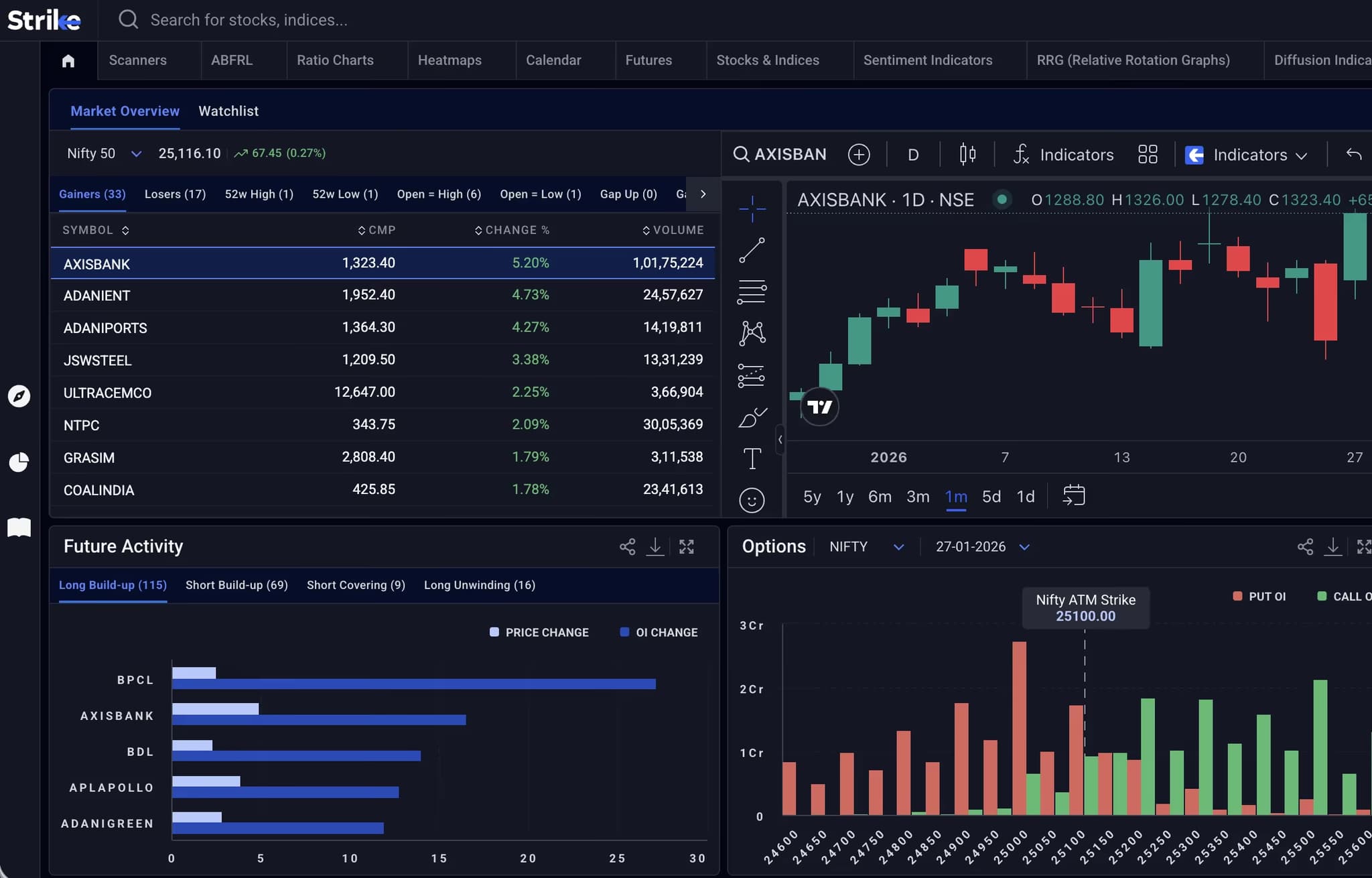
- Real-time market data
- Advanced charting tools
- Institutional-grade analytics
Join thousands of traders worldwide
Join 100,000+ traders receiving our exclusive newsletter with market analysis, trading strategies, and actionable insights.

Weekly Market Analysis
Expert insights on market trends and opportunities
Exclusive Trading Strategies
Proven techniques from professional traders
Free Trading Guide (Worth ₹7,999)
Comprehensive beginner to advanced trading guide
Early Access to New Content
Be the first to read our latest articles

"Strike's newsletter completely transformed my trading approach. The insights are invaluable!"
— Amit Sharma, Active Trader
50K+
Active Traders
$2.5B+
Trading Volume
150+
Markets Covered
24/7
Support Available