17 Option Selling Strategies That Work in 2026 (With Win-Rate Data)


 Author

 Editor
Option selling strategies are some of the most popular approaches traders use to generate income, benefit from time decay, and trade different market conditions with defined rules. Option selling strategies can produce consistent premium income and are mostly preferred by professionals, because according to SEBI report, most option contracts expire worthless, which is a very suitable condition for any option sellers.
The challenge is that there isn’t one strategy that works in every market. Some are designed for sideways markets, others for bullish or bearish trends, while a few profit from changes in volatility. In this guide, you’ll discover 17 proven option selling strategies, understand when to use each one, how they work, their risk-reward profile, and real-world examples—helping you select the right strategy instead of relying on guesswork.
What is Option Selling?
Option selling, also known as option writing, is a trading strategy where you sell an option contract to a buyer and receive a premium from the buyer. While selling options, you also take the obligation to fulfill the contract if the buyer exercises it, but profits if the option expires worthless.
How does an Option Seller Make Money?
Option sellers make money by collecting and keeping the premium received from option buyers. The core logic is, while buying an option, buyers immediately pay an upfront premium to option sellers to buy the contract. As this option contract starts losing its value, option sellers keep that premium as profit. Once option contracts become worthless at the end of expiry, option keeps the entire premium as profit.
There are three major factors that work in favour of option sellers and reduce the price of option contracts.
- Time decay (theta): Theta or time decay reduces the value of the options everyday if the underlying price does not move much in expected direction. This phenomenon helps option sellers to keep the premium.
- The underlying doesn’t move against you: When the underlying stays flat, and doesn’t move enough to make the option worth exercising, the option loses value and you can either let it expire or buy it back cheap.
- Volatility drops (vega): If the volatility falls after you sell an option, the option contract loses its value faster, letting you buy it back at a profit before expiration.
Hence, option sellers make profit once option prices start losing its value and sellers keep the premium as profit. Although during expiry, the option loses its value fast, many professional traders do not wait till expiry and exit early to avoid risk from gamma spiking.
Compare Best Option Selling Strategies
| Strategy | Risk / Reward | Typical Win Rate* | Best For |
| Cash-Secured Put | High downside risk (stock to zero) / Premium received | High (70–85%) | Bullish or neutral traders willing to own the stock at a discount |
| Covered Call | High downside risk / Premium + capped upside | High (70–85%) | Investors seeking income from existing stock holdings |
| Short Straddle | Unlimited risk / Limited premium | Medium (55–70%) | Experienced traders expecting very low volatility |
| Short Strangle | Unlimited risk / Limited premium | Medium-High (60–75%) | Traders expecting the underlying to remain within a range |
| Bull Put Spread | Defined risk / Limited reward | High (65–80%) | Moderately bullish traders seeking limited risk |
| Bear Call Spread | Defined risk / Limited reward | High (65–80%) | Moderately bearish traders seeking limited risk |
| Iron Condor | Defined risk / Limited reward | High (65–80%) | Neutral traders expecting a range-bound market |
| The Wheel | High downside risk / Premium + stock appreciation | High (70–85%) | Long-term investors generating recurring income |
| Ratio Spread | Limited or unlimited risk (depending on structure) / Limited to moderate reward | Medium (55–65%) | Traders expecting a limited move in one direction |
| Jade Lizard | Undefined downside risk / Limited reward with no upside risk | High (65–80%) | Neutral to moderately bullish traders in high IV markets |
| Iron Butterfly | Defined risk / Higher reward than Iron Condor | Medium (50–65%) | Neutral traders expecting price to expire near the strike |
| Broken Wing Butterfly | Defined risk (often reduced on one side) / Limited reward | Medium (55–70%) | Traders with a slight directional bias |
| Big Lizard | Undefined downside risk / Limited reward | Medium (60–70%) | Neutral to moderately bullish traders seeking higher premium |
| Twisted Sister | Undefined upside risk / Limited reward | High (65–80%) | Neutral to moderately bearish traders |
| Batman Strategy | Defined risk / Limited reward | Medium (55–65%) | Advanced traders expecting expiry near one of two target prices |
| Calendar Spread | Defined risk / Limited reward | Medium (55–70%) | Neutral traders expecting low near-term movement and rising IV |
| Diagonal Spread | Defined risk / Limited reward | Medium (55–70%) | Moderately directional traders benefiting from theta and IV |
| Short Guts | Unlimited risk / Limited premium | Medium (60–70%) | Experienced traders expecting limited price movement |
| Christmas Tree (Short) | Defined risk / Limited reward | Medium (55–65%) | Traders with a neutral to slightly directional outlook |
| Poor Man’s Covered Call | Defined risk (LEAPS premium) / Limited reward | High (65–80%) | Capital-efficient alternative to a covered call |
| Poor Man’s Covered Put | Defined risk (LEAPS premium) / Limited reward | High (65–80%) | Capital-efficient alternative to a covered put |
Best Option Selling Strategies Our Traders Use at Strike Money
In Strike Money we generally use 17 different option selling strategies based on market outlook. These strategies are briefly discussed below.
1. Cash-Secured Put (CSP)
Cash-Secured put is also a regular income strategy where you sell an OTM put option to earn regular premium while keeping enough cash to buy underlying shares if assigned. This option strategy is mostly used by investors to buy the stock at a discount price while earning regular premium while waiting to acquire the stock at a lower price.
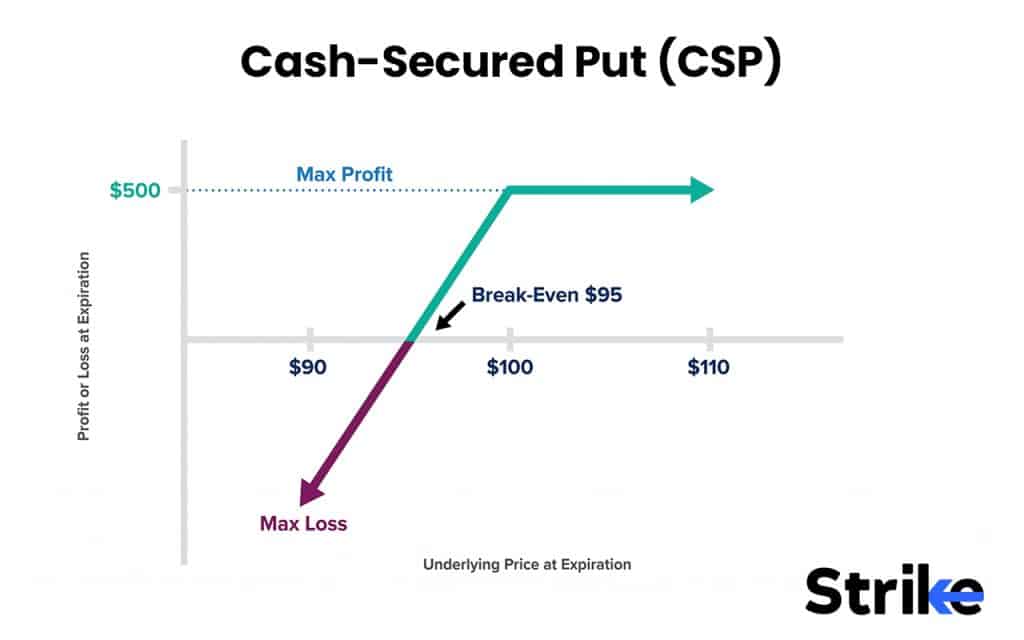
As we receive a premium by selling puts, this strategy is a net-credit strategy and involves two legs.
| Action | Instrument | Strike Price | Expiry |
| Sell | 1 Put Option | ATM or Slightly OTM | Same Expiry |
| Reserve | Cash Equal to Strike Price × Lot Size | — | Until Expiry |
Through the practice of Option Selling, you take on the obligation to fulfill the contract if the buyer exercises it, but you profit if the option expires worthless. Many professional traders rely on Option Selling to collect premium income in range-bound or stable markets.
The Cash-Secured Put strategy works best when you expect a stock to remain neutral or bullish, but you want to buy it at a discounted price. By opening a Cash-Secured Put, you sell the OTM put option at your desired price and earn premium until the stock eventually gets assigned to you.
| Cash-Secured Put (CSP) Summary Table | |
| Strategy Type | Net Credit Strategy |
| Maximum Profit | Net Premium Received |
| Maximum Loss | Strike Price − Premium Received (if the stock falls to zero) |
| Breakeven | Strike Price − Premium Received |
| Best When | Neutral to moderately bullish outlook, high implied volatility (IV) |
| Risk-Reward | Limited Reward, Significant Downside Risk |
| Classification | Bullish Income Strategy |
2. Covered Call
Covered call is a regular income generation option strategy where you sell the OTM call option of a stock that you already own to earn a regular premium. It is a two-legged option selling strategy mostly used by investors who want to earn extra returns on the stock they own, instead of letting their shares sit idle.
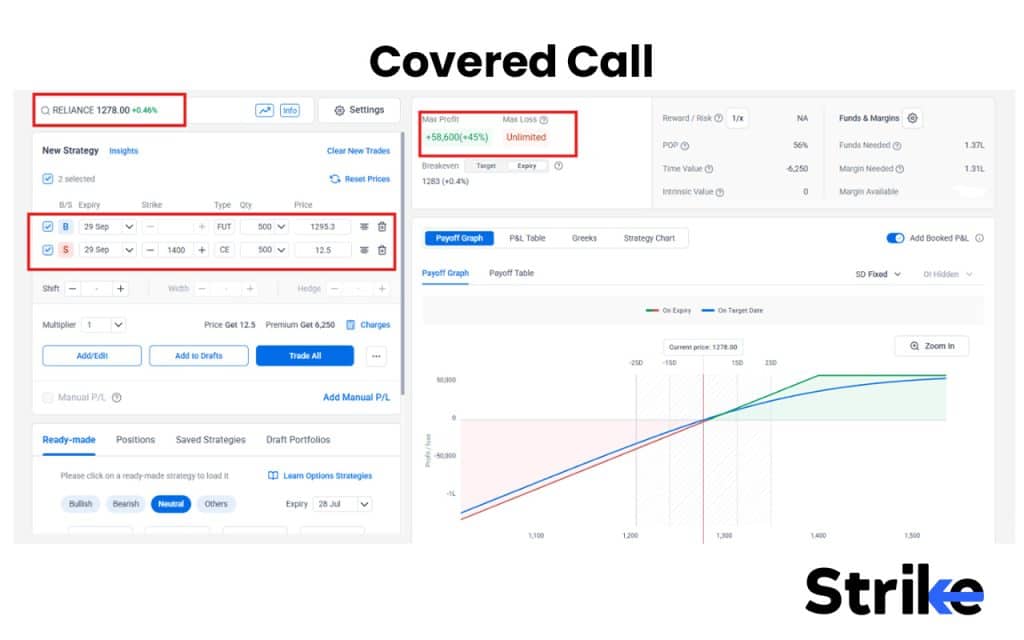
| Action | Instrument | Strike Price | Expiry |
| Buy/Hold | 100 Shares (or 1 Lot) of the Underlying Asset | — | — |
| Sell | 1 Call Option | OTM (Above Current Market Price) | Same Expiry |
You can create a Covered Call when you expect your owned stock to remain neutral, moderately bullish, or even go down slightly. Implementing a Covered Call allows you to generate income from your existing shares while providing a small buffer against minor price declines.
| Covered Call Summary Table | |
| Strategy Type | Net Credit Strategy |
| Maximum Profit | Premium Received + (Strike Price − Stock Purchase Price) |
| Maximum Loss | Similar to owning the stock (if the stock falls to zero, offset by the premium received) |
| Breakeven | Stock Purchase Price − Premium Received |
| Best When | Neutral to moderately bullish outlook, high implied volatility (IV) |
| Risk-Reward | Limited Reward, Significant Downside Risk |
| Classification | Bullish Income Strategy |
3. Short Straddle & Short Strangle
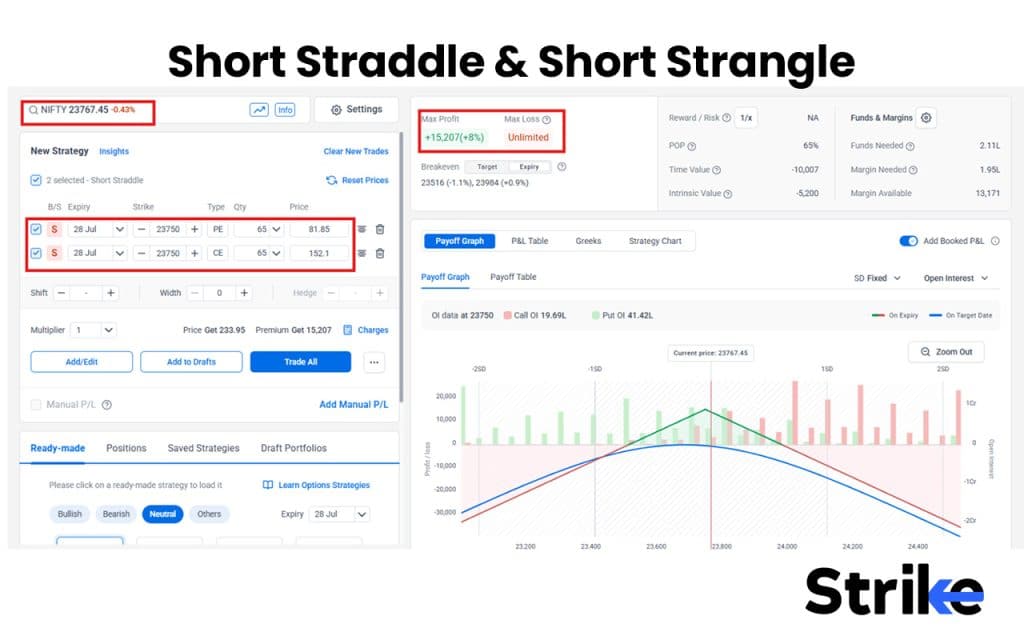
Short straddle and short strangle is a market neutral option strategy where traders aim to capture premium when the market expires sideways or within the selected range. Both these strategies involve simultaneously selling of call and put options, but of a different strike. In short straddle, we sell at the money (ATM) call and put option, whereas in short strangle, we sell out of the money (OTM) call and put option.
| Action | Option Type | Strike Price | Expiry |
| Sell | 1 Call Option | ATM | Same Expiry |
| Sell | 1 Put Option | ATM | Same Expiry |
As we sell at the money call and put options in short straddles, the maximum profit happens when the market expires exactly at the money (ATM). Short straddle is comparatively risky because it has a very narrow range, therefore the slightest price move can cause a loss.
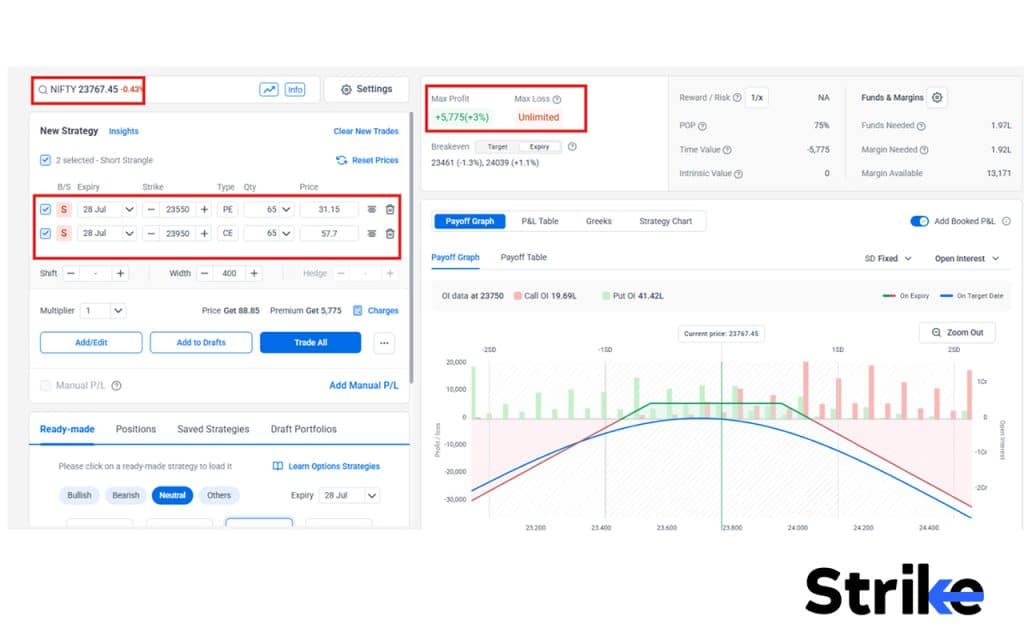
| Action | Option Type | Strike Price | Expiry |
| Sell | 1 Put Option | Lower Strike (OTM) | Same Expiry |
| Sell | 1 Call Option | Higher Strike (OTM) | Same Expiry |
Unlike short straddle, in short strangle, we sell out-of-the-money call and put options, giving us a wider profit range, instead of having a narrow range. If the market expires anywhere within this range, we will gain the maximum profit.
| Short Straddle & Short Strangle Summary Table | ||
| Metric | Short Straddle | Short Strangle |
| Market Bias | Neutral | Neutral |
| Typical Probability of Profit | 50–65% | 60–75% |
| Average Win Rate (Backtests) | 55–65% | 60–70% |
| Maximum Profit | Premium Received | Premium Received |
| Maximum Loss | Unlimited | Unlimited |
| Benefits from Time Decay | Very High | High |
| Benefits from Falling IV | Very High | High |
| Best Market Condition | Sideways, Low Volatility | Sideways, Moderate Volatility |
| Risk Level | Very High | Very High |
4. Credit Spreads (Bull Put & Bear Call)
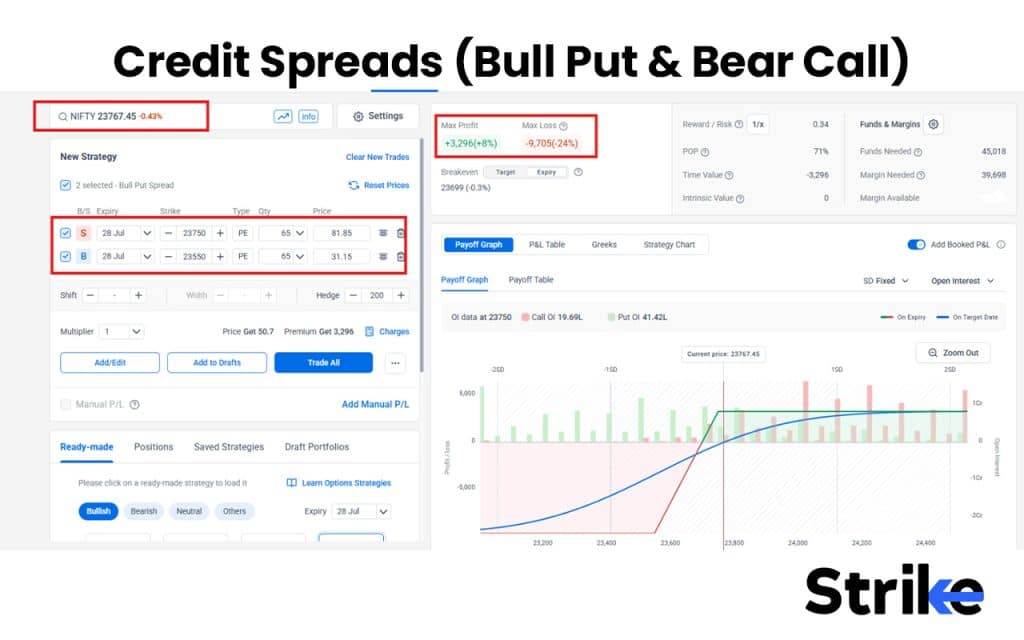
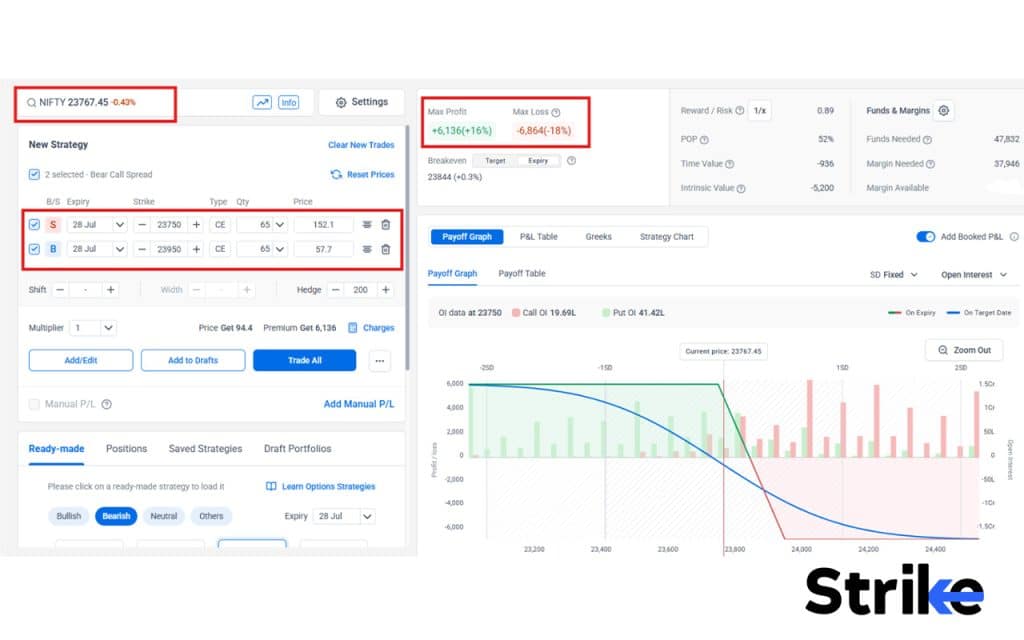
Credit spread is a defined-risk option strategy where you sell an ATM option to receive premium as a profit and buy an OTM option to limit the risk of unlimited loss. All these option contracts have the same expiry. This strategy is kind of a direction option strategy where you make profit when the market stays above or below a certain price level.
If you expect the market to stay above a specific price level, you create a bull put spread and if you expect the market to stay below a specific price level, you create bear call spread.
| Strategy | Action | Option Type | Strike Price | Expiry |
| Bull Put Spread | Sell | 1 Put Option | Higher Strike (OTM) | Same Expiry |
| Buy | 1 Put Option | Lower Strike (OTM) | Same Expiry | |
| Bear Call Spread | Sell | 1 Call Option | Lower Strike (OTM) | Same Expiry |
| Buy | 1 Call Option | Higher Strike (OTM) | Same Expiry |
Credit Spreads represent a two-legged options strategy because we sell one option and buy another as a hedge. In these types of Credit Spreads, a bear call spread profits when the option expires below the sold strike price, whereas a bull put spread makes a profit when the option expires above the sold strike.
| Credit Spreads (Bull Put & Bear Call) summary table | ||
| Metric | Bull Put Spread | Bear Call Spread |
| Market Bias | Bullish | Bearish |
| Probability of Profit (Typical)* | 60–75% | 60–75% |
| Average Win Rate (Backtests)* | 62–72% | 60–70% |
| Maximum Profit | Net Credit | Net Credit |
| Maximum Loss | Defined | Defined |
| Time Decay Benefit | High | High |
| Volatility Preference | Falling or Stable IV | Falling or Stable IV |
| Best Market Condition | Mild Uptrend / Sideways | Mild Downtrend / Sideways |
| Risk Level | Moderate | Moderate |
5. Iron Condor
Iron condor is a market neutral strategy where we combine an OTM Bull Put Spread and a OTM Bear Call Spread to collect premium from both the legs and simultaneously limit our unlimited loss in the market. You can also consider it as a strangle with hedges.
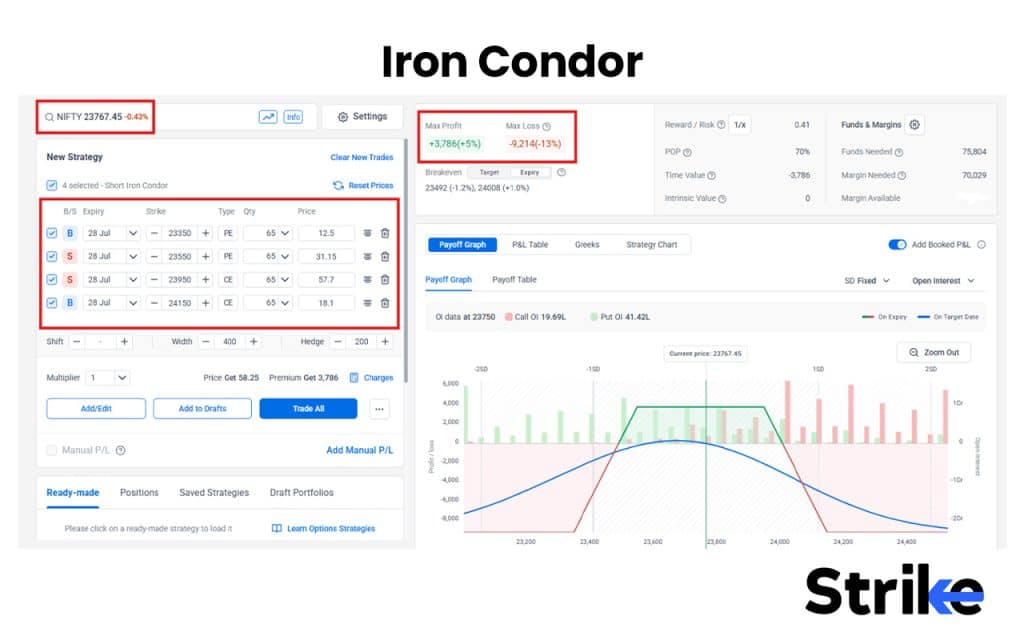
Iron condor is a four-legged strategy, which involves selling of one OTM Call and Put option and buying of one far OTM call and put option.
| Action | Option Type | Strike Price | Expiry |
| Buy | 1 Put Option | Lower Strike (OTM) | Same Expiry |
| Sell | 1 Put Option | Higher Strike (OTM) | Same Expiry |
| Sell | 1 Call Option | Lower Strike (OTM) | Same Expiry |
| Buy | 1 Call Option | Higher Strike (OTM) | Same Expiry |
You can create this strategy if you expect the market to remain sideways and expire within the expected range, so you receive the net premium as profit.
| Iron Condor Summary Table | |
| Strategy Type | Net Credit Strategy |
| Maximum Profit | Net Premium Received |
| Maximum Loss | Width of One Spread − Net Premium Received |
| Breakeven | Upper: Short Call Strike + Net Premium ReceivedLower: Short Put Strike − Net Premium Received |
| Best When | Neutral outlook, high implied volatility at entry followed by falling IV |
| Risk-Reward | Limited Risk, Limited Reward |
| Classification | Neutral Income Strategy |
6. The Wheel Strategy
Wheel strategy is a regular income generating option strategy where you use cash secured put and covered call option strategy and keep shifting between them to earn regular premium from both the strategy.
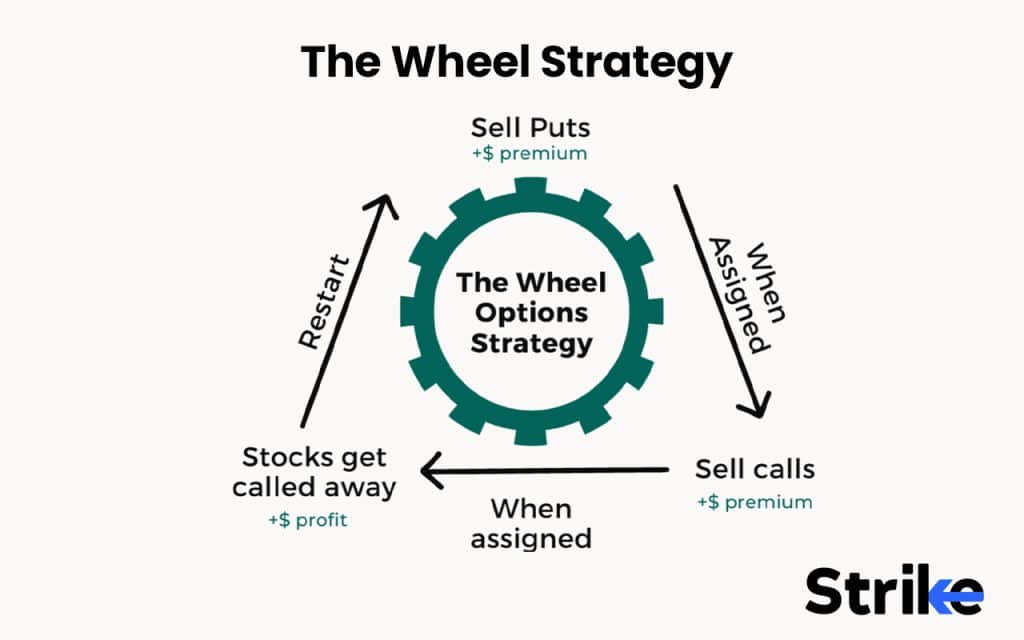
Wheel strategy is a multi-legged option strategy where you sell cash-secured puts to acquire a stock and then sell covered calls on the shares.
Step 1: Sell a Cash-Secured Put
| Action | Instrument | Strike Price | Expiry |
| Sell | 1 Put Option | ATM or Slightly OTM | Same Expiry |
| Keep | Cash to Buy Shares if Assigned | Equal to Strike × Lot Size | — |
Step 2: If Assigned, Sell a Covered Call
| Action | Instrument | Strike Price | Expiry |
| Buy/Receive | Underlying Shares (via Assignment) | Strike Price | — |
| Sell | 1 Call Option | ATM or Slightly OTM | Same Expiry |
This strategy is suitable for investors who want to earn regular income while comfortably holding the stocks. The cash-secured put is a net credit strategy and covered call is a net credit strategy.
| The Wheel Strategy Summary Table | |
| Strategy Type | Net Credit Strategy |
| Maximum Profit | Limited per cycle (Premium + Capital Gain if Shares Are Called Away) |
| Maximum Loss | Significant (If the Stock Price Falls Sharply) |
| Breakeven | Stock Purchase Price − Total Premium Received |
| Best When | Moderately bullish or neutral outlook with high implied volatility (IV) |
| Risk-Reward | Moderate Risk, Moderate Reward |
| Classification | Income Generation Strategy |
7. Ratio Spreads
A Ratio Spread is a moderately directional option strategy where you buy fewer options but sell more options of different strike prices. It aims to generate premium income while expecting the underlying to move only moderately.
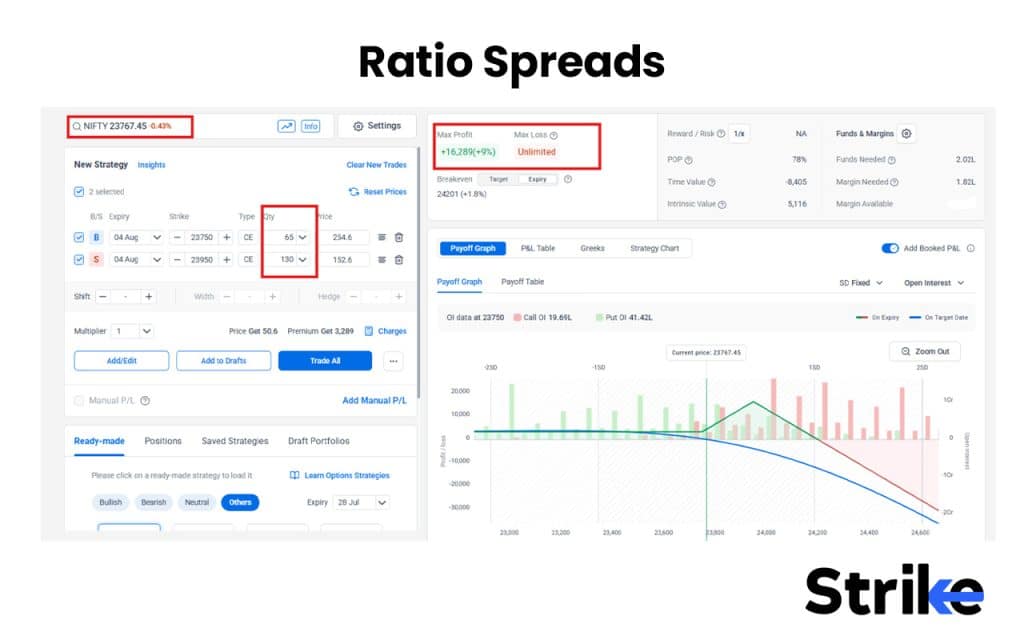
You can construct this strategy by buying one call or put option and selling 2 call or put options of the same type with the same expiry but different strike prices.
| Action | Option Type | Strike Price | Expiry |
| Buy | Call/Put | Lower Strike | Same Expiry |
| Sell | Call/Put | Higher Strike (2 Lots) | Same Expiry |
The logic behind a Ratio Spread is to earn from premium decay while expecting the underlying to stay near the short strike. Depending on the premiums, it may be entered as a Net Credit or Net Debit Strategy.
| Ratio Spreads Summary Table | |
| Strategy Type | Net Credit or Net Debit Strategy |
| Maximum Profit | Limited |
| Maximum Loss | Can Be Unlimited |
| Breakeven | Multiple Breakeven Points |
| Best When | Moderately Bullish (Call) or Moderately Bearish (Put) |
| Risk-Reward | High Risk, Limited Reward |
| Classification | Ratio Strategy |
8. The Jade Lizard
A Jade Lizard is an advanced options trading strategy designed to generate premium income with zero upside risk. It is a three-legged option strategy that combines a short (naked) put with a short call spread (bear call spread).
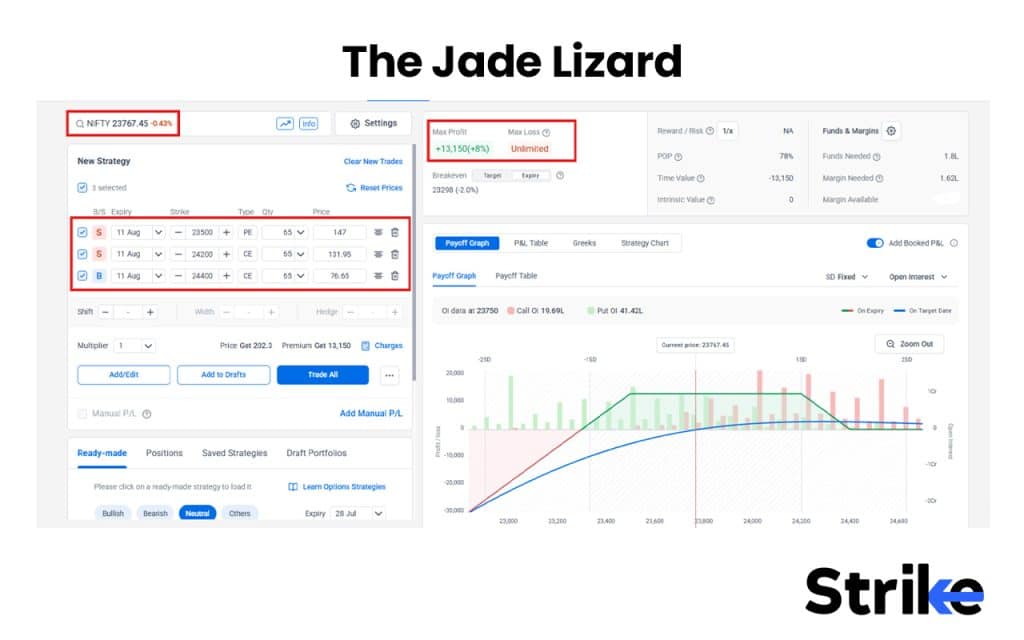
| Action | Option Type | Strike Price | Expiry |
| Sell | 1 Put Option | Lower Strike (OTM) | Same Expiry |
| Sell | 1 Call Option | Higher Strike (OTM) | Same Expiry |
| Buy | 1 Call Option | Further Higher Strike (OTM) | Same Expiry |
You can create this strategy when you expect the market to stay moderately bullish or to stay above a particular strike price till expiry. Since you receive more premium than you pay, a Jade Lizard is a Net Credit Strategy.
| The Jade Lizard Summary Table | |
| Strategy Type | Net Credit Strategy |
| Maximum Profit | Net Premium Received |
| Maximum Loss | Substantial on the downside (similar to a Cash-Secured Put, offset by premium) |
| Breakeven | Short Put Strike − Net Premium Received |
| Best When | Neutral to moderately bullish outlook, high implied volatility (IV) |
| Risk-Reward | Limited Reward, Significant Downside Risk |
| Classification | Bullish Income Strategy |
9. Iron Butterfly
Iron Butterfly is a market neutral strategy where we combine an ATM Bull Put Spread and an ATM Bear Call Spread to collect premium from both the legs and simultaneously limit our unlimited loss in the market. You can also consider it as straddle with hedges.
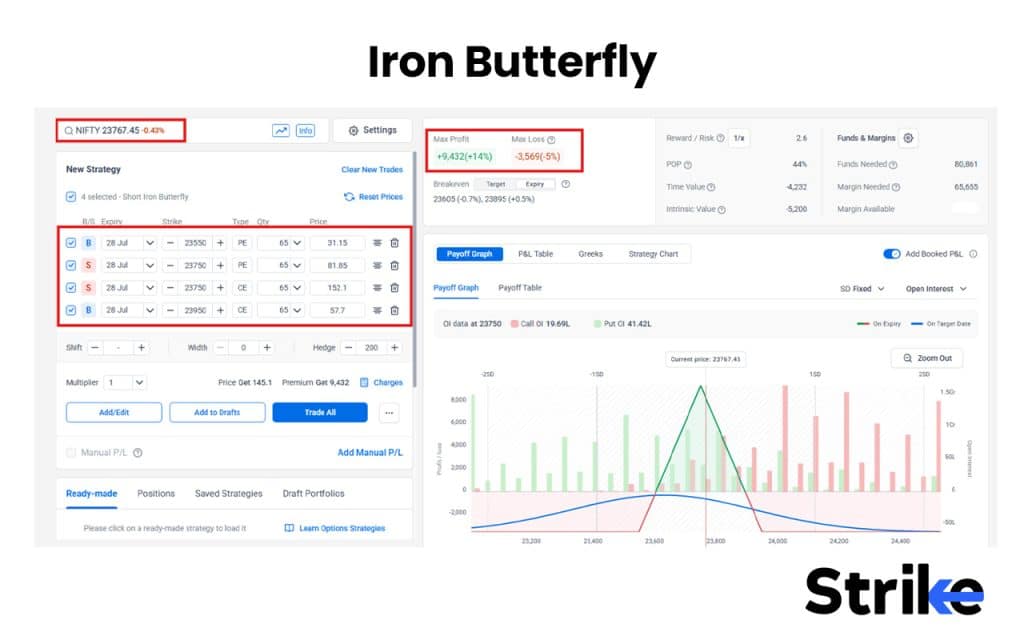
Iron butterfly is also a four-legged strategy, which involves selling one ATM Call and Put option and buying one OTM call and put option.
| Action | Option Type | Strike Price | Expiry |
| Buy | 1 Put Option | Lower Strike (OTM) | Same Expiry |
| Sell | 1 Put Option | Middle Strike (ATM) | Same Expiry |
| Sell | 1 Call Option | Middle Strike (ATM) | Same Expiry |
| Buy | 1 Call Option | Higher Strike (OTM) | Same Expiry |
You can create this strategy, when you expect the market to remain sideways and expire near the sold options to maximum premium as profit.
| Iron Butterfly Summary Table | |
| Strategy Type | Net Credit Strategy |
| Maximum Profit | Net Premium Received |
| Maximum Loss | Width of One Spread − Net Premium Received |
| Breakeven | Upper: Middle Strike + Net Premium ReceivedLower: Middle Strike − Net Premium Received |
| Best When | Neutral outlook, high implied volatility at entry followed by falling IV |
| Risk-Reward | Limited Risk, Limited Reward |
| Classification | Neutral Income Strategy |
10. Broken Wing Butterfly
A Broken Wing Butterfly is a modified version of a standard butterfly where the spread on one side is wider than the other side. This creates an asymmetric or uneven payoff chart reducing the cost of the strategy while keeping the risk limited.
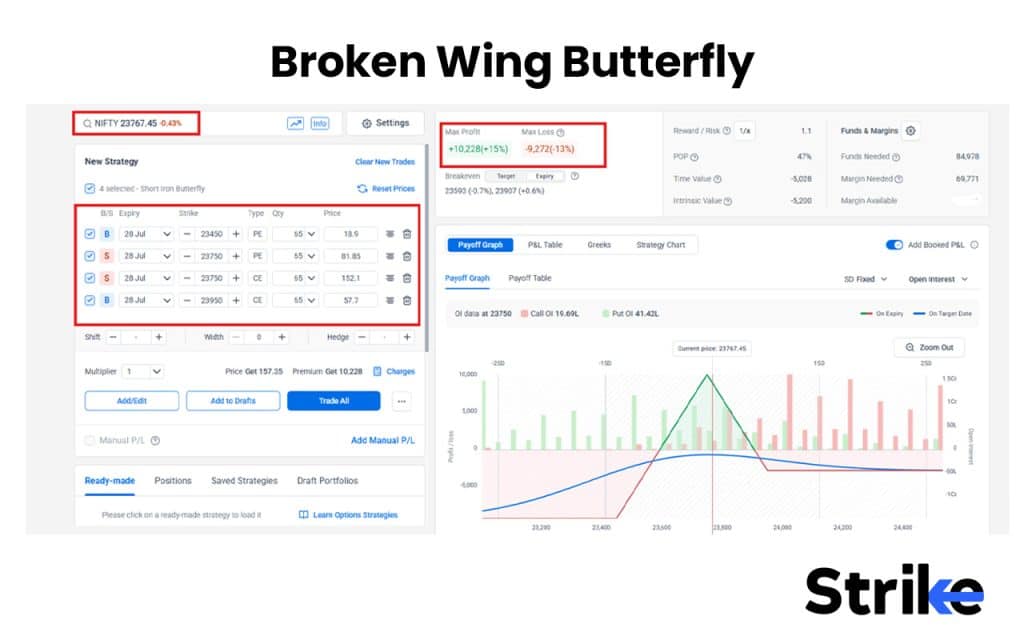
It is a four-legged option strategy created by buying one option at the lower strike, selling two options at the middle strike, and buying one option at a farther strike, creating unequal wing widths.
| Action | Option Type | Strike Price | Expiry |
| Buy | Call/Put | Lower Strike | Same Expiry |
| Sell | Call/Put | Middle Strike (2 Lots) | Same Expiry |
| Buy | Call/Put | Wider Higher Strike | Same Expiry |
You can create this strategy when the market moves in a moderate direction, either bullish or bearish. A Broken Wing Butterfly can be established as a Net Debit or Net Credit Strategy, depending on the strike selection and option premiums.
| Broken Wing Butterfly Summary Table | |
| Strategy Type | Net Debit or Net Credit Strategy |
| Maximum Profit | Limited |
| Maximum Loss | Limited |
| Breakeven | Depends on strike prices |
| Best When | Moderately Bullish or Bearish |
| Risk-Reward | Limited Risk, Limited Reward |
| Classification | Directional Spread Strategy |
11. Big Lizard
A big lizard option strategy is an advanced neutral to bullish option strategy, which can be created by combining bull put credit spread and naked short call option. This strategy is created when a trader expects the market to stay above the sold put strike and below the sold call strike until expiry.
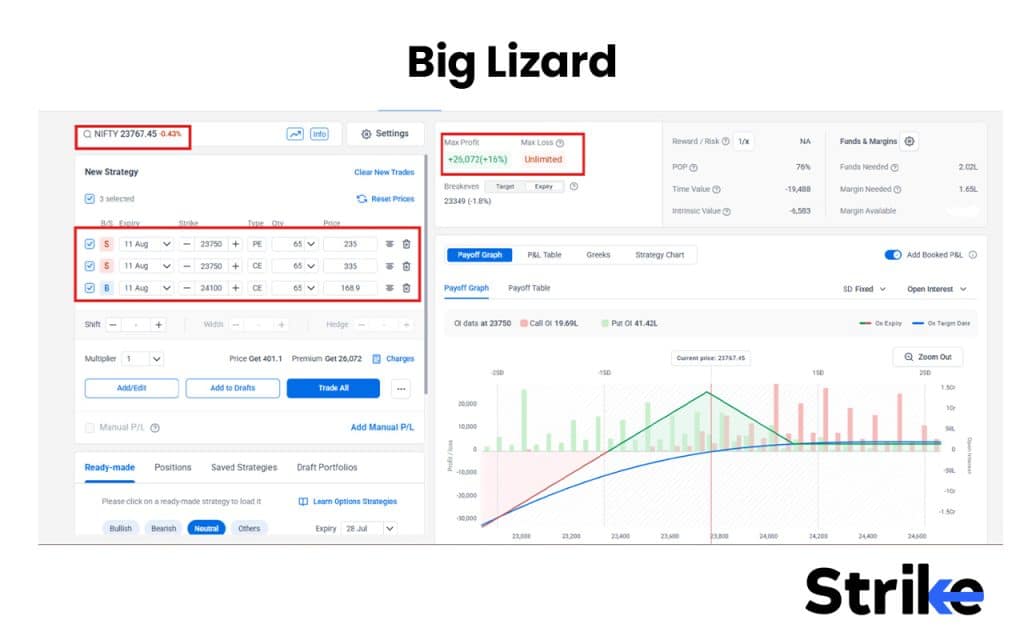
| Action | Option Type | Strike Price | Expiry |
| Buy | 1 Put Option | Lower Strike (OTM) | Same Expiry |
| Sell | 1 Put Option | Higher Strike (OTM) | Same Expiry |
| Sell | 1 Call Option | Higher Strike (OTM) | Same Expiry |
The Big Lizard is suitable only for experienced traders due to its uncovered short call.
The downside risk in this strategy is limited because of long protective put. But on the upside, if price rises sharply above the sold call strike, the strategy faces unlimited upside risk.
| Big Lizard Summary Table | |
| Market Bias | Neutral to Bullish |
| Typical Probability of Profit | 60–75% |
| Average Win Rate (Observed) | 60–70% |
| Maximum Profit | Net Credit Received |
| Maximum Loss | Limited Downside, Unlimited Upside |
| Benefits from Time Decay | High |
| Benefits from Falling IV | High |
| Best Market Condition | Sideways to Mild Uptrend |
| Risk Level | High |
12. Twisted Sister
Sister is a neutral to directional option strategy created by combining call and put of different strike price. It is a variation of iron condor or iron butterfly strategy where the one side is twisted away from the current market price to create an asymmetrical risk-reward profile.
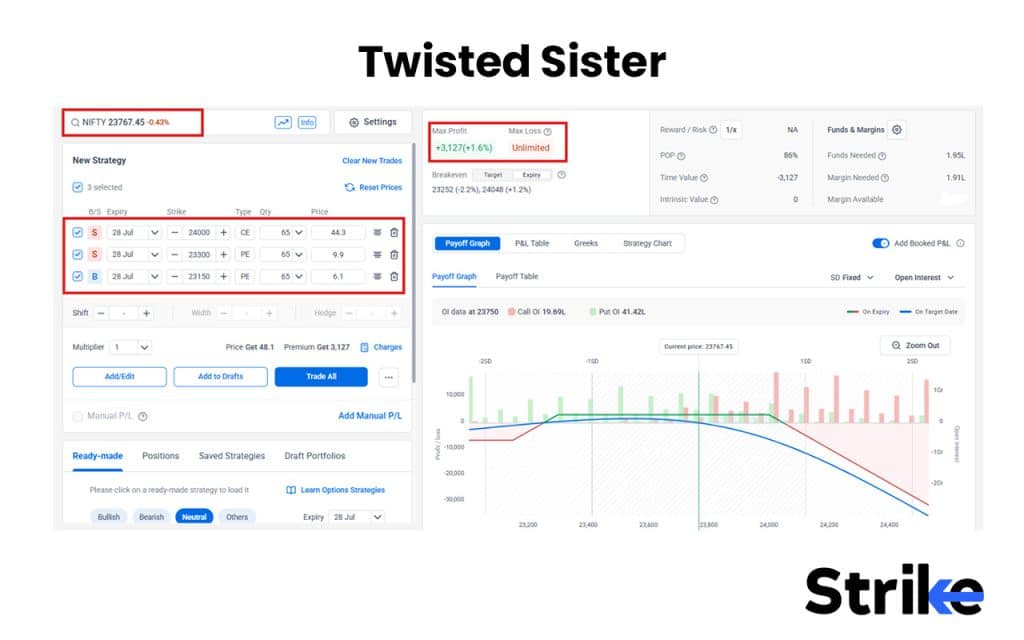
| Action | Option Type | Strike Price | Expiry |
| Buy | 1 Put Option | Lower Strike (OTM) | Same Expiry |
| Sell | 1 Put Option | Higher Strike (OTM) | Same Expiry |
| Sell | 1 Call Option | ATM/OTM | Same Expiry |
| Buy | 1 Call Option | Higher Strike (Far OTM) | Same Expiry |
By “twisting” one side of the position, traders can express a slightly bullish or bearish outlook while still benefiting from time decay (Theta). The strategy typically generates a net credit, has limited maximum profit, and defined maximum loss.
| Twisted Sister Summary Table | |
| Market Bias | Neutral to Slightly Bullish/Bearish |
| Typical Probability of Profit | 60–75% |
| Average Win Rate (Observed) | 60–70% |
| Maximum Profit | Net Credit Received |
| Maximum Loss | Limited |
| Benefits from Time Decay | High |
| Benefits from Falling IV | High |
| Best Market Condition | Sideways to Mild Trend |
| Risk Level | Moderate |
13. Batman / Double Jade Lizard
A Batman strategy is a market-neutral options strategy designed to profit when the underlying asset expires within a specific price range. It gets its name because the payoff graph resembles the Batman logo, with two profit peaks and a dip in the middle.
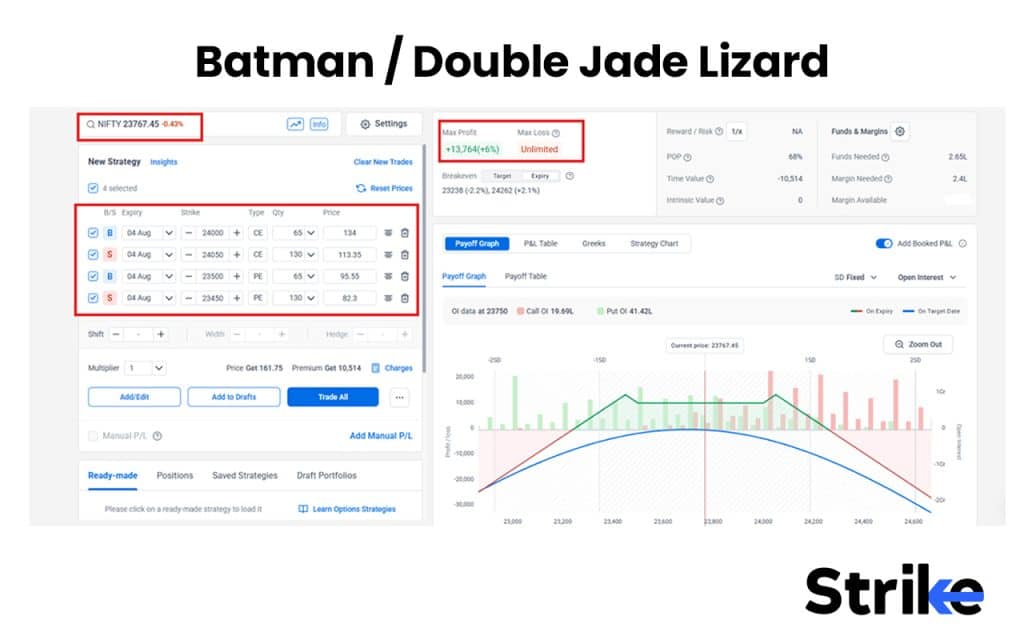
It is a four-legged option strategy created by combining two vertical spreads on the same option type (either all calls or all puts). The maximum profit occurs when the price expires near either of the two middle strike prices, while losses are limited because of the long options at the outer strikes.
| Action | Option Type | Strike Price | Expiry |
| Buy | 1 Call/Put Option | Lower Strike | Same Expiry |
| Sell | 1 Call/Put Option | Lower Middle Strike | Same Expiry |
| Sell | 1 Call/Put Option | Upper Middle Strike | Same Expiry |
| Buy | 1 Call/Put Option | Higher Strike | Same Expiry |
You can create this strategy when you expect the market to remain range-bound but believe it has a higher probability of expiring near one of two predefined price levels rather than exactly at the center of the range.
| Batman / Double Jade Lizard Summary Table | |
| Strategy Type | Net Debit or Net Credit (depends on strike selection) |
| Maximum Profit | Limited |
| Maximum Loss | Limited |
| Breakeven | Multiple Breakeven Points (typically four) |
| Best When | Neutral outlook with expected expiry near one of two target price levels |
| Risk-Reward | Limited Risk, Limited Reward |
| Classification | Neutral Range-Bound Strategy |
14. Calendar / Diagonal Spreads
Calendar spread, also known as time spread or horizontal spread, is option selling strategy where you simultaneously buy and sell same strike option but of different expiry dates.Typically, it involves buying a long-term expiry option and selling a short-term expiry option.
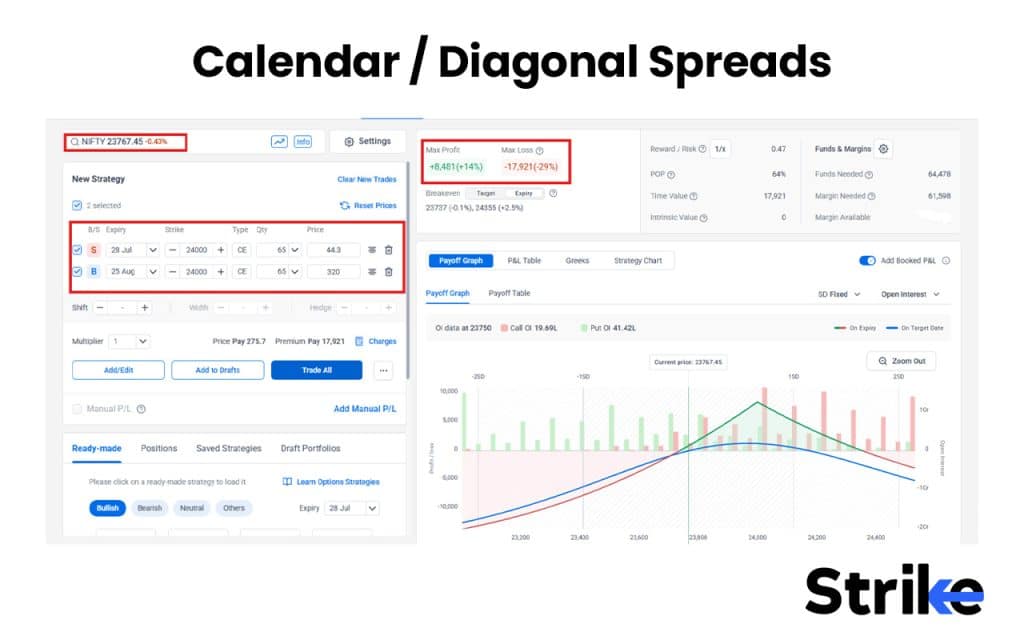
This strategy gives profit from theta decay of short-term sold options while giving protection from volatility from long-term bought options.
| Action | Option Type | Strike Price | Expiry |
| Buy | 1 Call Option | ATM | Far-Month Expiry |
| Sell | 1 Call Option | ATM | Near-Month Expiry |
Unlike calendar spread, diagonal spread is a directional option strategy where it combines features of calendar spread and a vertical spread. This strategy involves buying and selling of options with different strike prices with different expiries.
| Action | Option Type | Strike Price | Expiry |
| Buy | 1 Call Option | Lower Strike (ATM/ITM) | Far-Month Expiry |
| Sell | 1 Call Option | Higher Strike (OTM) | Near-Month Expiry |
In this strategy, maximum profit depends on stock price at the near month expiry and the remaining value of the long option.
| Calendar / Diagonal Spreads Summary Table | ||
| Metric | Calendar Spread | Diagonal Spread |
| Market Bias | Neutral | Slightly Directional |
| Typical Probability of Profit | 50–65% | 55–70% |
| Average Win Rate (Backtests) | 55–65% | 58–68% |
| Maximum Profit | Limited (Variable) | Limited (Variable) |
| Maximum Loss | Net Debit Paid | Net Debit Paid |
| Benefits from Time Decay | High | High |
| Benefits from Rising IV | Very High | High |
| Best Market Condition | Sideways | Mild Trend |
| Risk Level | Moderate | Moderate |
15. Short Guts
Short guts strategy is a market neutral option strategy. Unlike short strangle where we sell out of the money call and put option, in ghost short strategy, we sell in the money call and in the money put option with the same expiry but different strike price.
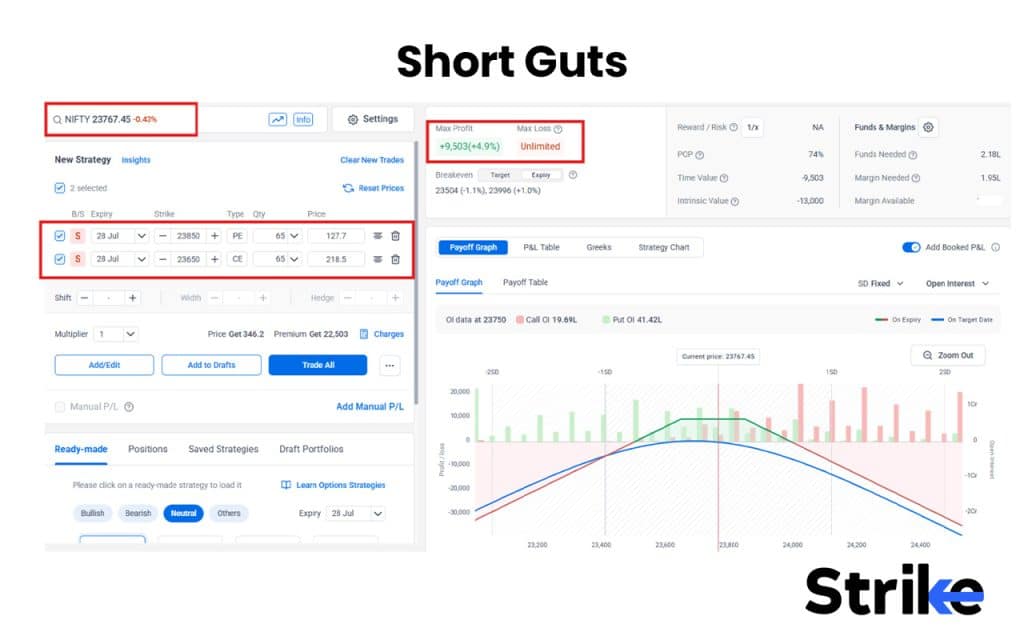
As we sell one ITM (In the Money) put and call option, it is a two-legged option strategy that you can create when you expect market
| Action | Option Type | Strike Price | Expiry |
| Sell | 1 Put Option | Higher Strike (ITM) | Same Expiry |
| Sell | 1 Call Option | Lower Strike (ITM) | Same Expiry |
Since we sell in-the-money call and put options, the premium we receive is comparatively higher. However, these sold options are uncovered, the strategy carries unlimited upside and downside risk.
| Short Guts Summary Table | |
| Market Bias | Neutral |
| Typical Probability of Profit | 45–60% |
| Average Win Rate (Observed Backtests) | 45–55% |
| Maximum Profit | Premium Received |
| Maximum Loss | Unlimited (Upside), Substantial (Downside) |
| Benefits from Time Decay | Very High |
| Benefits from Falling IV | High |
| Best Market Condition | Sideways, Low Volatility |
| Risk Level | Very High |
16. Christmas Tree (short)
A Short Christmas Tree is an advanced option-selling strategy created by combining multiple call options or put options at different strike prices. It is the opposite of a Long Christmas Tree and is designed to profit when the underlying asset makes a moderately strong move away from the middle strike before expiry.
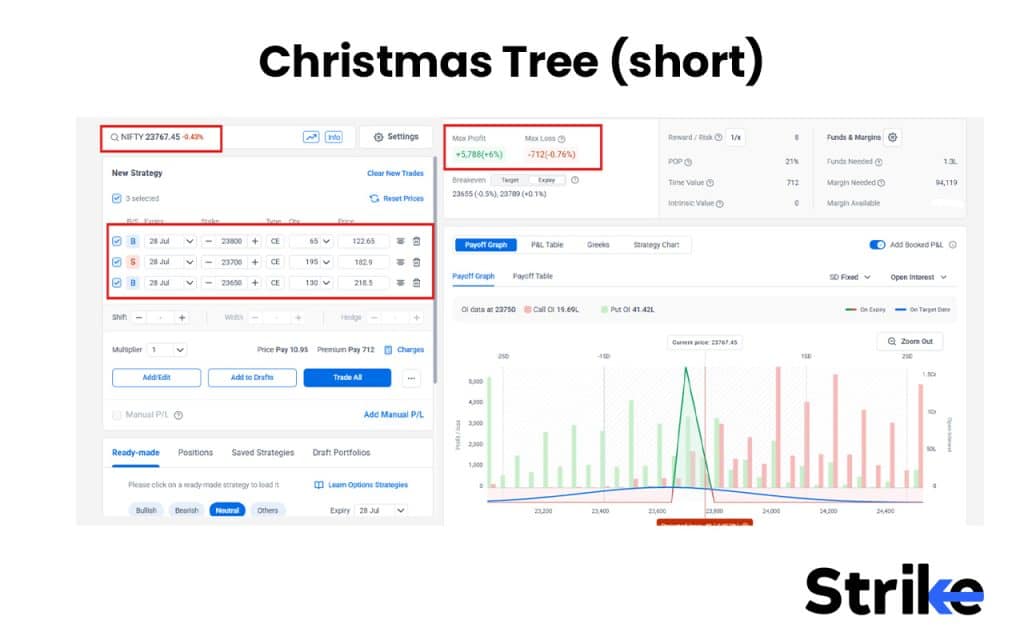
| Action | Option Type | Strike Price | Expiry |
| Sell | 1 Call Option | Lower Strike (ITM/ATM) | Same Expiry |
| Buy | 2 Call Options | Middle Strike (ATM/OTM) | Same Expiry |
| Sell | 1 Call Option | Higher Strike (OTM) | Same Expiry |
The strategy performs best when Nifty makes a moderate move away from the middle strike without an extreme breakout. Due to its complexity and relatively limited use.
| Christmas Tree (short) Summary Table | |
| Market Bias | Moderately Bullish or Bearish (depending on structure) |
| Typical Probability of Profit | 45–60% |
| Average Win Rate (Observed) | 45–55% |
| Maximum Profit | Limited |
| Maximum Loss | Limited |
| Benefits from Time Decay | Moderate |
| Benefits from Falling IV | Moderate |
| Best Market Condition | Moderate Directional Move |
| Risk Level | Moderate |
17. Poor Man’s Covered Call/Put
Poor Man’s Covered Call (PMCC) is a capital efficient option strategy where you can create a covered call strategy with low capital using options. This strategy exactly mimics the standard covered call strategy.
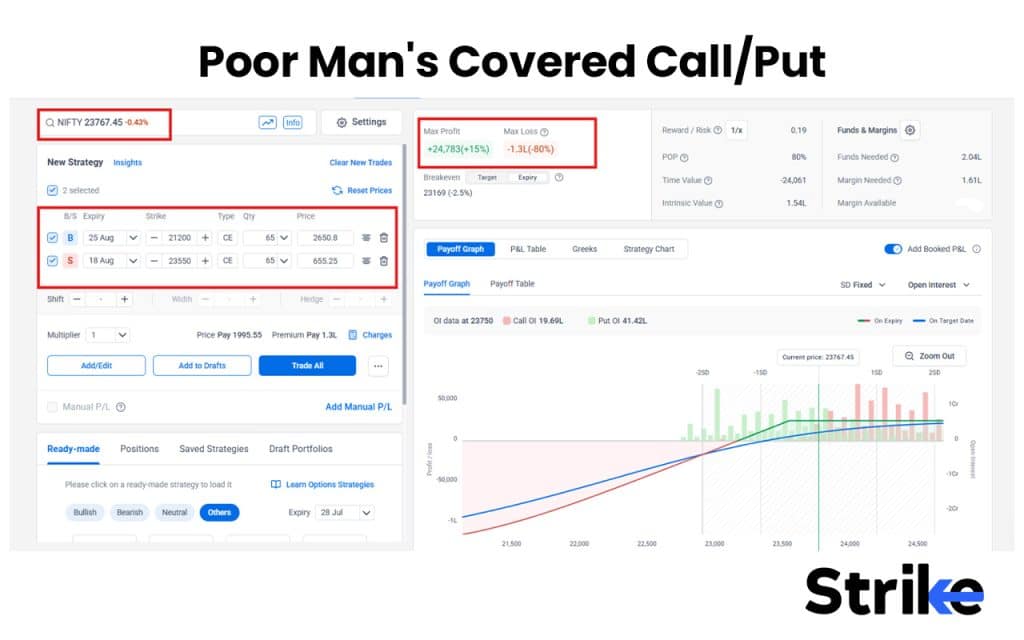
It is a two-legged option strategy where you buy a long-term deep ITM call option (LEAPS) and sell a short-term OTM call option.
| Action | Option Type | Strike Price | Expiry |
| Buy | 1 Call Option | Deep ITM | Long-Term (LEAPS) |
| Sell | 1 Call Option | OTM | Near-Term Expiry |
You can use a Poor Man’s Covered Call when you expect market moves to be bullish and want to generate covered call-like income. Since buying the long-term call in a Poor Man’s Covered Call costs more than the premium received, the strategy is always a net debit strategy.
| Poor Man’s Covered Call/Put Summary Table | |
| Strategy Type | Net Debit Strategy |
| Maximum Profit | Limited (Depends on the strike prices and premium received) |
| Maximum Loss | Net Premium Paid |
| Breakeven | Long Call Strike + Net Premium Paid |
| Best When | Moderately bullish outlook with low to moderate implied volatility (IV) |
| Risk-Reward | Limited Risk, Moderate Reward |
| Classification | Bullish Income Strategy |
How to Choose an Option Selling Strategy
Choosing the right option selling strategy depends on your market outlook, implied volatility (IV), risk tolerance, capital available, and experience level. There is no single strategy that works in every market. The best traders select a strategy that matches the current market conditions rather than forcing the same setup every time.
- Define Your Market Outlook: Start by identifying where you expect the underlying asset to move before expiry.
| Market Outlook | Suitable Option Selling Strategies |
| Strongly Bullish | Cash-Secured Put, Bull Put Spread |
| Moderately Bullish | Bull Put Spread, Covered Call |
| Neutral / Sideways | Iron Condor, Short Strangle, Short Straddle* |
| Moderately Bearish | Bear Call Spread |
| Strongly Bearish | Covered Call (on existing holdings), Bear Call Spread |
- Assess Your Volatility View: Option sellers generally benefit when implied volatility falls after entering the trade because option premiums decline.
| Volatility Expectation | Preferred Option Selling Strategies |
| IV Rising | Wait for richer premiums or use defined-risk credit spreads |
| IV High and Expected to Fall | Iron Condor, Short Strangle, Short Straddle, Credit Spreads |
| IV Stable | Covered Call, Cash-Secured Put, Credit Spreads |
| IV Low | Prefer defined-risk spreads or wait for better premium opportunities |
- Evaluate Your Risk Appetite: Choose a strategy whose maximum risk matches your comfort level.
| Risk Profile | Suitable Option Selling Strategies |
| Low Risk | Bull Put Spread, Bear Call Spread, Iron Condor |
| Medium Risk | Covered Call, Cash-Secured Put |
| High Risk | Short Strangle, Short Straddle, Naked Call, Naked Put |
- Consider Capital and Margin Requirements: Different option selling strategies require different amounts of capital or margin.
| Capital Available | Suitable Option Selling Strategies |
| Low | Bull Put Spread, Bear Call Spread |
| Medium | Iron Condor, Covered Call |
| High | Cash-Secured Put, Short Strangle, Naked Options |
- Match the Strategy to Your Experience: Some option selling strategies are easier to understand and manage than others.
| Experience Level | Suitable Option Selling Strategies |
| Beginner | Covered Call, Cash-Secured Put, Bull Put Spread |
| Intermediate | Bear Call Spread, Iron Condor |
| Advanced | Short Strangle, Short Straddle, Naked Options, Ratio Spreads |
A quick note: I’m not a financial advisor, and this isn’t a recommendation — options selling carries real risk, including assignment and, with undefined-risk strategies, potentially large losses. It’s worth paper-trading a strategy first and sizing positions so no single trade can hurt you badly.
How Do Option Sellers Make Money from Time Decay?
Time decay is gradual reduction in options premium as it gets closer to its expiry. Since option sellers make money when the sold option contract loses its value, theta decay works in option sellers favour.
When an option is sold, the seller receives a premium upfront. As each day passes, the option’s extrinsic (time) value decreases. If the option expires worthless, the seller keeps the entire premium as profit.
Let’s understand how time decay helps option sellers to make money using an example. Suppose you sell Nifty 25,200 Call Option for ₹120 in expectation that nifty will stay below 25,200 and option will expire worthless.
| Days to Expiry | Option Premium | Seller’s Unrealized Profit |
| 20 Days | ₹120 | ₹0 |
| 15 Days | ₹95 | ₹25 |
| 10 Days | ₹70 | ₹50 |
| 5 Days | ₹35 | ₹85 |
| Expiry | ₹0 (if OTM) | ₹120 |
As Nifty stayed below 25,200 till expiry, you as a seller received all the premium as a profit after expiry. As you can see, option loses its premium faster as expiry was nearing, because theta decay is not linear.
How Does Implied Volatility Affect Option Selling?
Implied volatility has a major impact on option selling, because implied volatility directly impacts the option premium. Unlike, theta which affects option premium gradually, implied volatility can change option premium rapidly based on market expectation.
During the period of high implied volatility and low implied volatility, the option premium moves differently that affects the overall profitability of option sellers.
- High Implied Volatility: During the period of high implied volatility, options have high premiums allowing option sellers to collect more premiums as profit.
- Low Implied Volatility: During periods of low implied volatility, options have low premiums, lowering the total profit for option sellers.
Since option sellers earn profit from premium, they usually prefer selling options during high volatility to earn higher premium. However, high IV does not mean direct sell because high IV means uncertainty, which can lead to sharp rise in premium further giving option seller loss. Hence, professional traders do not sell options only looking at high IV.
Which Option Greeks Matter Most to Option Sellers?
Theta, Delta, Vega, and Gamma are the most important option Greeks for option selling. These Greeks help sellers measure how changes in time, price, and volatility affect the option premium and their position.
- Theta (Time Decay): It is the most important Greek in options that measures how much the option premium will decrease with the passage of time. As it is directly linked with premium erosion, it is a biggest ally of option sellers. Higher theta generally means faster premium erosion and high probability of making profits.
- Delta: It is usually used to measure directional risk, because delta measures how much an option’s premium is expected to change when the underlying asset moves by ₹1. A higher delta means option premium will be more sensitive to underlying price movement, whereas lower delta means option premium will be less sensitive to underlying price movement. Therefore, option sellers prefer positions with low delta because they are less sensitive to underlying price movement.
- Vega: It measures how the implied volatility affects the option premium. A higher implied volatility means higher option premium and low implied volatility means low option premium. An option seller usually looks for high implied volatility, which increases the Vega of their position, to earn profit from a high option premium. This higher Vega means that when volatility eventually decreases, the option price will fall significantly, benefiting the seller.
- Gamma: It measures how fast a delta changes as the underlying asset moves. For option sellers high gamma increases the risk of losses, especially near the expiry, a small move in underlying price can rapidly increase Delta, causing losses to accumulate much faster.
Theta is the most important Greek for option sellers because it allows them to profit from the natural erosion of an option’s time value. However, successful option selling also requires monitoring Delta for directional exposure, Vega for changes in implied volatility, and Gamma for the increasing risk of sharp price movements near expiration. While Rho affects option prices, it usually has the least impact on short-term option-selling strategies.
How to Select Strike Prices When Selling Options
There are five important factors you should consider before selecting a strike price while selling an option which includes market outlook, expected volatility, days to expire, risk tolerance, and support/resistance level.
How to Choose an Expiration for Option Selling
Choosing expiration for option selling is mainly about balancing theta decay speed, gamma risk, premium size, and how much time you want to manage the trade. Short dated options have a faster theta decay but carries more gamma risk, whereas long dated options have a gradual theta decay but carries less gamma risk.
| Days to Expiry (DTE) | Characteristics | Best For |
| 0–7 Days | Very fast time decay, high gamma risk | Experienced traders |
| 15–30 Days | Good balance of premium and risk | Active traders |
| 30–45 Days | Strong premium with manageable risk | Most option-selling strategies |
| 45–60 Days | Higher premium but slower theta decay | Positional traders |
| 60+ Days | Slow time decay, capital tied up longer | Long-term income strategies |
While any Option Expiry can be traded, 30–45 DTE options are considered a sweet spot for selling because theta decay accelerates meaningfully. This specific Option Expiry window provides enough time for a thesis to play out or for you to adjust without the extreme gamma risk of the final 1–2 weeks.
How to Manage Risk When Selling Options
Risk management is the most important aspect of option selling. Although option sellers benefit from time decay (Theta), a single large adverse market move can wipe out several profitable trades. Following a few essential risk management rules can help protect your capital and improve long-term consistency.
- Define Your Maximum Risk Before Entering: Decide your entry, stop-loss, and profit target in advance to avoid emotional decisions during market volatility.
- Control Position Size: Keep your position sizing in such a way that the maximum loss should not exceed 1–2% of your trading capital per position.
- Prefer Defined-Risk Strategies: Instead of selling naked options, consider strategies with hedges like Bull Put Spreads, Bear Call Spreads, or Iron Condors. Such strategies have defined losses.
- Monitor Implied Volatility: Avoid selling option just because the IV is high, because high IV can also signal the possibility of larger price swings. Sell option when the IV is expected to drop.
- Avoid Holding Positions Through Major Events: Events like earnings announcements, RBI policy meetings, or election results can cause sudden price movements. Avoid selling options in such events or sell only if you have a strategy designed for such events.
- Exit Winning Trades Early: Experienced traders usually exit their trade after capturing 50-80% of the maximum profit, instead of waiting till expiry to capture all 100% premium. They do this to avoid risk due to gamma spiking during the final days.
The key to successful option selling is not collecting the highest premium—it is managing risk effectively. By controlling position size, defining losses in advance, using defined-risk strategies, monitoring implied volatility, avoiding high-risk events, and booking profits systematically, option sellers can improve consistency and protect their trading capital over the long run.
When Should an Option Seller Take Profit?
One of the biggest mistakes option sellers make is holding positions until expiration to collect the last bit of premium. While this may increase the maximum possible profit, it also exposes the trade to higher Gamma risk and unexpected market movements. Many experienced traders prefer to exit profitable trades early and lock in gains.
- Exit After Capturing 50–80% of the Premium: Exiting after 50-80% of the max profit is achieved to avoid the risk of gamma spiking during the final days before expiry.
- Exit Before Major Market Events: Exit if there are any major upcoming events like earnings announcement, RBI or Federal Reserve policy decision, election results, or union budget.
- Exit If the Market Outlook Changes: If the reason for selling an option is no longer valid, consider exiting the position.
Option sellers should focus on protecting profits rather than waiting for every option to expire worthless. Many experienced traders close positions after capturing 50–80% of the premium, before major market events, or when market conditions change. Taking profits systematically helps reduce risk and improves long-term trading consistency.
Can Option Selling Generate Regular Income?
Yes, option selling can generate regular income but not technically. The term regular is used, just because option selling usually has a high win rate, meaning it will give you profit more often. However, nothing is 100% guaranteed in the market and hence you will have to incur an occasional loss as well. So if you execute the trade proper risk management and position sizing, option selling can help you to generate some kind of regular income in the long run. How to Choose an Expiration for Option Selling
Choosing the right expiration in Option Income Strategies generally depends on your market outlook and how long you expect your market view to play out. These Option Income Strategies allow traders to consistently generate premium as long as they select the correct timeframe for their specific trade.
Is Option Selling Profitable in the Long Run?
Yes, option selling is profitable in the long run, but only when you execute it with proper risk management, position sizing, and well backtested strategy. Usually option selling is known for its high win percentage, which is actually true, most of the OTM options expire worthless, but high winrate is not enough.
The payoff chart of option selling strategies are usually asymmetrical, which means profits are small but losses are big. Therefore it is very important to manage risk in option selling because one occasional loss can wipe out days of small gains at once.
Best Tools and Platforms for Option Sellers
There are different tools and platforms available for trading options which includes Strike Money, Opstra, Sensibull, NSE, and TradingView. Let’s compare the features of these platforms using to find out which will be best for you.
| Feature | Strike | Sensibull | Opstra | TradingView | NSE Option Chain |
| Option Chain | Yes | Yes | Yes | No | Yes |
| Strategy Builder | Yes | Yes | Yes | No | No |
| Greeks Analysis | Yes | Yes | Yes | Limited | Basic |
| Implied Volatility (IV) Analysis | Yes | Yes | Yes | Limited | Basic |
| Open Interest (OI) Analysis | Advanced | Yes | Yes | Limited | Yes |
| Custom Indicators for Options | Yes | No | No | No | No |
| Option Screeners | Yes | Limited | Yes | No | No |
| Risk & Reward Analysis | Yes | Yes | Yes | No | No |
| Technical Charts | Yes | Limited | Limited | Advanced | No |
| Real-Time Alerts | Yes | Yes | Limited | Yes | No |
| Best For | All-in-one option traders | Beginners & strategy analysis | Advanced options analytics | Technical analysis | Official market data |
| Pricing | Freemium / Paid | Freemium / Paid | Paid | Freemium / Paid | Free |
Besides offering standard options tools such as option chains, Greeks, IV, OI analysis, and strategy builders, Strike also provides custom-built option indicators like strike OI insights, volatility skew, multistrike OI and more, that help traders identify trends, momentum, and institutional activity, features that are not available on the other platforms listed.

 5 mins