28 Bearish Candlesticks That Every Trader Should Master


 Author

 Editor
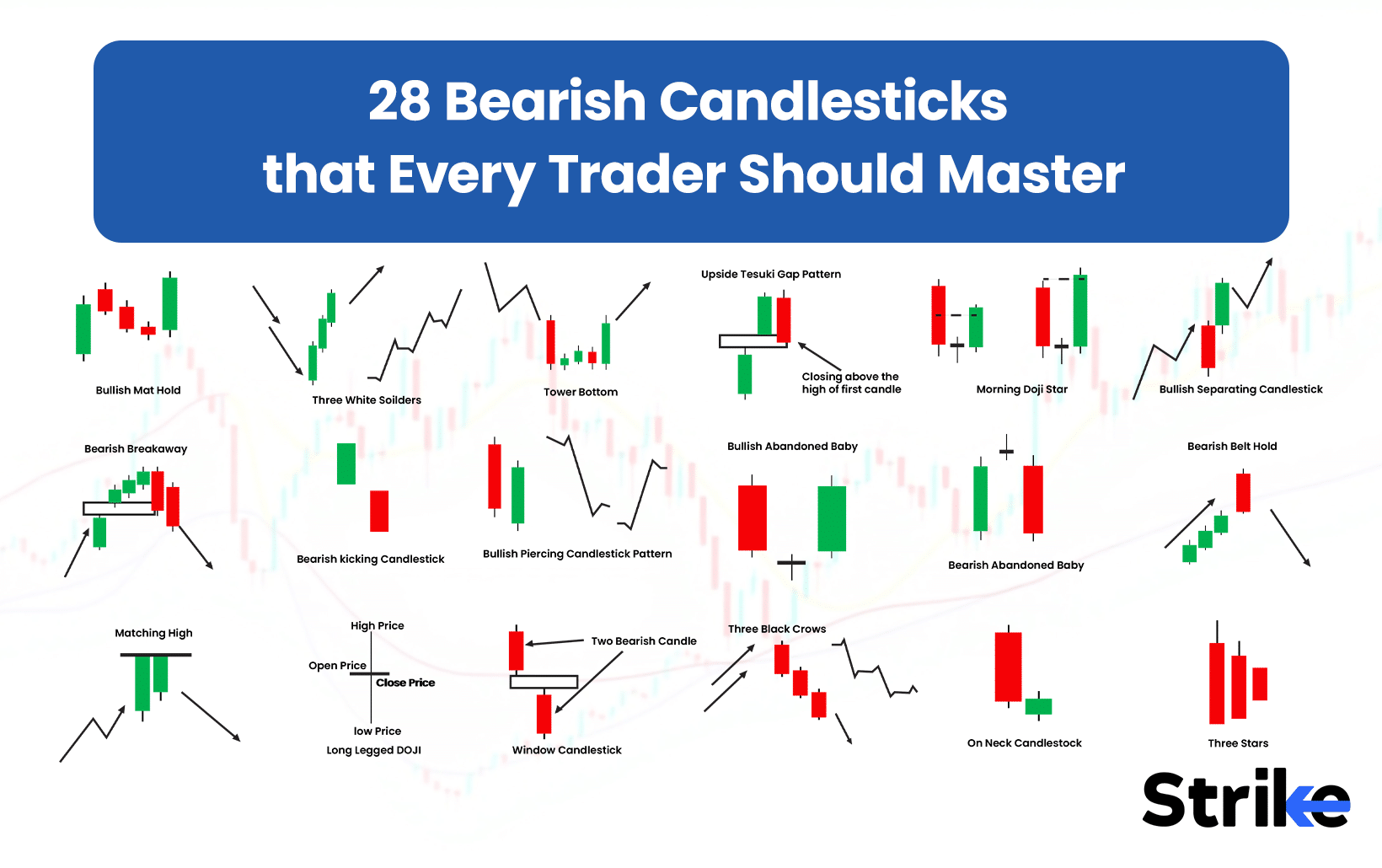
Bearish candlestick patterns provide traders with visual signals of supply–demand imbalance. Bearish candlestick patterns highlight moments when sellers dominate, helping identify reversals, continuations, or corrections. Used with confirmation tools, they improve timing and filter out market noise effectively.
Candlestick charting began in 18th-century Osaka rice markets, pioneered by merchants seeking price insight. It entered Western finance in the 1980s through translations and analyst adoption. Since then, standard definitions and backtests have embedded these patterns into technical trading systems.
A bearish candlestick forms when closing prices finish below the opening level. It often shows long upper shadows, engulfing moves, or gap-downs. These shapes signal selling pressure, resistance rejection, or trend continuation depending on context.
1. Bearish Marubozu
Bearish Marubozu is a candlestick that opens at the session’s high and closes at its low, forming a long body with no shadows. Bearish Marubozu represents absolute selling pressure, where sellers dominate every tick of the market without any buyer defense.
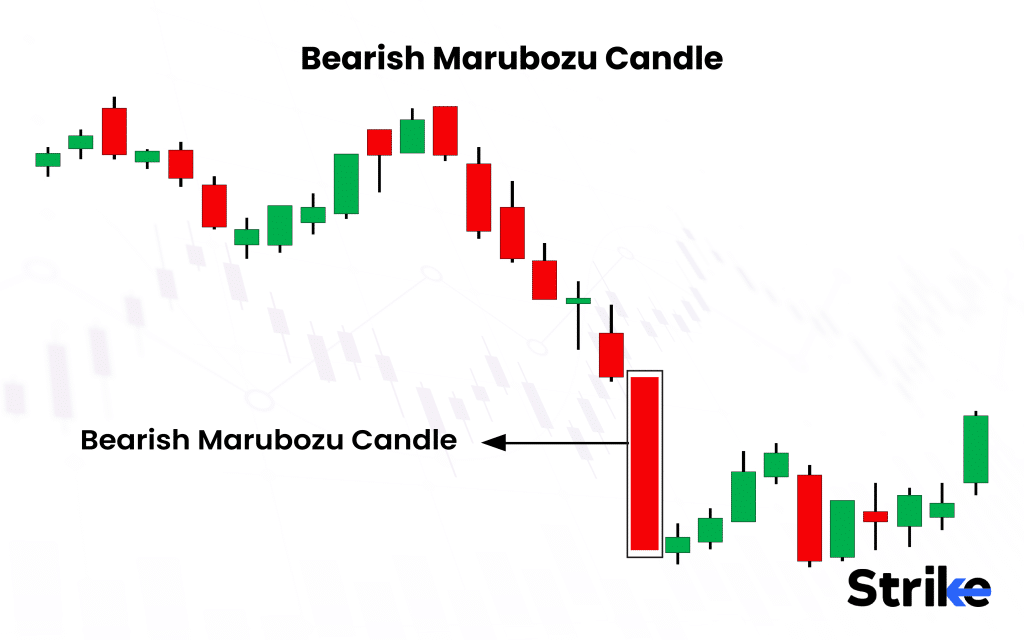
The candle communicates a session of uninterrupted bearish control, a rare situation where buyers are entirely sidelined. It signals continuation of a downtrend or exhaustion after a lengthy rally, often foreshadowing further weakness.
Such a structure forms when traders respond decisively to bearish catalysts—earnings disappointments, regulatory actions, or negative macro developments. Panic exits and institutional unloading push prices steadily lower, erasing any intraday recovery attempts.
Historically, this pattern was recognized in Edo-period rice trading, considered by Japanese analysts as one of the strongest proofs of one-sided conviction. The absence of wicks made it a “shaven head” candle, symbolizing finality in sentiment.
According to a 2015 Journal of Technical Analysis paper by the Market Technicians Association, bearish Marubozu patterns achieve better predictive accuracy when paired with rising volume and trend confirmation indicators, showing higher reliability than standalone occurrence.
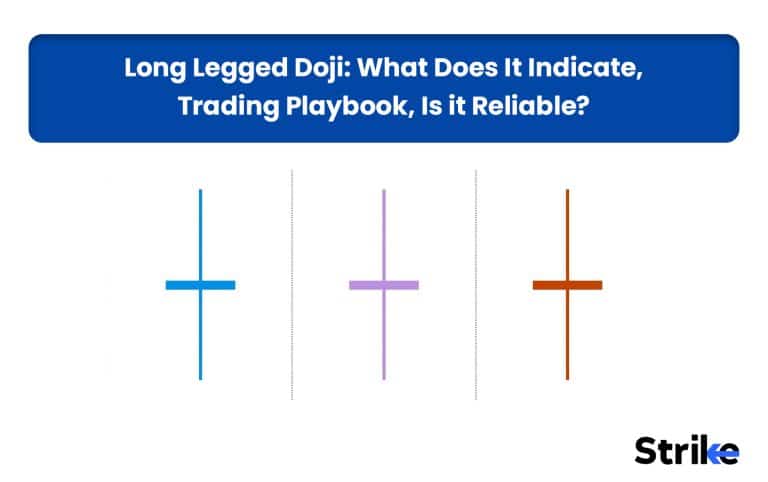
2. Gravestone Doji
Gravestone Doji is a candlestick where the open, low, and close are at the same level, leaving only a long upper shadow. Gravestone Doji conveys that bulls briefly pushed the price higher but were decisively overpowered by bears.
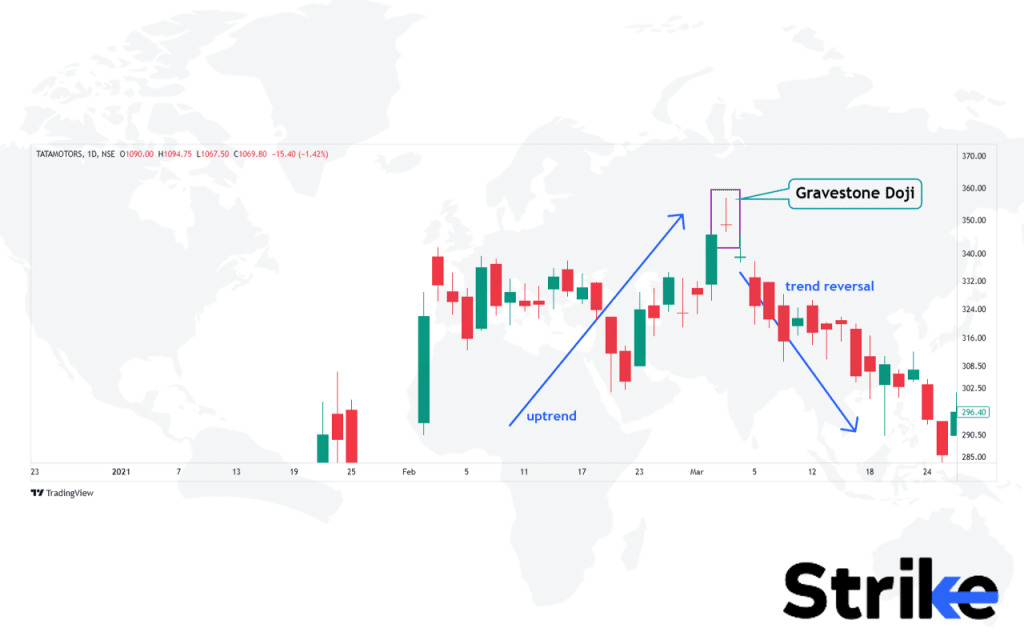
The pattern signals failure of upward momentum, as buyers lose conviction at elevated prices. It is often read as a sharp warning of bearish reversal, particularly at resistance or after an extended rally.
The psychology behind its shape is simple: enthusiasm fades once sellers flood in, rejecting higher valuations. Traders interpret it as the market writing its own gravestone for the preceding uptrend.
Japanese chartists gave it this ominous name centuries ago to reflect the death of bullish momentum. Its symbolic meaning made it popular across both Asian and Western candlestick traditions.
According to a 2018 CFA Institute Research Foundation review on technical signals, gravestone dojis show greater reliability on weekly timeframes and when confirmed by high trading volume, with accuracy improving in overbought conditions.
3. Bearish Spinning Top
Bearish Spinning Top is a candlestick with a small real body near the session’s low and long upper and lower shadows. Bearish Spinning Top reflects hesitation but with sellers ending in control of the close.
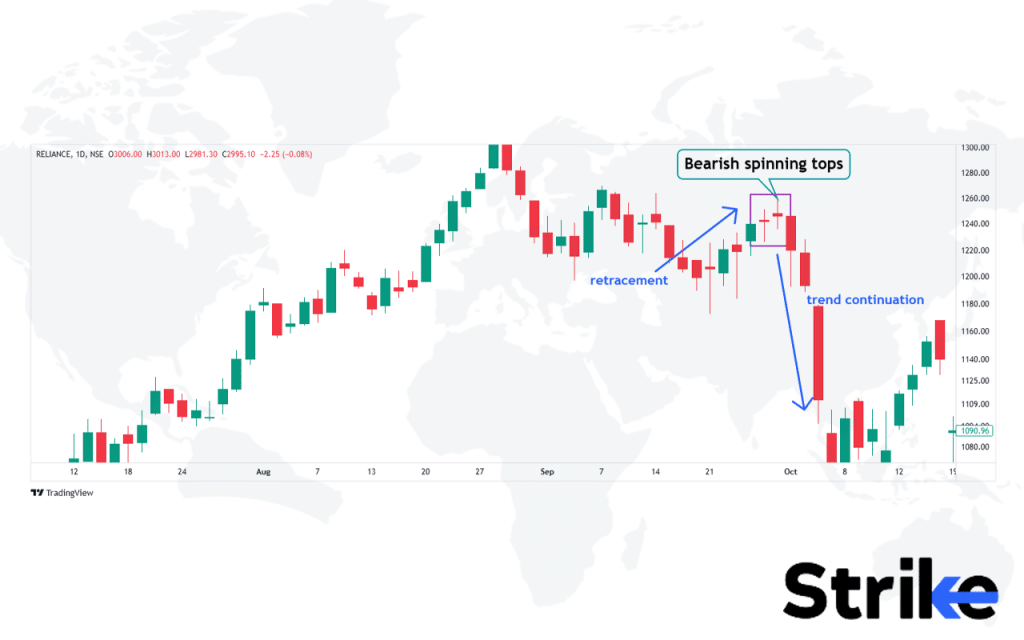
The candle shows a battle between buyers and sellers, but the weak close tilts sentiment toward the downside. It signals potential continuation of bearish momentum if confirmed by subsequent candles.
This shape forms when market participants attempt rallies and recoveries during the session, yet sellers repeatedly cap the upside. The closing near the lower end indicates that bearish pressure ultimately prevails.
Spinning tops have long been studied in Japanese candlestick literature as markers of indecision. The bearish version gained prominence when Western traders in the 1990s adapted candlestick charting to equity and futures markets.
According to Investopedia Technical Studies Review (2021), bearish spinning tops are not highly reliable as standalone signals but serve as strong reinforcement when aligned with resistance zones or volume surges.
4. Hanging Man
Hanging Man is a single-candle bearish reversal pattern that appears after an uptrend, with a small real body at the top and a long lower shadow. Hanging Man implies selling pressure entering the market despite bullish attempts.
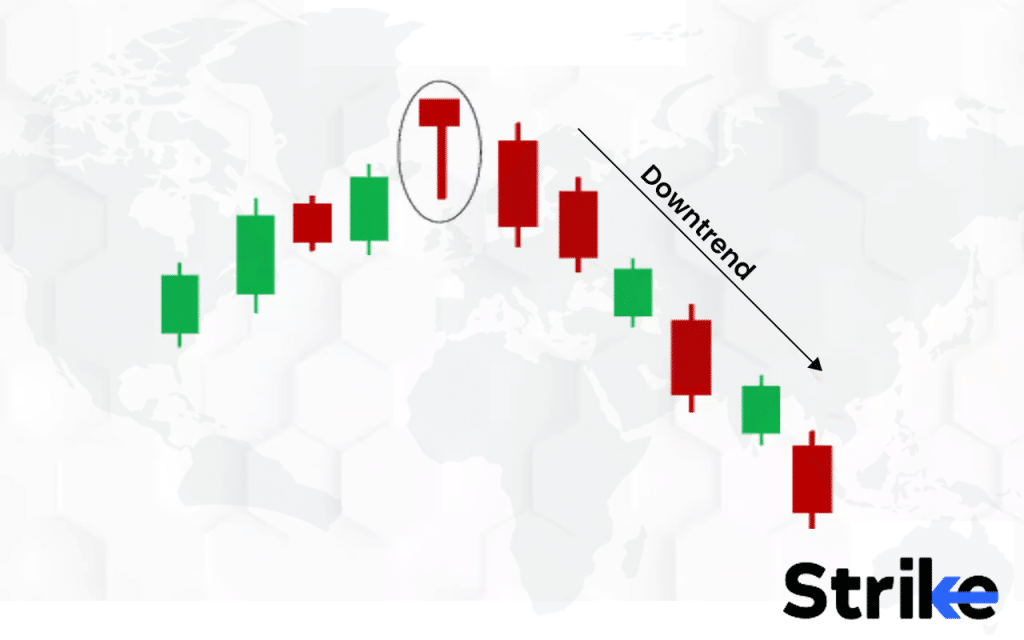
The candle suggests that although buyers kept prices elevated, sellers pushed them down significantly intraday before recovery. This intraday weakness is often treated as the first crack in bullish momentum.
Its formation typically occurs when traders begin profit booking after prolonged rallies. The lower shadow represents intraday panic selling, while the small upper body shows fragile control by buyers.
Japanese traders named it “Hanging Man” because the long lower shadow resembles a dangling body. The symbolism reinforced its reputation as a dangerous omen for overextended uptrends.
According to a 2017 study in the International Journal of Economics and Financial Issues, the Hanging Man is more predictive when it coincides with high trading volume and overbought technical indicators like RSI above 70.
5. Shooting Star
Shooting Star is a single bearish reversal candle with a small real body near the session low and a long upper shadow. Shooting Star shows failed attempts to sustain higher prices after aggressive intraday buying.
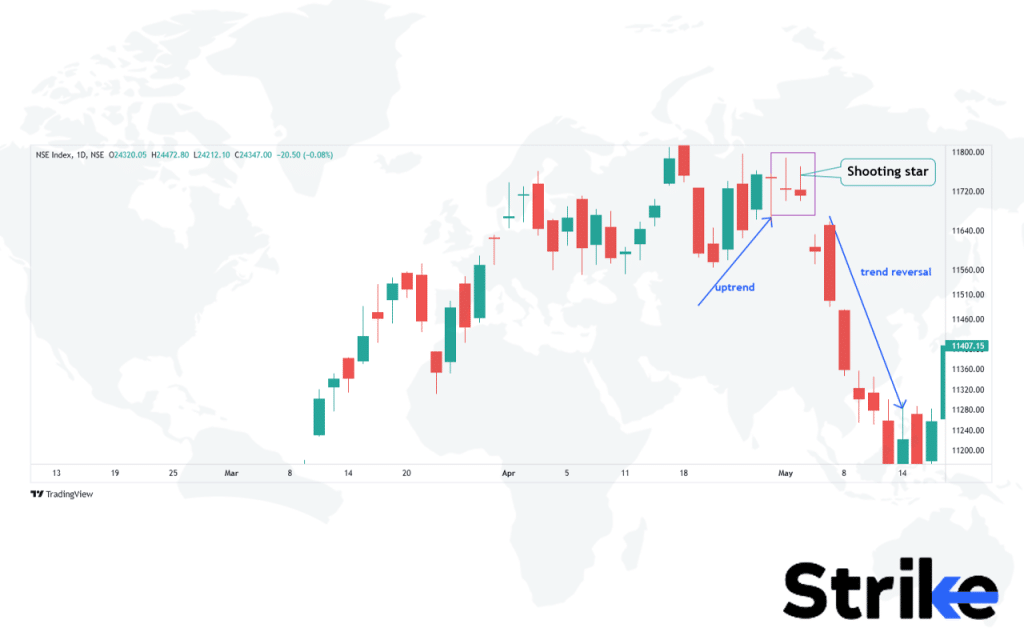
The candle reflects that bulls initially drove prices up, but bears regained control and forced a close near the lows. It is often interpreted as exhaustion of an uptrend.
This structure emerges when market enthusiasm peaks, only for traders to sell heavily into strength. The rejection of higher levels signals distribution from smart money to late entrants.
The Japanese named it “Shooting Star” as its shape resembles a star falling from the sky, symbolizing the end of bullish momentum. It has become one of the most widely tracked reversal signals in global markets.
According to StockCharts Technical Signal Guide (2020), the shooting star shows improved accuracy when paired with gap-ups or when occurring near major resistance levels on daily charts.
6. Bearish Engulfing
Bearish Engulfing is a two-candle reversal pattern where a large bearish candle completely engulfs the previous smaller bullish candle. Bearish Engulfing indicates a strong shift in sentiment as sellers overpower buyers.
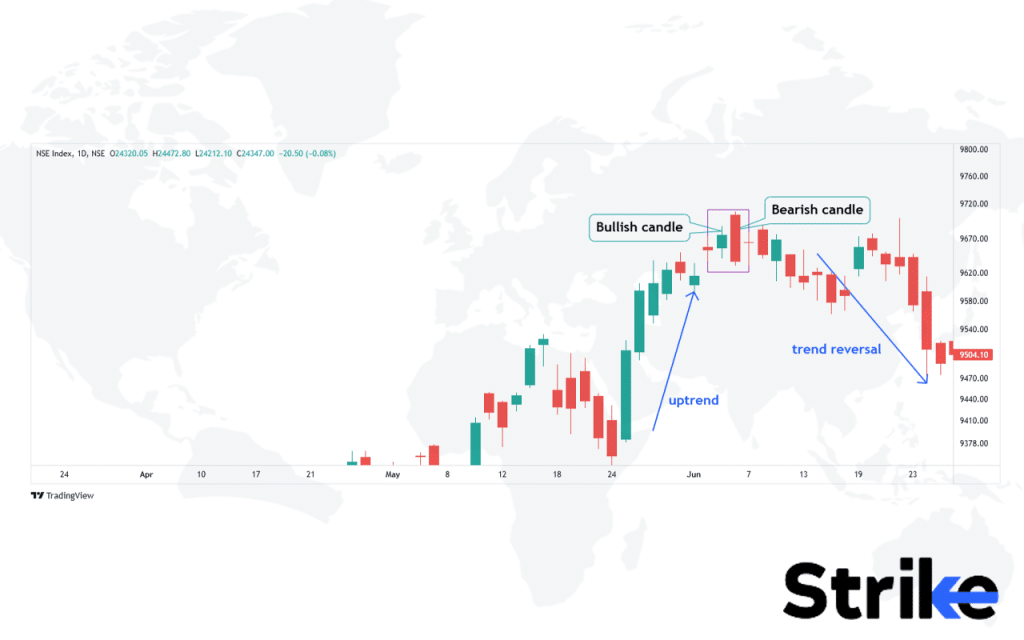
The pattern shows that optimism from the first candle is erased by decisive selling in the second. Traders treat this as confirmation of bearish momentum if the down candle closes near its low.
It forms when a market opens higher but selling pressure absorbs demand and closes well below the prior day’s open. This shift signals control moving from buyers to sellers.
The Bearish Engulfing has been studied extensively since candlestick analysis spread to Western markets in the 1980s. Analysts noted its effectiveness in identifying turning points after extended rallies.
According to research in the Journal of Applied Financial Economics (2019), bearish engulfing patterns show higher success rates in equity indices than in commodities, particularly when volume doubles compared to the previous session.
7. Dark Cloud Cover
Dark Cloud Cover is a two-candle bearish reversal pattern where the second bearish candle opens above the prior bullish high but closes deep into its body. Dark Cloud Cover represents sellers reversing optimism quickly.
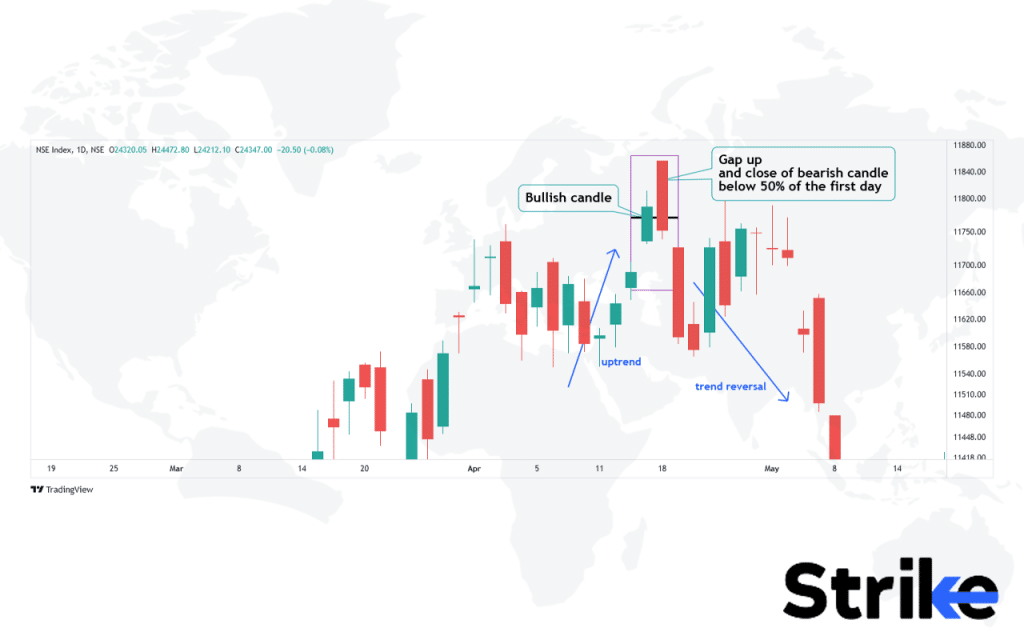
The candle indicates that buying enthusiasm was strong at the open but collapsed by the close. It is seen as an early warning of downward reversal after uptrends.
Its formation occurs when traders initially gap prices higher on bullish news, but strong selling emerges during the session. The bearish close below the midpoint of the previous candle confirms weakness.
The name “Dark Cloud Cover” originated from Japanese charting to describe a dark candle overshadowing the brightness of bullish optimism. It visually conveys the sudden mood shift in markets.
According to a 2016 MTA Journal article, the Dark Cloud Cover is statistically more effective when the second candle closes below 60% of the first candle’s body and is accompanied by above-average volume.
8. Bearish Harami
Bearish Harami is a two-candle pattern where a small bearish candle fits entirely within the prior larger bullish candle. Bearish Harami signals indecision and possible reversal after an uptrend.
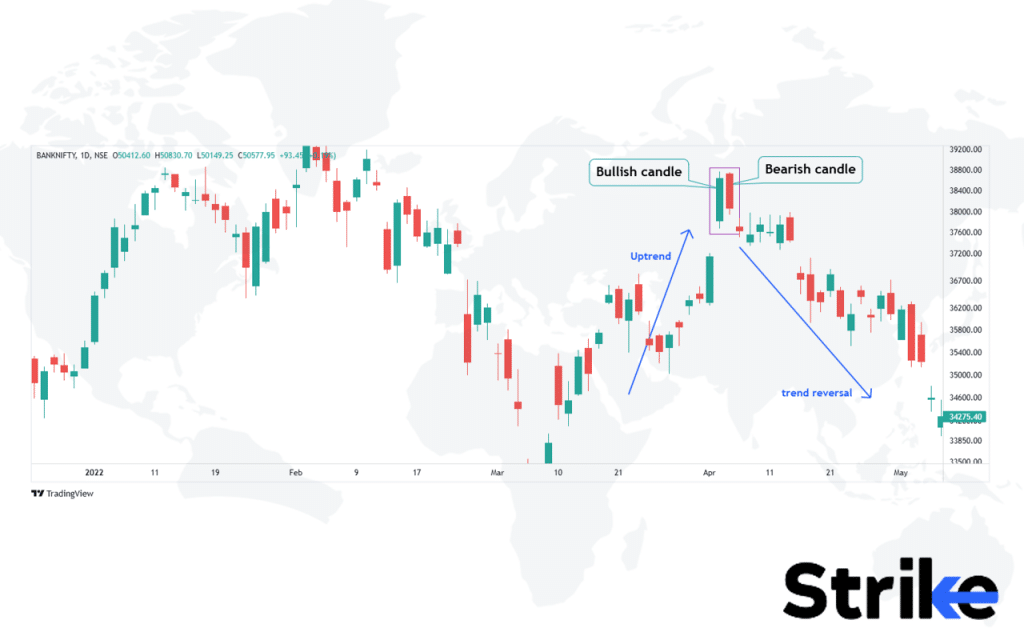
The pattern conveys that bullish momentum is slowing down, as the small candle indicates hesitation following strong buying. This hesitation is often the first sign of trend exhaustion.
It forms when market participants are reluctant to push prices higher after a bullish run, allowing sellers to compress price movement. The reduced range is a warning of declining demand.
The Harami, meaning “pregnant” in Japanese, visually resembles a small candle “inside” a larger one, symbolizing potential change. It was introduced to Western traders in the 1990s and gained popularity for spotting turning points.
According to a 2019 Asia-Pacific Journal of Financial Studies article, bearish Harami patterns have stronger predictive power in low-volatility markets, particularly when supported by momentum oscillators.
9. Tweezer Top
Tweezer Top is a two-candle bearish reversal pattern where both candles show identical or nearly identical highs. Tweezer Top reflects repeated rejection of higher prices.
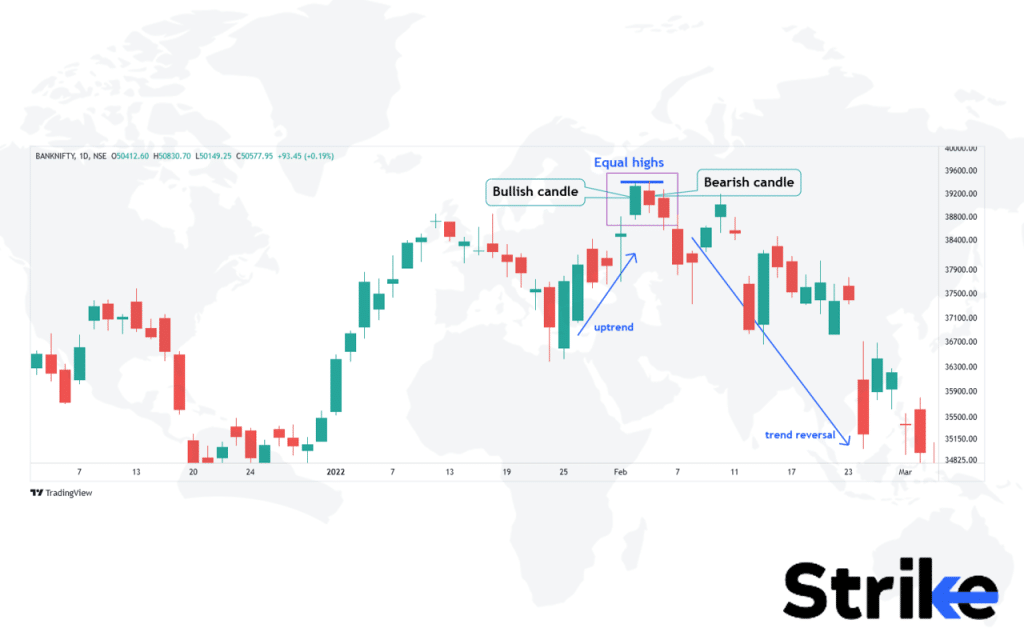
The pattern suggests that buyers attempted to push the market higher on consecutive sessions, but sellers defended the same resistance level. The double rejection increases bearish conviction.
It typically forms at overbought levels where traders are quick to sell into strength. The failure of two consecutive candles to break resistance confirms market hesitation.
The Tweezer Top originated from Japanese candlestick literature, where “tweezers” symbolized sharp precision in rejecting price levels. It later became a staple in forex and equity trading manuals worldwide.
According to The Technical Analysis of Stock Trends (Edwards & Magee, revised 2018), tweezer tops are especially effective on weekly charts, often preceding medium-term pullbacks.
10. Bearish Counterattack
Bearish Counterattack is a two-candle pattern where a strong bullish candle is immediately followed by a bearish candle that closes at or very near the previous open. Bearish Counterattack shows aggressive rejection of optimism.
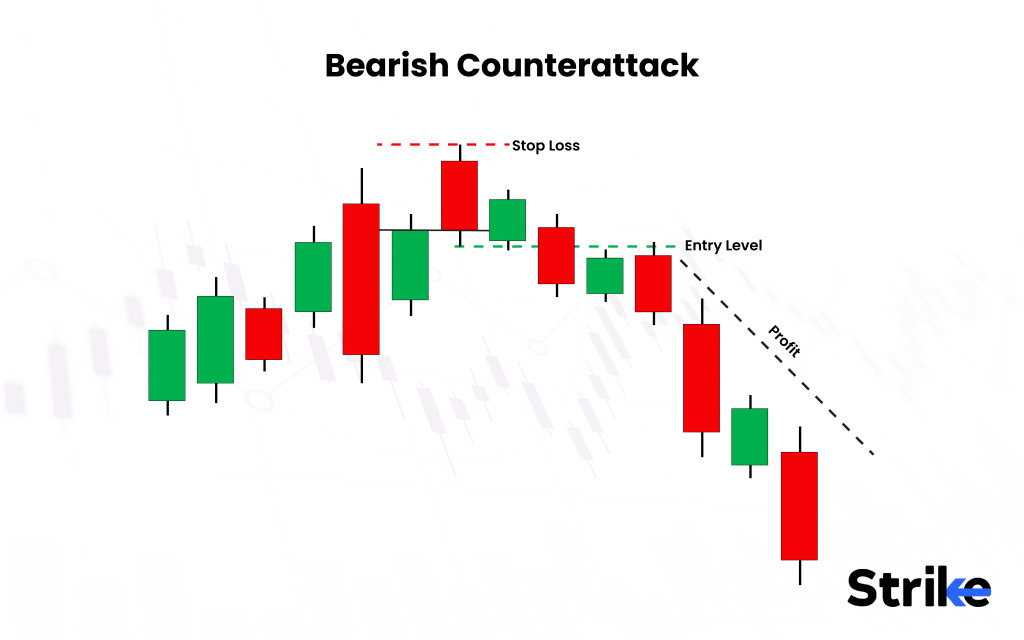
The sudden bearish reversal signals that sellers regained control exactly at the point where bulls had initiated their move. Traders interpret this as a psychological “pushback” against rising prices.
It forms when positive sentiment drives a strong bullish close, but sellers flood in the next session, pulling prices back to square one. This nullifies the previous bullish effort.
Japanese candlestick texts describe counterattack lines as symbolic duels between buyers and sellers. The bearish version represents bears regaining lost territory.
According to an NSE Market Research publication (2017), bearish counterattack patterns are most reliable when supported by high trading volume and appear after long bullish streaks.
11. Evening Star
Evening Star is a three-candle bearish reversal pattern consisting of a strong bullish candle, a small-bodied candle (indecision), and a large bearish candle closing deep into the first. Evening Star is one of the most powerful top-reversal signals.
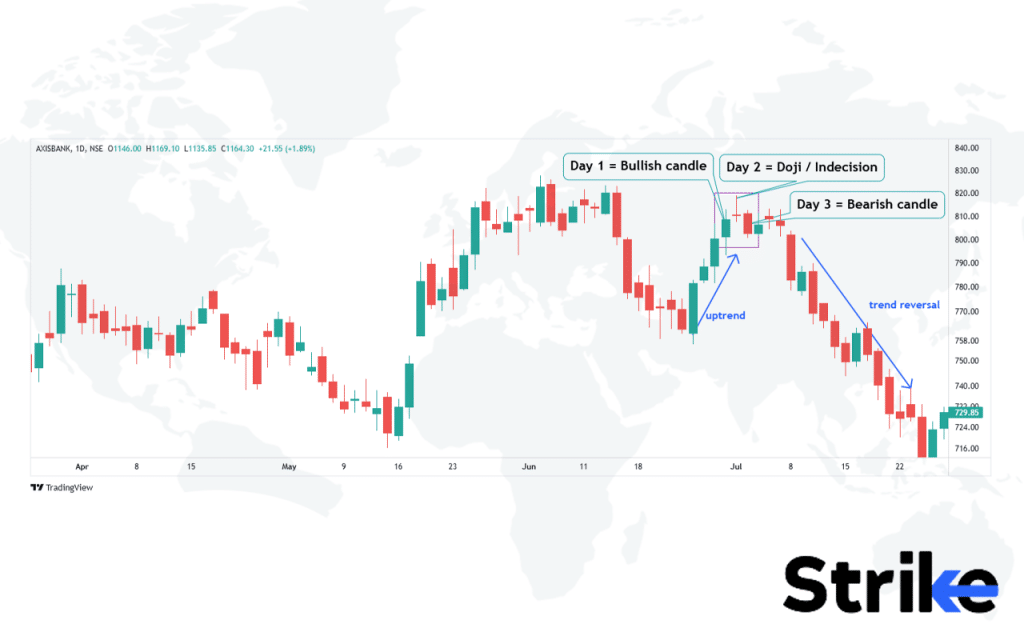
It reflects a clear shift from optimism to hesitation, followed by aggressive selling. Traders treat the third candle’s confirmation as proof of a new downtrend.
The pattern usually forms after prolonged rallies when buyers lose conviction. Sellers seize the opportunity, producing a sharp correction.
The name “Evening Star” comes from Japanese charting traditions, symbolizing the appearance of a star at dusk that heralds darkness. Its metaphorical meaning aligned with its role as a bearish omen.
According to Technical Analysis of Financial Markets (John Murphy, 1999), Evening Stars are highly reliable reversal signals, especially when the bearish third candle erases more than 50% of the first candle’s gains.
12. Evening Star Doji
Evening Star Doji is a variation of the Evening Star where the middle candle is a Doji instead of a small body. Evening Star Doji enhances the bearish reversal signal by showing extreme indecision before sellers take over.
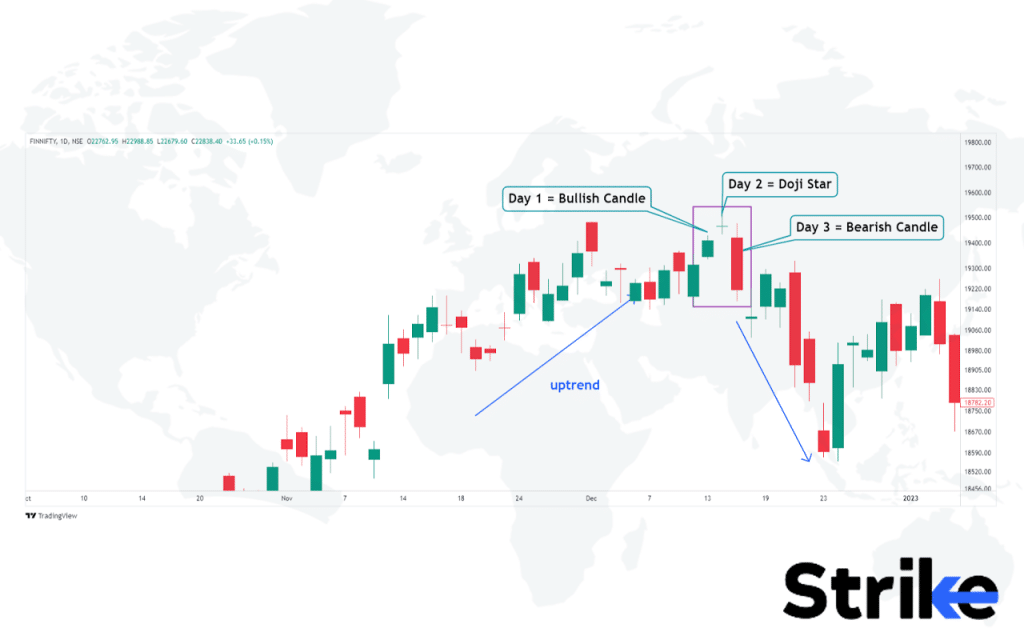
The presence of the Doji highlights that buyers failed to extend gains despite an initial push. The subsequent bearish candle confirms the reversal decisively.
This structure forms when bullish momentum stalls, producing a Doji, and bears immediately capitalize with a sharp sell-off. The hesitation followed by collapse makes it particularly strong.
Japanese texts considered Doji-based evening stars among the most reliable reversal indicators. Western traders later adopted it into standard candlestick trading setups.
According to CFA Institute Technical Signal Studies (2016), Evening Star Doji patterns have higher accuracy than standard Evening Stars, particularly when they occur at long-term resistance levels.
13. Three Black Crows
Three Black Crows is a three-candle bearish continuation pattern with three long bearish candles closing progressively lower. Three Black Crows demonstrates sustained and overwhelming selling momentum.
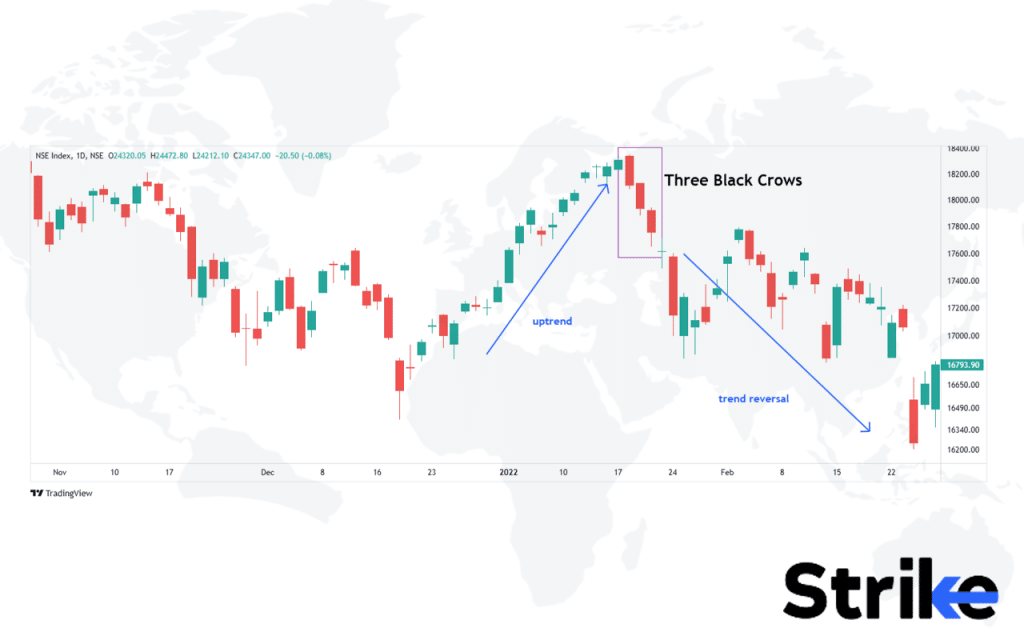
The pattern reflects a series of sessions where sellers dominate from open to close, leaving little room for bullish recovery. It confirms strong bearish conviction after rallies.
It forms when institutions or large traders steadily unload positions across multiple sessions. The repeated lower closes demonstrate controlled distribution.
Historically, Japanese traders described this formation as “three black soldiers marching downward.” It remains one of the clearest visual symbols of market weakness.
According to a 2020 Journal of Behavioral Finance study, the Three Black Crows pattern correlates strongly with investor panic phases, improving its reliability when accompanied by rising volume.
14. Falling Three
Falling Three is a five-candle bearish continuation pattern consisting of a long bearish candle, three small bullish or neutral candles within its body, and another long bearish candle. Falling Three confirms that sellers maintain control despite minor pauses.
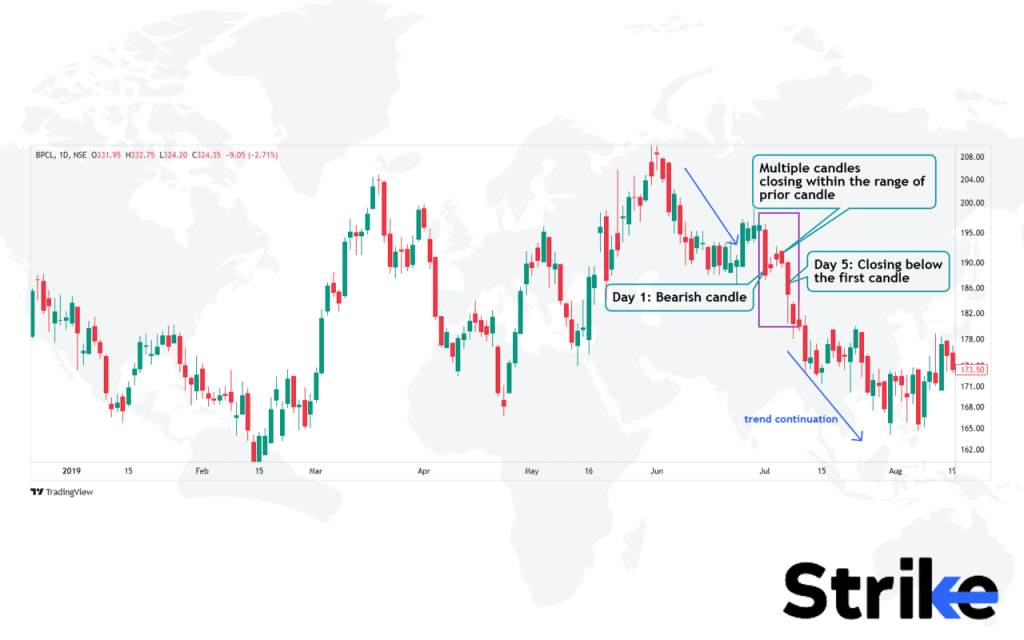
It indicates a temporary consolidation during a downtrend rather than a true reversal. The final bearish candle reasserts dominance and signals continuation.
The pattern forms when short-covering or mild optimism interrupts a decline, but selling quickly resumes. The inability of buyers to push beyond the initial bearish candle reinforces weakness.
This setup was recorded in traditional Japanese candlestick studies as part of continuation series patterns. Western analysts classified it as a reliable sign of trend persistence.
According to a Technical Analysis Review (2021, Chartered Market Technician journal), Falling Three patterns achieve higher predictive value when the middle candles show shrinking volume, confirming they are mere pauses.
15. Mat Hold
Mat Hold is a five-candle continuation pattern; in its bearish form it begins with a long bearish candle, pauses with three small counter-trend candles that stay inside the first body, and ends with another strong bearish candle. Mat Hold signals a brief consolidation inside a downtrend before sellers reassert control and push price lower.
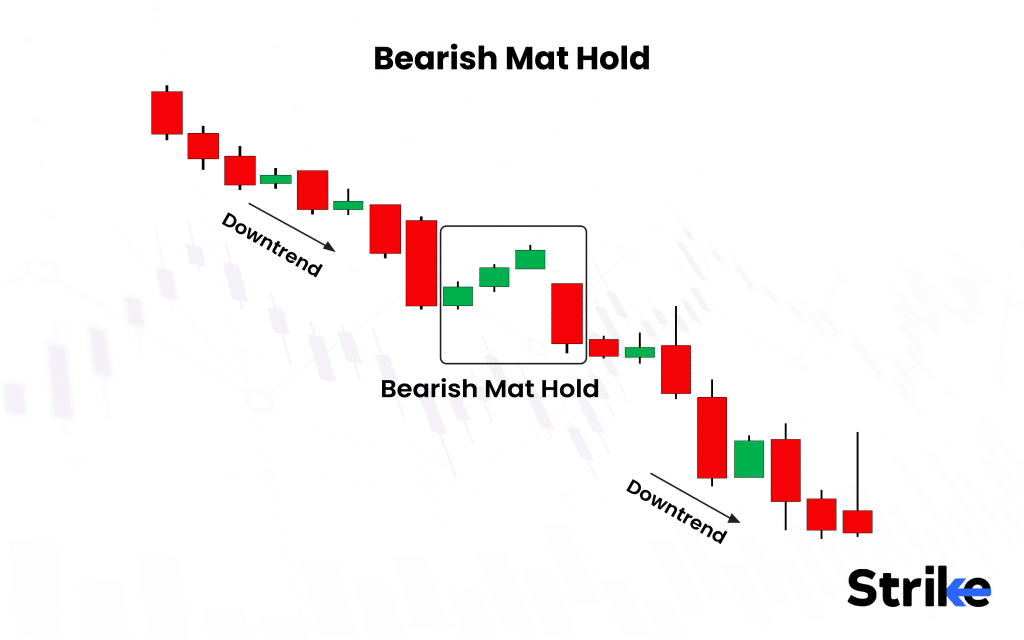
Japanese texts classify it among the “method” formations that depict trend persistence, and Western literature adopted the scheme as a template for orderly distribution. Traders read the interior three candles as a testing phase where rallies are capped and the path of least resistance remains down.
This develops when short-covering and bargain hunting create a narrow rebound, but larger hands keep selling into strength, preventing the pullback from clearing the first candle’s range. The final wide-range bearish close typically arrives as trapped late buyers exit and momentum systems re-engage short.
Regarding effectiveness, peer-reviewed tests generally find little standalone forecasting edge for most candlestick signals. Some studies show that Mat Hold works better when confirmed by volume drops during the middle candles and renewed expansion during the final bearish candle.
16. Bearish Abandoned Baby
Bearish Abandoned Babyis a three-candle top reversal: a long bullish candle, a gapped-up doji isolated from both sides, and a gap-down bearish candle closing deep. Bearish Abandoned Baby spotlights exhaustion of the uptrend and a decisive handoff from buyers to sellers.
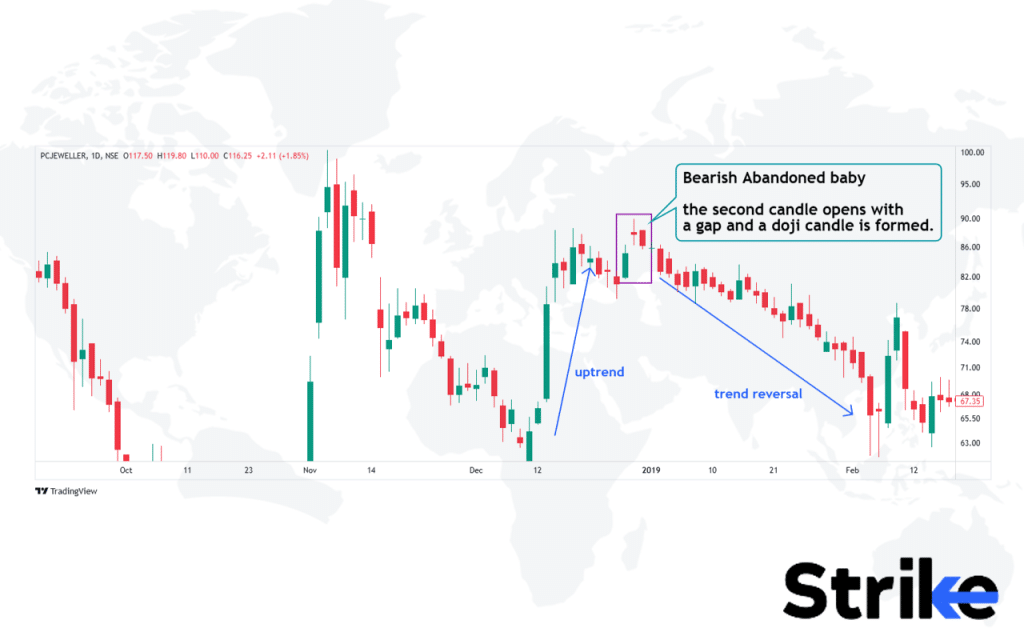
It’s visually a failed last gasp higher that never finds follow-through, followed by a vacuum under price as bids disappear. The pattern is prized because the twin gaps create clear invalidation and momentum cues.
It forms when enthusiasm gaps price up into a Doji (indecision), but liquidity evaporates on the next open and sellers hit bids below the prior range. That gap separation isolates late longs and often forces immediate de-risking.
Backtests suggest conditional efficacy, with some data showing about two-thirds success in equity indices when strict gap rules are applied. Traders generally wait for volume confirmation before treating it as tradeable.
17. Three Outside Down
Three Outside Down is a three-candle bearish reversal that begins with a bullish candle, follows with a bearish candle that engulfs it, and confirms with a third bearish candle closing lower. Three Outside Down formalizes a momentum shift by combining engulfing pressure with immediate continuation.
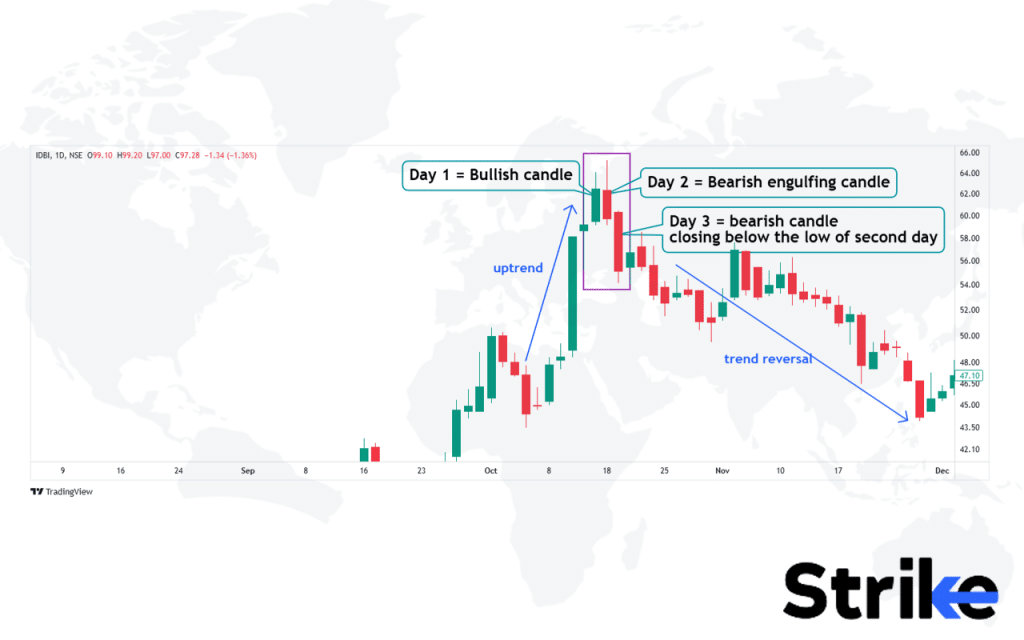
Traders like it because the second line does more than “inside-day hesitation”—it wipes out the prior session, then the third line proves bears can press. The sequence provides structure for stops (above the engulfing high) and targets (prior support).
It often appears when a strong open attracts late buyers but larger sellers overwhelm demand, setting the stage for a follow-through flush. The confirmation bar reflects continued distribution by institutions rather than a one-off swing.
Empirical tests suggest Three Outside Down patterns can be among the more reliable three-candle signals. Their performance is improved when aligned with downtrending moving averages and resistance levels.
18. Three Inside Down
Three Inside Down is a three-candle bearish reversal that starts with a large bullish candle, prints a smaller bearish candle within it (a Harami), and confirms with a third bearish close below the prior low. Three Inside Down depicts slowing upside momentum that turns into actual downside follow-through.
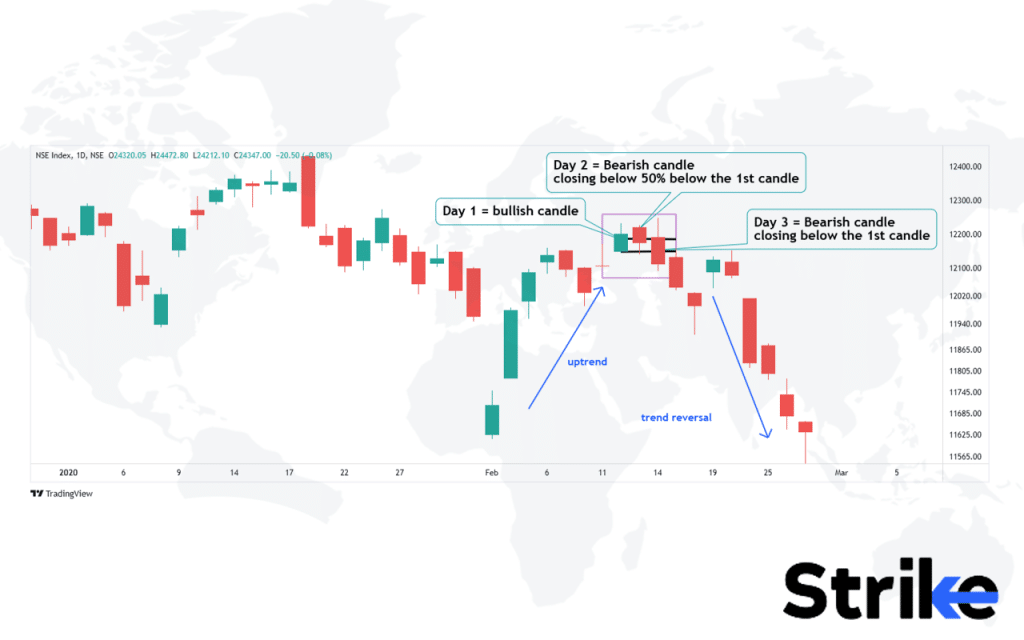
The inside second line shows compression as buyers lose urgency, while the third line demonstrates that sellers can take control outside the prior range. Traders treat it as “Harami with proof.”
It forms when early distribution caps progress, compresses ranges, and then spills price below recent support as stops cascade. The psychology is a flip from buy-the-dip to sell-the-rip.
Educational sources classify it as a Harami variant requiring confirmation, with reliability rising near major resistance and in high-volume environments. The structure makes it appealing to traders seeking confirmation beyond a single day’s hesitation.
Large-sample evidence is mixed: standalone Three Inside Down signals rarely deliver consistent results across markets. Reliability improves when they coincide with macro catalysts or technical overextensions.
19. Bearish Kicker
Bearish Kicker is a two-candle shock pattern where the second candle gaps down and opens near its low with strong bearish follow-through, typically after bullish action the prior day. Bearish Kicker emphasizes a sudden regime change—news or flow flips sentiment so hard that price “kicks” into a new area.
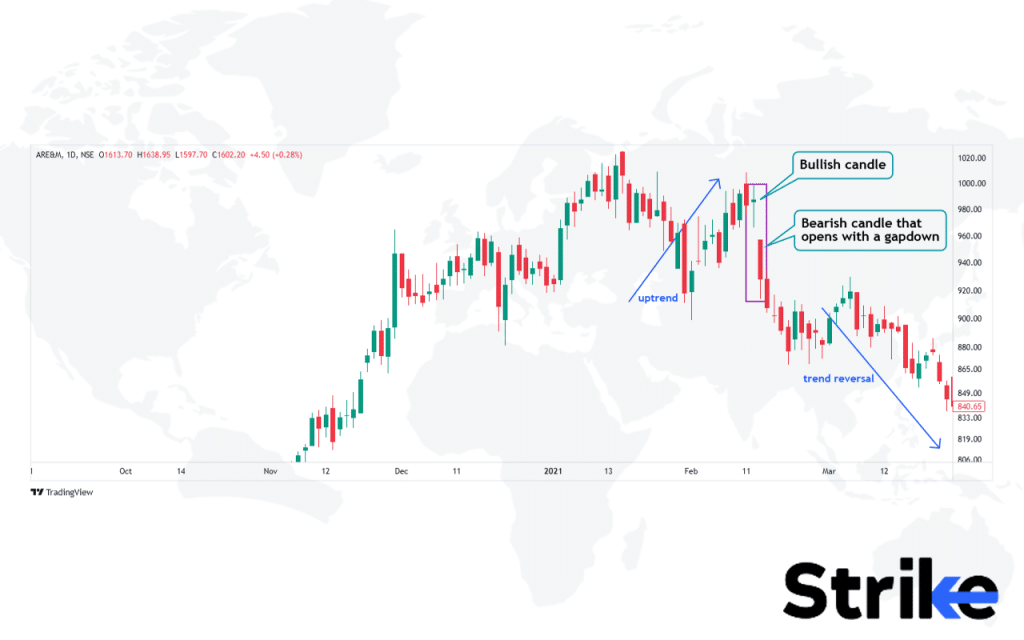
It’s technically a gap-driven momentum break that discourages mean-reversion attempts because no overlap exists with the prior body. Many traders treat it as a “don’t-fade” event until the gap fills.
The setup often appears on surprise catalysts—earnings misses, guidance cuts, or regulatory headlines—when overnight order flow reprices the asset. The lack of overlap traps longs and invites systematic shorting into the open.
Contemporary primers describe the kicker as one of the strongest two-bar reversals in theory, but they also warn that gaps distort backtests and require liquidity-aware execution. The absence of overlap makes it visually distinctive and emotionally powerful.
In data, its standalone edge isn’t dominant, with many backtests showing near 50/50 outcomes. Reliability rises sharply when the kicker occurs at key resistance levels or in line with broader macro shocks.
20. Bearish Belt Hold Pattern
Bearish Belt Hold is a single wide-range bearish candle that opens at the session high (often by a gap) and sells off steadily to close near the low. Bearish Belt Hold communicates immediate supply dominance from the open with no meaningful intraday recovery.
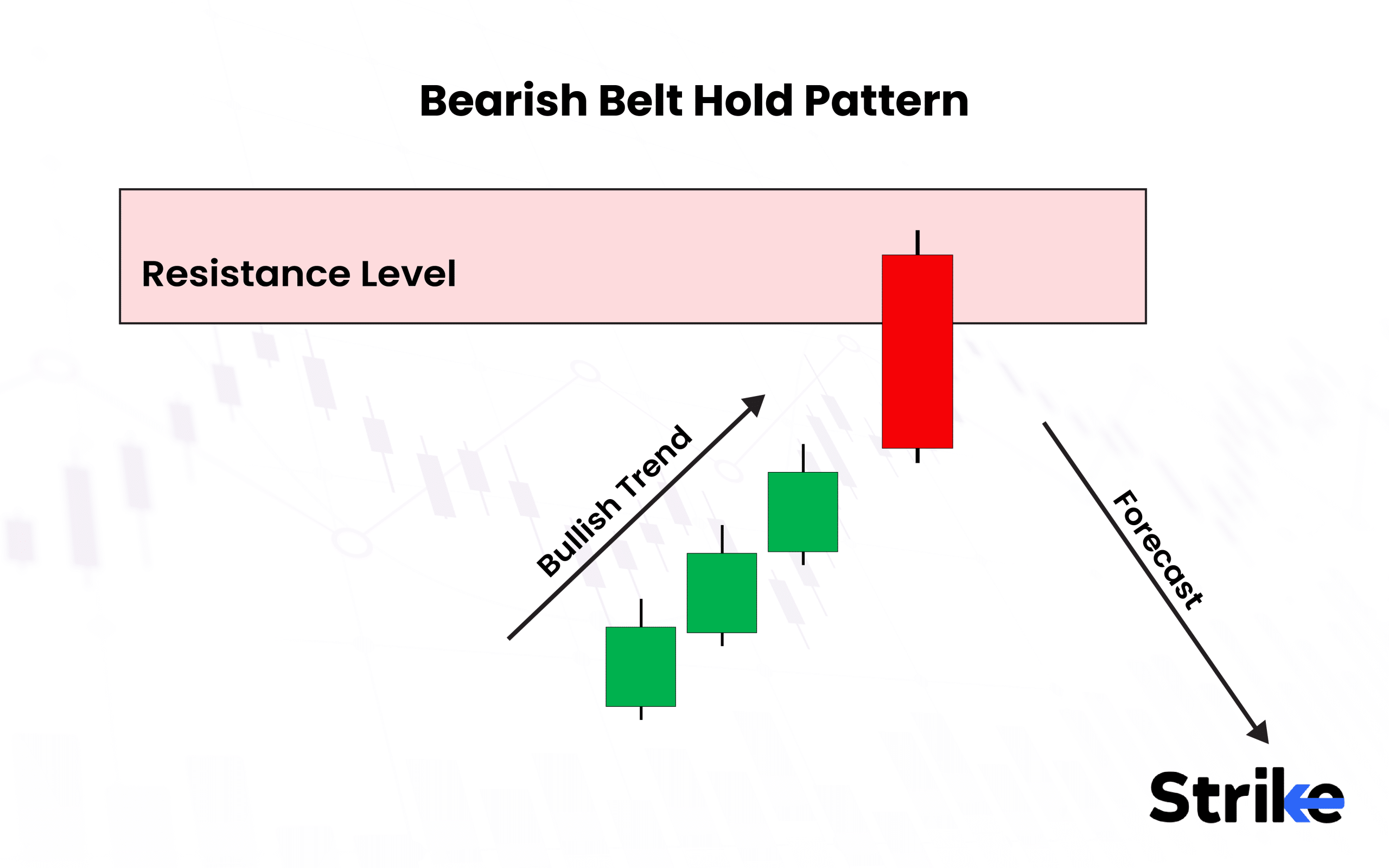
Because there’s no upper shadow, the candle is a visual of “sold from the bell,” commonly read as a momentum bar that can start or extend downtrends. Traders often anchor stops above its high and look for follow-through.
It typically emerges when overnight sentiment flips and the opening auction clears at optimistic prices before aggressive supply floods the tape. Subsequent selling pressure leaves a long body and little to no wick overhead.
Reference guides point out that, despite its clean look, the pattern appears frequently and can whipsaw without broader confirmation. Many traders demand a second bearish candle for confirmation before acting on it.
Backtests suggest that belt hold candles alone are not very predictive, but they become useful when aligned with downtrend confirmation indicators. Their effectiveness increases with higher volume and bearish market context.
21. Bearish Doji Star Pattern
Bearish Doji Star is a two-candle reversal at the top of an uptrend: a long bullish candle followed by a gap-up doji that signals indecision. Bearish Doji Star sets up a potential turn lower that usually requires bearish confirmation on the next bar.
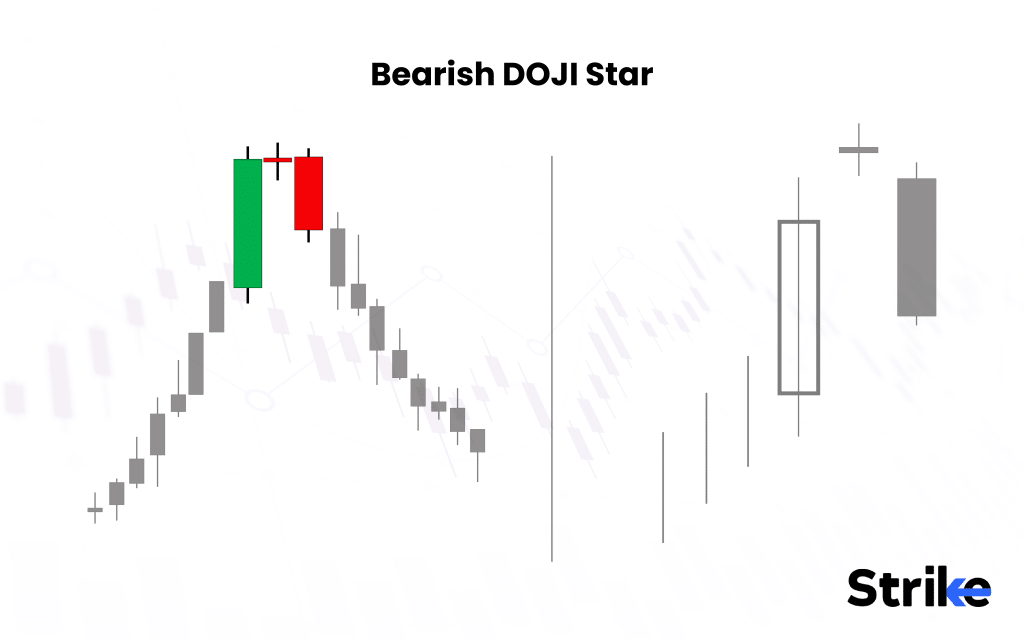
The psychology is straightforward: bulls push price high enough to gap, but the session stalls into a Doji, revealing fragile demand and the possibility of supply taking over. Confirmation with a strong bearish close converts indecision into reversal.
Historically it’s a classic from Japanese candlestick literature, later formalized in Western scanning libraries with explicit gap and confirmation rules. Its simplicity has made it one of the most widely recognized Doji-based reversal setups.
As for reliability, doji-based signals by themselves are weak information and need context like overbought readings and volume. Traders often wait for a break of support or a third bearish candle before committing to positions.
22. Matching Low / Matching High
Matching High is a bearish reversal pattern formed by two consecutive candles with identical highs after an uptrend. Matching Low, by contrast, appears in downtrends but the bearish relevance lies in the High variation that shows resistance holding firm.
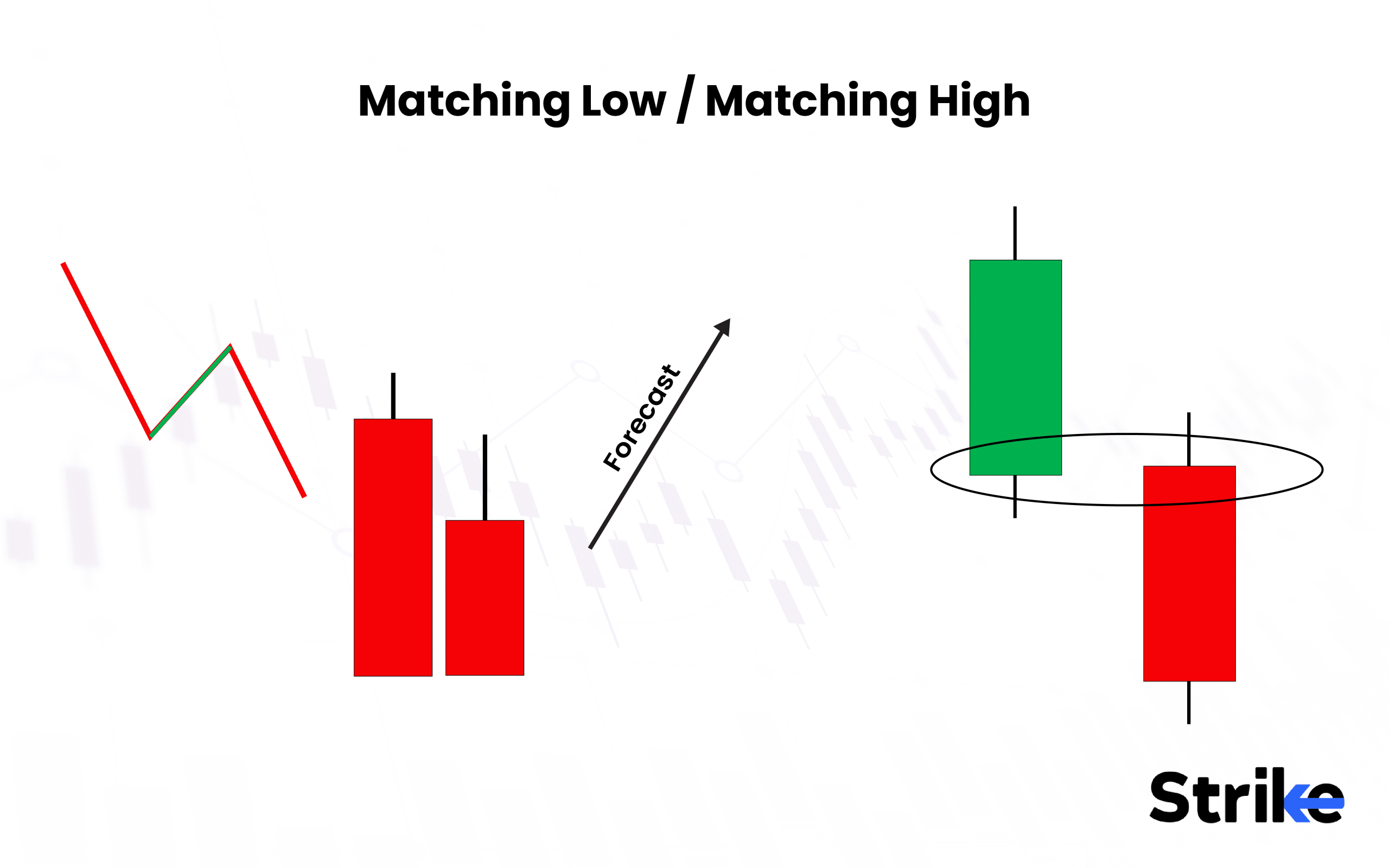
The psychology is that bulls attempt to push higher twice but meet equal resistance at the same level, which validates supply overhead. Traders interpret it as the market failing to break a ceiling despite repeated tries.
It often appears at or near key resistance zones, where institutional selling absorbs buying pressure at fixed levels. The repeated rejection serves as a red flag for weakening momentum.
Historically, these patterns were catalogued in candlestick manuals as signals of important turning points, drawing attention to the significance of repeated highs or lows. The Japanese interpretation emphasized that repetition of price failure was not coincidence, but a sign of exhausted demand.
Its reliability improves when matched with overbought oscillators or when the highs occur at long-established resistance. Without such context, the pattern is prone to false starts in sideways markets.
23. Separating Lines (Bearish)
Bearish Separating Lines is a two-candle continuation pattern where a bearish candle follows a bullish one but both open at the same price. Bearish Separating Lines confirms the existing downtrend by rejecting bullish recovery.
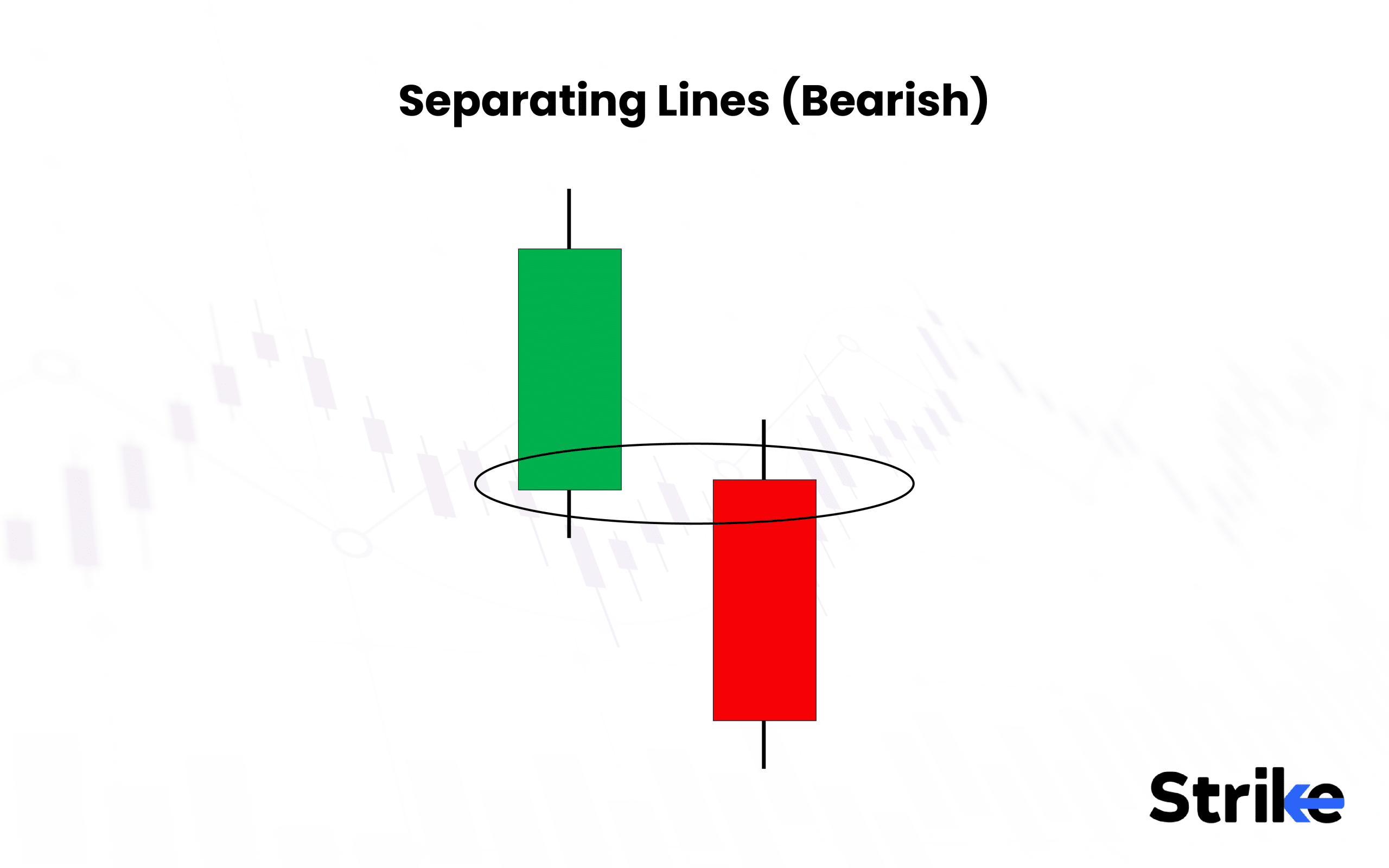
The candle structure shows that buyers tried to pull the market higher but failed to sustain momentum, and the trend quickly returned to bearish direction. This reinforces conviction in the ongoing downtrend.
It typically forms when short bursts of optimism open prices higher, but overwhelming supply brings them back to trend alignment. The identical open price highlights the futility of the bullish effort.
Japanese traders treated it as proof of bears re-establishing dominance after a short-lived interruption. In modern usage, it’s considered a continuation rather than reversal setup.
Reliability is moderate, with better results when the second candle has heavy volume and closes near the low. On its own, the pattern is not strong unless accompanied by broader bearish confirmation.
24. Meeting Lines Pattern
Meeting Lines is a two-candle pattern where a bearish candle follows a bullish one and closes near the previous candle’s close. Meeting Lines is considered a potential reversal signal when it appears after an uptrend.
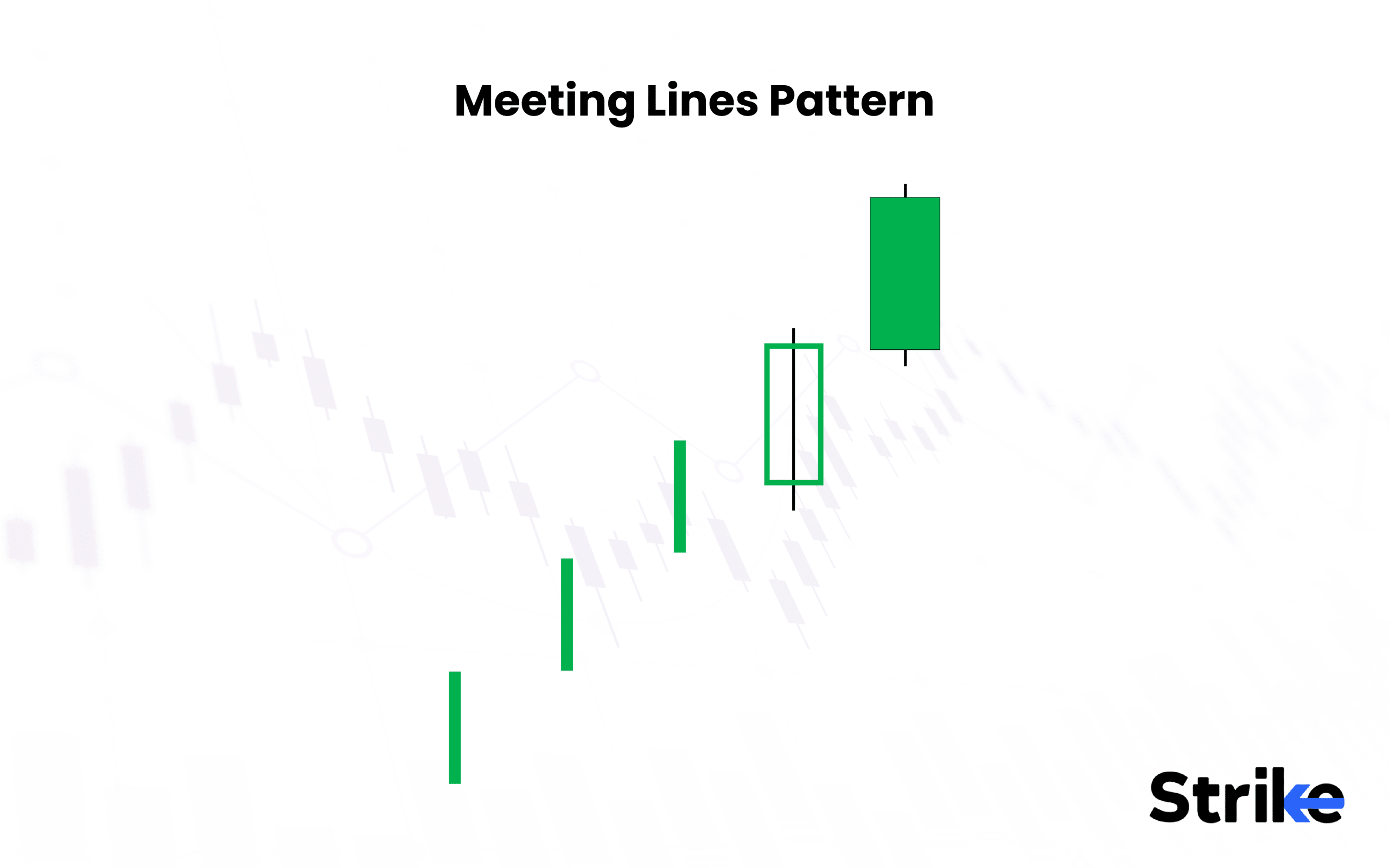
The pattern reflects confrontation between buyers and sellers at the same price zone. Although bears succeed in pushing the price down intraday, the close near the prior session’s close indicates strong equilibrium.
It typically forms during periods of uncertainty when neither side can establish dominance. Bears still gain an edge, however, as they interrupt the bullish rhythm.
The name comes from the fact that the closing prices “meet” at nearly the same level, symbolizing a standoff. Japanese candlestick literature originally classified it among reversal candidates.
Its effectiveness depends on market context: alone, it has limited predictive power, but when combined with resistance levels or volume surges, it can foreshadow a trend change.
25. On-Neck Pattern
On-Neck is a two-candle bearish continuation pattern where a long bearish candle is followed by a smaller bullish candle that closes just at or slightly above the prior close. On-Neck suggests sellers remain dominant despite a minor upward push.
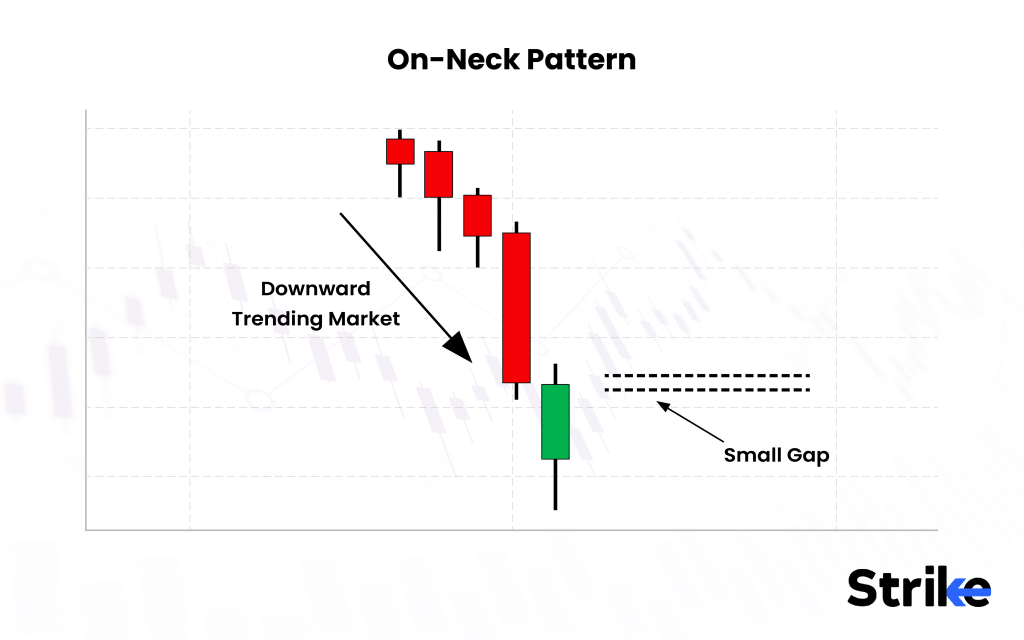
The structure conveys that buyers attempted to counter the prior selloff but failed to gain traction, meaning price barely moved upward, signalling that the downtrend remains intact.
It usually occurs during sharp declines when small rallies appear due to bargain-hunting, but the second candle’s close near the previous low shows a lack of follow-through from bulls.
In Japanese naming, the “On-Neck” reference highlights how the second candle clings to the neckline of the prior bearish candle. Analysts consider it a sign of continuation rather than reversal.
On-Neck pattern has higher significance when the next candle confirms with a bearish close below the prior low. Without confirmation, it often becomes noise in volatile markets.
26. In-Neck Pattern
In-Neck is another two-candle bearish continuation pattern where the second bullish candle closes slightly above the prior bearish close but remains within its body. In-Neck reflects weak buyer pressure that fails to overcome strong bearish sentiment.
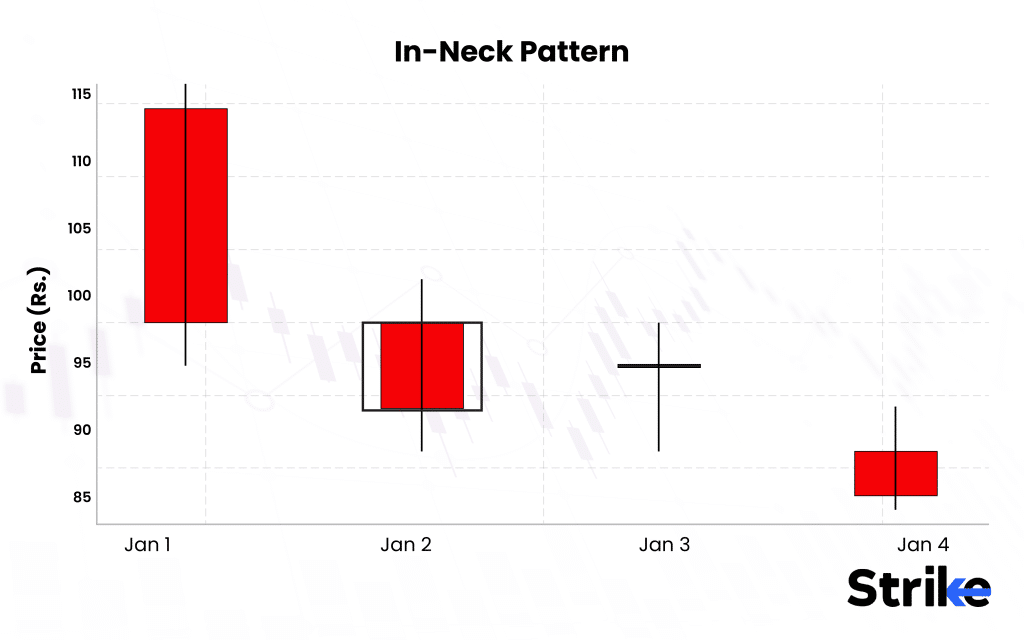
The psychology is that bulls manage to lift price marginally, creating the illusion of strength, but the rebound is capped well within the bearish candle, suggesting the market remains under seller control.
It forms during ongoing downtrends where small counter-trend moves are quickly absorbed by supply. Sellers reassert dominance soon after, resuming the decline.
Japanese chartists used the “neckline” metaphor to describe the second candle’s position relative to the first. It symbolizes attempts at recovery being held down at the throat of the trend.
Effectiveness is moderate at best, and confirmation is required from subsequent bearish action. Its role is mainly to signal pauses rather than decisive reversals.
27. Thrusting Pattern
Thrusting Pattern is a two-candle bearish continuation setup where the second candle is bullish and closes within the lower half of the prior bearish candle. Thrusting Pattern shows a weak counter-trend attempt that lacks conviction.
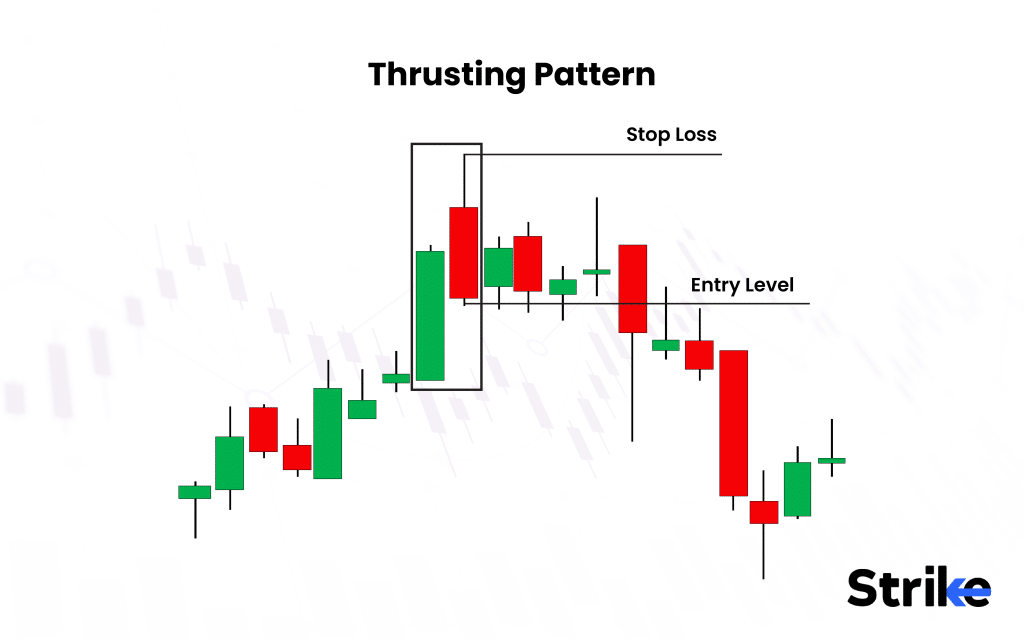
The structure demonstrates that sellers dominated the first candle, while buyers failed to push the second candle past the midpoint, marking it as a failure of bullish effort.
It typically develops after strong declines when bargain hunters step in but cannot offset the downward momentum. The result is a shallow retracement before the trend resumes lower.
The term “Thrusting” refers to the second candle’s push into the prior body but failing to rise above its midpoint. Japanese and Western texts classify it among the weaker continuation signals.
Its predictive strength improves when followed by another bearish candle confirming the trend. On its own, it has limited statistical edge and works best in strongly trending markets.
28. Upside Gap Two Crows Pattern
Upside Gap Two Crows is a three-candle bearish reversal pattern that begins with a bullish candle, gaps higher, prints a small bearish candle, and then produces another bearish candle closing into the gap. Upside Gap Two Crows warns that upward momentum is being rejected despite initial strength.
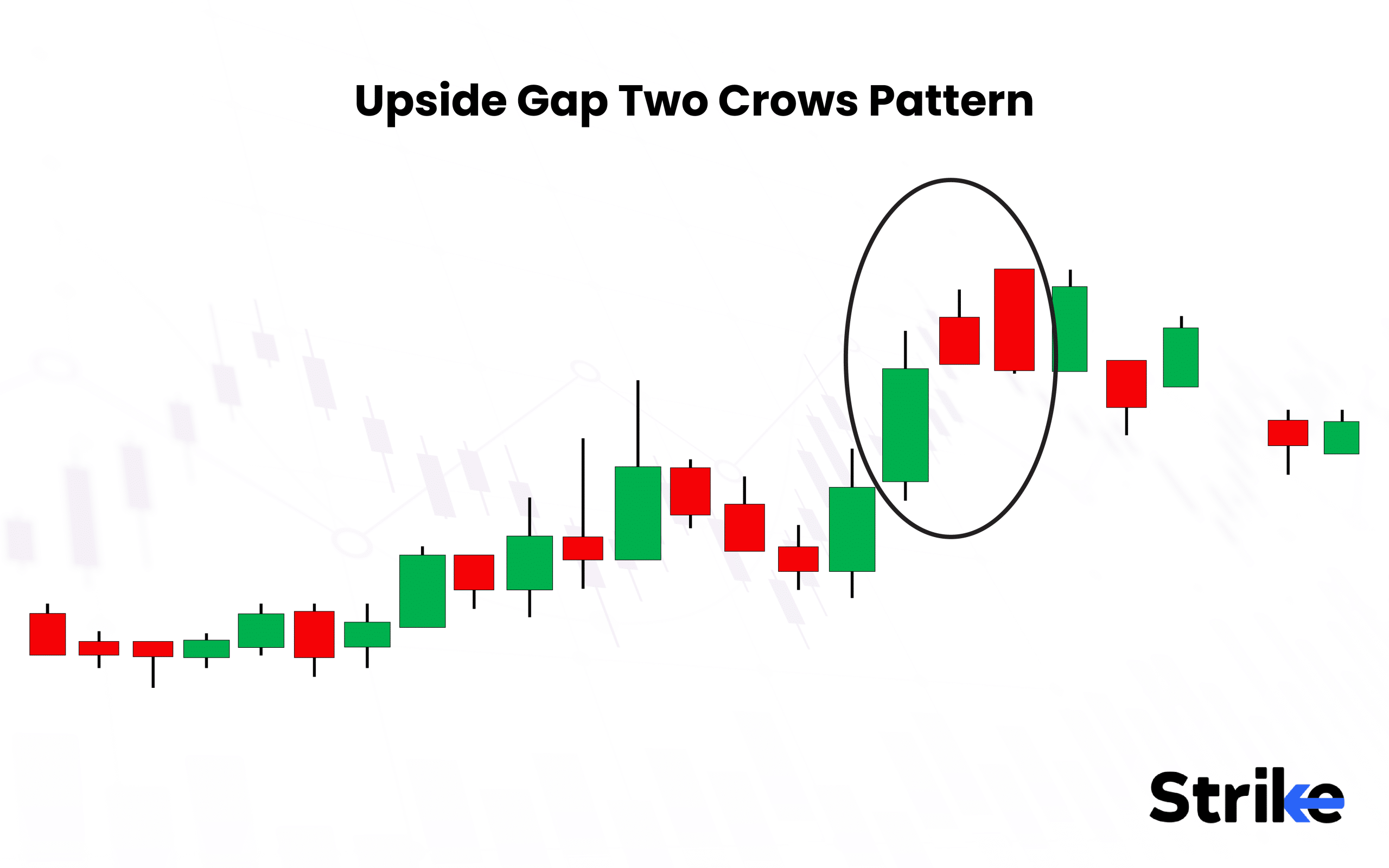
The structure illustrates that buyers push price higher with a gap, but consecutive bearish candles eat into that optimism. The third candle closing lower signals distribution by sellers.
It forms when overbought markets attempt a final push upward through gaps, only to meet heavy selling. This sequence traps late bulls and often reverses the trend.
The pattern was named because two “crows” (bearish candles) appear after an upward gap, visually resembling birds descending on a rising price. It has been widely cited as a reversal warning in candlestick literature.
Its reliability is relatively low when isolated, but it strengthens when combined with resistance levels and declining momentum indicators. Traders often wait for a fourth confirming bearish candle before committing to it.
How Reliable Are Bearish Candlestick Patterns?
Bearish candlestick patterns are moderately reliable, averaging 48%–55% accuracy when used alone. Their reliability improves significantly when confirmed with trend, resistance, and volume analysis.
For instance, research on U.S. equities found that raw candlestick signals provided no statistical edge against random chance. However, when combined with moving averages and RSI filters, reliability increased to nearly 60%.
Single-candle signals like the Shooting Star tend to be weaker, producing frequent false alarms in sideways markets. In contrast, triple-candle patterns like Evening Star and Three Black Crows provide stronger conviction because they capture multi-session psychology.
Timeframe plays a key role. Weekly charts tend to outperform daily or intraday setups, since noise is reduced and crowd sentiment has time to fully express itself. Traders report the highest reliability in liquid stocks and indices where volume confirms the story.
How to Confirm a Bearish Candlestick Signal?
To confirm a bearish candlestick signal, it is important to gather multiple confirmations or confluences rather than relying on a single pattern in isolation.
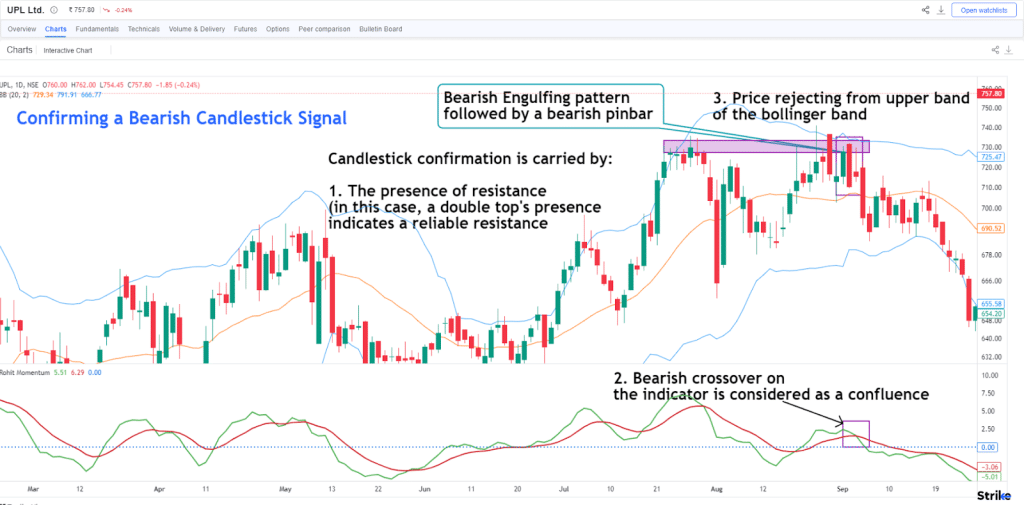
In this example, a bearish engulfing pattern appears first, followed by a bearish pin bar candlestick. Since these candlesticks can appear randomly across a chart, additional factors are required to validate that the signal is genuinely pointing to a potential downside move.
Presence of a reliable resistance
A clearly defined resistance zone adds strong confirmation. In this case, the presence of a double top creates a strong resistive price structure. When a bearish candlestick pattern forms right at the resistance of a double top, it significantly strengthens the probability of a downward move.
Indicator-based confirmation
The price rejecting from the upper Bollinger Band indicates that the asset is overextended on the upside and is showing signs of exhaustion. This rejection suggests that selling pressure is starting to build. In addition, the RMI indicator displayed a bearish crossover, which supports the idea that bears are beginning to gain control over bulls.
Anatomy of the candlestick pattern
The structure of the candlesticks should perfectly align with the definition of the pattern. In this case, the bearish engulfing pattern is valid because the red candle completely covers the body of the previous green candle. The next candle forming a bearish pin bar provides further evidence that the price is being repeatedly rejected from the upper levels, reinforcing the resistance.
These are some of the most important confirmations to look for before executing a trade based on a bearish candlestick signal. When price action, structure, and indicators all point in the same direction, the probability of a successful bearish trade setup increases significantly.
Do Bearish Candles Work Everywhere?
No, bearish candlestick patterns do not work equally well across all markets or timeframes. Their reliability depends on liquidity, volatility, and trading hours.
In highly liquid markets like Nifty 50 or S&P 500, patterns reflect collective psychology and achieve better results. In illiquid small-cap stocks, random gaps distort signals and weaken reliability.
Timeframes matter greatly. A Gravestone Doji on a weekly chart is significant, while the same on a 5-minute chart is often noise.
Different asset classes show variation too. Equities and indices respond well because of crowd behavior. In contrast, cryptocurrencies, which trade 24/7, often distort candlestick logic since there is no clear session open or close.
Thus, bearish candlestick patterns are not universal. They deliver their best results in liquid, structured markets with defined trading sessions and consistent order flow.
How to Identify Bearish Candlestick Patterns?
The most efficient way to identify bearish candlestick patterns is by combining visual recognition with automated tools like Strike. Strike scans for known formations, saving time and ensuring accuracy.
Manually, traders must study relationships between candle bodies and shadows. For example, a Bearish Marubozu has no wicks and closes at the low, while a Dark Cloud Cover opens with a gap up but closes below the midpoint of the prior bullish candle.
Key characteristics to observe
- Body dominance – whether bearish bodies fully engulf bullish ones.
- Shadow length – long upper wicks often indicate rejection.
- Location – patterns near resistance are more meaningful.
Strike overlays these criteria on live charts, reducing subjectivity. The tool also provides alerts, which helps traders act quickly when patterns form.
Learning manual recognition remains important, however, since traders must understand the psychology behind patterns. Combining education with automation creates both speed and insight.
How to Buy Stocks Using Bearish Candlestick Patterns?
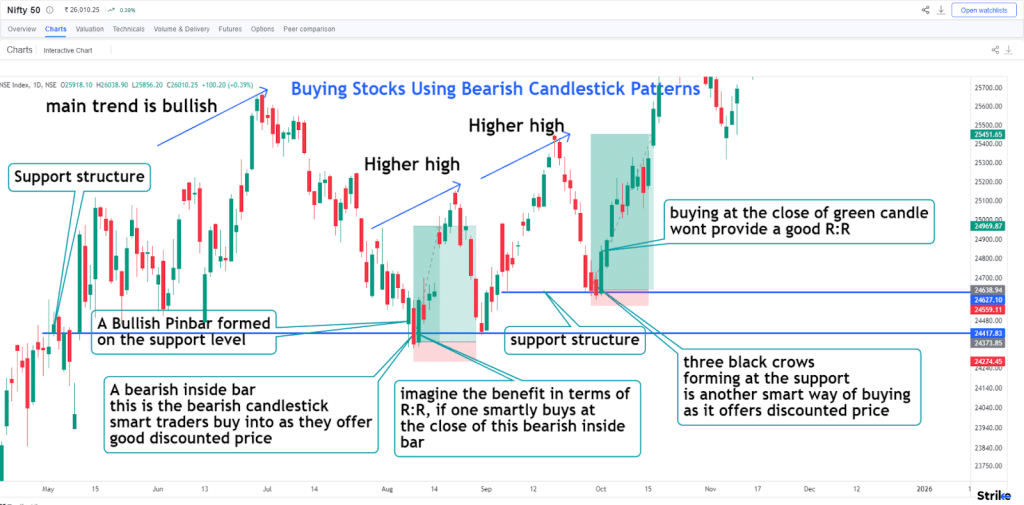
To buy stocks using a bearish candlestick pattern, you must first understand that bearish candles do not always signal selling. While most traders associate them with short-selling or weakness, smart participants often use specific bearish patterns to identify discounted entry zones within a broader uptrend.
Most retail traders focus only on buying after bullish candlestick patterns form because those signals feel safer and more obvious.
However, experienced traders position themselves before the bullish pattern appears, using select bearish candles that form at key price levels. These candles often appear when the stock is temporarily pulling back to a strong support zone.
The most important condition for using bearish candlesticks as a buy trigger is that the higher time-frame trend remains clearly bullish. If the main trend is up, a bearish candle on a lower time frame usually represents a pullback, not a full reversal.
This pullback creates an opportunity to enter at a better price instead of chasing a breakout at higher levels.
One effective setup is the bearish inside bar formed after a bullish candle at a support level. The bullish candle shows that buyers are active at that level. The following bearish inside bar represents a brief pause or profit-booking, not a breakdown.
When this pattern forms at a reliable support zone, it offers a strategic entry. The closing price of the bearish inside bar is used as the potential buying price, with a stop-loss placed slightly below the support level to limit risk.
Another method involves a sequence of three consecutive bearish candles moving toward a strong support level. This controlled decline often looks negative to retail traders, but in reality it is guiding the price back to a high-demand area. When these bearish candles approach and touch a reliable support zone, they frequently trigger bear traps, where sellers get trapped and price quickly reverses upward. This creates an ideal discounted buying opportunity for disciplined traders.
Indicators such as RSI, moving averages, or Bollinger Bands further strengthen this setup. If RSI is near oversold while price is at a strong support, or if the price touches the lower Bollinger Band and starts stabilizing, the confirmation becomes stronger.
The greatest advantage of buying at bearish candlesticks in an uptrend is the excellent risk-to-reward ratio. You enter at a lower price, your stop-loss is tight, and your potential upside follows the direction of the main trend. This approach allows you to trade smarter rather than chasing price after the move has already begun.
How to Backtest Bearish Candlesticks
The correct way to backtest bearish candlestick patterns is to test them systematically on historical OHLC data. This avoids subjectivity and provides measurable statistics.
Step 1: Collect historical price data for the asset.
Step 2: Code each pattern definition with strict rules (e.g., engulfing requires full body overlap).
Step 3: Scan for every occurrence across a multi-year dataset.
Step 4: Track results by measuring price movement after each pattern.
Step 5: Compare outcomes to random signals to determine whether the pattern adds value.
Metrics to analyze
- Win rate (%)
- Average return per trade
- Maximum drawdown
- Risk/reward ratio
Backtesting often reveals that raw success rates hover around 50%. With filters like trend alignment and volume confirmation, win rates climb closer to 60%.
This data-driven process helps traders distinguish which patterns deserve trust and which are noise.
Difference between a Bearish Reversal & a Bearish Continuation Pattern?
The difference between a bearish reversal and a bearish continuation pattern is that reversal patterns signal a change in direction, while continuation patterns extend an existing downtrend. Both are vital for traders.
| Type | Examples | Role in Trading | Reliability Factors |
| Reversal | Shooting Star, Evening Star, Bearish Engulfing | Mark tops, warn of new downtrend | Stronger near resistance with high volume |
| Continuation | Falling Three, Bearish Separating Lines, Thrusting Pattern | Confirm ongoing bearish momentum | Work best in strong trending markets |
Reversal patterns help identify exit points or short entries near highs. Continuation patterns support trend-following strategies where traders add to positions.
What are Single, Double, and Triple Bearish Candlestick Patterns?
Single, double, and triple bearish candlestick patterns are classified by the number of candles involved in their formation. This classification of different types of candlesticks helps traders measure strength and context.
| Category | Number of Candles | Examples | Strength Level | Notes |
| Single | 1 | Shooting Star, Hanging Man, Bearish Marubozu | Low | Frequent false signals, need confirmation |
| Double | 2 | Bearish Engulfing, Dark Cloud Cover, On-Neck | Medium | More reliable due to dual-session psychology |
| Triple | 3 or more | Evening Star, Three Black Crows, Falling Three | High | Strongest because of multi-session confirmation |
Single patterns are quick to spot but often misleading. Double patterns add more conviction, while triple patterns reflect a gradual but decisive shift in sentiment.
Traders often prioritize double and triple setups in their strategies. These offer better statistical reliability and clearer stop-loss levels.
Differences between Bearish & Bullish Candlesticks
The difference between bearish and bullish candlesticks lies in the market psychology they represent. Bearish patterns reflect supply dominance, while bullish patterns show demand control.
| Feature | Bearish Candlesticks | Bullish Candlesticks |
| Sentiment | Sellers in control | Buyers in control |
| Color convention | Red or black | Green or white |
| Typical close | Below the open | Above the open |
| Key examples | Shooting Star, Evening Star, Dark Cloud Cover | Morning Star, Bullish Engulfing, Three White Soldiers |
| Best reliability zone | Near resistance, in overbought conditions | Near support, in oversold conditions |
While both use the same candlestick structure, interpretation depends on location and trend. A Hammer is bullish at the bottom of a decline, while a Hanging Man is bearish at the top of a rally.
Recognizing these differences helps traders correctly apply candlestick analysis without misclassifying signals.
 19 mins