15 Popular Swing Trading Strategies to Use for Consistent Profit

 Author

 Editor
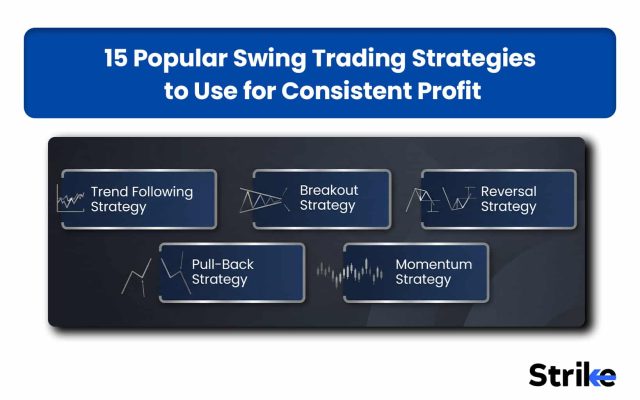
Swing trading strategies are a set of rules or methods that are used to capture short- and medium-term price swings by holding trades a few days to a few weeks. Swing trading strategies involve determining trends, pullbacks, and reversal points to trade at the most desirable prices and to sell when the price turns in your favor.
They are popular since they provide a balance between the opportunity and the practicality, where traders don’t need to spend all day monitoring the market like intraday trading, but they can always take advantage of regular price changes.
The actual advantage lies in being able to time entries around pullbacks, risk management, and riding the trend and not in predicting specific tops or bottoms. In this blog we are going to discuss 15 such swing trading strategies in detail.
Summary of Swing Trading Strategies
| No. | Strategy | Core Idea | Best Use Case |
|---|---|---|---|
| 1 | Support & Resistance | Buy near support, sell near resistance | Range-bound markets |
| 2 | Moving Average Crossover | Identify trend shifts using MA crossovers | Trending markets |
| 3 | RSI Strategy | Use overbought/oversold levels for reversals | Pullbacks in trends |
| 4 | Breakout Trading | Enter when price breaks key levels | Strong momentum moves |
| 5 | Trend Following | Trade in direction of overall trend | Sustained trends |
| 6 | Momentum Trading | Ride strong price momentum | High-volume moves |
| 7 | Pullback Trading | Enter on temporary retracement in trend | Trending markets |
| 8 | Channel Trading | Trade within parallel price channels | Sideways markets |
| 9 | Bollinger Bands Squeeze | Trade volatility expansion after squeeze | Breakout setups |
| 10 | Fibonacci Retracement | Identify retracement levels for entry | Trend continuation |
| 11 | Candlestick Analysis | Use patterns for entry/exit signals | All market conditions |
| 12 | Chart Pattern Analysis | Trade patterns like triangles, flags | Breakouts & reversals |
| 13 | Pair Trading | Trade relative performance of two assets | Market-neutral setups |
| 14 | PEAD Strategy | Trade post-earnings drift | Earnings season |
| 15 | VCP (Volatility Contraction Pattern) | Trade contraction before breakout | Institutional accumulation |
1. Support and Resistance Trading
Support and resistance trading involves finding a key price level (support or resistance) from where the market has historically reversed and taking a trade based on the reaction of price at those price levels. This strategy is primarily used to catch reversals.
These leaves are usually concentrated with institutional buying and selling activities.
- When price approaches the support level, strong demand absorbs the selling pressure and pushes the price higher.
- When price approaches the resistance level, strong supply absorbs buying pressure and pushes the price lower.
Support and resistance trading performs best in sideways market conditions or near potential reversal zones on higher timeframes like daily and 4H.
To trade support and resistance, follow the three major steps discussed below.
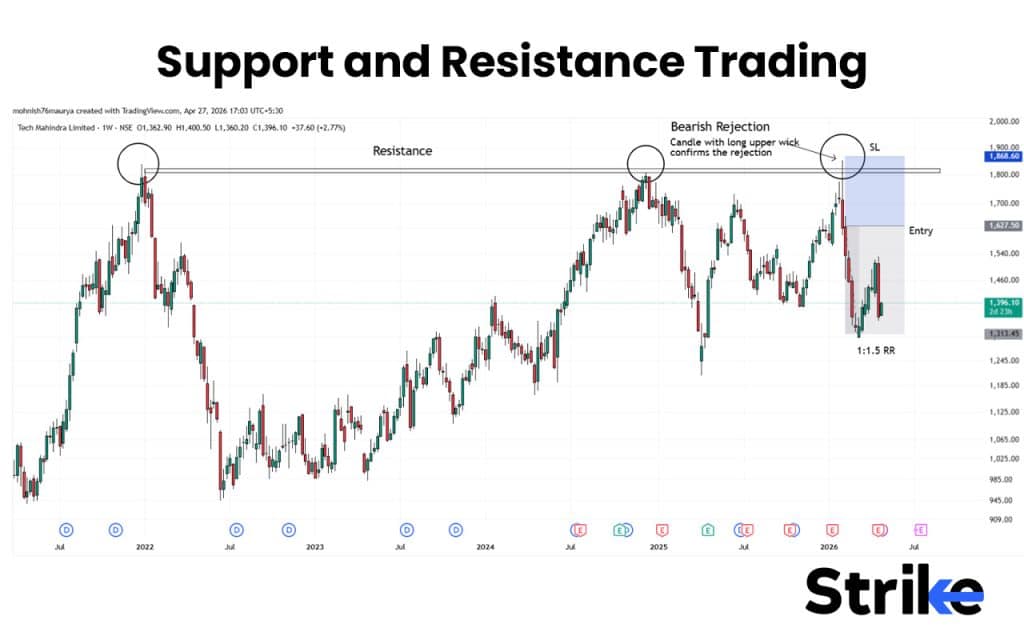
- Entry: Enter a long position near a support level after a confirmation (bullish reversal candle or chart pattern) or enter a short position near a resistance level after a confirmation (bearish reversal candle or chart pattern).
- Stop-loss: Below the support level or reversal pattern low for a long trade and above the resistance or reversal pattern high for a short trade.
- Target: Next key level or minimum of risk to reward of 1:2.
Before entering, check whether the price has tested support or resistance at least 2-3 times in the past. Use RSI overbought (at resistance) and oversold (at support) to confirm the rejection.
| Support and Resistance Trading Summary | |
|---|---|
| Best Timeframe | 1H, 4H, and Daily (Higher timeframes give stronger levels and fewer false signals) |
| Trade Entry | Enter near support for buying and near resistance for selling, only after confirmation (rejection candle, strong bounce, or volume spike) |
| Profit Target | Next key level (Resistance for buy, Support for sell) or maintain minimum 1:2 risk:reward. |
| Stop Loss | Slightly below support (for buying) and above resistance (for selling) to avoid stop hunts |
| Exit | Exit at target level, or early exit if price shows strong rejection/opposite momentum before reaching the target. |
The support and resistance zone can be 0.5–1.5% wide based on the timeframe.
2. Moving Average Crossover Strategy
The moving average crossover strategy is a trend-following trading strategy where traders use two moving averages (a short period and a long period) to identify the trend direction and momentum shift in the market.
These crossovers basically suggest whether the short-term price momentum is overpowering or underpowering the long-term average price trend.
- Bullish Crossover: When the short-period moving average crosses above the long-period moving average from below, it indicates strengthening price momentum and a potential uptrend.
- Bearish Crossover: When the short-period moving average crosses below the long-period moving average from above, it indicates weakening price momentum and a potential downtrend.
This strategy works best in trending markets where the market is showing a strong directional move.
A moving average crossover strategy can be traded by following three major steps.
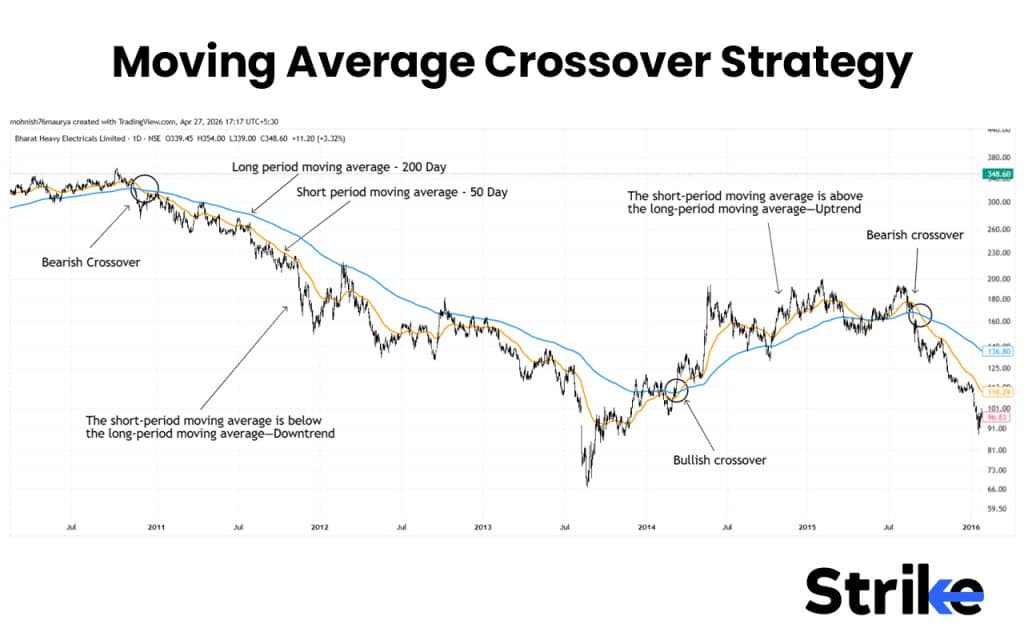
- Entry: Enter long after a bull’s crossover or enter short after a bearish crossover.
- Stop-loss: Below recent swing low for a long trade and above recent swing high for a short trade.
- Target: Ride the profit until the opposite crossover happens or book profit at the next key level.
If price has moved very far from moving averages during a crossover, that setup is considered weak compared to price staying closer to moving averages during a crossover.
| Moving Average Crossover Strategy Summary | |
|---|---|
| Best Timeframe | 1H, 4H, Daily |
| Trade Entry | Buy when short-term MA crosses above long-term MA (Golden Cross); Sell on opposite crossover |
| Profit Target | Ride trend until opposite crossover or key S/R level |
| Stop Loss | Below recent swing low (buy) / above swing high (sell) |
| Exit | Opposite crossover or loss of momentum |
The reliability of a crossover increases when the price sustains above or below both the moving averages after the crossover.
3. Relative Strength Index (RSI) Strategy
The Relative Strength Index (RSI) strategy is a momentum-based trading strategy where RSI is mainly used to identify overbought/oversold conditions, potential trend reversals, and trend continuation.
RSI basically measures the strengths of the market on a scale of 0 to 100, where an RSI value above 70 indicates an overbought condition and an RSI value below 30 indicates an oversold condition. Apart from identifying overbought and oversold conditions, RSI also helps in identifying weakening of momentum using divergence.
- Bullish Divergence: When price keeps falling but RSI values start rising, it suggests weakening of bearish momentum and a potential bullish reversal.
- Bearish Divergence: When price keeps rising but RSI values start falling, it suggests weakening of bullish momentum and a potential bearish reversal.
The RSI strategy works best when it is combined with proper market context, rather than using it in isolation. For sideways markets, RSI 30-70 works better for catching reversals. In an uptrend, RSI 40-50 works best for pullback entries, while in a downtrend, RSI 60-50 works better for pullback entries.
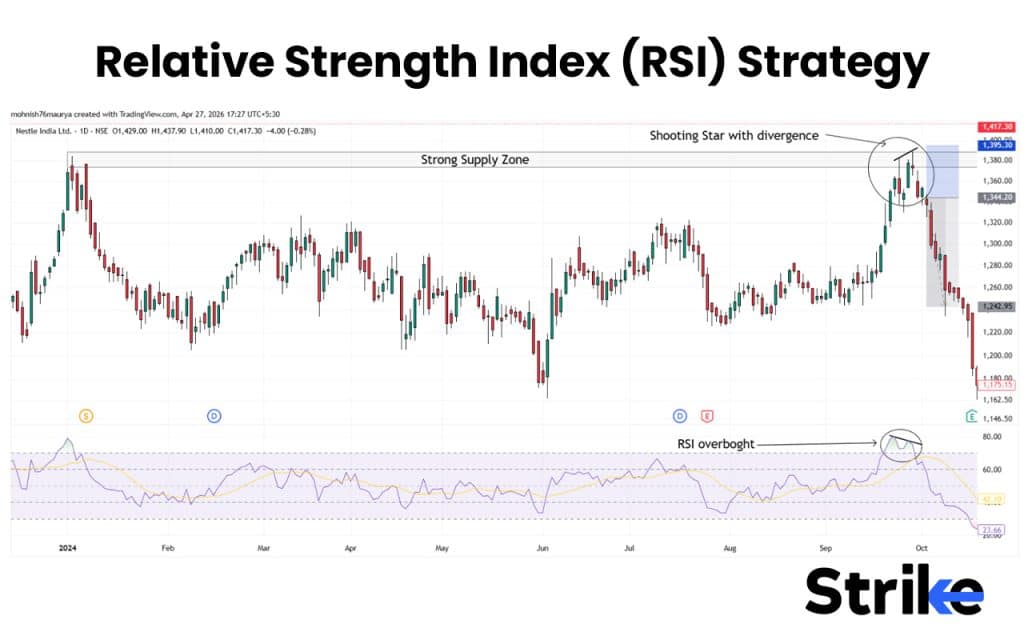
An RSI trading strategy can be used to trade either trend reversals or trend continuation.
- Trend Reversal Setup: During a range-bound market, enter long when price form a bullish reversal candle pattern during an RSI oversold condition and enter short when price forms a bearish reversal candle pattern during an RSI overbought condition.
- Trend continuation setup: Buy when RSI near 30–40 in uptrend; Sell when RSI near 60–70 in downtrend (with confirmation)
| Relative Strength Index (RSI) Strategy | |
|---|---|
| Best Timeframe | 1H, 4H, Daily |
| Trade Entry | Buy when RSI near 30–40 in an uptrend. Sell when RSI near 60–70 in downtrend (with confirmation) |
| Profit Target | Previous swing high/low or trend continuation |
| Stop Loss | Below recent low / above recent high |
| Exit | RSI reversal or divergence signal |
Before entering a trade, make sure to enter on strong reversal candles during the RSI overbought/oversold conditions. For a more confirmed entry, prefer entering after a confirmation candle (the second candle after the rejection candle that closes above or below the reversal candle).
4. Breakout Trading
Breakout trading involves trading a break of a well-defined support or resistance level in order to capture a strong directional trend. These breakouts occur when the market shifts from a balanced phase (consolidation) to an imbalance phase (where one party completely dominates the other).
This imbalance is driven by institutional participation and triggering of clustered stop-loss orders. The entry of new retail traders also fuels the breakout, which leads to a sharp and sustained move.
- Bullish Breakout: When price breaks resistance and moves up, it forms a bullish breakout.
- Bearish breakout: When price breaks below support and moves down, it forms a bearish breakout.
Breakout trading works best when the market shifts from a low-volatility to a high-volatility phase after a tight consolidation. To trade breakout, follow three simple steps briefly discussed below.
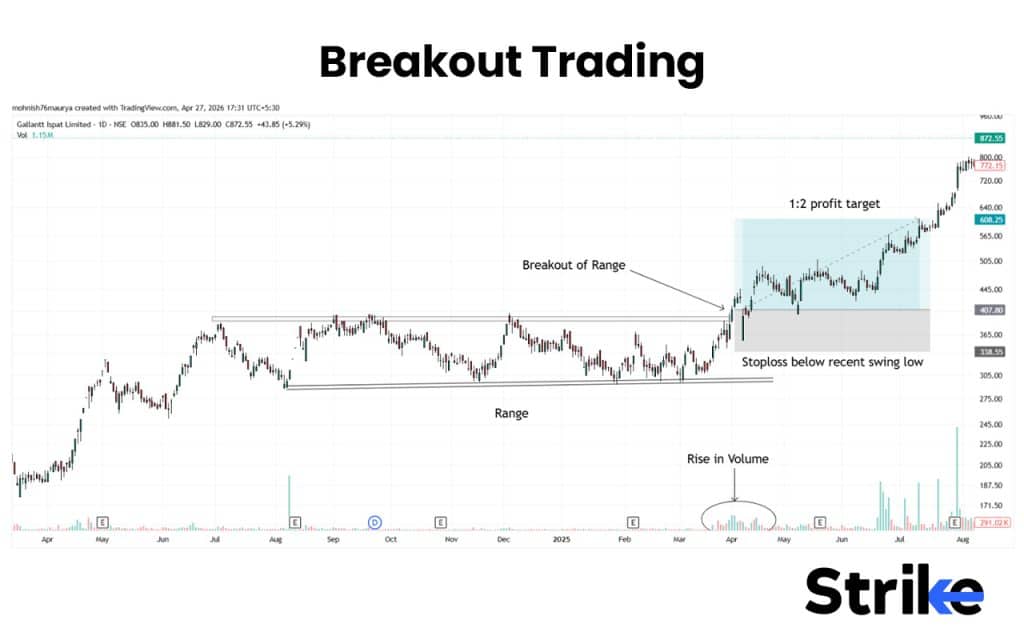
- Entry: Enter long when the price breaks resistance or enter short when the price breaks support with a big candle and good volume.
- Stop-loss: Place your stop-loss below or above a recent swing low or breakout candle.
- Target: Keep target based on measured move or use minimum of 1:2 RR
| Breakout Trading Strategy Summary | |
|---|---|
| Best Timeframe | 15M, 1H, 4H |
| Trade Entry | Enter on breakout of key level with volume confirmation |
| Profit Target | Measured move or next S/R level |
| Stop Loss | Inside the breakout range |
| Exit | Failed breakout or reversal candle |
5. Trend Following Strategy
A trend-following strategy involves taking up trades in the direction of the trend of the market in order to make a profit from the trend of the market as long as the trend is intact. Markets always move in trends because of sustained institutional activity and continuous order flow.
Instead of catching tops and bottoms, trend traders ride the middle, which is where the most reliable and repeatable profits are made. Hence, this strategy works best in a strong trending market, where the market moves with a clear structure of higher highs/lows or lower highs/lows.
Steps to trade a trend-following trading strategy are mentioned below.
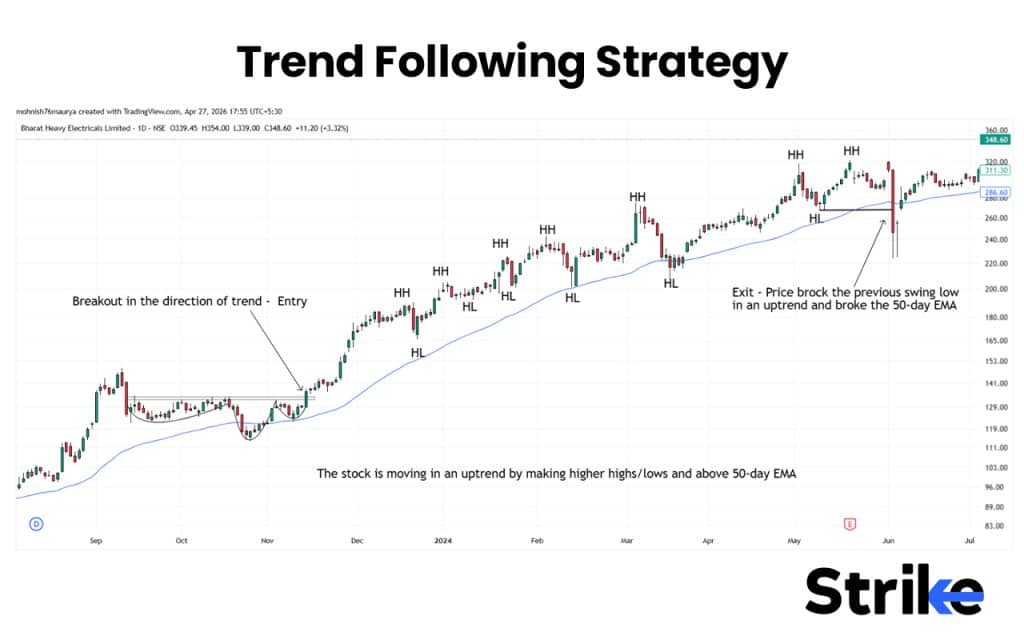
- Entry: Identify the clear trending market by marking market structure or by using moving averages. Enter on pullback, break of previous swing high, or break of any continuation chart pattern.
- Stop loss: Below the recent swing low or pattern low in an uptrend or below the recent swing high or pattern high in a downtrend.
- Profit target: Trail the position as long as the trend is intact (use EMA), or exit at a major support or resistance level. Maintain the minimum RR of 1:2.
A strong impulsive move followed by a shallow pullback confirms the strengths of the trend. Also look if volume supports the trend.
| Trend Following Strategy | |
|---|---|
| Best Timeframe | 4H, Daily |
| Trade Entry | Enter in direction of trend on pullbacks |
| Profit Target | Trail profits along trend |
| Stop Loss | Below higher low / above lower high |
| Exit | Trend structure break |
Many traders hesitate to enter a strong trending market because the price looks “too high” or “too low” to them; this is where they miss the move.
6. Momentum Trading
Momentum trading is a strategy where traders aim to capture a quick directional move in stocks that are moving strongly in one direction with high speed and strength. Momentum trading involves capturing the fastest part of the move, while trend trading involves riding the entire move.
Such strong momentum appears in stocks due to a sudden increase in buying and selling activity because of news, earnings, or strong institutional activity. As momentum builds, more traders jump in, creating a chain reaction that pushes prices in the same direction more aggressively.
Momentum trading works best in highly volatile and trending markets. In a slow or sideways market, momentum quickly fades.
You can do momentum trading by following the simple steps discussed below.
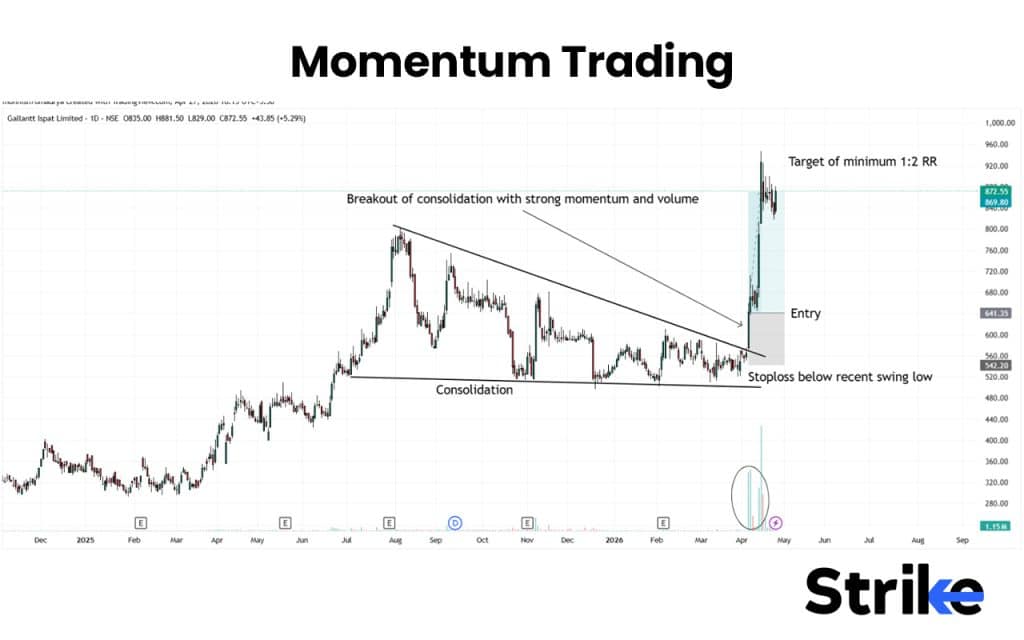
- Entry: Enter on breakout of consolidation pattern with strong momentum candle with high volume or enter on small pullback after a small impulsive move.
- Stop loss: Below the recent consolidation or breakout level or below the momentum candle low
- Target: Book partial profits after a quick move and trail the rest of the positions to capture the extended momentum. Maintain a minimum 1:2 RR.
Strong momentum candles often have a wide range with minimal wicks and a sudden volume expansion.
| Momentum Trading Strategy Summary | |
|---|---|
| Best Timeframe | 15M, 1H |
| Trade Entry | Enter when strong price + volume expansion |
| Profit Target | Ride momentum burst |
| Stop Loss | Below momentum candle |
| Exit | Momentum slowdown or reversal |
In momentum trading, the best momentum trades come just after expansion begins and fades faster than trends. Hence, it is important to book profits fast in momentum trading.
7. Pullback Trading
Pullback trading is a trading strategy where traders enter the trend in the direction of the trend after a temporary price retracement, aiming to capture the next leg of the trend.
The core idea behind the pullback trading strategy is rooted in Dow Theory, which says price does not move in a straight line. Price moves in phases: an impulsive phase and a corrective phase. This corrective phase in a trend comes due to short-term profit booking. Pullback traders plan their entry during the pullback phase to capture the next impulsive phase of the trend.
Pullback trading works best in an established trending market where the trend is clear, especially on higher timeframes.
There are four simple steps to trade pullbacks in a trending market. These steps are briefly discussed below.
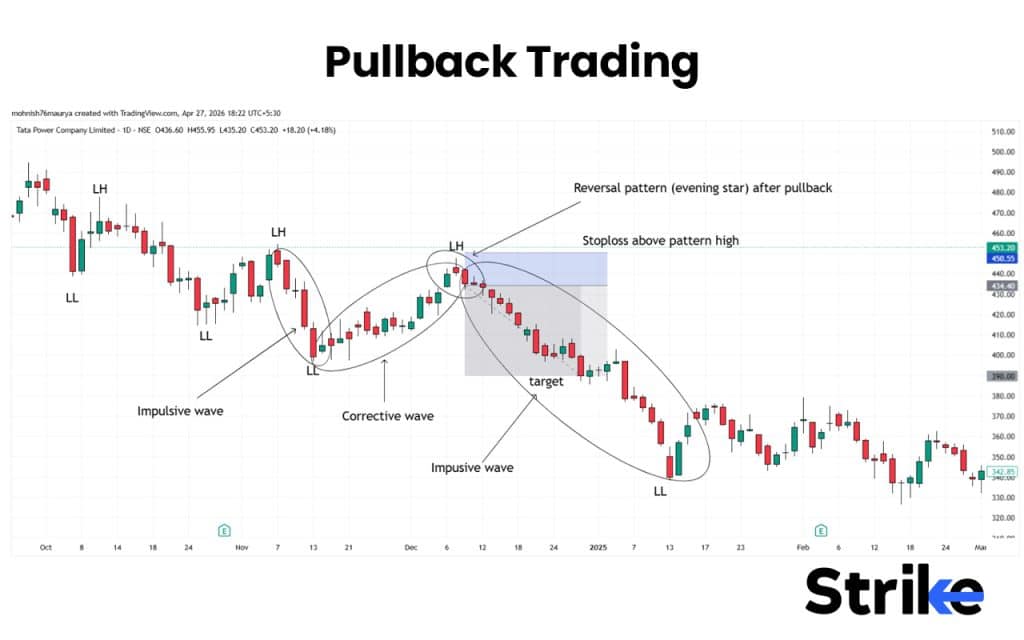
- Trend Identification: Identify the market trend using higher highs/lows or lower highs/lows or by using moving averages.
- Entry: Wait for price to pull back to its key area, like support/resistance, moving average, or Fibonacci level. Enter a long position when the price pulls back and forms a bullish reversal pattern on key levels in an uptrend. Enter a short position when the price pulls back and forms a bearish reversal pattern on key levels in a downtrend.
- Stop loss: Place your stop loss beyond the pattern’s high or low or beyond swing high and low.
- Target: For a long trade, consider the next resistance or swing high as a target, and for a short trade, consider the next support or swing low as a target. Consider a minimum of a 1:2 RR.
| Pullback Trading Strategy Summary | |
|---|---|
| Best Timeframe | 1H, 4H |
| Trade Entry | Enter after pullback in trend with confirmation |
| Profit Target | Previous high/low or trend continuation |
| Stop Loss | Below pullback low / above pullback high |
| Exit | Weak continuation or reversal sign |
It is very important to distinguish between a healthy pullback and a weak pullback. A healthy pullback typically retraces to 38–61.8% of its prior trend. If pullback is more than 78.6%, the pullback is weak; avoid trading such pullbacks.
8. Channel Trading
Channel trading involves identifying the price channel formed by two parallel trend lines and taking trades based on price movement within these channels. In a channel, one line (lower boundry) acts as a dynamic support and the other (upper boundary) acts as a dynamic resistance.
This strategy works when price moves in a trending, controlled, and rhythmic manner, oscillating between support and resistance of a channel. This gives traders a buy at support and sell at resistance opportunity.
Channel trading performs best in steady, well-structured trends where price respects boundaries.
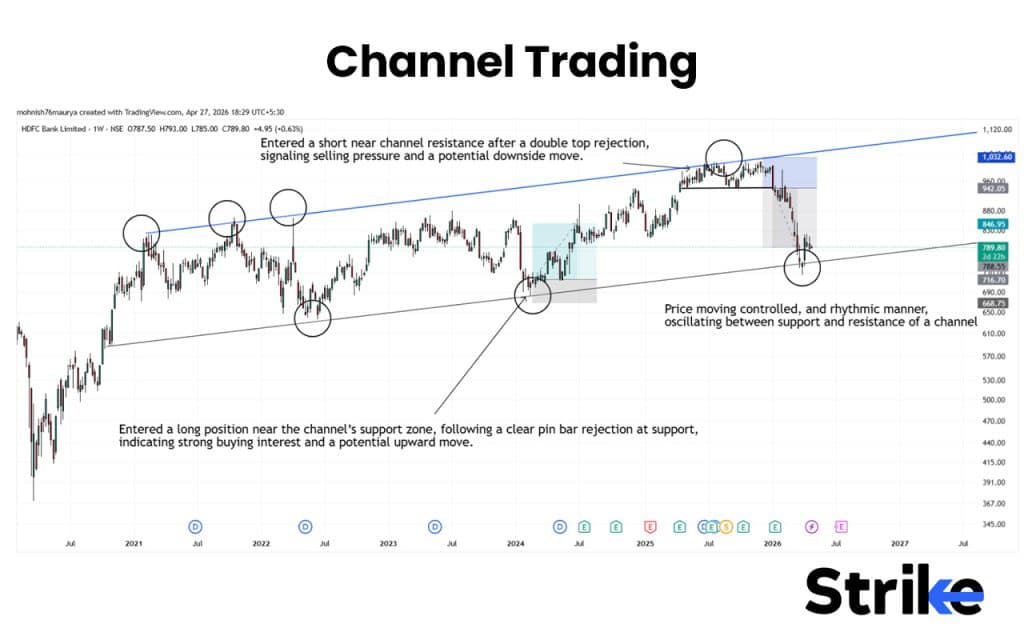
- Entry: Enter long near the lower boundary (support) after a bullish pattern and enter long near the upper boundary (resistance) after a bearish pattern.
- Stop Loss: Below the lower boundary for buy trade and above the upper boundary for sell trade.
- Target: Opposite side of the channel, or trail the position if the price has strong continuation. Maintain a minimum of 1:2 RR.
The more time price respects the channel boundary, the more reliable the channel becomes. However, the reliability of a steeper channel is less compared to a gradual channel.
| Channel Trading Strategy Summary | |
|---|---|
| Best Timeframe | 1H, 4H |
| Trade Entry | Buy at channel support, Sell at channel resistance |
| Profit Target | Opposite boundary of channel |
| Stop Loss | Outside channel boundary |
| Exit | Breakout from channel |
9. Bollinger Bands Squeeze
The Bollinger Band squeeze strategy is a volatility-based trading strategy where traders identify the period of low volatility using the Bollinger Band squeeze and aim to capture a sharp breakout when volatility expands.
Bollinger bands contract when price moves slow and sideways, but this contraction cannot last forever. Once a strong imbalance is created, price expands rapidly, leading to a breakout. This shift from low volatility to high volatility gives traders a trading opportunity.
It is less effective when volatility is already high or when the market is choppy without clear direction.
There are four simple steps to trade the Bollinger Band squeeze strategy, which are discussed briefly below.
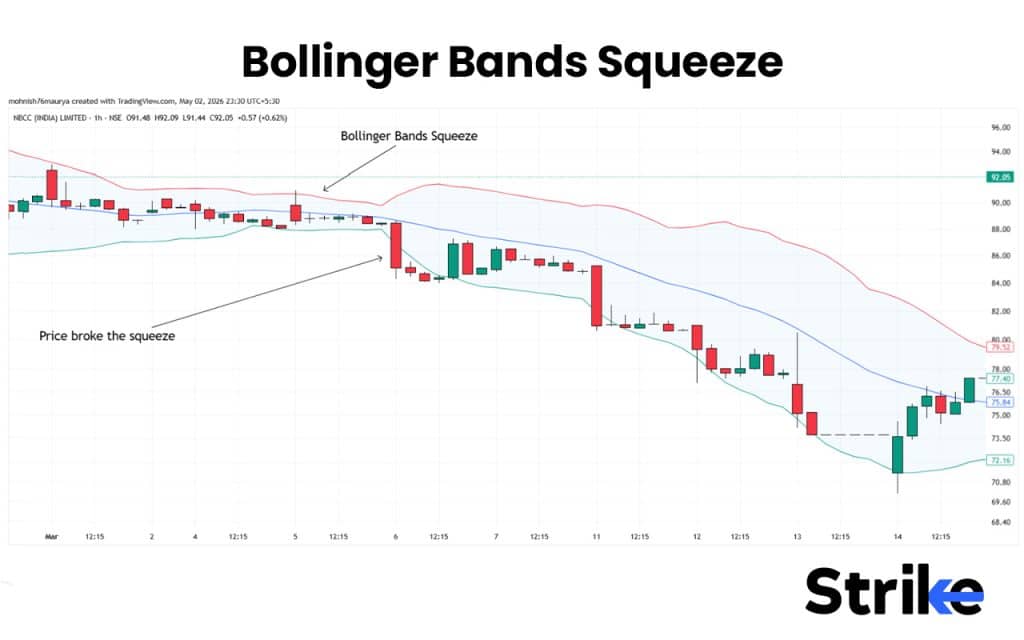
- Identification: Identify the Bollinger Band squeeze and wait for price to break above or below the squeeze.
- Entry: Enter long when the price breaks above the squeeze or enter short when price breaks below the squeeze.
- Stop loss: Above or below the squeeze or beyond recent swing high or low.
- Target: Aim for the next key level, or trail the target using moving averages. Maintain the minimum of 1:2 RR
| Bollinger Bands Squeeze Strategy | |
|---|---|
| Best Timeframe | 15 Min, 1H, 4H |
| Trade Entry | Buy near lower band (oversold), Sell near upper band (overbought) |
| Profit Target | Middle band (20 SMA) or opposite band |
| Stop Loss | Outside the band (below lower band for buy, above upper band for sell) |
| Exit | Band breakout with strong momentum or price closing beyond bands |
10. Fibonacci Retracement
Fibonacci retracement is a type of pullback trading where traders use Fibonacci ratios (38.2%, 50%, and 61.8%) to identify the potential area from where price would reverse and continue its original trend after a pullback.
The Fibonacci retracement strategy works on the logic that markets do not move in a straight line. Markets tend to retrace some percentage of their previous move before continuing further. These retrenchment levels are calculated and plotted based on Fibonacci numbers. At these levels, buyers and sellers re-enter the market.
This strategy works in a well-defined trending market, especially on higher timeframes.
There are four major steps to trading Fibonacci retracements, in which drawing Fibonacci is the most crucial step.
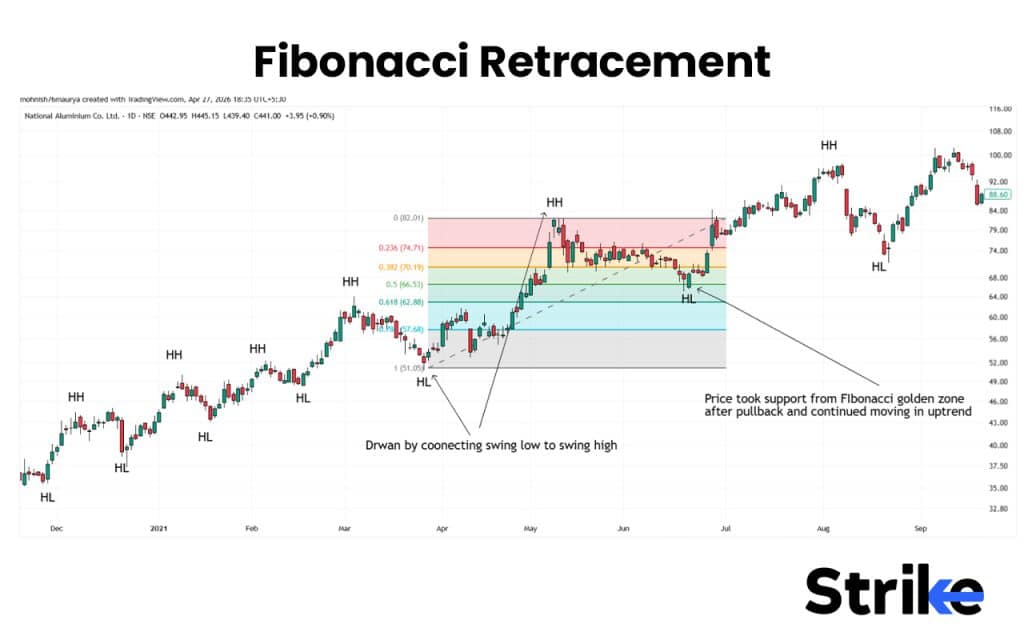
- Draw Fibonacci Retracement: Connect the swing low and swing high in an uptrend to identify potential support levels for pullbacks. Conversely, connect swing high and swing low in a downtrend to identify potential resistance levels.
- Entry: Wait for the price to react to any of the key retracement levels (38.2%, 50%, 61.8%) after the pullback. Enter long near resistance or short near support with confirmation.
- Stop loss: Below the recent low for long trades or above the swing high for short trades.
- Target: Previous swing highs or lows, Fibonacci extension levels, or a minimum of a 1:2 RR.
However, it is important to understand whether the particular Fibonacci level is strong enough to provide support or resistance. For confirmation, look for strong price rejection on key Fibonacci levels.
| Fibonacci Retracement Strategy Summary | |
|---|---|
| Best Timeframe | 1H, 4H, Daily |
| Trade Entry | Enter near 38.2%, 50%, 61.8% levels with confirmation |
| Profit Target | Previous swing high/low |
| Stop Loss | Below next Fibonacci level |
| Exit | Level failure or reversal |
The 61.8 level is considered a golden ratio from where price reverses most of the time. Retracements below 61.8 are generally less reliable because of deep correction.
11. Candlestick Analysis
Candlestick analysis is a trading strategy where traders enter a trade by studying candlestick patterns. The size and shape of each candlestick pattern represents the psychology of buyers and sellers.
These candle patterns can be single or multiple candle patterns, bullish or bearish reversal candle patterns. These patterns work because they reflect the real-time behavior of participants.
Candlestick patterns work best when used with the right market context (support/resistance or overbought/oversold zones) instead of alone.
Trading candlestick patterns involves three major steps, which are briefly discussed below.
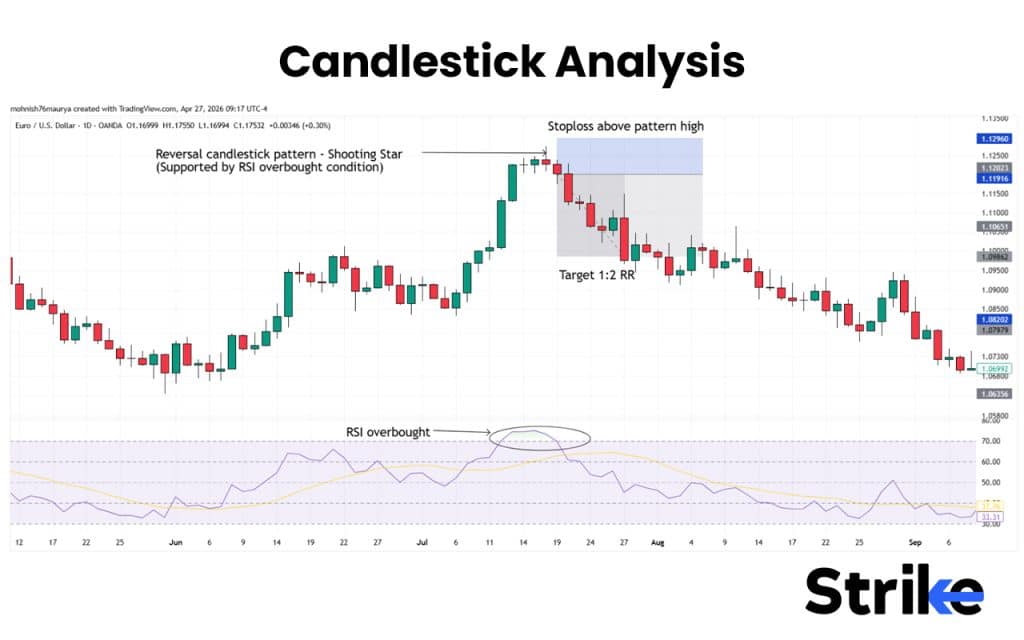
- Entry: Enter a long position after a bullish reversal candlestick pattern forms near support or enter short after a bearish reversal candlestick pattern forms near resistance.
- Stop loss: Place your stop loss beyond the candlestick pattern’s high or low.
- Target: Aim for the next resistance or support as a target or trail the stop loss till the momentum is intact. Take at least a 1:2 RR.
The confirmation of a candlestick pattern can be increased by combining it with indicators like volume and RSI.
| Candlestick Analysis Trading Strategy Summary | |
|---|---|
| Best Timeframe | All timeframes (best on 1H+) |
| Trade Entry | Enter based on patterns (engulfing, pin bar, etc.) at key levels |
| Profit Target | Nearby S/R levels |
| Stop Loss | Below/above pattern |
| Exit | Opposite candle signal |
The best candlestick setup forms when it aligns with structure, trend, and key levels.
12. Chart Pattern Analysis
Chart pattern analysis trading involves identifying the chart patterns, like triangles, head and shoulders, flags, etc., and trading continuation or reversal trends after the pattern breaks.
These patterns reflect a gradual shift in supply and demand where accumulation, distribution, or indecision between buyers and sellers happens. When the patterns complete, they break out or reverse, driven by institutional activity.
Such chart patterns work best in clear and well-formed market structure, like trending markets for trend continuation trades or exhausted markets for trend reversal trades.
There are four simple steps to trade chart patterns, which are briefly discussed below.
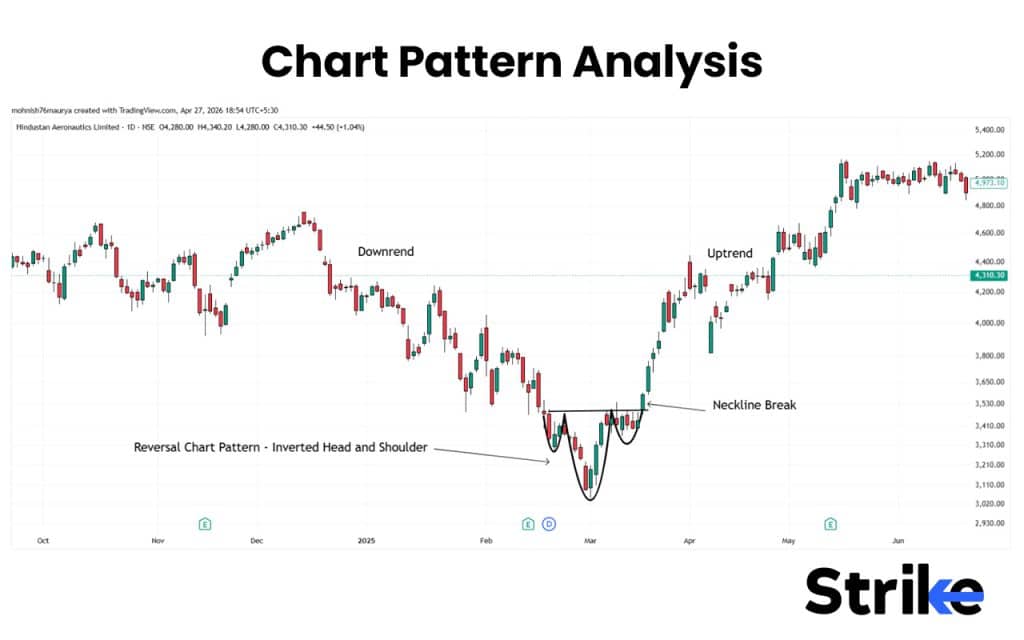
- Pattern Identification: Identify the chart pattern, whether it is a continuation, neutral, or reversal chart pattern.
- Entry: Enter the trade once the price breaks out of the pattern with a strong candle and good volume.
- Stop loss: Place your stop loss below/above the breakout level or beyond the opposite side of the pattern
- Target: Measure the height of the pattern and project it in the direction of breakout or aim for the next key level. Try to maintain at least an RR of 1:2.
For a more conservative entry, wait for a retest of the breakout level.
| Chart Pattern Trading Strategy Summary | |
|---|---|
| Best Timeframe | 1H, 4H, Daily |
| Trade Entry | Enter on breakout of pattern (triangle, H&S, etc.) |
| Profit Target | Measured move of pattern |
| Stop Loss | Inside pattern structure |
| Exit | Pattern failure |
The longer the time taken for the pattern to form, the stronger is the breakout due to increased order buildup.
13. Pair’s Trading
Pair trading is a market-neutral strategy where traders aim to profit from buying one share and selling another related share simultaneously to capture the relative performance difference between them, rather than the overall market direction.
Pair trading works on the idea that similar stocks or sectors tend to move together due to the same fundamentals or industry factors. However, sometimes one stock may outperform or underperform temporarily, creating a deviation from their usual relationship. Traders trade this imbalance and expect the price to revert back to their historic relation, allowing traders to make a profit from this convergence.
Pairs trading works best in stable market conditions where relationships between stocks remain consistent.
There are four important steps to trading pairs, which are briefly mentioned below.
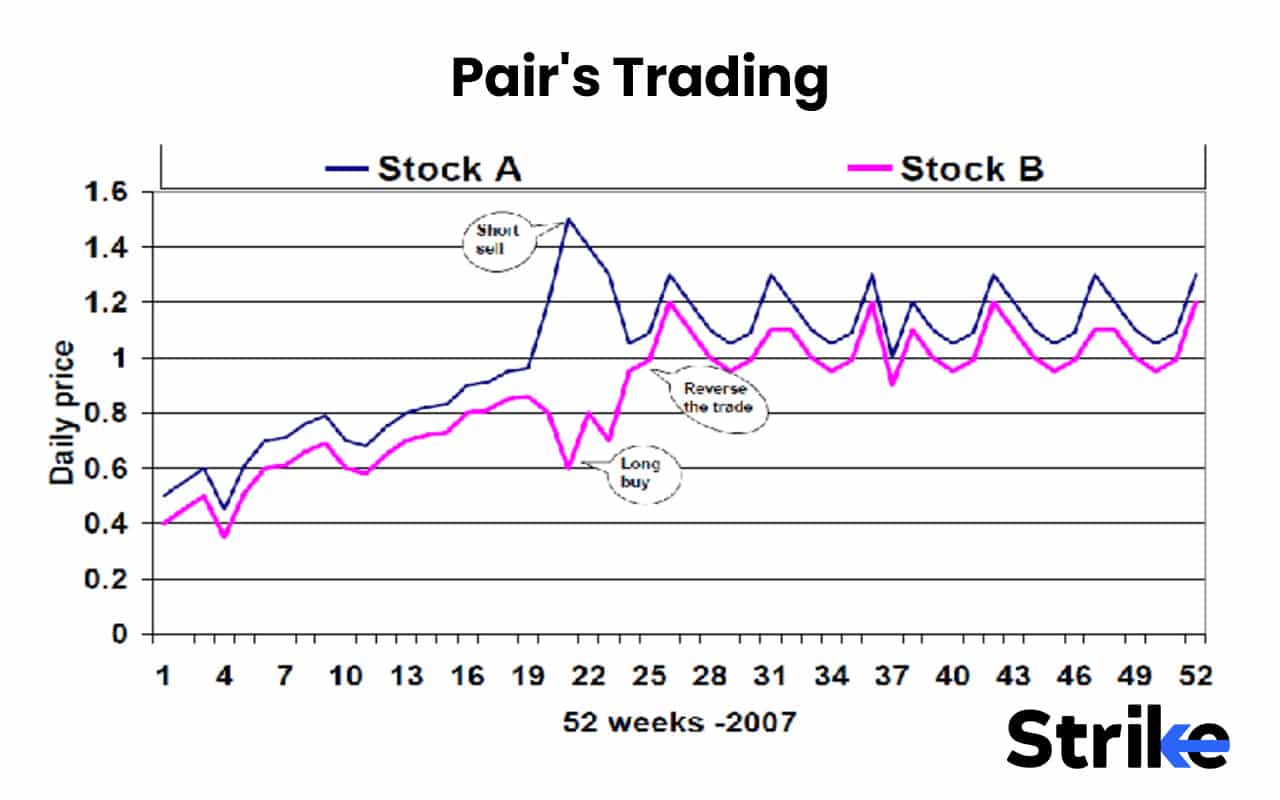
- Identification: Identify the mismatch or divergence between two similar or directly correlated stocks.
- Entry: Buy the undervalued stock and sell the overvalued stock.
- Stop loss: Exit if divergence continues beyond expected range or if correlation between stocks weakens significantly
- Target: Edit when the price of the stocks returns to its historical average or when both positions reach expected relative equilibrium.
For confirmation, check the historical correlation between the pairs or a clear deviation from the average spread.
| Pair Trading Summary | |
|---|---|
| Best Timeframe | Daily |
| Trade Entry | Enter when spread deviates (buy undervalued, sell overvalued) |
| Profit Target | Mean reversion |
| Stop Loss | Further divergence beyond threshold |
| Exit | Spread normalization |
The risk in pair trading is a breakdown of correlation between two stocks. When correlation breaks, strategy fails.
14. Trading Post-Earnings Announcement Drift (PEAD)
Trading Post-Earnings Announcement Drift (PEAD) is an earnings-based strategy where traders capitalize on stocks that have a tendency to continue the move even after the initial reaction to earnings.
When a company announces an unexpected result, either good or bad, the price reacts quickly. However, institutions take time to build positions, causing a gradual price drift instead of an instant move. This allows traders to benefit from this delayed price adjustment and sustained order flow.
This strategy works best in stocks with strong earnings surprises and high participation.
To trade PEAD, identify the stocks with strong earnings and wait for the initial reaction, like a gap-up or gap-down.
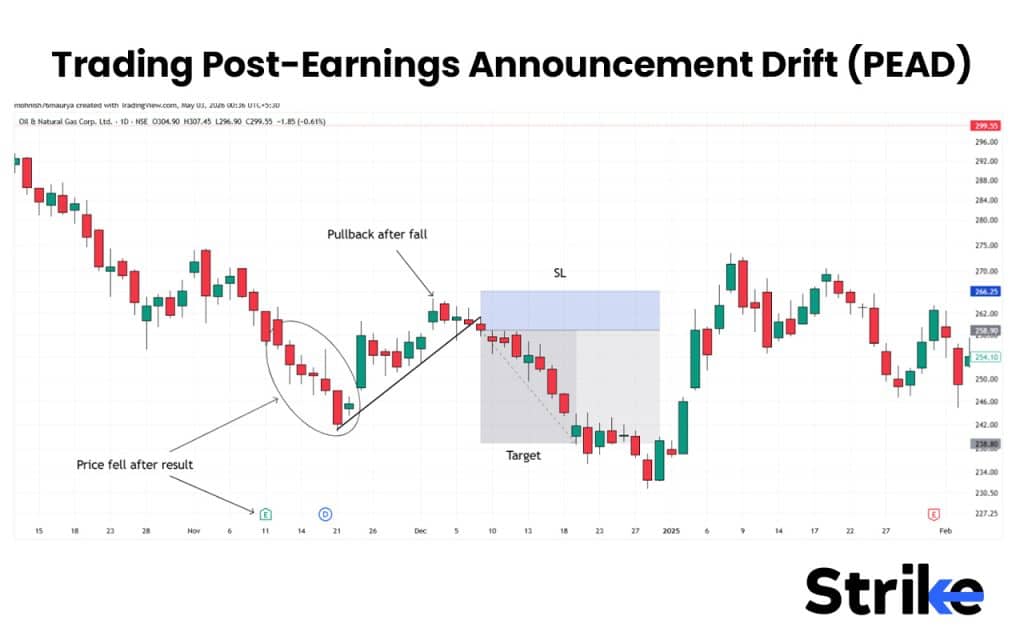
- Entry: Enter on consolidation or pullback after the initial reaction is over. Enter long on good-earning stocks or enter short on bad-earning stocks.
- Stop-loss: Above or below swing points.
- Target: Previous resistance/support levels or ride the trend for multiple sessions as drift continues. Maintain a minimum Risk:Reward of 1:2
| Trading Post-Earnings Announcement Drift (PEAD) | |
|---|---|
| Best Timeframe | Daily, 4H |
| Trade Entry | Buy after positive earnings surprise with strong breakout, Sell after negative surprise with breakdown |
| Profit Target | Ride the drift (partial booking at key resistance/support levels) |
| Stop Loss | Below post-earnings breakout candle (for buy) / Above breakdown candle (for sell) |
| Exit | Momentum fades, gap fill, or reversal pattern appears |
15. Volatility Contraction Pattern (VCP)
A volatility contraction pattern (VCP) is a volatility-based trading setup where price forms a series of tightening pullbacks with falling volatility. Once a price breaks out of this pattern, it often gives a strong trending move.
The volatility contraction pattern (VCP) works on the principle of volatility contraction and expansion. Each smaller pullback from the previous one indicates that the selling pressure is getting absorbed. Once this consolidation completes, even a small increase in demand can trigger a powerful breakout due to limited supply, leading to sharp price expansion.
VCP works best in a strong trending market with high institutional participation.
To trade VCP, first wait for the price to form a tightening structure, not any type of consolidation.
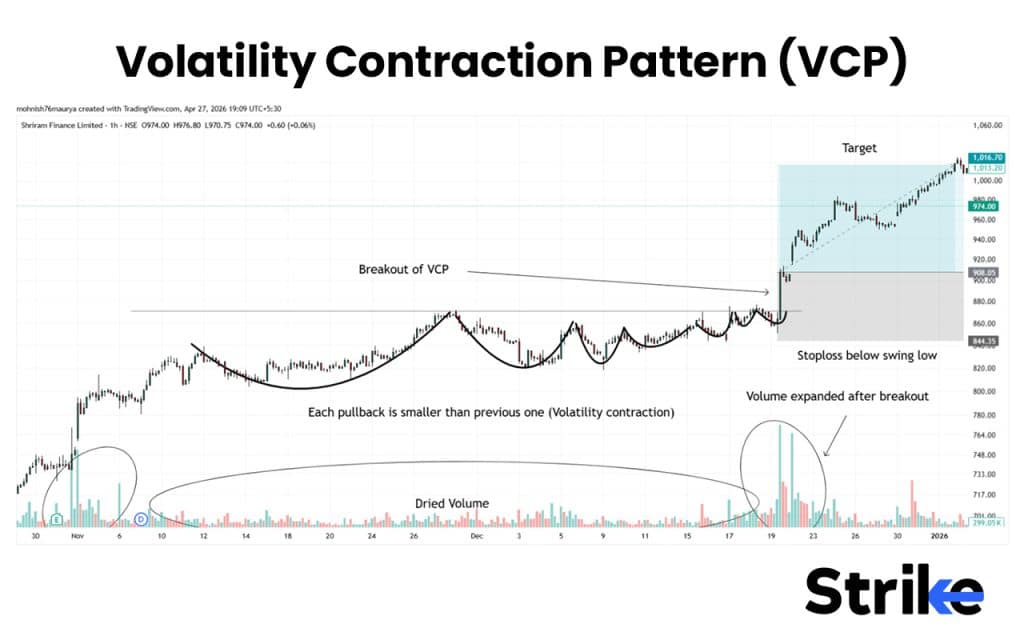
- Entry: Identify the contraction near support where each pullback is lower than the previous one and enter the trade after price breaks the resistance.
- Stoploss: Just below the low of the most recent pullback in contraction.
- Target: Ride the breakout move with a trailing stop loss or set a profit target based on a measured move basis. Maintain a minimum of 1:2 RR.
Use a volume indicator to confirm the VCP. During the contraction period volume usually dries and volume expands on breakout.
| Volatility Contraction Pattern (VCP) Strategy Summary | |
|---|---|
| Best Timeframe | Daily |
| Trade Entry | Enter on breakout after volatility contraction |
| Profit Target | Strong trend expansion |
| Stop Loss | Below last contraction low |
| Exit | Failed breakout or volume drop |
The tighter the consolidation, the more explosive the breakout, because of the limited supply. In VCP, volume contraction is equally important to price contraction for a strong setup.
Does Swing Trading Actually Work?
Yes, swing trading does work, but its success entirely depends on strategy, discipline, risk management, and market condition, because swing trading is not a strategy; it’s a framework. According to data published on FXReplay, about 10% of swing traders achieve consistent annual profits, often in the 10-30% range, due to common pitfalls like poor risk control and emotional trading.
However, professional and experienced swing traders make a profit of 25 to 60% with a win rate of 35-60%. This clearly highlights an important reality: most retail traders fail in swing trading not because the method doesn’t work, but because they lack a repeatable system, ignore risk management, chase trades, and let emotions dictate their decisions.
Can You Make Consistent Profit with Swing Trading?
Yes, making consistent profit with swing trading is possible, but it requires strict discipline and trading skills. There are four important rules you should follow in order to make consistent profits, which are briefly discussed below.
- Risk Management: Do not risk more than 1-2% of your trading capital. Use stop-loss and position sizing and maintain favorable risk-to-reward ratios (minimum 1:2). This method helps to protect your capital during losing streaks.
- Clear Strategy: Trade with a clear rule-based, backtested strategy with a minimum of 45-50% win rate.
- Patience in Consolidations: Avoid trading choppy ranges and overtrading. Wait for higher timeframe breakouts to capture trending moves. Focus on quality setups rather than quantity.
- Realistic Expectations: Aim only for 1-2% a month, which makes it 12 to 24% a year. As most of the traders lose chasing unrealistic gains.
Consistency comes from discipline and repeatable execution, not big wins. Focus on protecting capital and steady gains over time.
What Timeframe is Used for Swing Trading Analysis?
Higher timeframes such as 4 hrs, daily, and weekly are considered to be the best timeframes for swing-trading analysis. Higher timeframes filter out intraday market noise and give clear market structure.
Traders also use multi-timeframe analysis to increase the winning probability. Weekly for trend direction, daily for setup confirmation, and 4-hour/1-hour for precise entry.
| Trading Style | Analysis Timeframes | Hold Duration | Core Logic |
|---|---|---|---|
| Conservative | Weekly + Daily | 1–4 weeks | Trade in direction of macro trend; focus on strong structure and high-probability zones |
| Standard | Daily + 4H | 3–10 days | Capture swing moves within broader trend using pullbacks and continuation setups |
| Aggressive | 4H + 1H | 1–5 days | Exploit short-term momentum, early breakouts, and faster price inefficiencies |
How to Find Stocks for Swing Trading?
There are mainly two methods to find stocks for swing trading: manual and automation. The manual method involves actively scanning each stock and building a watchlist of selected stocks. This method builds strong chart-reading skills but is time-consuming.
There are various software programs available in the market that filter stocks for swing trading based on predefined rules. Examples of these tools are StrikeMoney, Chartink, and Screeners.
StrikeMoney has technical scanners that filter stocks for swing trading based on technical indicators, like RSI, MACD, Moving Average, Stochastics , etc.
Along with this, StrikeMoney has RMI (Rohit Momentum Indicator), a custom indicator that gives buy and sell signals based on stocks’ momentum. This helps to find swing trading stocks with buy and sell signals.
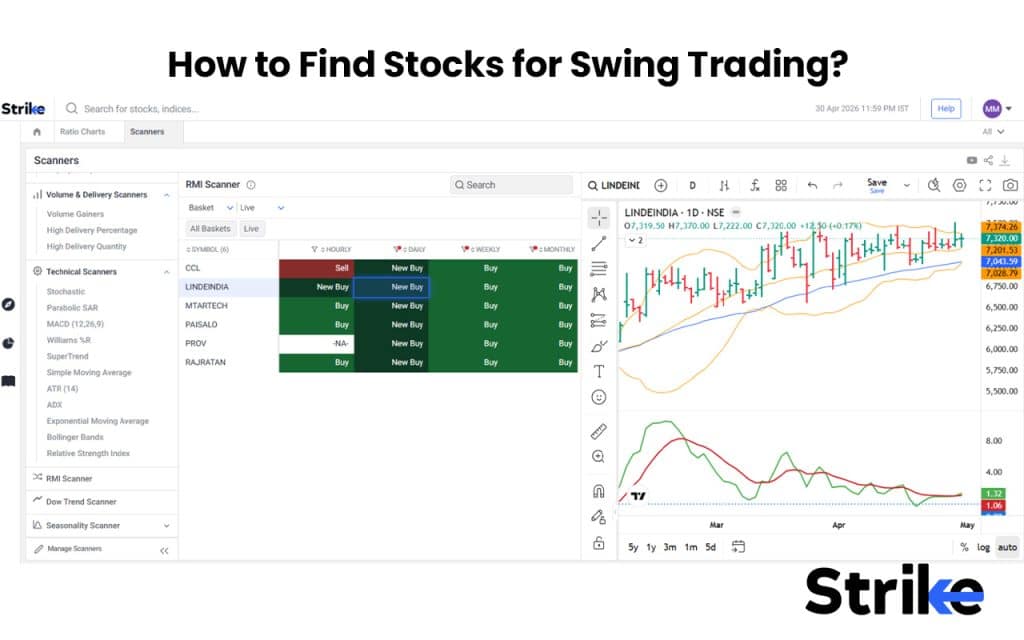
- If monthly and weekly RMI are in a buy signal, it means the broader trend is bullish.
- Enter in stock with a new buy signal on the daily timeframe. This gives good stocks for wrong trading.
- Conversely, do it for self-setup.
Along with these, StrikeMoney also has an RRG and Dow trend scanner that helps filter stocks for swing trading based on strength and trend.
How to Calculate Optimal Risk-Reward Ratio for a Swing Trade?
To calculate the optimal risk-reward ratio for swing trading, first you have to identify the entry, stop loss (above or below the swing or support/resistance), and target (on a measured move basis or the next key level).
- Risk = Entry – Stop-Loss
- Reward = Target – Entry
- RRR = Risk / Reward or Reward / Risk
For example, buy a stock at ₹500, stop-loss at ₹485 (risk ₹15), and target ₹530 (reward ₹30). RRR = 15:30 or 1:2
The RRR 1:2 is optimal and commonly used by swing traders; however, traders should adjust the RRR based on volatility. For higher volatility, go for an RRR of 1:3 or more, while for low volatility, lower the RRR to 1:1.5.
The table below shows the minimum risk-reward ratio required based on win rate.
| Win Rate | Minimum Risk-Reward Ratio (Breakeven) |
|---|---|
| 33% | 1:2 |
| 40% | 1:1.5 |
| 50% | 1:1 |
| 60% | 1:0.67 |
The optimal RRR is a function of your win rate and market conditions.
How to Manage Overnight Gap Risk in Swing Trading?
There are four ways to manage overnight gap risks in swing trading, which are briefly discussed below.
- Use Smaller Position Sizes Before Major News Events: Major events such as earnings, policy decisions, or global news can cause sharp overnight gaps. Avoid or enter with a smaller size (0.5-1% risk) during such events.
- Hedge Positions Using Options: Hedging means protecting your positions from unexpected market events. Options are commonly used to hedge the positions, especially put options to protect the downside risk. Protective puts/calls or spreads are common hedging strategies to reduce risk without exiting their core position.
- Diversify: Diversify across sectors and stocks to reduce the chance of a single event impacting your entire portfolio.
- Trade only strong and liquid stocks: Try trading only high-volume, fundamentally strong stocks, as they have more controlled and predictable gaps.
Overnight gaps can’t be controlled; they can only be managed. The edge is in position sizing and risk control, so one gap doesn’t impact your overall capital.
Best Books to Learn Swing Trading Strategies
The best books to learn swing trading strategies are discussed below in the table.
| Book | Author | Best For | Core Focus |
|---|---|---|---|
| How to Swing Trade | Andrew Aziz, Brian Pezim | Complete learning | Practical setups, execution |
| Mastering the Trade | John F. Carter | Advanced strategies | Trade setups, risk, psychology |
| Swing Trading for Dummies | Omar Bassal | Easy learning | Basics, simple strategies |
| The Art and Science of Technical Analysis | Adam Grimes | Price action mastery | Market structure, behavior |
| Technical Analysis of the Financial Markets | John J. Murphy | Strong foundation | Indicators, chart patterns |
| The Master Swing Trader | Alan Farley | Strategy building | Swing setups, timing |
| Swing Trading Simplified | Mark Lowe | Step-by-step learning | Entry/exit, risk management |
Most books converge on three pillars, which are price action, risk management, and psychology that ultimately drive consistency in swing trading.
Best Swing Trading Strategies for Beginners
Best swing trading strategies for beginners are discussed below in the table.
| Strategy | Best Market Condition | Core Edge | Best Timeframe | Difficulty |
|---|---|---|---|---|
| Support & Resistance Trading | Sideways / Range | Buying low, selling high | 1H, 4H, Daily | Low |
| Moving Average Crossover | Trending | Simple trend confirmation | 1H, 4H | Low |
| RSI Strategy | Trending / Pullback | Identifying overbought/oversold zones | 1H, 4H | Low |
| Channel Trading | Range-bound | Trading within price channels | 1H, 4H | Low |
| Candlestick Analysis | All Conditions | Understanding price behavior | 1H+ | Low |
| Chart Pattern Analysis | All Conditions | Repeating market structures | 1H, 4H | Medium |
| Basic Breakout Trading | Volatile | Simple level breakout trades | 15M, 1H | Medium |
Focus on reading price and structure, not mastering everything. Consistency comes when you start understanding behavior, not just following setups.
Best Swing Trading Strategies for Expert Traders
The best swing trading strategies for expert traders are discussed below in the table.
| Strategy | Best Market Condition | Core Edge | Best Timeframe | Difficulty |
|---|---|---|---|---|
| Trend Following | Strong Trending | Riding institutional order flow | 4H, Daily | Medium |
| Pullback Trading | Trending | Entering at value zones | 1H, 4H | Medium |
| Breakout Trading | Volatility Expansion | Capturing range expansion | 15M, 1H | Medium |
| Momentum Trading | High Momentum | Strong price + volume bursts | 15M, 1H | High |
| Bollinger Bands Squeeze | Low Volatility → Breakout | Volatility contraction to expansion | 1H, 4H | High |
| Fibonacci Retracement | Trending | Institutional retracement levels | 1H, 4H | Medium |
| VCP (Volatility Contraction Pattern) | Pre-Breakout | Tight consolidation before expansion | Daily | High |
| Pair’s Trading | Mean Reverting | Statistical arbitrage | Daily | High |
| PEAD Strategy | Event-Driven | Post-earnings drift | Daily | High |
All these strategies work on one principle, aligning with smart money and market context. The real edge comes from execution, patience, and consistency, not just the setup.
 19 mins