Smart Money Concepts (SMC): 12 Core Principals with Trading Guide

 Author

 Editor
Smart Money Concept (SMC) is shifting the focus of traders from traditional use of indicators to understanding the actual reason behind the price movement. Smart Money Concept (SMC) gained popularity due to its deeper understanding of market movement.
The smart money concept (SMC) originated by Michael J. Huddleston, known as The Inner Circle Trader (ICT) in the 2000s, but it gained widespread popularity in 2010 through online forums and videos. Learning SMC helps traders to build patience, sharper observation, and emotional stability.
What Are Smart Money Concepts?
Smart money concept is the trading methodology which involves tracking the action of institutional players, such as banks, hedge funds and market makers, helping retail traders to align their trades alongside them.
Instead of relying heavily on lagging indicators, SMC studies market structure, liquidity, order flow, and key price zones to identify where “smart money” is likely accumulating or distributing positions.
How Does Smart Money Concepts Work?
Smart money concepts work by analyzing and understanding how smart money build their orders and execute them into the market. Smart money refers to the professional market participants with huge capital, advanced data, and superior execution ability. Since institutions have massive capital, they can not enter and exit the trade instantly. Instead, they gradually accumulate or distribute the positions over time.
During smart money accumulation, they push the price toward areas where retail stop-losses are clustered to hunt down the stoploss and to grab liquidity to complete the accumulation. Once enough smart money positions are built and liquidity is absorbed, prices move in one direction with a strong momentum fueled by the very orders that were stopped out.
What are the Main Principles of Smart Money Concepts?
There are 12 core principles of Smart Money Concepts which are important to understand before trading SMC. These 12 core principles are discussed below.
1. Market Structure (HH, HL, LH, LL)
Market structure is the foundation of Smart Money Concept (SMC) which helps traders to understand who is in control. When bulls are in control, the market will move by making Higher Highs (HH) and Higher Lows (HL) marking an uptrend. Whereas, when bears are in control, markets will move by making Lower Highs (LH) and Lower Lows (LL) marking a downtrend.
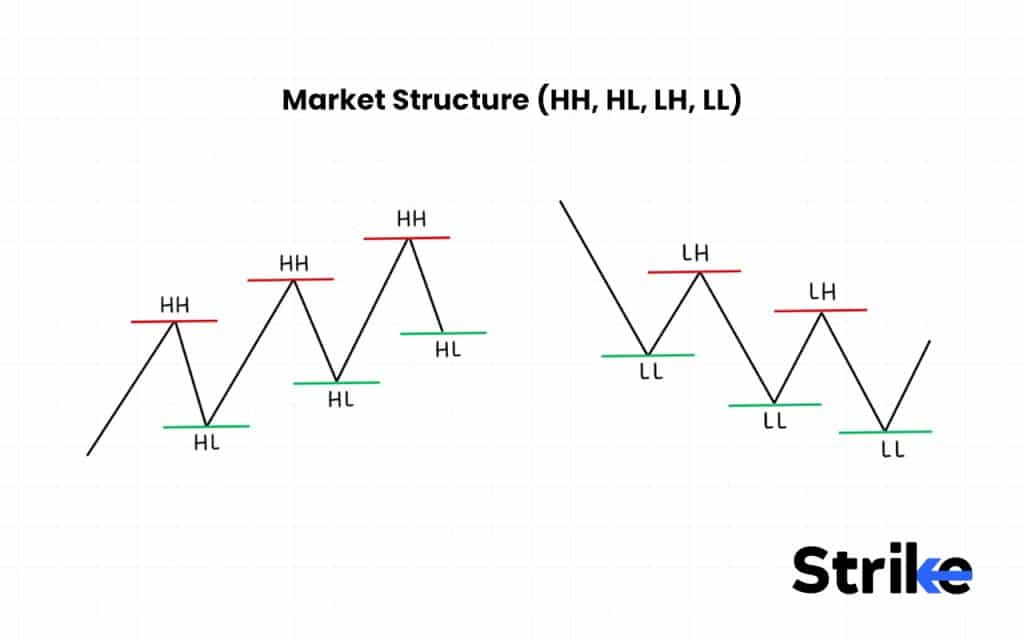
This reflects the intent and order flow of the institutions. According to Dow Theory, the break of any of these structures gives the first clue of trend reversal or continuation.
2. Break of Structure (BOS)
Break of Structure (BOS) in SMC helps confirm the trend continuation. Break of Structure occurs when price decisively breaks above or below of key market structure points (swing high or swing low). This break indicates that the institutions have entered the trade with large orders flow, driving prices in a new direction.
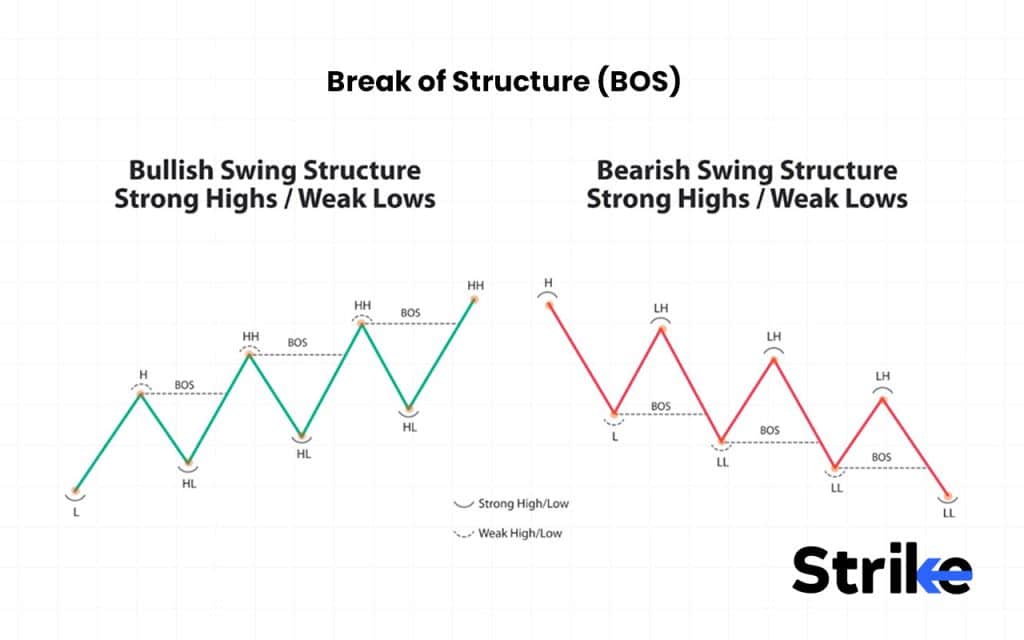
If price breaks swing high in a prevailing uptrend, it confirms the continuation of the uptrend and the break is called as Bullish BOS. Whereas, if price breaks swing low, it confirms the continuation of downtrend and the break is called Bearish BOS.
3. Change of Character (CHoCH)
Change of Character (CHoCH) in SMC gives early signals of potential trend reversal by breaking the market structure in the opposite direction of the ongoing trend. A bearish CHoCH happens when price breaks the swing low or Higher Low (HL) in an uptrend. A bullish CHoCH happens when price breaks the swing high or Lower High (LH) in a downtrend.
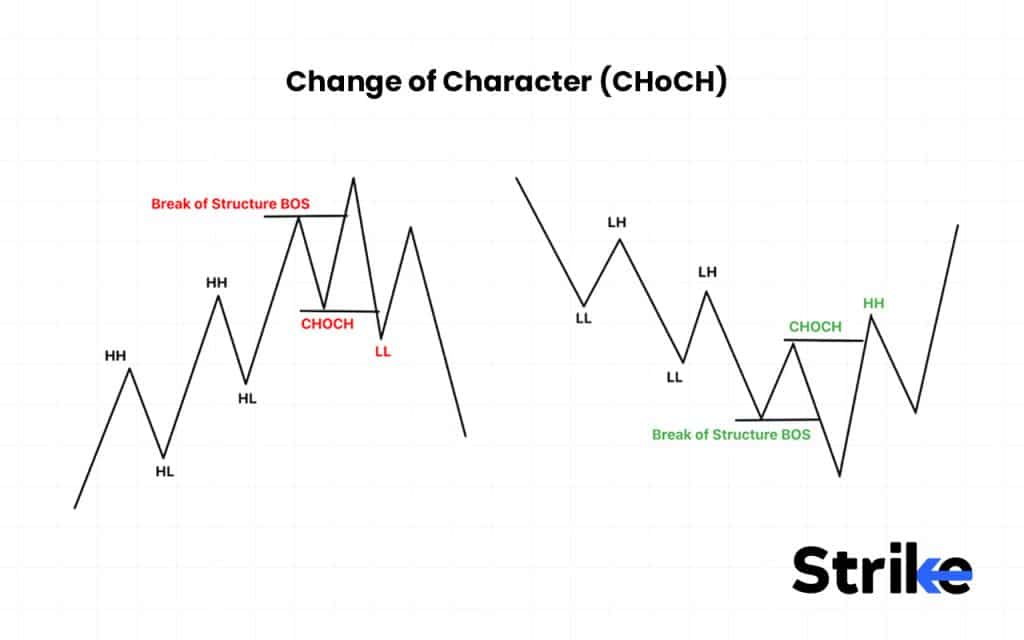
Unlike BOS, which confirms the trend continuation, CHoCH warns about the potential trend reversal alerting traders to stop trading in old trends.
4. Liquidity
Liquidity is the area on the pierce chart where large numbers of orders are placed, such as equal highs/lows, stoploss clusters, and previous day sessions high or low. Smart money often targets these areas to trigger retailers stop loss in order to execute their bulk orders. After taking up the liquidity, prices give sharp directional moves.
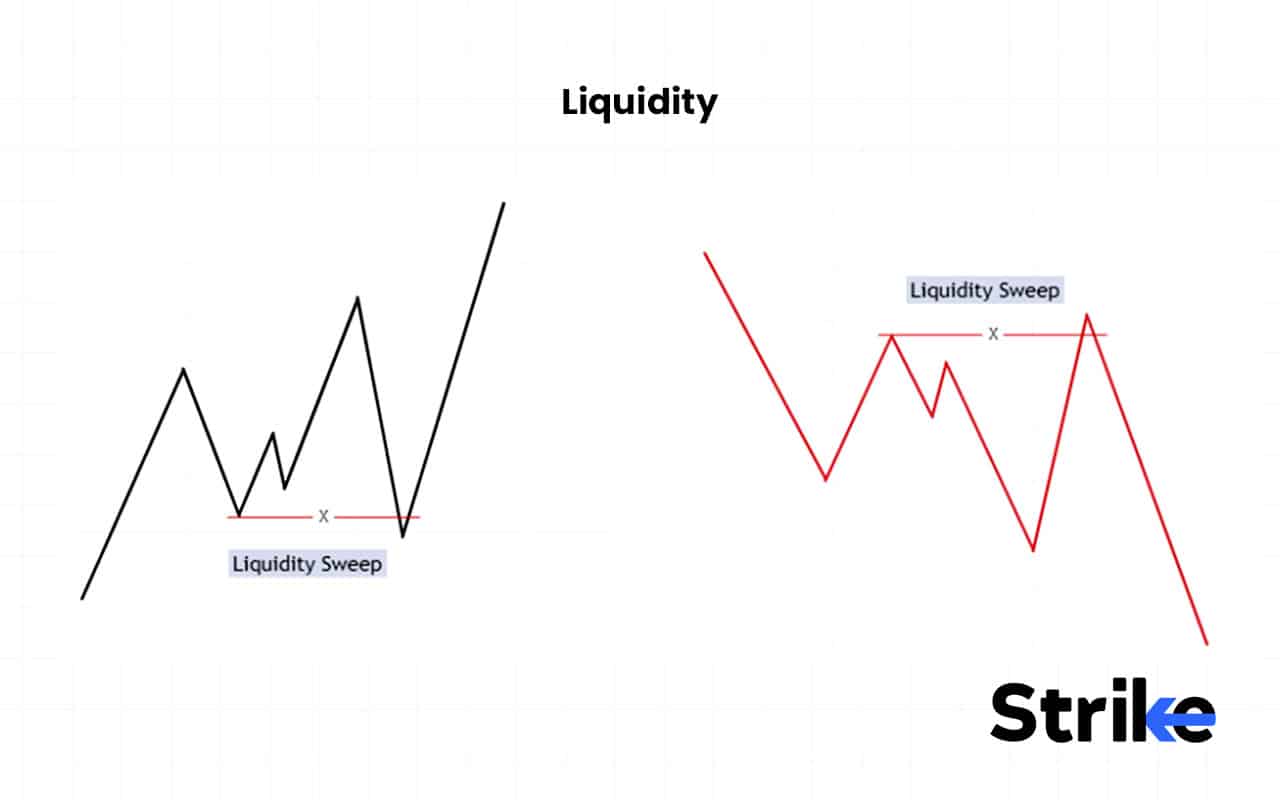
SMC helps retailers to understand the working of liquidity and aligning their trades alongside institutions.
5. Order blocks (OB)
Order block is the price range where smart money places large orders usually just before the strong move. This order blocks are typically formed by the last opposite colour candle before impulsive move. Smart money often brings price to this order block for rebalancing or adding more positions, which makes them a key area of interest for entries.
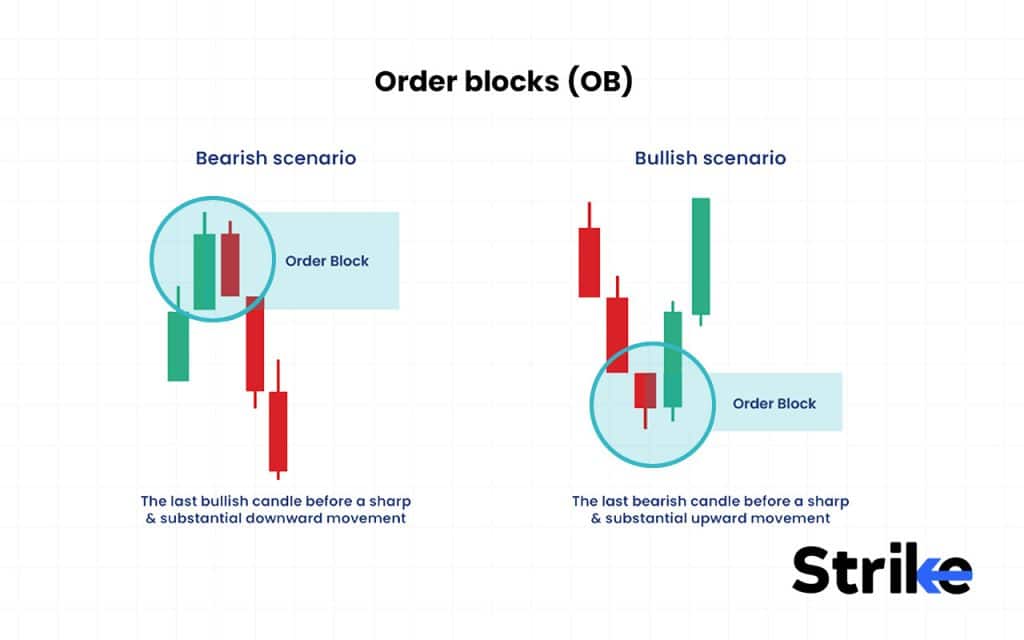
In Smart Money Concept, the order block represents the footprint of institutions where they previously added capital
6. Inducement
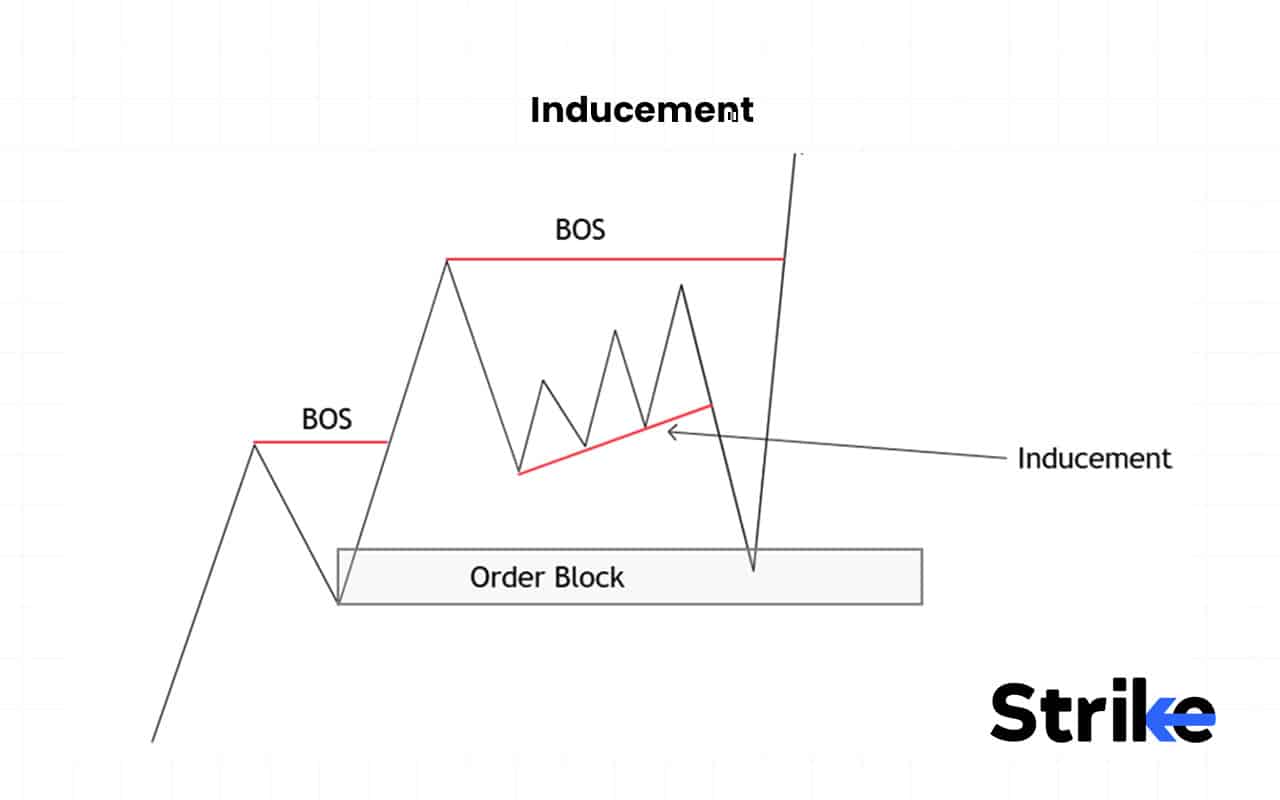
Inducement is the smart money tactics to trap retail traders by forcing them to take early or wrong entries. Smart money later uses these retailers’ stop loss to create liquidity. Once the retailer stoplosses are placed after inducement, institutions sweep the liquidity by hunting retailers stoploss. Hence, inducement helps institutions or smart money to clear out weak hands before the actual move.
7. Fair Value Gaps (FVG)
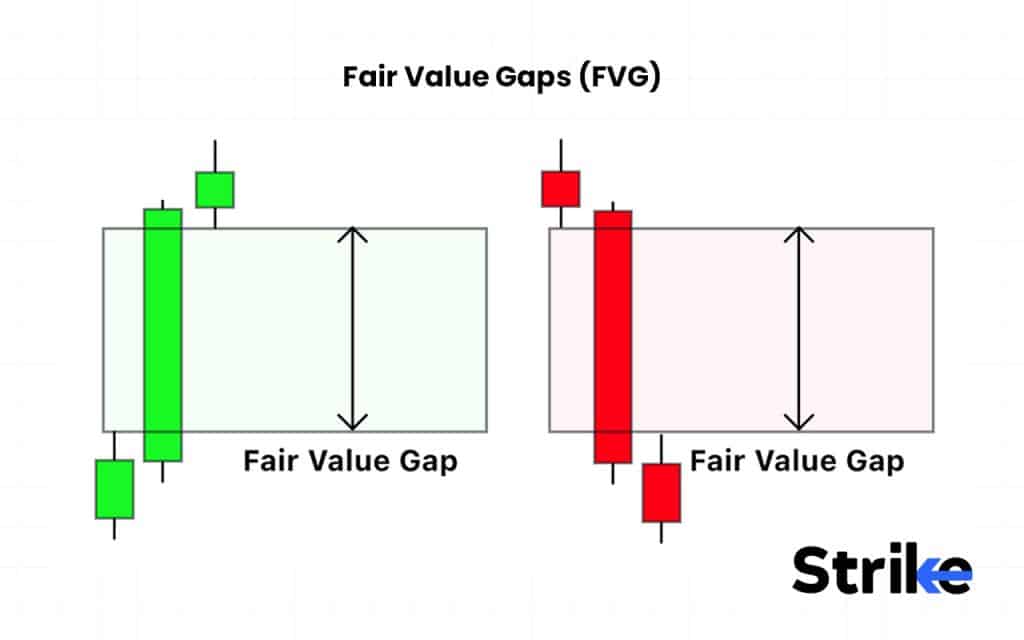
Fair Value Gaps (FVGs) are the price imbalance created by the aggressive institutional buying and selling activity, where prices move too quickly in one direction. This rapid move usually leads to uneven execution of orders leaving a gap between three consecutive candles. Institutions often bring price back to this Fair Value Gap (FVG) to rebalance the positions before continuing the trend.
8. Imbalance
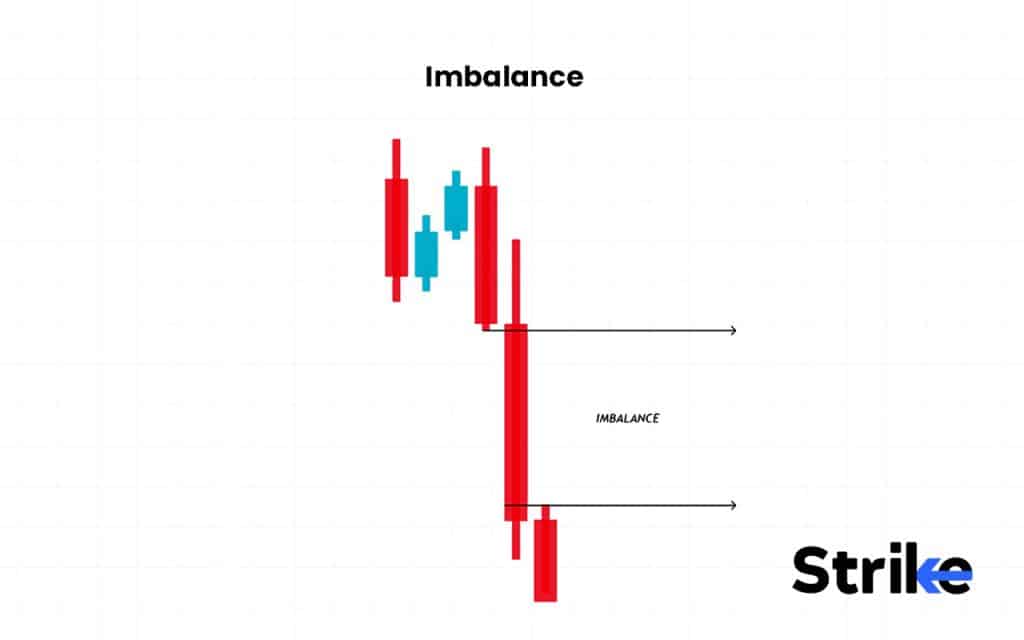
Imbalance is the market condition where price aggressively moves in one direction due to unequal buying and selling pressure. This happens when one side dominates completely, leaving behind gaps and low traded areas. These areas later act as a key strong area of interest.
9. Mitigation Block
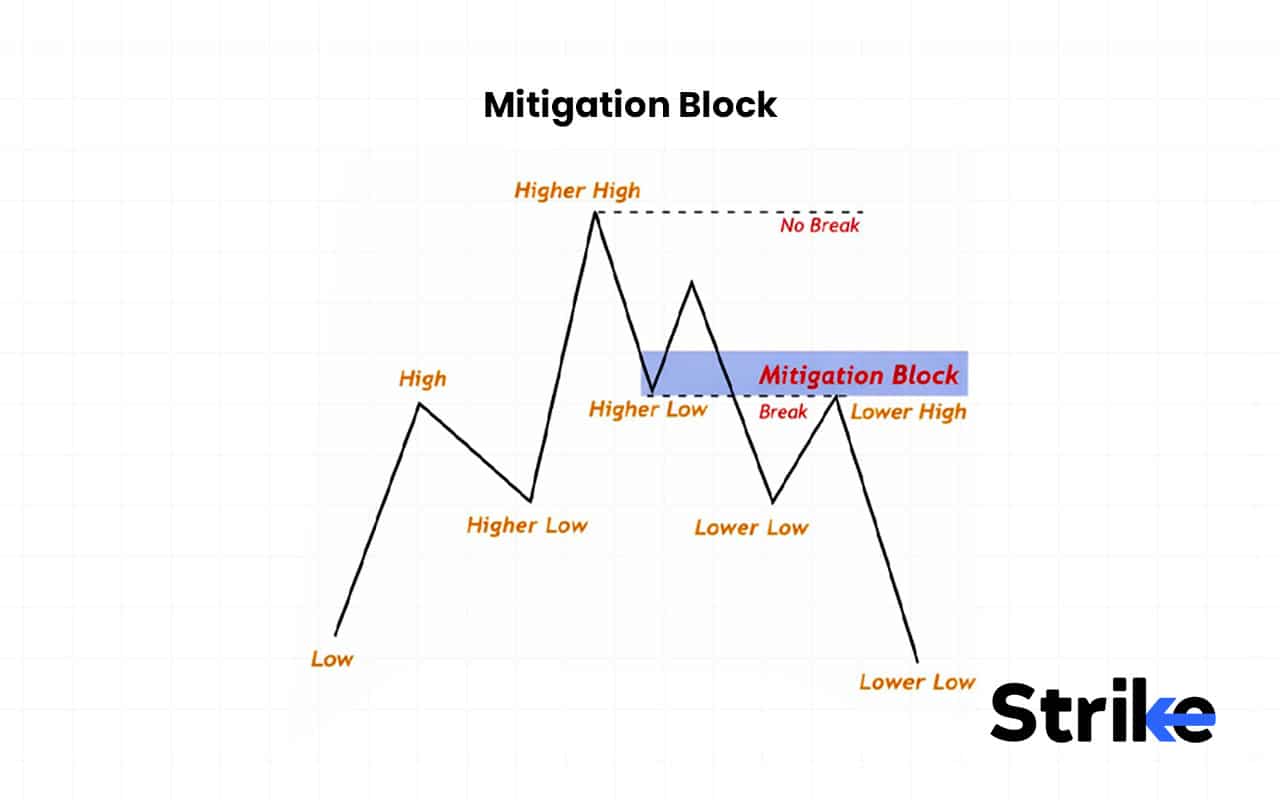
Mitigation block also known as immature break block is a type of order block formed when price returns to the previous order block to mitigate or rebalance unfilled institutional orders. These blocks are seen before the next impulsive move and are an important area for smart money rebalancing.
10. Premium–discount zone
Premium-discount zones are zones within a price range of swing high and swing low,where smart money prefers to sell or buy. This zone is divided into two halves, the upper 50% is the premium zone where institutions look for sell opportunities, and the discount zone is the lower 50% zone where institutions look for buying opportunities.
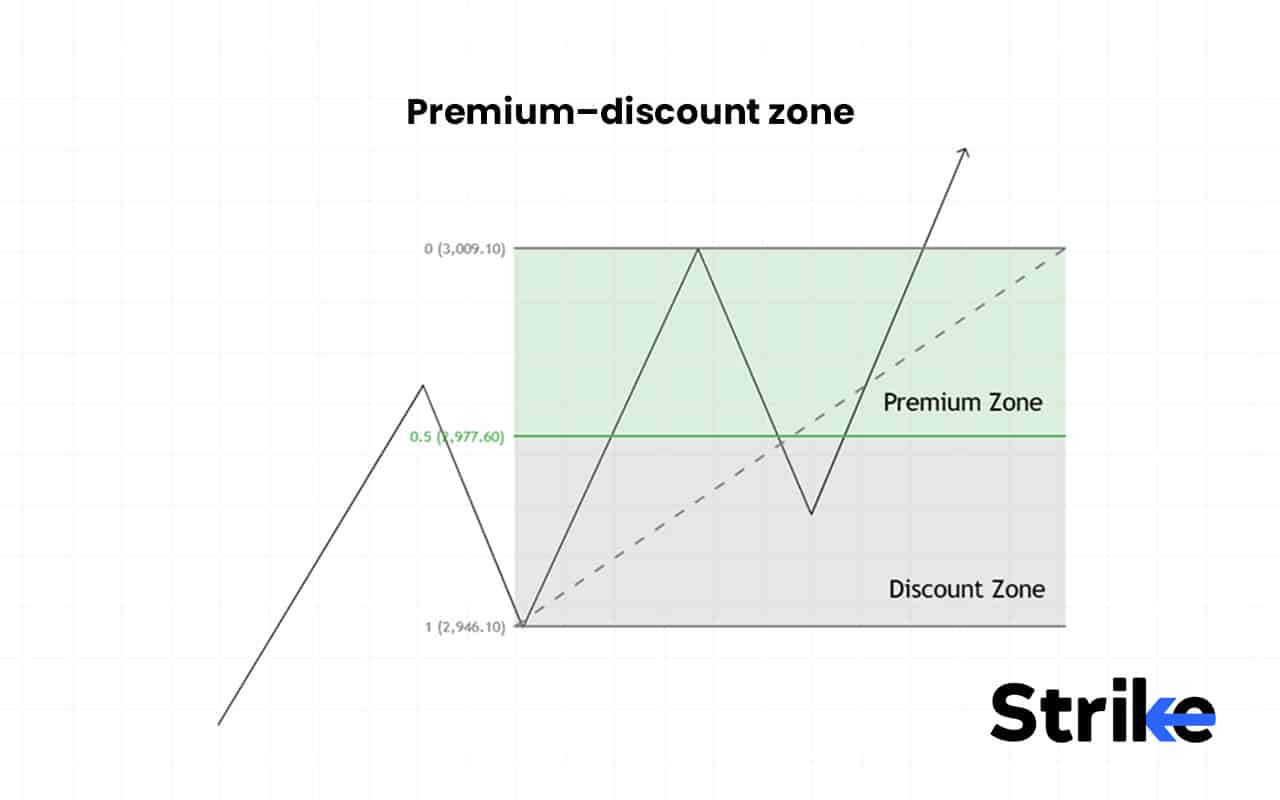
This zone focuses on value based entries aligned with market structure.
11. Supply & demand Zone
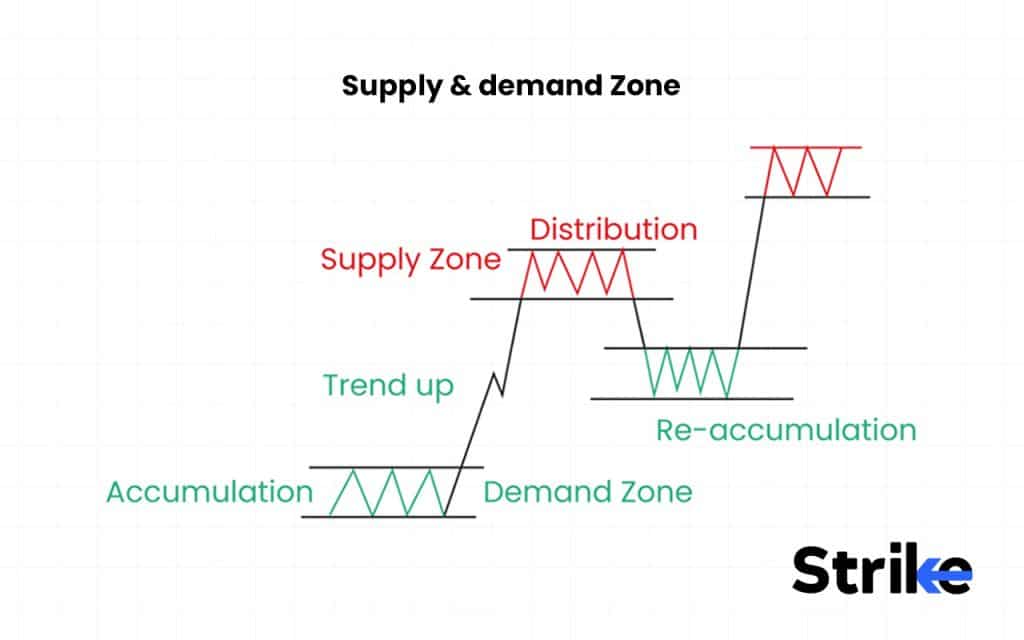
Supply and Demand Zone represent the price range where smart money has bought or sold aggressively. Demand zone forms when smart money buying exceeds selling, whereas supply zone is formed when institution selling exceeds buying. Supply & demand zones act as an important area of interest because smart money often defends or revisits them to add or exit positions.
12. Breaker Block
Break Block is a type of order block which fails to hold the price in its original direction and flips its role after a strong change in market direction. When a bullish order block fails by a bearish break, it acts as a resistance when price retraces back to that zone. Similarly, When a bearish order block fails by a bullish break, it acts as a support when price retraces back to that zone.
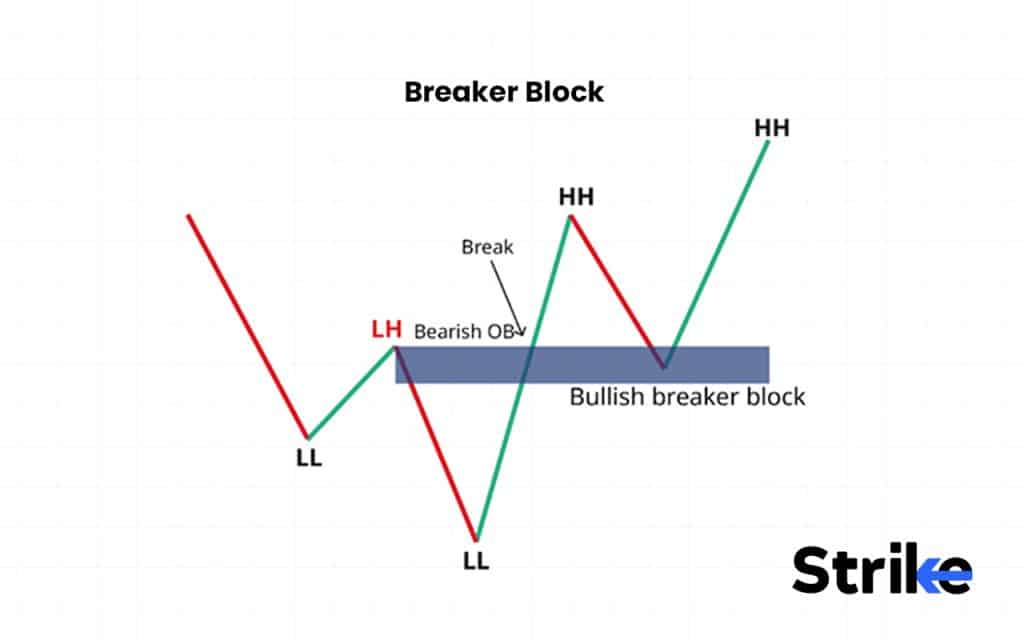
Break blocks are often formed after liquidity sweep or strong shift in market structure. This order block suggests trend continuation not trend reversal.
How do you Trade using Smart Money Concepts?
There are four simple steps to trade using the smart money concept. The steps include deciding trend bias, identifying key zones, waiting for setup to form, executing the trade, and risk management.
- Decide Trend Bias: Use a higher timeframe such as 4H, daily or weekly and mark the market structure to decide trend bias. Set a bullish bias if the market is making higher highs and higher lows with BOS. Whereas, set a bearish bias if the market is making a lower high and lower lows with a break of structure.
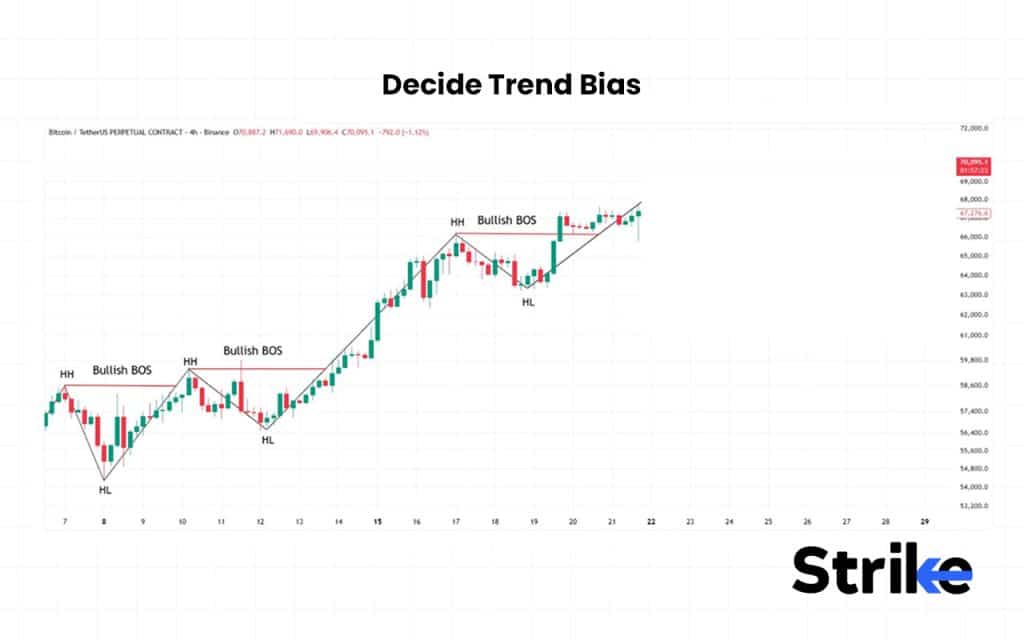
The above chart shows the price of Bitcoin is moving up by making HH and HL along with bullish BOS.
- Identify Key Zones: After marking market structure, mark the key zones for entries. The key zones include order blocks, FVGs, supply/demand zones, premium/discount zones.
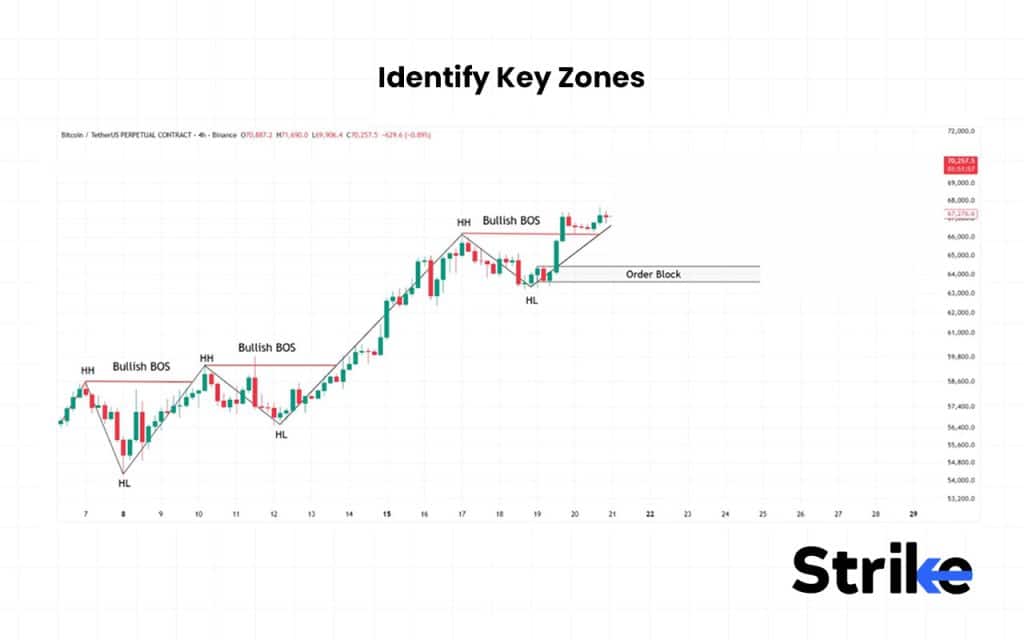
We have identified the order block by marking high and low of the last opposite candle before the impulsive move.
- Wait for Setup: Wait for price to enter one of these zones or area of interest followed by price inducement and liquidity grab and to enter the trade. You can also use a lower timeframe for entries after marking key zones on a higher timeframe.
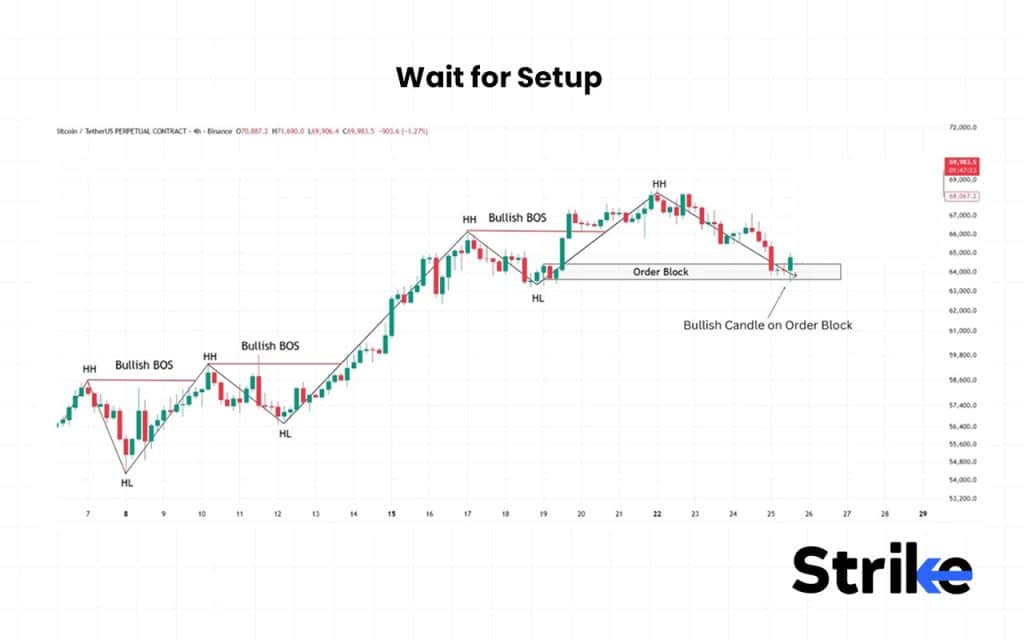
Price retraced back to the order block and formed a bullish candle, which is a good entry signal. A trader can enter the trader by placing stoploss just below the zone and targeting 1:2 RR.
- Entry and RIsk management: Enter on confirmation and put your stoploss beyond the zone. Have a minimum of 1:2 RR.
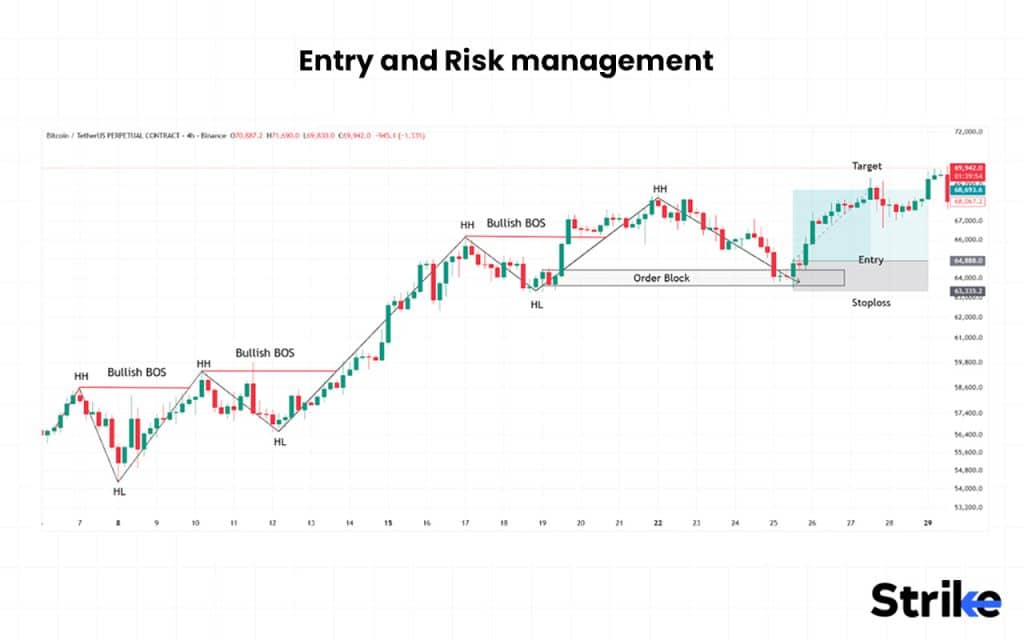
By following the above steps, you align your trades with smart money instead of retail emotions.
What Indicators Work with SMC?
Although SMC is purely based on price action, still we can use some popular indicators along with SMC to increase the probability of setup. Indicators that work best with SMC are volume, VWAP, moving averages, RSI, and session indicator.
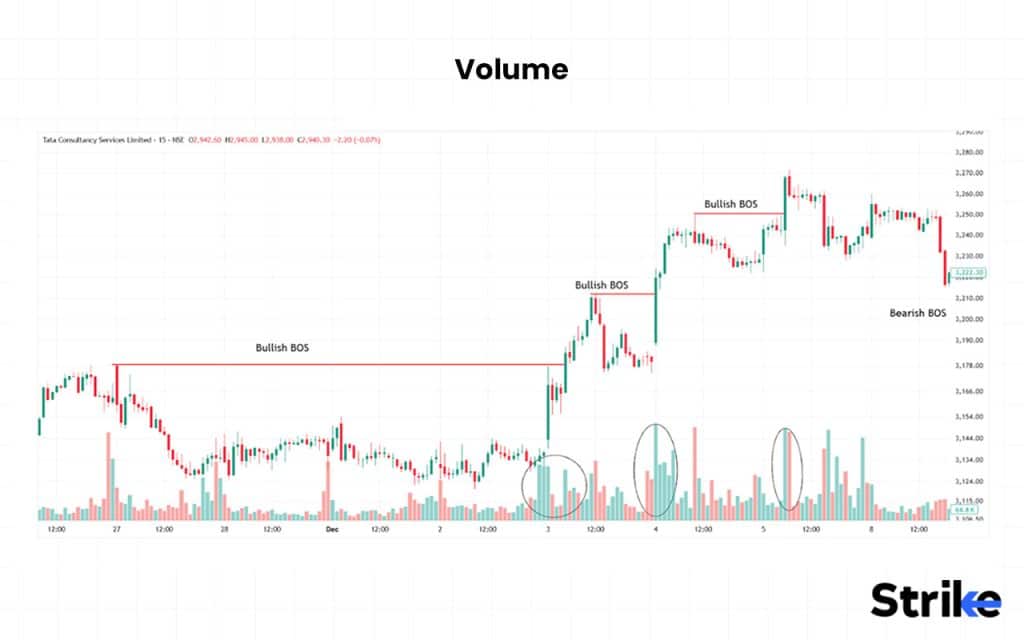
- Volume: These indicators help confirm institutional participation during liquidity grab, BOS, CHoCH, accumulation and distribution.
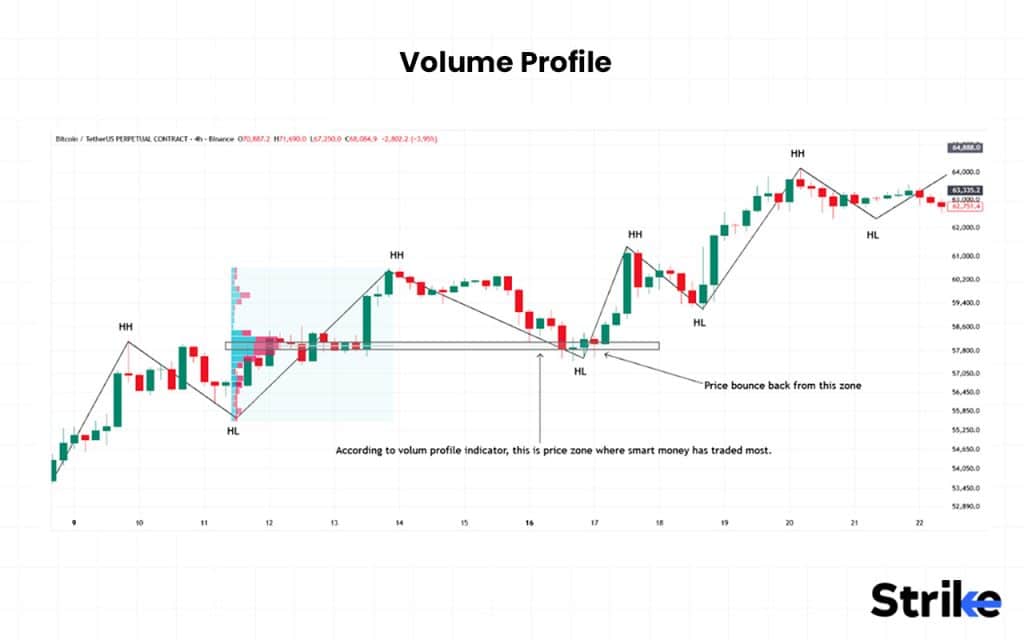
- Volume Profile: Volume Profile indicator helps to identify the area where smart money has traded most. High volume areas show the region of accumulations and distribution, while low volume areas indicate imbalance where prices have moved fast.
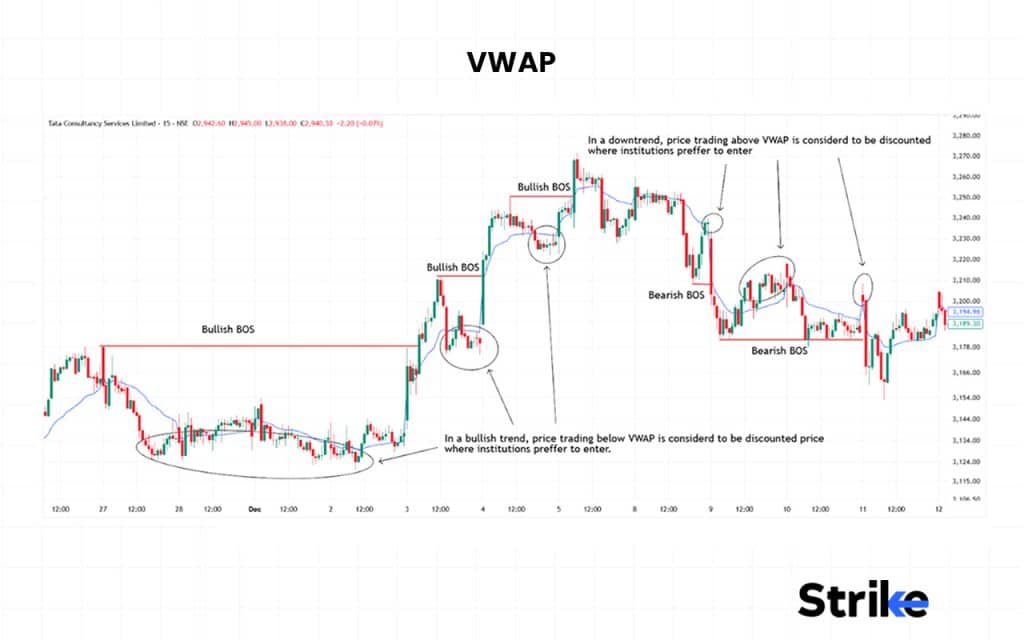
- VWAP: VWAP Helps traders to identify the institutional fair value and dynamic premium-discount zones where smart money will possibly enter or exit the trade.
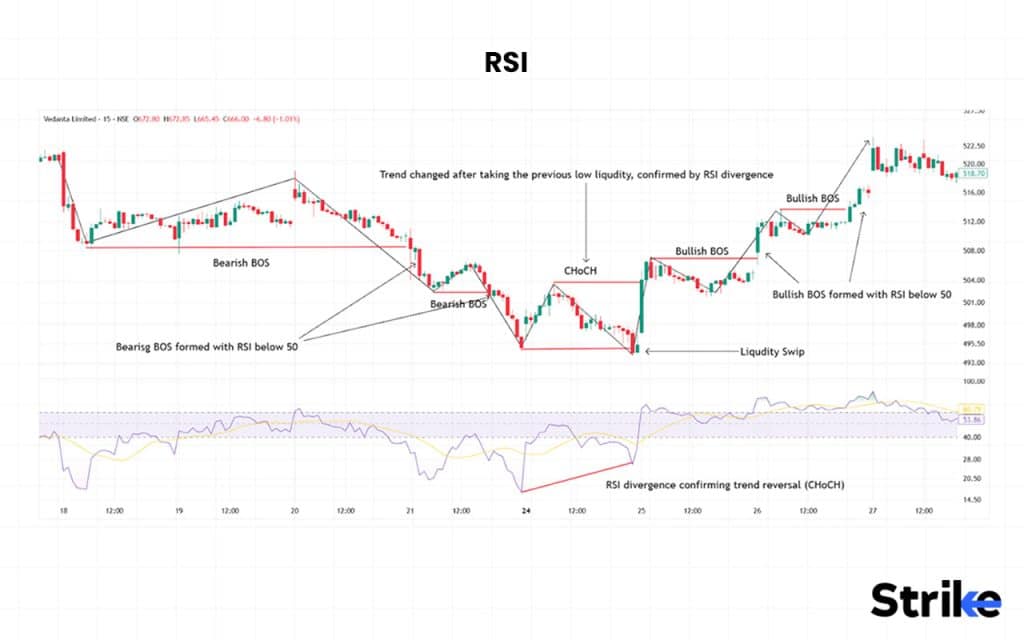
- RSI: Helps to filter most reliable BOS, if bullish BOS forms above RSI 50 or if bearish BOS forms below RSI 50, the reliability of these BOS increases. It also helps to spot divergence after stoploss hunting or CHoCH, suggesting shift in momentum.
- Session Indicators: This indicator helps identifying different sessions in the market where traders can trade the highly liquid session where smart money executes most of the trades.
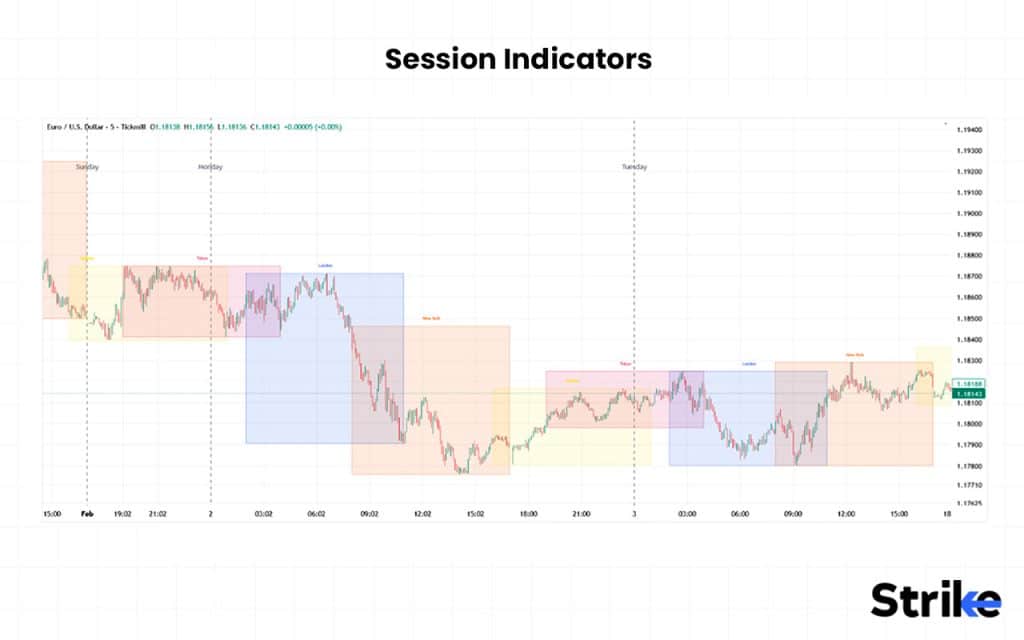
The above chart with session indicator clearly shows the time range of different sessions where London and New York sessions have the most volatility and volume.
How to Avoid SMC False Signals?
To avoid false signals in Smart Money Concept (SMC), it is important to trade with context and confirmation, not just using isolated patterns. There are four important points you should follow to avoid false SMC signals.
- Align with Higher Timeframe: Always align your trade with higher timeframe market structure. Avoid trading BOS or CHoCH if it counters the higher timeframe market structure.
- Wait for liquidity seep: BOS or CHoCH without a stoploss hunting or liquidity sweep is often a fake move.
- Focus on entering at value zones: Wait for price to return to its area of interest or value zone, such as order blocks, FVGs, mitigation blocks, or premium–discount areas. Smart money often pushes prices to such zones, allowing you to enter the trade along with institutions with a good stoploss.
- Avoid low quality sessions: Smart money is mostly inactive during low quality sessions. Such sessions have thin volume, which means prices can move even with small orders creating false signals.
Patience is the real edge in SMC trading. Wait for proper context and confirmation, because smart money moves with precision not in a hurry.
Is Smart Money Concepts Actually Profitable?
Yes, the smart money concept is profitable but only when it is applied with the right context. Vestinda backtested the SMC strategy on DXY where entry was based on supply and demand zones. According to their backtest report, it can deliver 5-50% of ROI with a profit factor greater than 1.5 and win rate of 50-65%.
Is SMC better than regular Price Action?
No, there is no real comparison between SMC and regular price action because they both are essentially the same at the core. They both follow the same market structure, lows and highs and price dynamics.
Price action describes what price is doing, whereas SMC states the same moves using liquidity and institutional behavior. SMC is merely a sophisticated elaboration of classic price action, and not a different or better approach.
Is SMC better than Traditional Technical Analysis?
No, SMC is not better than traditional technical analysis because Technical Analysis concentrates on price-indicating signals, patterns and mathematical indications whereas Smart Money Concepts concentrate on price structure, liquidity and institutional action to explain why the patterns exist.
Factually, SMC does not displace technical analysis concept, it sifts and puts it into perspective. The signs can indicate that there is a breakout, yet SMC clarifies that it is either a genuine move or a liquidity trap.
 19 mins