35 Types of Trading in The Stock Market – Complete Guide with Examples


 Author

 Editor

Trading is the practice of buying and selling of financial instruments in order to make profit from their short-term price movement. Trading these financial instruments involves stocks, commodities, currencies, derivatives, and digital assets. Unlike long-term investing, trading focuses on capturing a short-term price movement by actively analyzing price behavior, volume, trends, and market sentiment.
The origin of trading dates back thousands of years to the barter system and early commodity exchange in civilizations such as Mesopotamia and Ancient Rome. Over the time, trading evolved from physical market place to well organised stock exchanges in the 17th century, and eventually into today’s digital, high-speed global markets where transactions occur in milliseconds.
How Many Types of Trading are There?
There are mainly 35 types of trading based on holding period, instruments, strategy and analysis. These 35 types of trading are mentioned briefly below in the table.
| Type of Trading | What Is It + Best Timeframe | Suitable For | Risk Potential |
| Based on Holding Period | |||
| Day Trading | Buying & selling within the same day; intraday charts (1–15 min) | Active traders with time | High |
| Swing Trading | Holding trades for days to weeks; 1H–Daily charts | Working professionals | Medium |
| Position Trading | Long-term trend-based trading; Weekly–Monthly charts | Long-term investors | Low–Medium |
| Scalping | Ultra-fast trades in seconds/minutes; 1–5 sec / 1-min charts | Highly skilled traders | Very High |
| Based on Strategy & Analysis Type | |||
| Momentum Trading | Trading strong price moves; 5-min–1H charts | Trend-following traders | High |
| Trend Trading | Riding long/short-term trends; 1H–Daily | All levels | Medium |
| Breakout Trading | Trading break of key levels; 5-min–1H | Technical traders | Medium–High |
| Range Trading | Buying support, selling resistance; 15-min–4H | Sideways market traders | Medium |
| Reversal Trading | Trading trend reversals; 15-min–4H | Experienced traders | High |
| Algorithmic Trading | Automated rule-based trading; all timeframes | Coders & quants | High |
| Arbitrage Trading | Exploiting price differences; milliseconds | Institutions | Low |
| Options Trading | Trading calls & puts; varies | Advanced traders | High |
| Fundamental Trading | Based on economic/company data; Daily–Monthly | Long-term thinkers | Low–Medium |
| Technical Trading | Indicator & chart-based trading; all timeframes | All traders | Medium |
| Quantitative Trading | Math/model-driven strategies; all timeframes | Quants & analysts | High |
| News-Based Trading | Trading event-driven volatility; 1–5 min | Fast decision makers | Very High |
| Social Trading | Community-based sentiment trading; all timeframes | Beginners | Medium |
| Copy Trading | Replicating expert trades; all timeframes | Beginners with capital | Medium |
| Price Action Trading | Pure chart reading; no indicators; 5-min–Daily | PA-focused traders | Medium |
| Chart Pattern Trading | Pattern-based setups (M/W, H&S); 15-min–Daily | Visual traders | Medium |
| Contrarian Trading | Trading against market sentiment; Daily | Experienced investors | High |
| Value Investing | Buying undervalued assets; Monthly–Yearly | Long-term investors | Low |
| Dividend Trading | Trading for dividend income; Monthly–Yearly | Passive investors | Low |
| Insider Trading | Trading on non-public information; any timeframe | Illegal activity | Extremely High |
| Smart Money Trading | Following institutional footprints (SMC/ICT); 5-min–1H | Skilled PA traders | High |
| Seasonality Trading | Trading recurring market cycles; Weekly–Monthly | Swing/position traders | Medium |
| Sector Rotation Trading | Shifting sectors based on macro trends; Monthly | Portfolio managers | Medium |
| Based on Instrument Type | |||
| Stock Trading | Trading company shares; all timeframes | All investors | Medium |
| Forex Trading | Currency trading; 1-min–Daily | High-liquidity traders | High |
| Crypto Trading | Trading digital assets; 1-min–Daily | High-risk traders | Very High |
| Commodity Trading | Trading oil, gold, agri; 5-min–Daily | Hedgers & traders | High |
| Futures Trading | Leveraged contracts; 1-min–Daily | Advanced traders | Very High |
| ETF Trading | Trading exchange-traded funds; Daily–Monthly | Beginners & investors | Low–Medium |
| Bond Trading | Trading government/corporate bonds; Monthly | Conservative investors | Low |
| Metal Trading | Trading gold, silver, platinum; 5-min–Daily | Commodity traders | Medium–High |
1. Day Trading
Day trading, also known as intraday, is the style of trading which involves the buying and selling of financial instruments within a same trading day with no positions carried overnight. The goal of day trading is to make profit from the short-term price movement driven by intraday volatility, liquidity, and momentum rather than long-term fundamentals. The timeframe used in day trading includes 3min, 5min and 15 min.
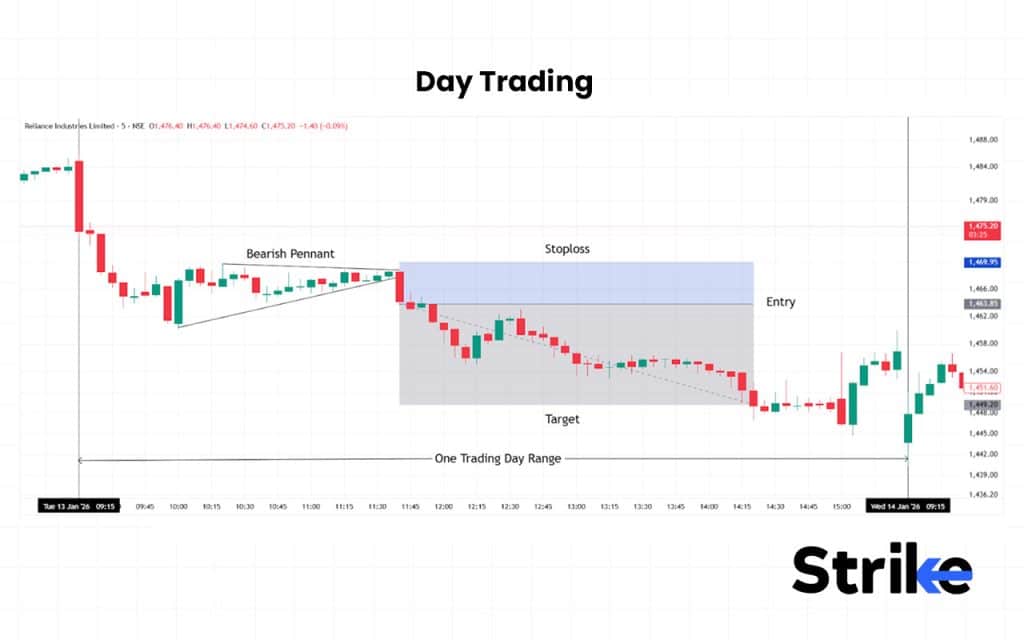
In the above chart, Reliance Industries formed a Bearish Pennant pattern on the 5 min chart on 13th Jan 2026, broke the pattern to the downside on the same day confirming the pattern. This breakdown provided a clean intraday short setup giving us a trade of 1:2 risk to reward within the same session.
Pros vs Cons of Day Trading
| Pros | Cons |
| No overnight risk | High stress and screen time |
| Frequent opportunities | High transaction costs |
| Fast capital turnover | Requires strict discipline |
| Clear intraday risk control | Small mistakes are costly |
| Works well in volatile markets | Most beginners lose money |
According to tradeciety, only 4-10% of day traders profit consistently after fees, per broker data, whereas 80-90% day traders fail to make consistent profits.
2. Swing Trading
Swing trading is the style of trading where traders hold their position for several days to week in order to profit from price swing in a broader trend. Unlike day trading, swing trading does not require constant screening time. The timeframe used in swing trading involves daily and 4-hour timeframes.
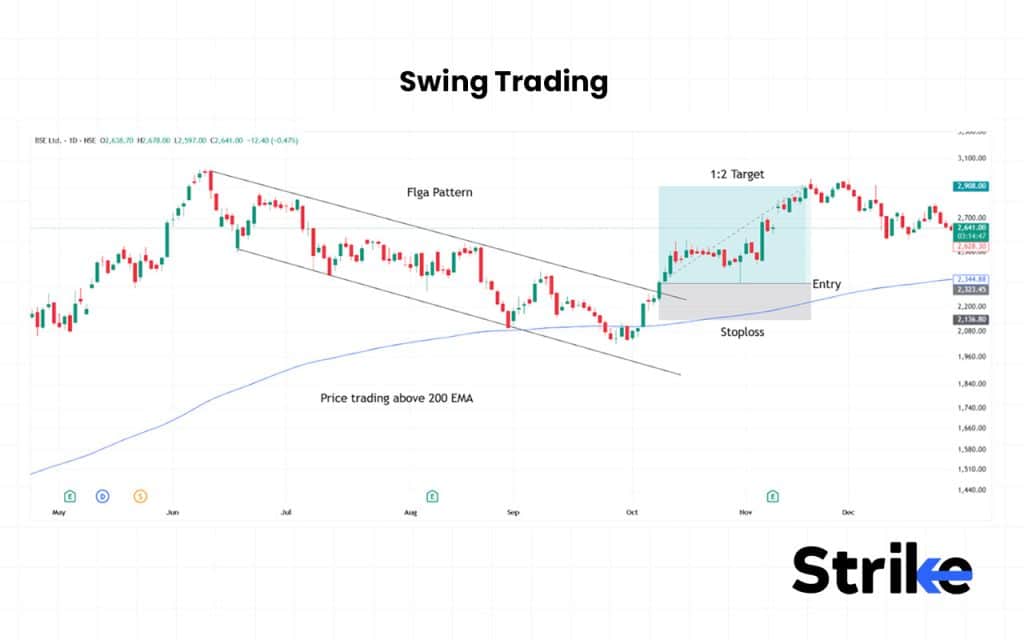
In the above chart we can see BSE Ltd has given a breakout of flag pattern in an uptrend on the daily chart. The trade lasted for almost 4 weeks giving us profit of 1:2 RR.
| Pros | Cons |
| Less screen time than day trading | Overnight and gap risk |
| Better risk–reward potential | Slower feedback |
| Works well in trending markets | Requires patience |
| Lower transaction costs | Market-wide news impact |
| Suitable for working professionals | Drawdowns can last days |
TraderLion reports experienced swing traders achieve 10-30% annual returns with disciplined strategies, while 90% of active traders lose overall.
3. Positional Trading
Positional trading is the long term trading style where traders hold their position for a long period of time ranging from several weeks to months or years benefiting from major trend moves. Positional trading focuses on a higher time frame and broader market structure along with fundamentals and macroeconomics.
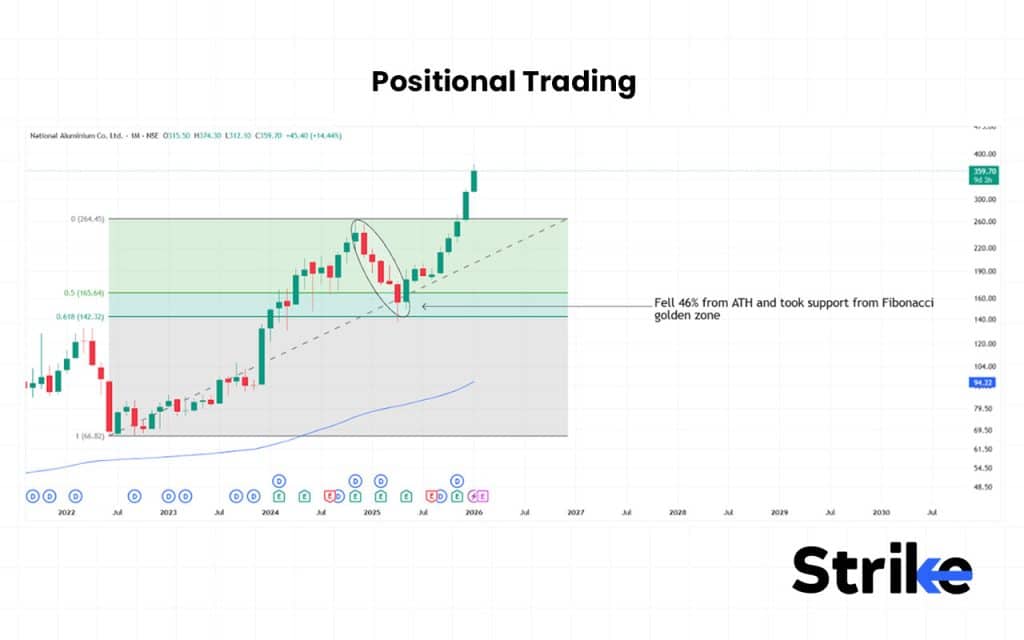
The above chart shows corrections in National Aluminium stock by 46% from ATH. This opened the opportunity for positional traders to buy the shares at 46% discount. Stock took support from the Fibonacci golden zone where positional traders could have bought after a change of character on a lower time frame. This trade is still running since the last 7 months giving more than 100% return.
Pros vs Cons of Position Trading
| Pros | Cons |
| Minimal screen time | Capital locked for long periods |
| Less affected by intraday noise | Slow feedback |
| High reward potential | Requires patience |
| Lower transaction costs | Larger drawdowns possible |
| Suited for strong trends | Not ideal for sideways markets |
Around 20-40% of the traders maintain long-term profits in positional trading, which is far better than day trading where the profitables are 1-10%. Quantified strategies backtested results on S&P 500 shows the win rate of 60-70% if the holding exceeds one year.
4. Scalping
Scalping is a very short term trading strategy where traders aim to make profit from very short term price movement with seconds or minutes. The timeframe used in scalping is usually 1-minutes to 5-minutes. This style of trading focuses on speed, liquidity, momentum, and precision rather than large price targets.
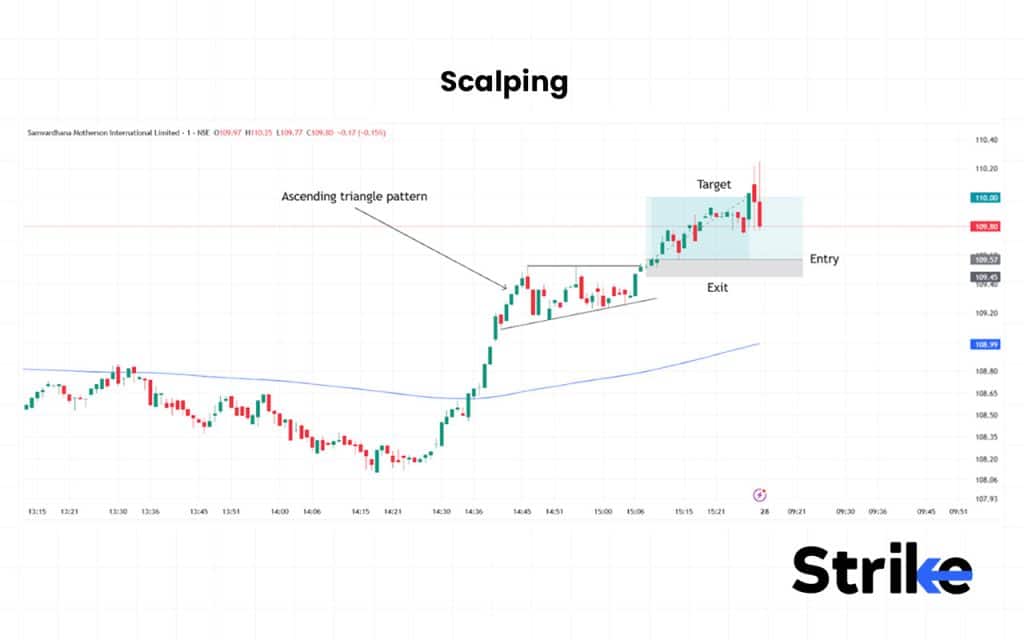
The above chart shows the breakout of the ascending triangle pattern on a 1 min timeframe. A scalper could have entered the trade on a breakout with a profit target of 1:2 or 1:3. In this case, we achieved 1:3 RR within 20 min.
Pros vs Cons of Scalping
| Pros | Cons |
| No overnight risk | Extremely stressful |
| Many trading opportunities | High brokerage & slippage |
| Quick results | Requires fast execution |
| Small stop-loss size | Very low margin for error |
| Works in liquid markets | Not beginner-friendly |
Regulatory data from ESMA, ASIC, and broker reports (e.g., 2020–2025) consistently suggest that around 80–95% of retail day traders and short-term participants lose money quarterly, leaving only a small fraction (roughly 1–10%) profitable long-term—an important reality check for anyone exploring Scalping Trading.
5. Momentum Trading
Momentum trading is the strategy where trades utilise the strength and the speed of an asset in a particular direction. Traders buy assets when it shows a strong upward price momentum or sell assets when it shows a strong downward momentum, with the expectation of continuation of existing trend. The timeframe in this strategy depends on the style of trading.
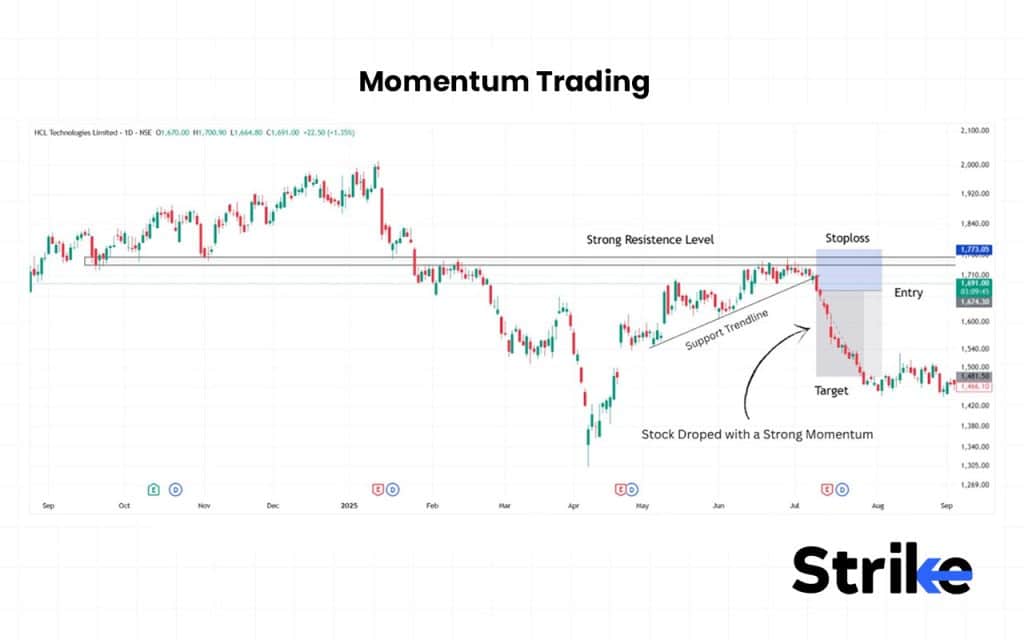
Image above shows the drop in the stock HCL Technologies LTD after reaching its strong resistance level of 1740-1750, with a strong downside momentum. The stock dropped more than 12% within the span of 18 days.
Pros vs Cons of Momentum Trading
| Pros | Cons |
| Trades align with trend strength | Sharp reversals can cause losses |
| Clear entry and exit logic | Late entries reduce risk–reward |
| Works well in trending markets | False breakouts in choppy markets |
| Scalable across timeframes | Requires fast decision-making |
| Strong risk–reward potential | Momentum fades quickly |
According to Quantinsti, around 60-70% of the momentum trading strategy underperforms benchmark S&P 500 over a long period due to trend reversals. But the skills trader can achieve 10-20% of annualized return with strict risk management.
6. Trend Trading
Trend trading is a trading style where traders identify the established market trend, such as bullish, bearish or sideways and trade in the same direction of the market aiming to capture the portion of the trend. Trend trading can be done across all the time frames depending on the trader’s style.
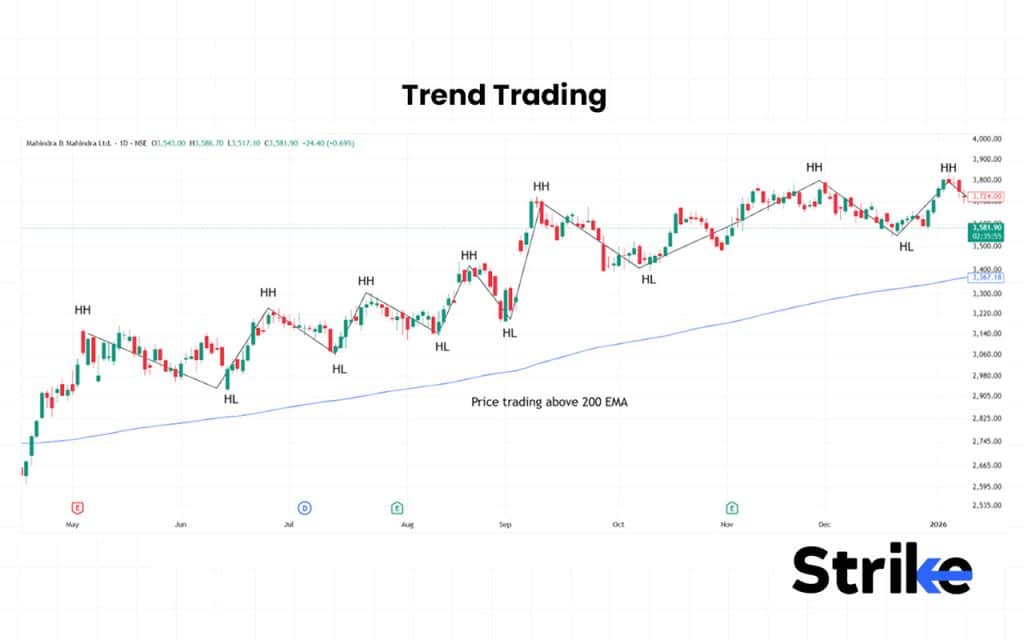
The above chart shows the M&M stock is in uptrend making higher highs/ higher lows and trading above 200 EMA. A trend trader can trade such stocks by buying it on pullback and selling it until the trend reverses.
Pros vs Cons of Trend Trading
| Pros | Cons |
| Captures large price moves | Late entries reduce reward |
| Fewer trades, lower costs | Sideways markets cause losses |
| Works across asset classes | Requires patience |
| Simple rules-based approach | Trends don’t last forever |
| Strong risk–reward potential | Drawdowns during pullbacks |
Trend following strategies deliver 8-15% annualized returns in backtests across commodities and equities, with top systems like Turtle Traders achieving 20-80% CAGR historically, though 70-80% of retail trend traders underperform benchmarks due to drawdowns exceeding 30%
7. Breakout Trading
Breakout trading is a type of trading where a trader enters a trade when price breaks above resistance or below support level, signalling the start of a new trend or strong momentum. The core idea of breakout trading is that once price escapes a consolidation, it often moves quickly in the breakout direction due to fresh participation and stoploss.
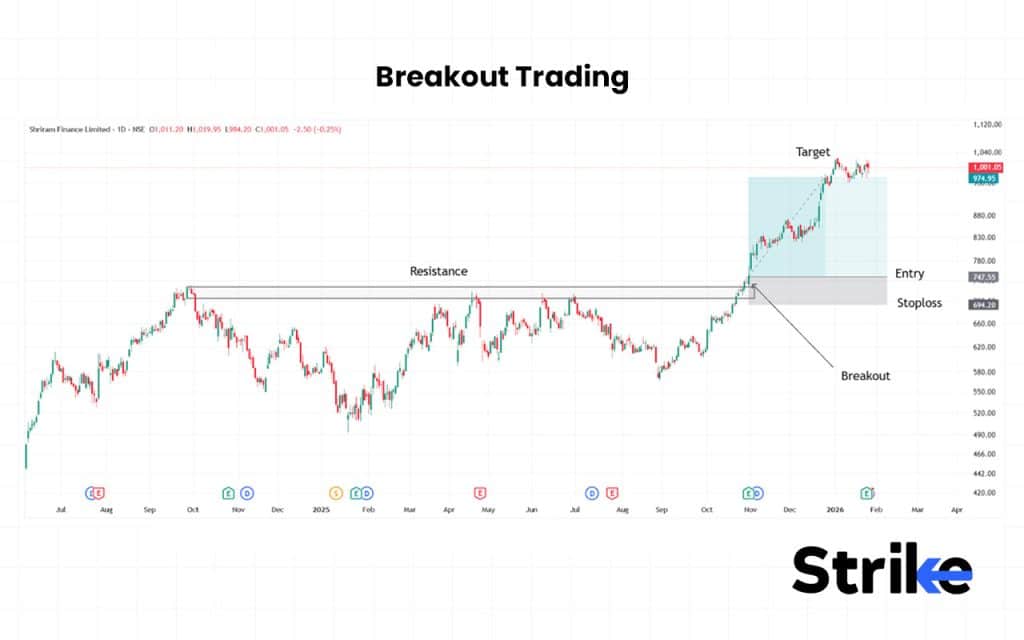
Above is the stock chart of Shriram Finance, which was facing resistance near the level of 700 to 730. On 29 October 2025, stock closed above the level of this zone, giving breakout of the resistance. A breakout trader would have entered a long position after a breakout with RR of 1:2 or 1:3.
Pros vs Cons of Breakout Trading
| Pros | Cons |
| Captures strong momentum moves | False breakouts are common |
| Clear entry and stop levels | Requires patience before entry |
| High risk–reward potential | Late entries reduce reward |
| Works well in volatile markets | Choppy markets cause losses |
| Simple rule-based logic | Needs volume confirmation |
Trading Rush analysis (100 breakouts tested) showed that raw breakouts delivered roughly a 36% win rate, while filtered setups with pullback and volume confirmation improved results to 50–58%, with 40–50% turning out to be false moves—making 1:2 risk-reward ratios more viable in strong trends. This highlights why structured rules are essential in Breakout Trading.
8. Range Trading
Range trading is the type of trading where traders buy the asset at support and sell at resistance within a horizontal price range in a sideways market. In a ranging market, price keeps oscillating between support and resistance level where traders focus on repeated price swings rather than trend continuation.
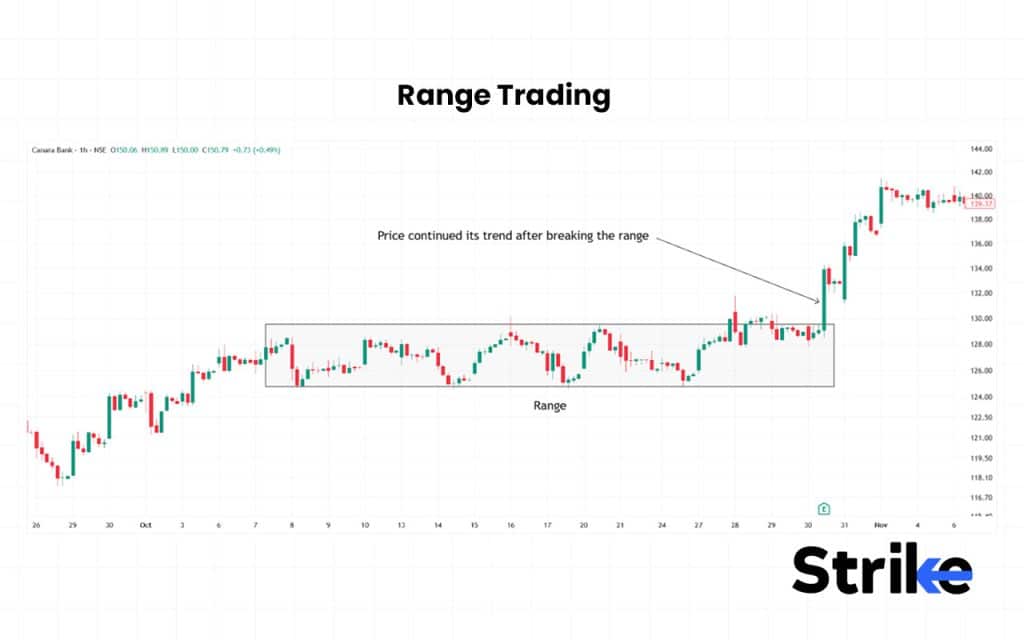
As we can clearly see in the above chart, Hindustan Unilever stock price was consolidating between the price range of 2383 and 2708. By identifying these levels as support and resistance zones, traders can go long when price comes to support and short when price reaches its resistance.
Pros vs Cons of Range Trading
| Pros | Cons |
| Works in sideways markets | Fails during breakouts |
| Clear entry and exit zones | False signals in low-volume markets |
| Lower risk with tight stops | Limited profit per trade |
| Predictable strategy for beginners | Requires patience |
| Can combine with oscillators | Less effective in strong trends |
According to quantified strategies, range trading shows a high win rate of 65-80% considering the proper risk management.
9. Reversal Trading
Reversal trading is the strategy where traders enter a trade expecting an ongoing trend to reverse. Traders typically buy at the end of downtrend, expecting trend change from bearish to bullish and visa versa. Unlike trend-following or breakout strategies, reversal trading profits from shifts in market sentiment and is used near key support or resistance levels.
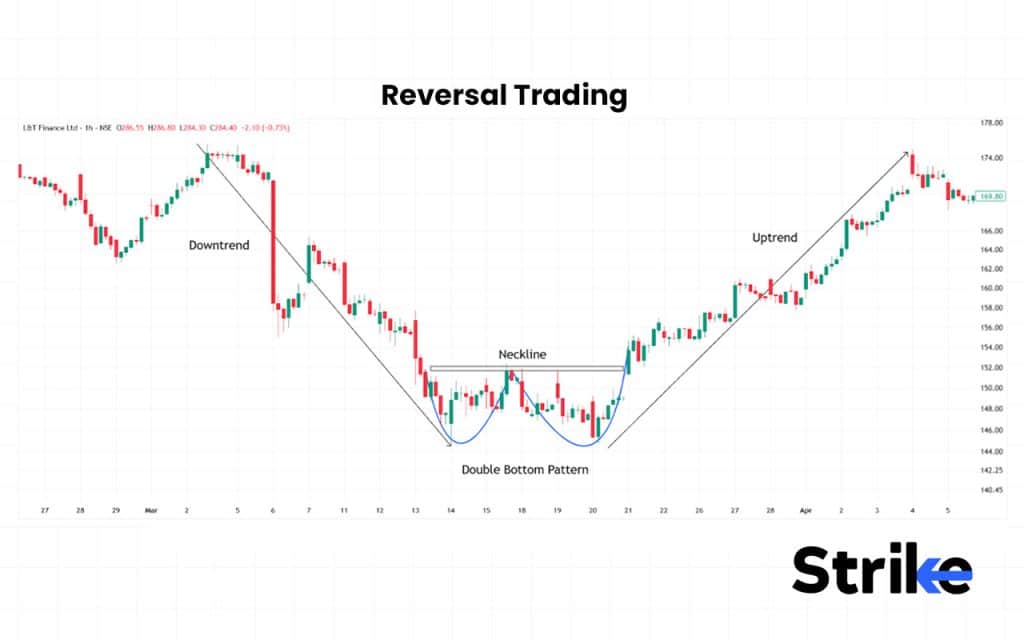
As we can see in the chart above, L&T Finance reversed its trend from downtrend to uptrend after making double bottom. A trend reversal trader can capitalize on such trade with favorable risk to reward.
Pros vs Cons of Reversal Trading
| Pros | Cons |
| Potential for large profits | High risk if trend continues |
| Works well at key levels | Requires precise timing |
| Can be combined with oscillators | False signals are common |
| Profitable in trending exhaustion | Difficult for beginners |
| Offers attractive risk–reward | Needs strong confirmation |
According to ACY Securities’ AI-driven backtest report, reversal trades showed the lowest win rate at 41.2% across 32 trades with a net loss of -$870.90, underperforming trend-following setups.
10. Algorithmic Trading
Algorithmic trading (Algo Trading) is a method where trades are executed by the computers using predefined rules and programming languages. Algo trading helps remove human emotion, and gives precise, fast execution based on technical signals, and statistical models. Algo trading can be operated across all the timeframes, from millisecond (HFT) to daily or weekly strategies.
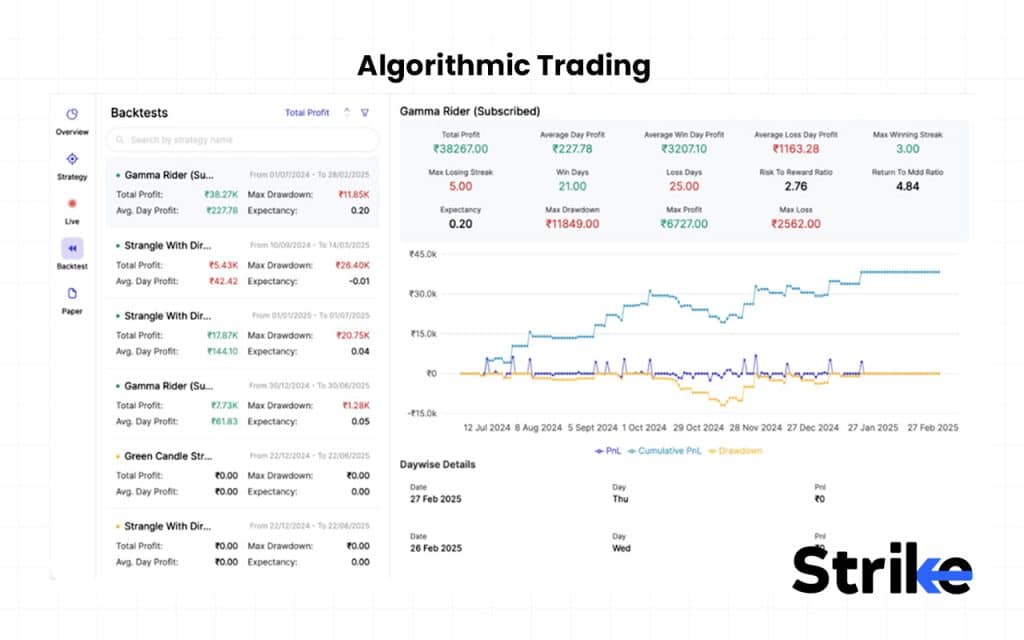
The above image is the dashboard of Tradlgo, showing the backtest result of an algo strategy called Gamma Rider which displays key metrics like total profit (₹38,267), average daily profit, win vs. loss days, risk-to-reward ratio, and maximum drawdown. This means that predefined rules in this algo strategy are profitable and ready to deploy.
Pros vs Cons of Algorithmic Trading
| Pros | Cons |
| Eliminates emotional mistakes | Requires coding or software knowledge |
| Fast and precise execution | System failures or bugs can be costly |
| Can trade multiple instruments simultaneously | High setup and maintenance cost |
| Backtesting improves strategy reliability | Over-optimization risks |
| Operates 24/7 in automated markets | Needs continuous monitoring |
Algo trading market size reached ~USD 20B in 2026 per Mordor Intelligence, up from $17B in 2023, with 8-16% CAGR projected through 2035 driven by India’s 55% NSE algo share.
11. Arbitrage Trading
Arbitrage is the strategy where traders trade the price difference of the same asset across different markets or exchanges. Unlike directional trading, arbitrage does not require market trends, support and resistance. In arbitrage profits come from simultaneous buying low and selling high to exploit inefficiencies. Arbitrage can occur across stocks, forex, commodities, cryptos, or derivatives, and is often executed on very short timeframes.
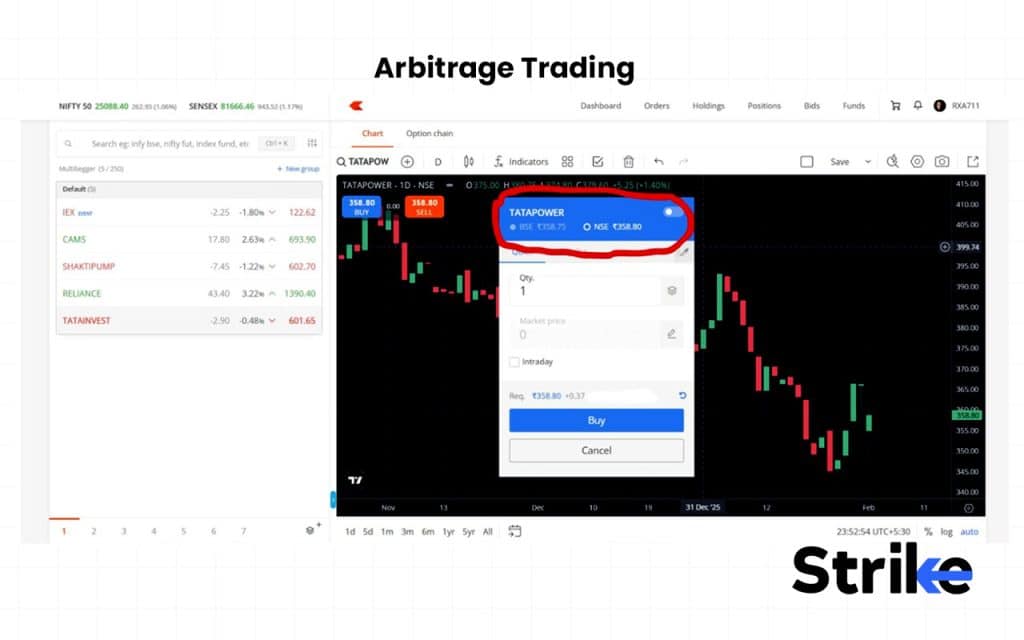
As we can see in the above image, the price of TATAPOWER differs by 0.05 on two different exchanges. Arbitrage traders identify such price differences to make profits. This trading is not meant for retailers and mainly done by institutions using systems.
Pros vs Cons of Arbitrage Trading
| Pros | Cons |
| Low-risk if executed correctly | Requires ultra-fast execution |
| Profits independent of market direction | High competition from HFT firms |
| Exploits market inefficiencies | Small profit margins per trade |
| Can operate across multiple markets | Needs sophisticated technology |
| Works in highly liquid assets | Transaction costs can erase profits |
According to EnrichMoney analysis, Arbitrage Trading achieves a 70–90% success rate through mean-reversion models, with an average win return of around 0.1–0.5% per trade.
12. Options Trading
Option trading is the trading of the derivatives of the underlying asset that gives the right but not the obligation to buy or sell an underlying asset at a predetermined price within a specific period of time. Unlike stocks, option trading allows traders to leverage their positions and hedge risk. Option trading can be done across all the ime frame from 1 min to 1 week or month.
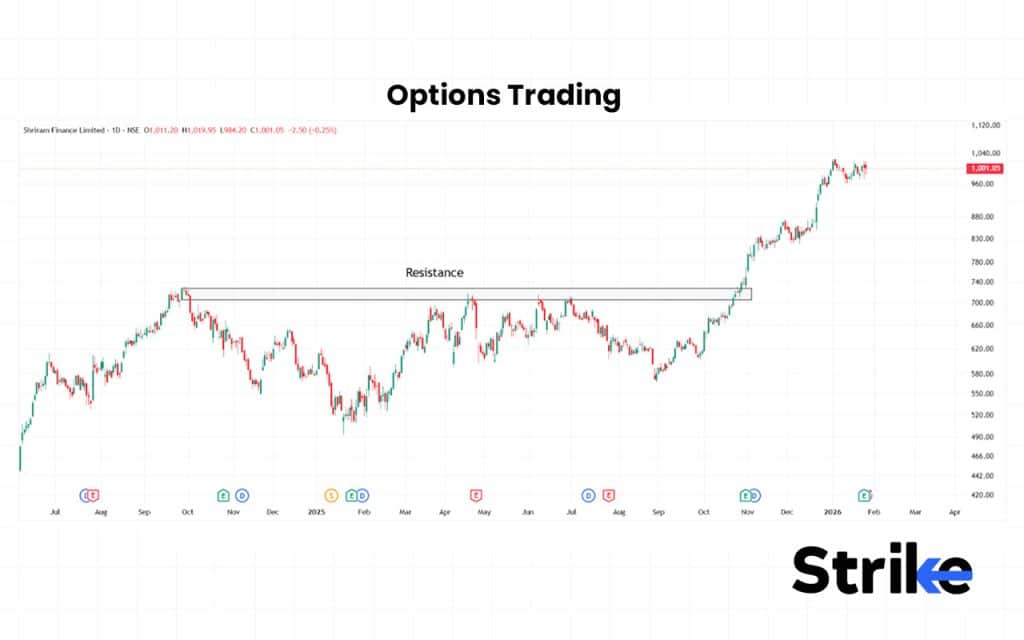
After breaking a resistance level, the Shriram Finance rose more than 30% within 60 days. An option trader could have bought an ATM call option of strike 700 or could have sold put option of same strike.
Pros vs Cons of Options Trading
| Pros | Cons |
| Leverage allows high returns | High risk of total loss |
| Hedging opportunities | Complex strategies require skill |
| Flexible strategies for any market | Time decay reduces value |
| Can profit in up, down, or sideways markets | Requires constant monitoring for intraday trades |
| Defined risk strategies (spreads) | Volatility can drastically affect pricing |
According to Dhan, nearly 90% of NSE F&O volume is dominated by options activity. However, in option trading, OTM buyers reportedly face 80–90% loss rates, as reflected in SEBI broker data—highlighting the importance of strategy selection and risk management.
13. Fundamental Trading
Fundamental trading strategy involves the use of fundamental factors to make buy and sell decisions rather than short-term price action. The fundamental factors include economic, financial, and company-specific data, intrinsic value, market cycles, earnings reports, and macroeconomic indicators to identify assets that are undervalued or overvalued. Fundamental trading is done for longer duration such as swing and positional.
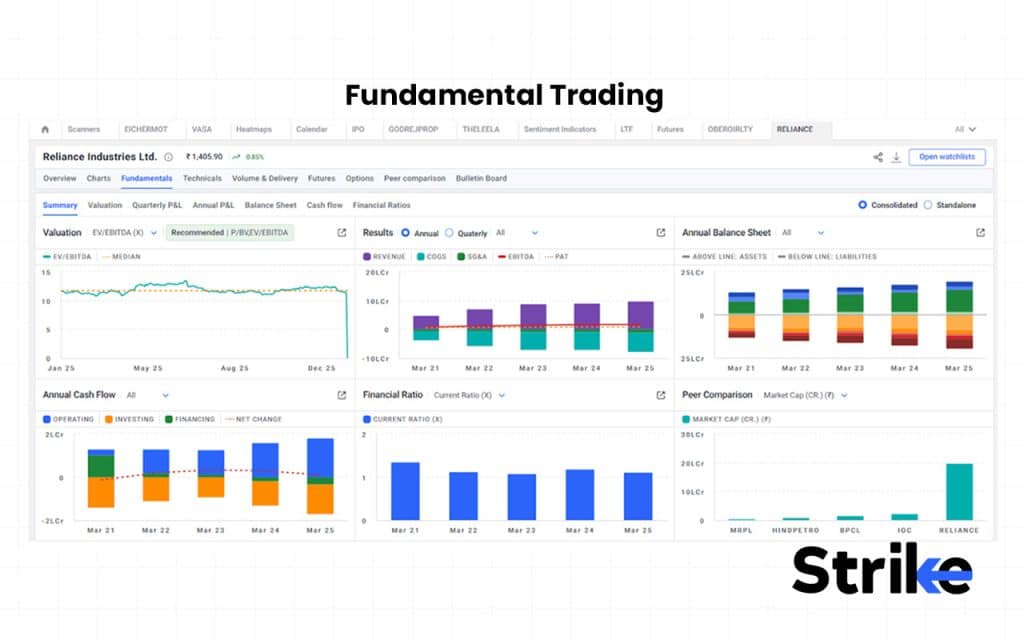
The above image is showing the fundamental data of Reliance Industries which is essential for fundamental trading. Fundamental traders analyse this data to find undervalued and overvalued companies for trading and investing .
Pros vs Cons of Fundamental Trading
| Pros | Cons |
| Focus on long-term value, less noise | Slow feedback; requires patience |
| Can avoid market overreactions | Not suitable for fast intraday profits |
| Lower transaction costs | Requires in-depth research |
| Reduces emotional trading | Market can remain irrational longer than expected |
| Works well for positional or investment strategies | Misses short-term momentum opportunities |
Fundamental trading on the NSE focuses on simple metrics like P/E ratios (Nifty 50 averages 24–25x), EPS growth above 15%, ROE over 20%, and low debt-equity below 0.5.
14. Technical Trading
Technical trading is a strategy where a trader makes decisions of buying and selling based on price action, chart patterns, and technical indicators rather than fundamental data. Unlike fundamental trading, which focuses on intrinsic value, technical trading focuses on historic price and volume behaviour. It can be applied across all the timeframe, from scalping to swing and positional.
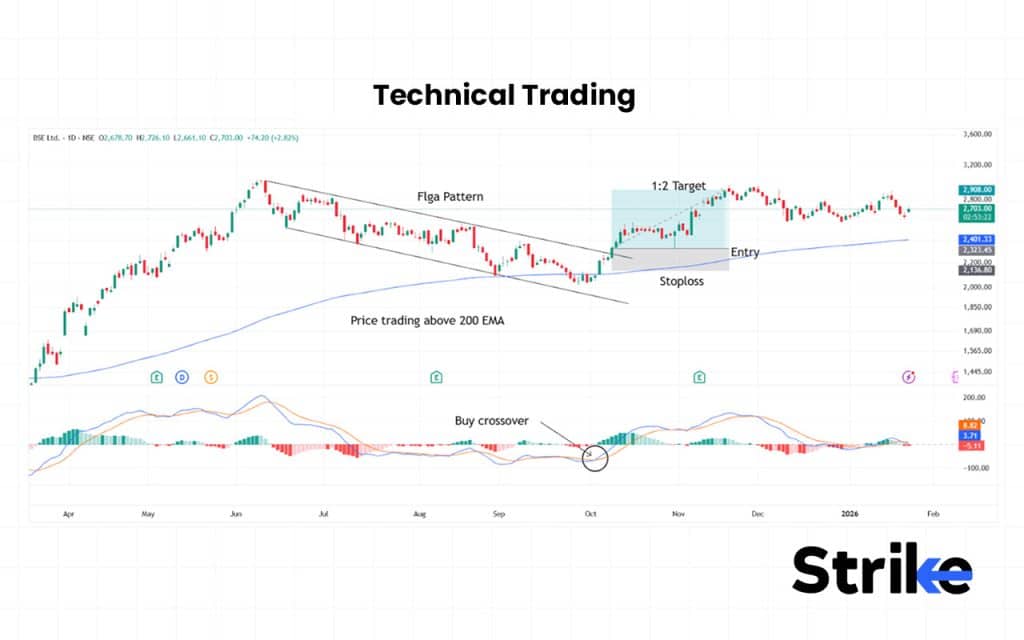
The above chart shows the trade taken in stock BSE, completely based on technicals using price action, chart pattern and indicator. The price made a flag pattern above 200 EMA, indicating a pause in an uptrend. The break of this pattern supported by MACD gave us a good trade of 1:2 RR.
Pros vs Cons of Technical Trading
| Pros | Cons |
| Works across all markets | Can produce false signals |
| Can be applied to any timeframe | Requires discipline and practice |
| Quick feedback on trades | Indicators can lag or conflict |
| Suitable for intraday to long-term strategies | Relies heavily on historical data |
| Objective rules for entries and exits | Market fundamentals ignored |
The winrate and profitability entirely depends on the style of trading. Day trading/scalping with 40–60% wins, needs high risk-reward. Swing/positional with 50–70% wins with fewer trades. Algo/arbitrage with 70–95% wins, but retail edges are limited.
15. Quantitative Trading
Quantitative trading is the trading strategy where buying and selling of an asset is done based on the mathematical models, statistical analysis, and predefined algorithms, using computers. Quantitative trading operates across all the timeframes simultaneously, where holding periods can range from milliseconds to days or weeks.
Pros vs Cons of Quantitative Trading
| Pros | Cons |
| Emotion-free execution | High setup complexity |
| Scalable across markets | Requires programming & data skills |
| Backtested before deployment | Models can break in new regimes |
| Handles large data efficiently | Infrastructure and data costs |
| Consistent rule-based execution | Overfitting risk if poorly designed |
As per QuantInst backtest report from 2010-2025, a quant fund generates an average of 12-18% CAGR with a Sharpe ratio of 1.2-1.8.
16. News-Based Trading
The News-Based trading involves taking position based on market moving news such as economic data releases, earnings announcements, central bank decisions, geopolitical events, or breaking headlines. News-based trading focuses on speed, reaction and expectation vs outcome, not historical price patterns. These trades are usually short lived with holding periods of few minutes, few hours to few days.
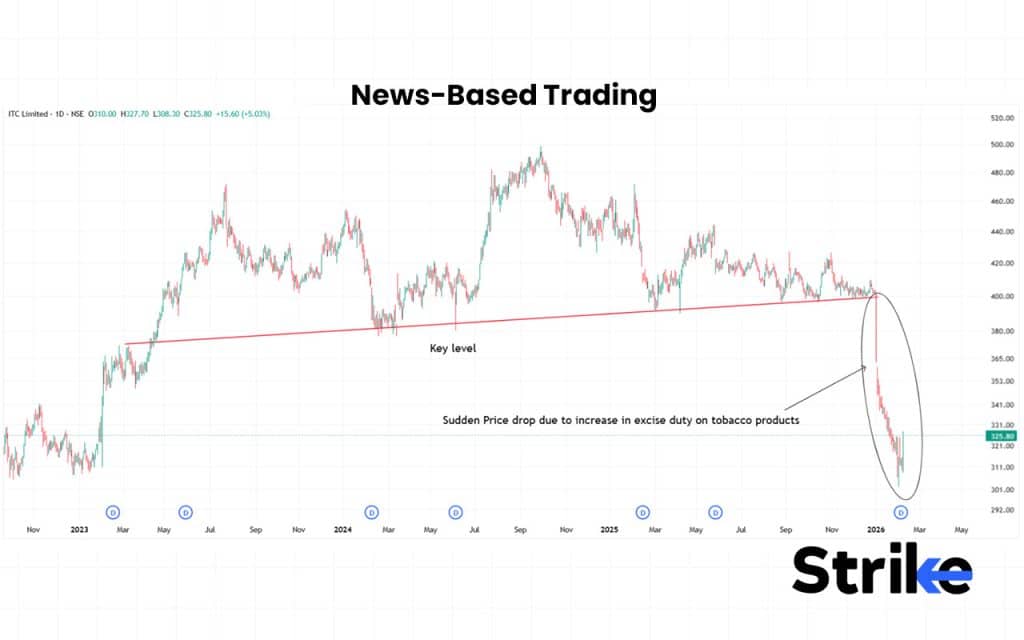
The above- mentioned chart is a chart of stock ITC which was at its key level before the fall. This sharp fall was influenced by government decisions to raise excise duty. Stock broke its key support level after news and fell more than 25%, where traders could have plans for a short trade.
Pros vs Cons of News-Based Trading
| Pros | Cons |
|---|---|
| Captures fast, large price moves | Extremely high volatility |
| Short holding period | Slippage and spread widening |
| Works across stocks, forex, indices | Requires fast execution |
| Clear event-based catalyst | False moves and whipsaws |
| Less reliance on indicators | High emotional pressure |
According to Xuejun Jin, Cheng Chen, Xiaolan Yang (2024). The effect of international media news on the global stock market. Positive international news sentiment was statistically linked to higher stock market returns across 35 countries from 2006–2020.
17. Social Trading
Social trading is a type of trading where a trader takes a trade by observing, following or copying the trade of other traders through online platforms and communities. Instead of developing their own strategies, traders depend on collective intelligence, shared trade ideas, or automated copy-trading systems.
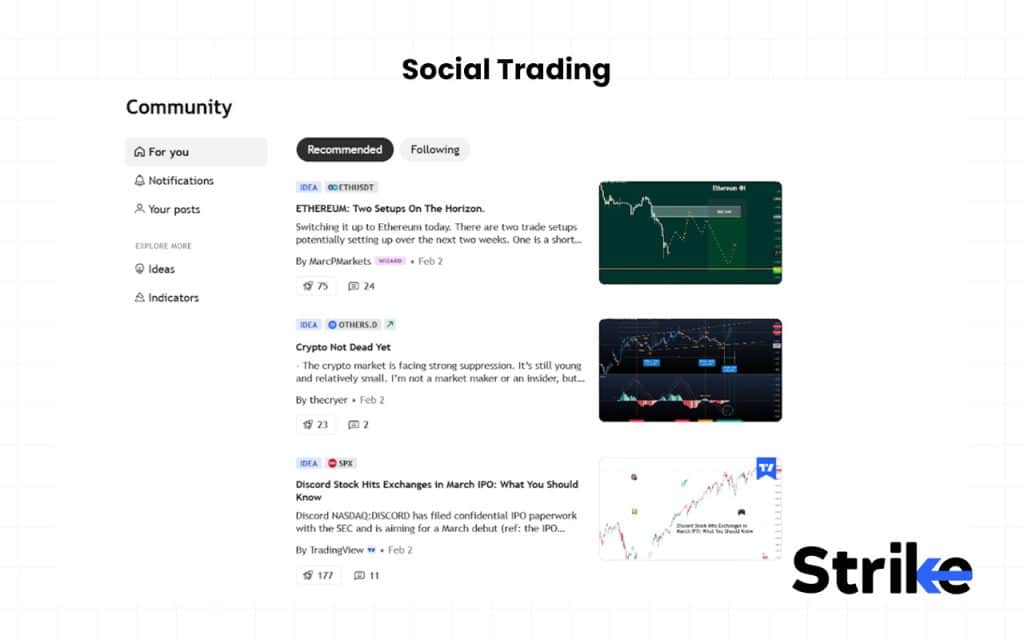
The image above shows the TradingView Community section, where traders publicly share their market analysis and chart ideas. Users can view, learn from, or follow their favorite contributors. You can also post your analysis as a contributor, a TradingView premium membership is required.
Pros vs Cons of Social Trading
| Pros | Cons |
| Beginner-friendly approach | Overdependence on others |
| Access to experienced traders | Past performance may not continue |
| Time-saving | Limited control over trade logic |
| Transparent performance metrics | Risk of blindly copying |
| Learning through observation | Strategy style may not suit you |
With more people looking to invest on their own, social trading platforms with options like copy trading and peer-to-peer views are becoming popular. The global social trading platform market is projected to grow at a CAGR of 9% between 2025 and 2034.
18. Copy Trading
Copy trading is the type of trading where traders or investors automatically copy or replicate the trade of another trader in real time. Unlike social trading, which focuses on idea sharing, copy trading focuses on execution. The timeframe of trading entirely depends on the strategy of the trader being copied which can range from scalping to swing or positional.
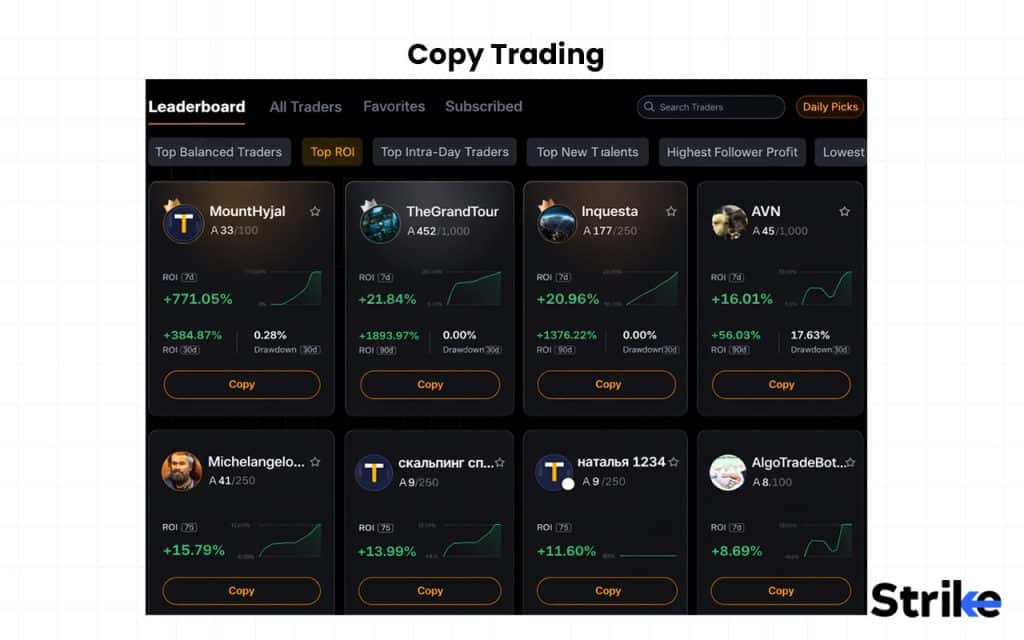
Above is the screen shot from Bybit platform, which shows the list of top traders based on ROI. An individual can copy the trade of preferred traders just by clicking the copy button.
Pros vs Cons of Copy Trading
| Pros | Cons |
| Fully automated execution | Loss of strategic control |
| Beginner-friendly | Dependence on trader’s discipline |
| Saves time and effort | Strategy may stop working |
| Access to professional traders | Risk of large drawdowns |
| Transparent performance data | Slippage and execution differences |
A study by the Massachusetts Institute of Technology analyzing social trading behavior found copy trading improved average investor returns by ~6–10% compared to self-directed retail trading.
19. Price Action Trading
Price action trading is the type of trading where decisions are made entirely based on price movement, without relying heavily on indicators. In price action trading traders read candlesticks, market structure, support-resistence, and momentum to understand buyers-seller behaviour. It is used across all timeframes, from 1–5 minute charts for intraday trading to daily and weekly charts for swing and positional trades.
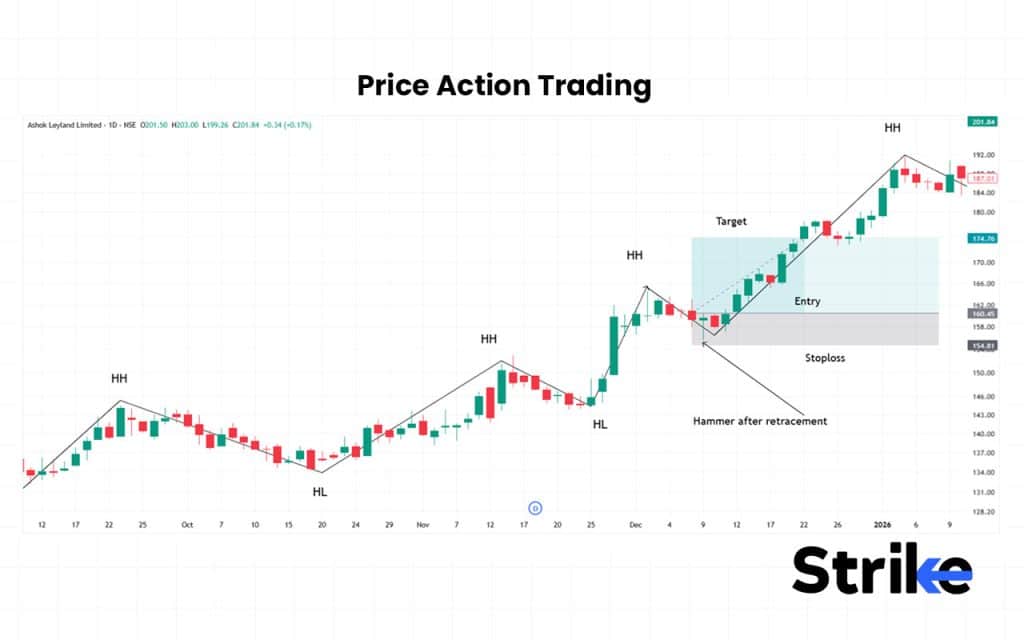
The above price structure of Ashok Leyland is clearly showing that the stock is in uptrend marking higher highs and higher lows. A price made hammer candle pattern after a pullback in an uptrend. A trader could have entered after hammer to trend continuation trade. This is how an opportunity can be identified just by using price action.
Pros vs Cons of Price Action Trading
| Pros | Cons |
| Clean, indicator-free charts | Requires experience and screen time |
| Works in all markets | Subjective if rules aren’t defined |
| Adapts to any timeframe | No fixed signals |
| Strong risk–reward setups | Needs patience and discipline |
| Reflects real market behavior | Difficult for beginners initially |
According to “Thomas Bulkowski” in his Encyclopedia of Chart Patterns, longer patterns have the highest reliability, with a win rate exceeding 60%.
20. Chart Pattern Trading
Chart pattern trading is a type of trading where traders identify repeating price structure on charts to predict the future price movement. The logic behind the chart pattern trading is that market psychology repeats itself, creating recognizable formations such as breakouts, consolidations, and reversals.
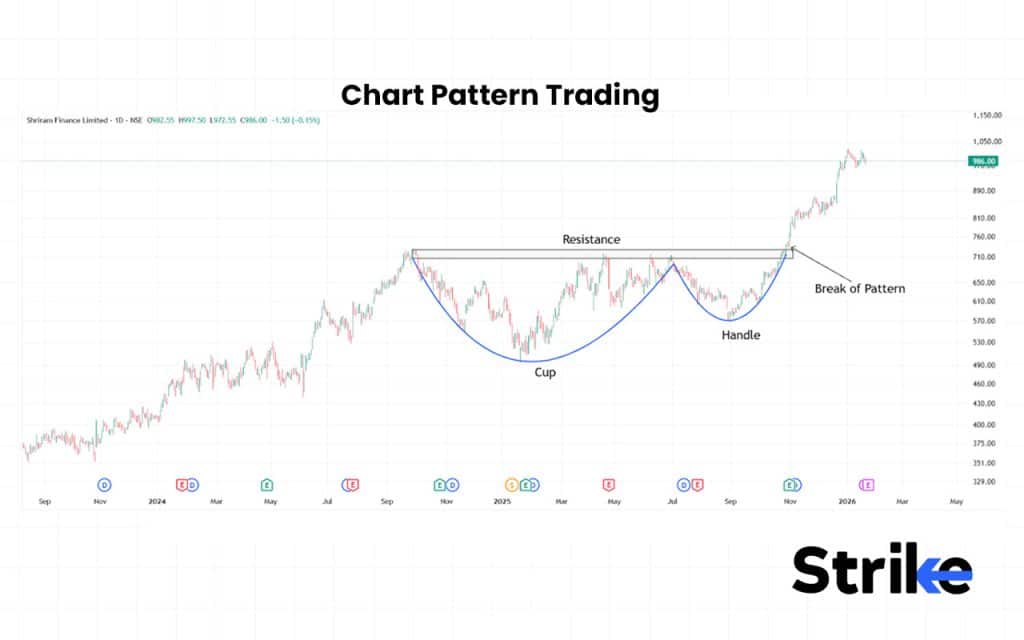
The above chart shows the formation of a cup and handle pattern, which is a bullish setup. A breakout from this structure triggered strong upside momentum, where traders built long positions to capitalize on the move—demonstrating how structured setups work effectively in chart pattern trading.
Pros vs Cons of Chart Pattern Trading
| Pros | Cons |
| Clear visual trade setups | Subjective pattern identification |
| Defined entry, stop & target | False breakouts are common |
| Works in trending markets | Needs volume confirmation |
| Applicable across timeframes | Patterns can fail in choppy markets |
| Good risk–reward opportunities | Requires patience |
21. Contrarian Trading
Contrarian trading is a type of trading where traders take position against the prevailing trend instead of following trend or breakout. Contrarian traders often look for crowded trades, emotional extremes, and exhaustion points where price is likely to reverse.
The logic is that when traders are majorly either bullish or bearish, risk-reward shifts in favor of the opposite side. Contrarian trading is mostly applied on higher timeframes, as sentiments take time to form.
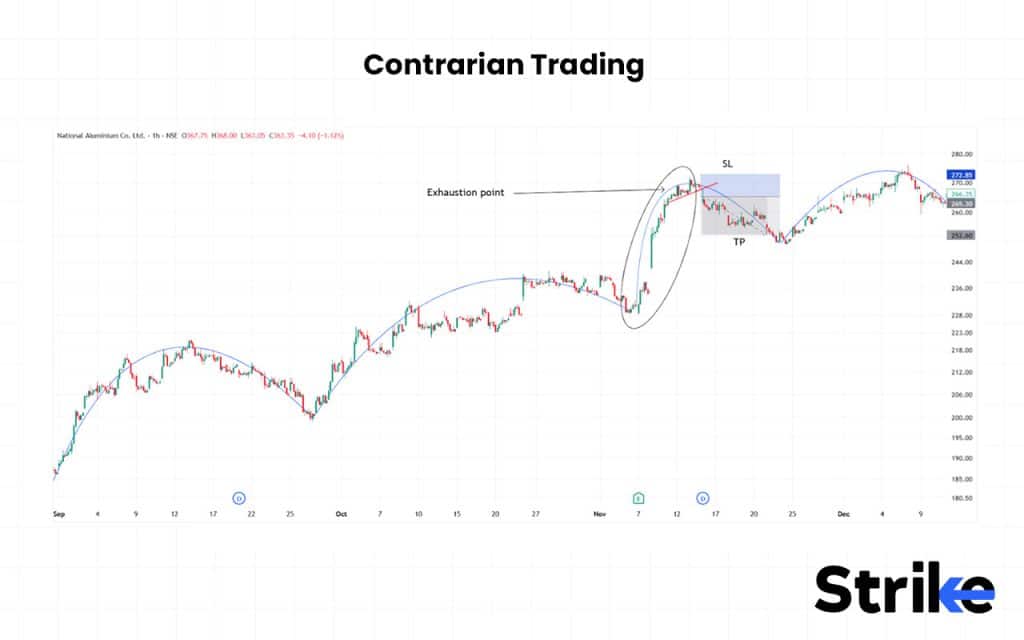
As we can clearly see in the chart above, strong optimism of buyers pushed National Aluminum stock price, where buying pressure exhausted creating a possible top. A contrarian trader would look for a short trade at this exhausted point against the trend.
Pros vs Cons of Contrarian Trading
| Pros | Cons |
| Excellent risk–reward near extremes | Difficult timing |
| Works well in range-bound markets | Trend can extend longer than expected |
| Early entries at turning points | Requires strong conviction |
| Less crowded trades | High drawdowns if mistimed |
| Capitalizes on emotional markets | Not beginner-friendly |
According to backtests published on QuantifiedStrategies.com, the RSI < 20 setup on the S&P 500 demonstrated how Contrarian trading can be effective over the long term. Between 1993–2025, the strategy showed roughly a 75% win rate, delivered an average gain of about 0.6% per trade, generated approximately 7–8% CAGR, remained invested only around 30% of the time, and experienced significantly lower drawdowns (around 25%) compared to a traditional buy-and-hold approach.
22. Value Investing
Value investing is a long-term investment approach where investors buy an undervalued stock relative to its intrinsic value. Value investors analyze fundamentals such as earnings, cash flow, assets, and valuation ratios instead of focusing on short-term price movement. It operates on a longer time horizon.
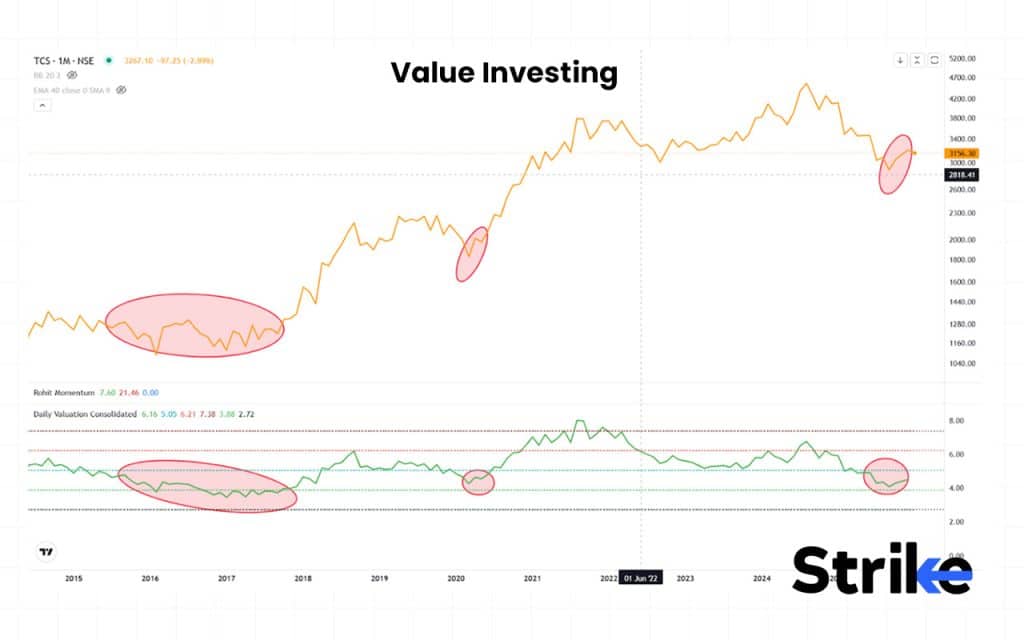
The chart above illustrates the statistical valuation of TCS using standard deviation analysis. When stocks trade below its -1 or -2 standard deviation of its valuation, stock is considered as undervalued. Investors use these deviation zones to identify probable accumulation areas to accumulate the stocks.
Pros vs Cons of Value Investing
| Pros | Cons |
| Lower downside risk over long term | Capital tied up for long periods |
| Margin of safety in valuation | Slow return realization |
| Less trading stress | Underperformance in momentum markets |
| Benefits from compounding | Requires deep fundamental analysis |
| Works well in bear or sideways markets | Value traps are possible |
According to Arista Wealth analysis of U.S. markets, value investing has historically outperformed growth stocks by 4.4% since 1927.
23. Dividend Trading
Dividend trading is an income based strategy where investors buy stocks and receive regular income in form of dividend. Unlike value or growth investing, dividend trading emphasizes cash flow, payout stability, and yield consistency. This strategy operates on bigger timeframes with holding periods ranging from months to multiple years.
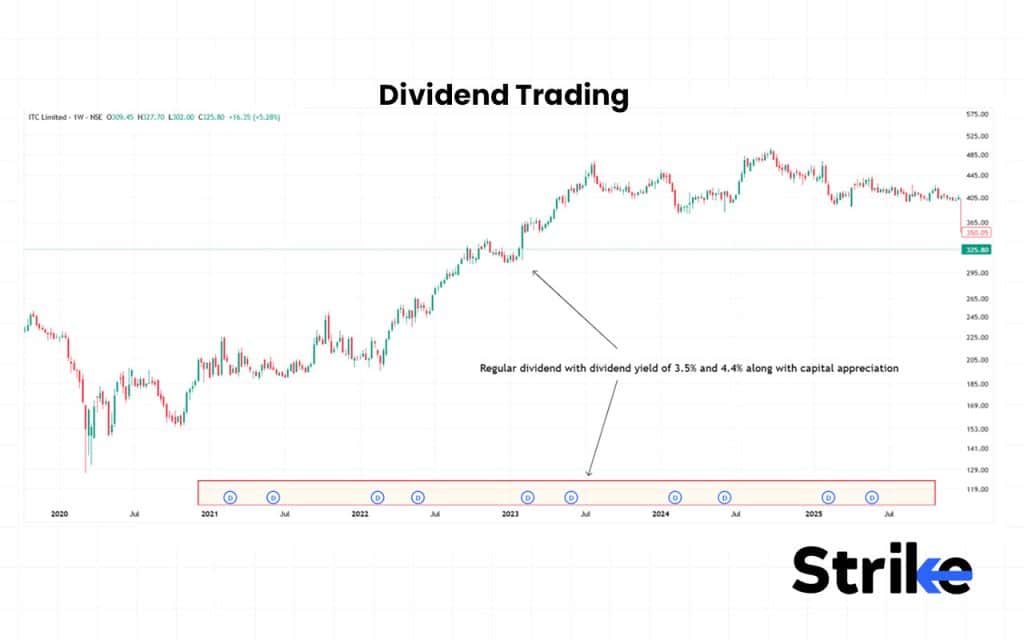
Above chart is a price chart of ITC, which shows the gradual rise in stock price over the time along with dividend. As we can see at the bottom highlighted area of the chart, ITC announced a dividend 2 times in a year with a dividend yield of 3.5 to 4.4%. An investor can buy such fundamentally strong stock for capital appreciation along with dividend income.
Pros vs Cons of Dividend Trading
| Pros | Cons |
| Regular income stream | Slower capital growth |
| Lower volatility stocks | Dividend cuts risk |
| Compounding through reinvestment | Tax implications |
| Suitable for long-term investors | Underperforms in strong bull markets |
| Less emotional decision-making | Yield traps possible |
A good dividend yield for sustainable long-term investing typically falls between 3-6%, balancing income generation with payout safety and growth potential. Yields above 8% often signal unsustainable dividends or value traps,
24. Insider Trading
Insider trading refers to buying and selling of the securities based on non-public information about the company. This non-public information can include earnings, mergers, regulatory actions, or major corporate decisions. This kind of trading is prohibited worldwide due to unfair advantage. Although, legal insider activity exists only when company insiders trade after proper disclosure and within regulatory limits.
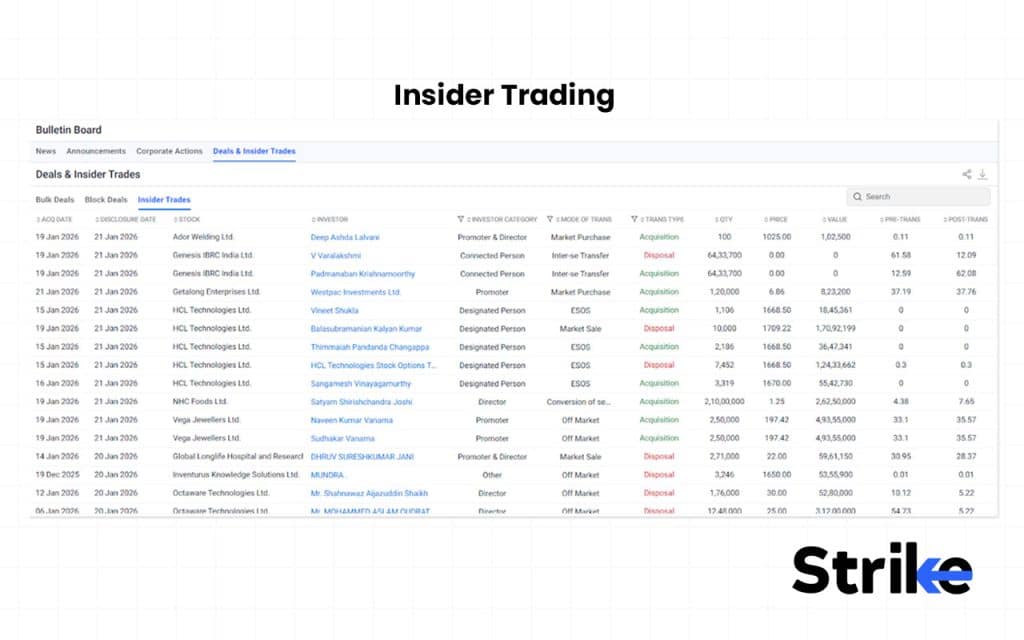
Image above shows the deals and insider activity with name of the stocks and investor, category of investor, their mode of transaction, quantity, price, and value. This legal insider information can be used to speculate the share price for trading and investing.
Pros vs Cons (From a Market Perspective)
| Pros (Perceived) | Cons (Reality) |
| Early access to critical information | Illegal and unethical |
| High probability trades | Severe legal penalties |
| Strong informational edge | Market trust erosion |
| Predictable outcomes | Criminal charges, fines, bans |
| Short-term gains | Long-term career destruction |
The above-mentioned insider data are considered legal as per regulations. However, Insider Trading becomes illegal when someone trades based on confidential, non-public information to gain an unfair advantage in the market.
25. Smart Money Trading
Smart money trading focuses on tracking and aligning the trade with institutional money such as banks, hedge funds, and large financial players rather than the retail crowd. Smart money traders look for the area with large institutional orders and how liquidity is engineered. This style is commonly applied on higher timeframes for bias and lower timeframes for execution, making it suitable for intraday, swing, and positional trading.
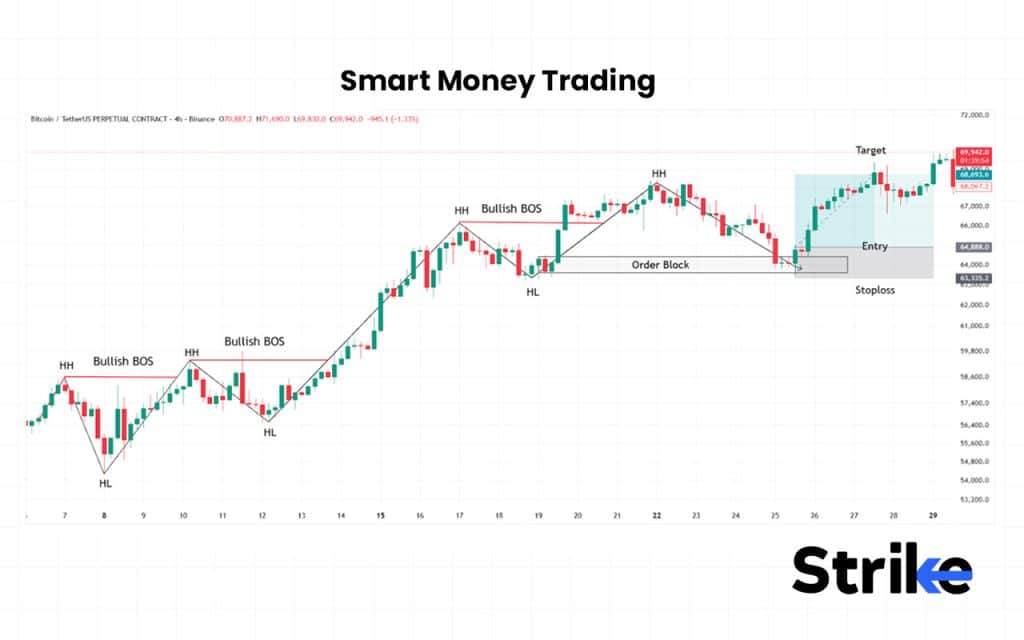
The above Bitcoin chart clearly demonstrates how Smart Money Concepts (SMC) can be used to track institutional direction. A clear Break of Structure (BOS) helps identify the overall trend bias, confirming market strength. After the breakout, a key area of interest forms in the order block zone, where institutions are likely positioned. When price retraces back into this order block and reacts strongly, it validates the zone and continues moving in the original trend direction.
Pros vs Cons of Smart Money Trading
| Pros | Cons |
| Trades aligned with institutions | Steep learning curve |
| High risk–reward setups | Subjective if not rule-based |
| Clear market structure logic | Requires multi-timeframe analysis |
| Works across markets | Over-analysis is common |
| Emphasizes liquidity & intent | Not beginner-friendly |
The concept of SMC was introduced by Michael J. Huddleston, known as The Inner Circle Trader (ICT) in the 2000s, but it gained widespread popularity in 2010 through online forums and videos.
26. Seasonality Trading
Seasonality trading involves analyzing recurring, calendar-based patterns in financial markets. This seasonal pattern arises due to economic cycles, earnings seasons, fiscal years, commodity demand cycles, and behavioral factors. Seasonality trading focuses on a long period with trades often planned from weeks to months.
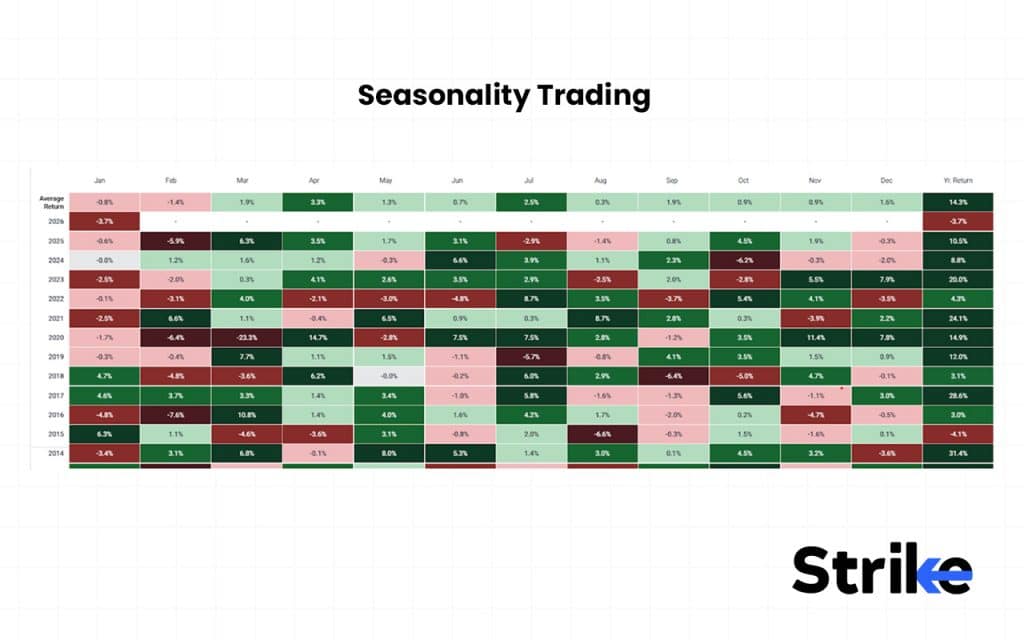
Above is the image of Seasonality screener which shows month wise performance of Nifty 50 over the last 20 years showing the average return of each month in the last 20 years. It shows that the Nifty performs best in the month of April with an average return of 3.3% return. Whereas in the month of February, Nifty gives an average return of -1.4%. Hence, this seasonality indicator helps traders to plan for their trade accordingly.
Pros vs Cons of Seasonality Trading
| Pros | Cons |
| Based on long-term statistical behavior | Not precise on entry timing |
| Works well in commodities & indices | Seasonal patterns can weaken |
| Lower trading frequency | Requires patience |
| Complements technical & fundamental analysis | Not suitable for scalping |
| Data-backed probability edge | Macro shocks can disrupt cycles |
Although seasonality screener will help you to identify best trading time for any particular asset, it should not be used in isolation, as macro events and structural market changes can disrupt seasonal trends.
27. Sector Rotation Trading
Sector rotation involves shifting of capital from one sector to another based on economic cycles, relative strength, and momentum. Instead of focusing on individual stocks, this approach tracks which sectors are leading, weakening, or improving at different stages of market cycle. Sector rotation trades are executed on higher timeframes which makes it suitable for swing and positional trades.
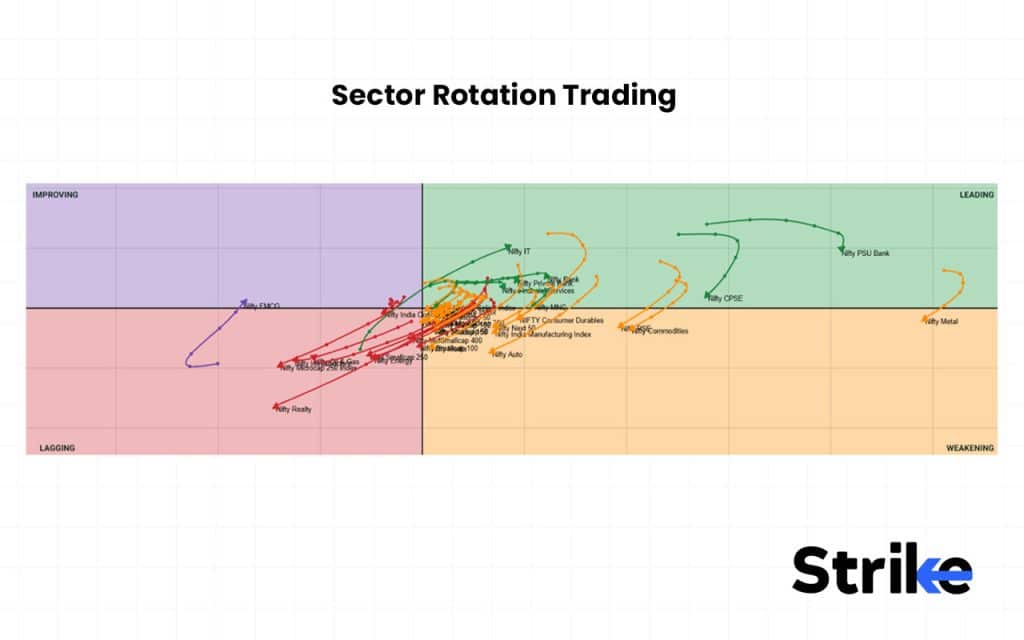
The above given Image is the RRG (Relative Rotation Graphs), which shows the rotation of sectors in a cyclical manner from getting weak to strong and from strong to weak. Investors and traders can rotate their funds from a weakening sector to a strong sector to utilize the fund with full potential.
Pros vs Cons of Sector Rotation Trading
| Pros | Cons |
| Captures broader market trends | Slower signals |
| Reduces single-stock risk | Requires macro understanding |
| Works well with ETFs | Rotation timing can lag |
| High probability in trending markets | Not suitable for short-term trading |
| Aligns with institutional flows | Sector correlations can change |
Sector rotation backtest in the Indian market generated 3-7% annualized alpha over Nifty buy-hold, according to moneycontrol.
28. Stock Trading
Stock trading is the process of buying and selling the shares of publicly listed companies in order to make profits from stock price movement. Stock trading operates only for a specific period of time fixed by exchange.
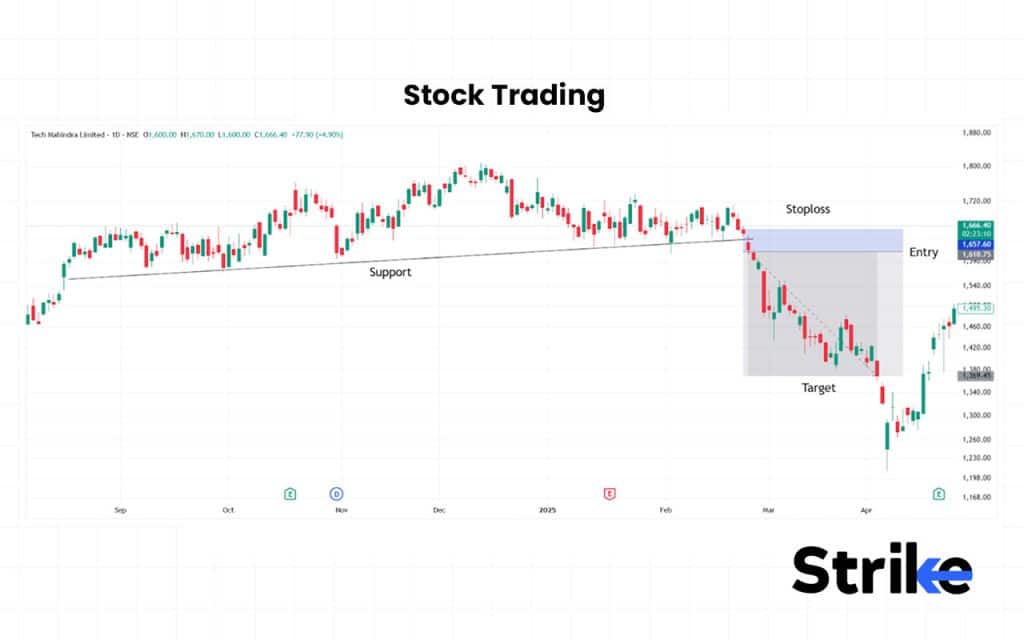
Above is the chart of stock of company Tech Mahindra, which is an Indian multinational information technology services and consulting company. The price of the stock dropped after breaking a technical support level, where traders could have profited by short selling the stock.
Pros vs Cons of Stock Trading
| Pros | Cons |
| High liquidity in major stocks | Market volatility risk |
| Suitable for all experience levels | Requires continuous learning |
| Multiple strategies and timeframes | Emotional decision-making |
| Transparent pricing | Capital loss possible |
| Regulated markets | Returns are not guaranteed |
According to an article written by Naylyan Nazifova, the global stock exchange market generated $670 billion in revenue by the end of 2025, where NYSE alone records around 1.5 billion shares traded daily, worth roughly $80 billion.
29. Forex Trading
Forex trading involves buying and selling of currency pairs in order to make profit from change in exchange rate. Unlike stock trading, forex trading is decentralized and open for 24 hours for five days a week. In forex, the currency price move is influenced by interest rates, inflation, central bank policy, economic data, and geopolitical events which makes forex trading more sensitive to global macro conditions.
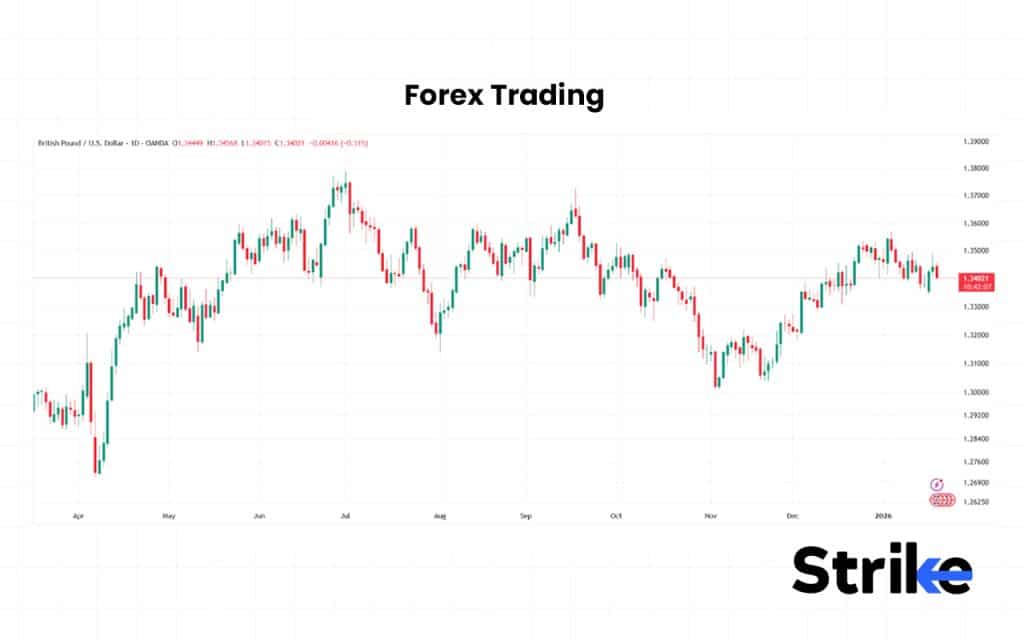
Given above is the price chart of the currency pair GBP and USD, where traders are trading the fluctuation between the exchange rate of GBP and USD.
Pros vs Cons of Forex Trading
| Pros | Cons |
| 24-hour market access | High leverage risk |
| Extremely liquid market | Sensitive to macro news |
| Low capital requirement | Sharp volatility spikes |
| Easy short-selling | Emotional overtrading common |
| Tight spreads in major pairs | Weekend gap risk |
Forex trading has the highest volume compared to other forms of trading with global forex daily trading volume reaching around $7.5 trillion in April 2025 per BIS Triennial Survey, which 42% increase from 2022.
30. Crypto Trading
Crypto trading involves buying and selling of cryptocurrencies and digital assets such as Bitcoin, Ethereum, and altcoins to profit from price volatility. Crypto markets are also decentralized, highly speculative, and operate 24/7 where price is driven by liquidity and sentiment rather than traditional fundamentals.
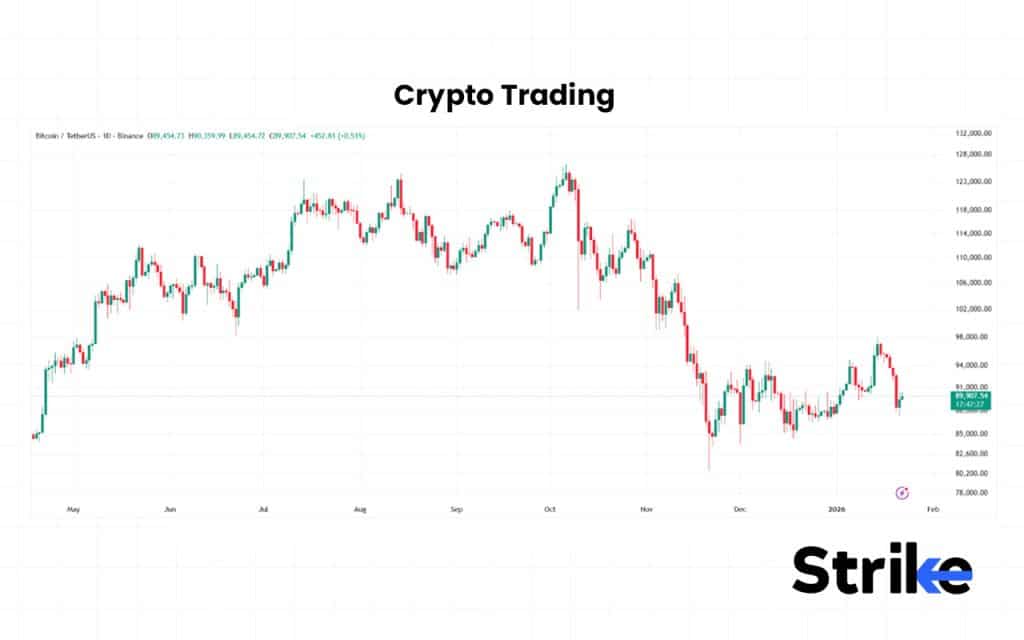
The given image is of the famous crypto currency “Bitcoin” which operates 24/7. Bitcoin is one of the most traded assets due to its volatility, liquidity and 24 hrs access. The average daily trading volume of bitcoin is around 82 Billion USD across major exchanges.
| Pros | Cons |
| 24/7 market access | Extreme volatility |
| High momentum opportunities | Regulatory uncertainty |
| Low entry barriers | Market manipulation risk |
| Strong trend cycles | Frequent false breakouts |
| Easy access to derivatives | Emotional overtrading common |
Crypto is one of the most traded assets in the world due to its volume,liquidity and accessibility. According to btcc, the Crypto trading volumes reached $18.6 trillion in 2026 (spot + derivatives), up 9% from 2025.
31. Commodity Trading
Commodity trading involves buying and selling of the raw materials and primary goods such as oil, gold, silver, natural gas, agricultural products, and base metals. The price of commodities is mainly driven by supply and demand, production levels, weather, geopolitics, and global economic cycle. Commodity trading is widely used to hedge the position and for speculation, usually on a higher timeframe.
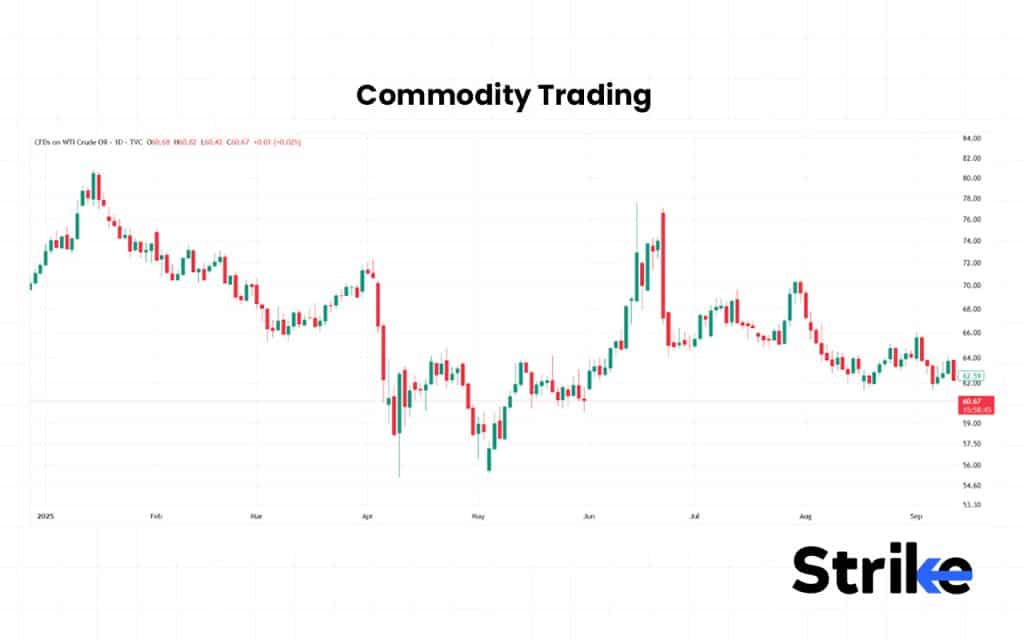
Above is the chart of famously traded commodity “USOIL” where prices fluctuate based on global economic and geopolitics.
Pros vs Cons of Commodity Trading
| Pros | Cons |
| Strong macro-driven trends | High volatility |
| Effective inflation hedge | Complex fundamentals |
| Works well with seasonality | Sharp reversals |
| Diversification from equities | Futures roll-over costs |
| Clear supply–demand logic | Leverage risk |
Commodity is mostly traded through derivatives contracts. The size of global commodity derivative market is around $123 trillion in 2025, per Statista projections.
32. Futures Trading
Futures trading is a buying and selling of standardized contracts of an asset such as Nifty 50 index, stocks or commodities at a future date, traded on NSE’s F&O segment with high leverage. Futures trading involves hedging, speculation, and arbitrage for intraday/swing strategies due to liquidity and no expiry rush like options.
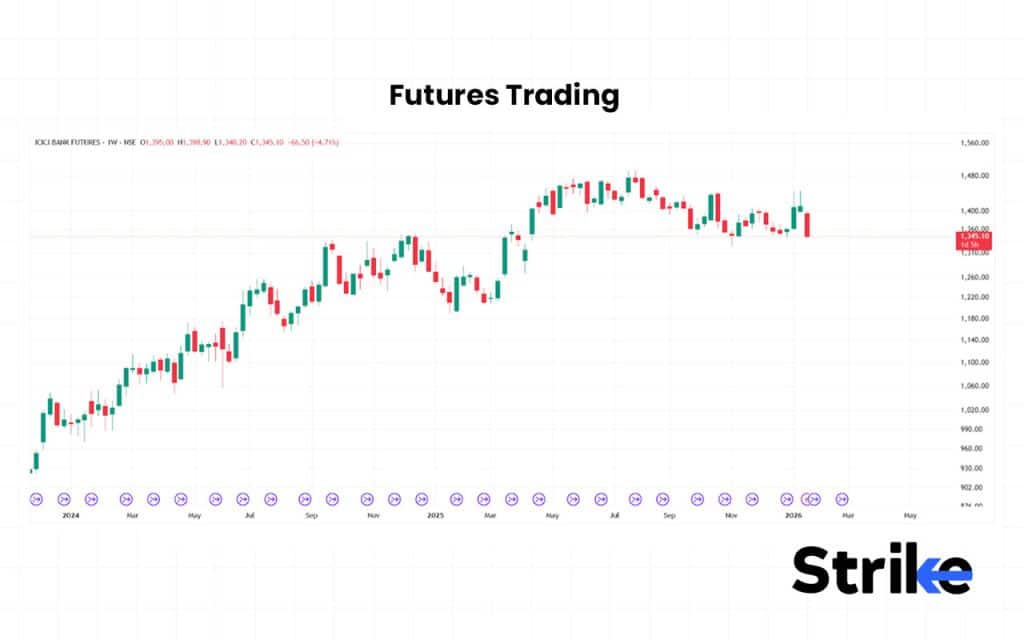
The above given chart is the chart of ICICI Bank Futures contract which moves exactly the same as the underlying ICICI Bank share. Traders analyse and speculate the share but trade futures to get the advantage of leverage.
Pros vs Cons of Futures Trading
| Pros | Cons |
| High liquidity and tight spreads | High leverage risk |
| Easy long and short positions | Margin calls possible |
| Transparent, exchange-regulated | Requires strict risk control |
| Works across asset classes | Contract expiry complexity |
| Efficient hedging tool | Not beginner-friendly |
In India, the highest futures trading activity happens in Indexes such as Nifty, Bank Nifty and Commodities such as Gold and other MCX metal.
33. ETF Trading
ETF trading involves buying and selling of Exchange Traded Funds (ETF), which is a basket of securities that tracks indices, sectors, commodities, bonds, or themes. Unlike trading individual stocks, ETF trading helps to avoid company specific risk through its diversification. ETFs are traded just like stocks on exchanges, commonly used in swing trading, positional trading, and strategic allocation.
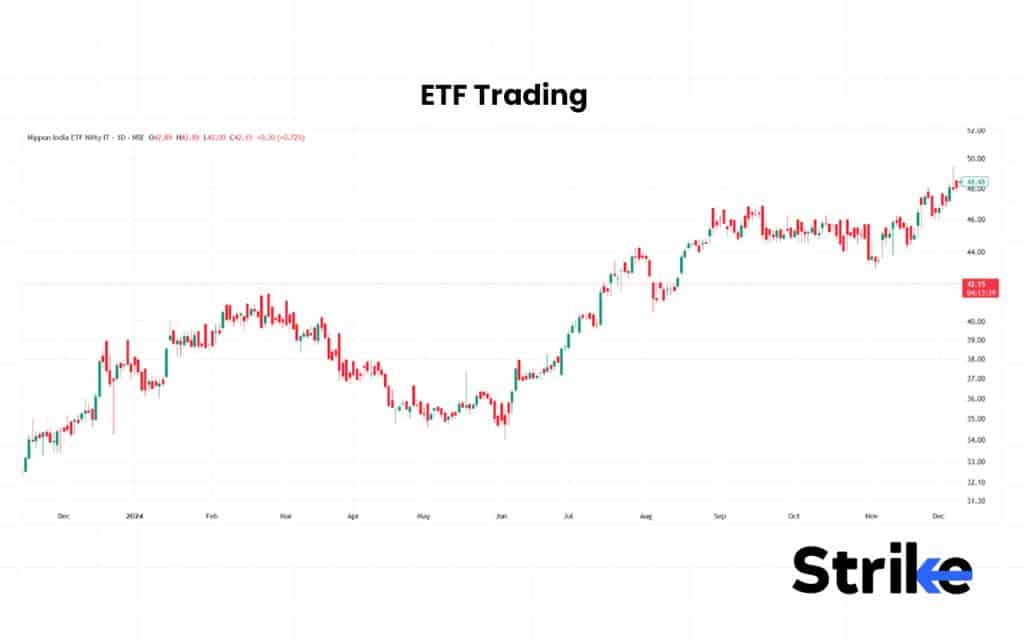
The above given image is the ETF of the Indian IT sector which tracks the basket of major Indian IT companies like Infosys, HCL, and Wipro. This offers investors an easy and diversified exposure IT sector.
Pros vs Cons of ETF Trading
| Pros | Cons |
| Diversification reduces risk | Lower volatility limits quick gains |
| Transparent and regulated | Tracking error possible |
| Lower capital requirement | Less responsive than single stocks |
| Ideal for sector rotation | Limited leverage options |
| Suitable for beginners | Some ETFs have low liquidity |
According to a PwC report, the global ETF market is projected to reach $18 trillion by the end of 2026, with the US ETF market dominating at around $14.0 trillion in assets at the beginning of 2026—highlighting the growing importance of ETF Trading worldwide.
34. Bond Trading
Bond trading is buying and selling of debt instruments issued by government, municipalities or corporations. Unlike stocks and crypto, bond prices are affected by interest rates, yield movements, credit risk, and maturity profiles rather than price momentum alone. Bond prices move inversely to interest rate which makes it highly sensitive to central bank policies. Bond trading is generally less volatile and operates on a medium to long-term time horizon.
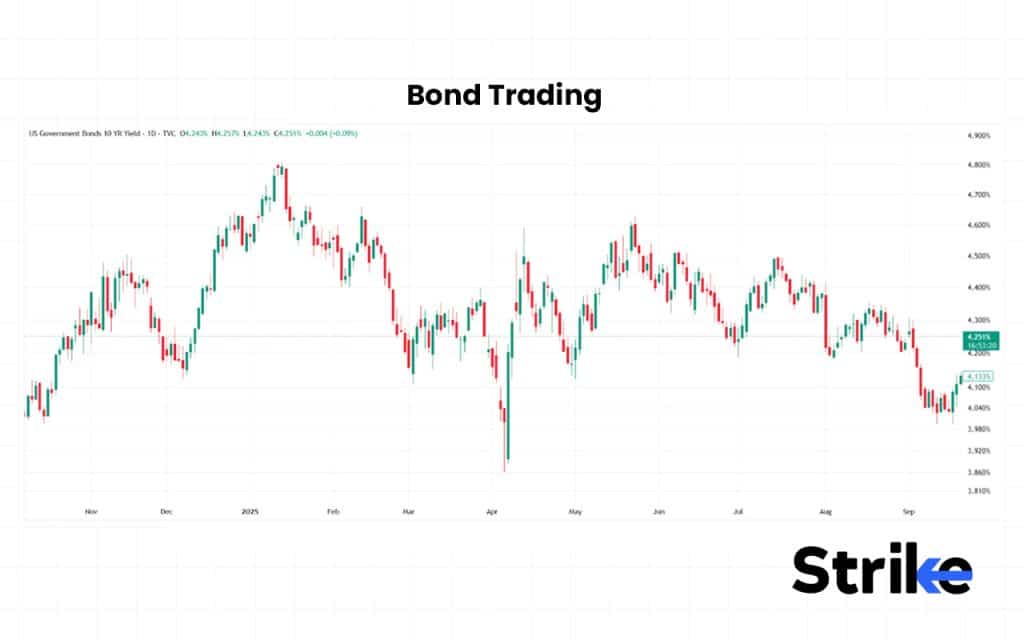
Above is the chart of US Government Bonds 10 YR Yield where price is getting affected by interest rates, yield movements, credit risk, and maturity profiles. Bond traders utilise this fluctuation in bond price to make profits.
Pros vs Cons of Bond Trading
| Pros | Cons |
| Lower volatility than equities | Lower return potential |
| Stable income through coupons | Sensitive to rate hikes |
| Effective portfolio hedge | Complex yield dynamics |
| Predictable cash flows | Inflation risk |
| Favored during risk-off phases | Limited short-term opportunities |
Global bond markets are much larger than equity markets. According to icma group, the global bond market value is around USD 127–128 trillion in outstanding notional, expected to grow to about USD 167–168 trillion by 2031 at roughly 5.6% CAGR.
35. Metal Trading
Metal trading involves buying and selling of precious metals like gold, silver, platinum or base metals such as copper, aluminium, zinc to profit from their price movements. The price of these metals are affected by inflation, currency strength, industrial demand, geopolitical risk, and global economic cycles. Metal trading is widely used for hedging, diversification and macro positioning, often on medium to longer term time frames.
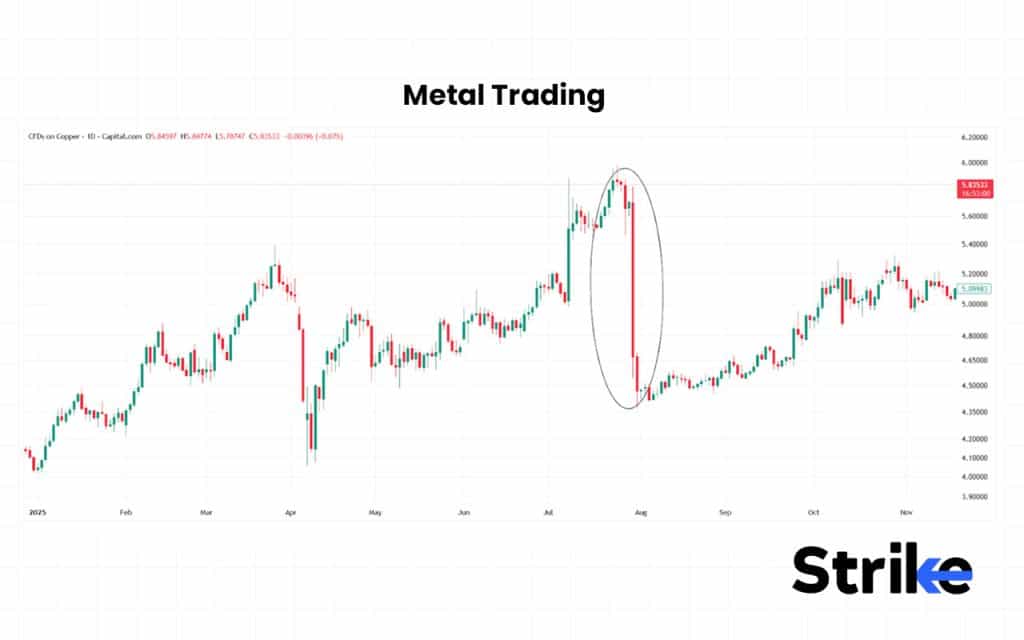
As we can see from the chart above, the copper price dropped more than 20% on July 30% 2025, after trump announced a 50% tariff on semifinished copper products. This is how metal prices are affected by geopolitical events where traders and investors can capitalize.
Pros vs Cons of Metal Trading
| Pros | Cons |
| Strong hedge against inflation | High volatility during news |
| Clear macro drivers | Sharp reversals possible |
| Works well in uncertainty | Futures leverage risk |
| Long-term trend clarity | Influenced by USD strength |
| Diversification benefits | Requires macro awareness |
Among all the metals, gold is the most traded metal and has the largest market share among. According to ebc financial group, the annual global trade and investment of gold flows in the hundreds of billions to over 1 trillion dollars, including physical, ETFs, futures, and OTC instruments.
Which Type of Trading is Best for Beginners?
The best type of trading for beginners is not one that makes the most profits, it’s the one which builds skill, discipline, and consistency. Such strategies include swing, positional, price action and trend trading.
- Swing Trading: In swing trading, trade lasts for days to week giving enough time to think and learn, easy to manage risk and have less emotional pressure than intraday trading.
- Position Trading: This helps beginners understand market cycle, requires less screen time and teaches about patience.
- Price Action Trading: This helps beginners understand how price actually moves, building a strong chart-reading skills.
- Trend Trading: This type of trading gives fewer false signals than reversals and is easy to combine with indicators.
As a beginner, traders should focus on building strong fundamentals instead of chasing profits. The above-mentioned strategy helps reduce emotional decisions and build a solid foundation—something that is essential across all Type of Traders, whether intraday, swing, or positional.
What is the Easiest Type of Trading?
Swing trading is considered as the easiest type of trading becauseit captures short-to-medium term price movements using a bigger timeframe such as 4-hour and daily charts, which helps filter out market noise. Swing trading usually follows simple concepts of support / resistance, and basic price action.
Since this style works on a higher timeframe, traders have enough time to analyze and plan the trade. It is ideal for beginners, working professionals, and part-time traders who cannot monitor markets all day.
Which Type of Trading is Riskiest?
Option buying is considered as the riskiest type of trading due to its leverage and time decay. In option buying, losses can occur even when the market moves in the expected direction due to theta decay. In option buying, success requires precise timing, strong momentum, and favorable volatility all together.
Since most options expire worthless, the probability is naturally stacked against buyers, which makes option buying highly risky for beginners—highlighting why understanding the Risk Reward Ratio is critical before entering such trades.
Which Type of Trading is Most Profitable?
Positional trading and swing trading is the most profitable type of trading as it captures large market moves while keeping transaction costs and emotional stress low.
This type of trading is mostly used by professionals and institutions in the Stock Market to generate higher returns through trend-following and position-based strategies. This style benefits from compounding profits over time by riding major trends.
Which Trading Type is Best for Small Capital?
Option buying and swing trading is best for small capital accounts, as it allows to make big profits with limited stoploss. Small accounts need relatively higher percentage returns to grow meaningfully, and both these styles allow making big profits.
Swing trading offers a stable growth with a bigger time framework, defined stop losses and reduced emotional uncertainty, which makes it more sustainable. Options buying can be used to trade with a very low capital base, and with the aim of making sharp moves, though it is more risky since it is sensitive to time and volatility. Therefore, they both are applicable to small capital, however, rigorous risk management and discipline are necessary to prevent a quick loss of capital.
What is the Best Trading Style for Full-time Employment?
Swing and positional trading is the best trading style for full-time employment because they require minimal screen time and give enough time for decision making. Swing trading involves capturing a price move over days or weeks using a higher timeframe chart making it suitable for working professionals.
Whereas positional trading extends this approach further, holding trades for weeks to months, giving traders enough time to manage the trade. These styles reduce emotional stress and work well with less availability, making them ideal for traders balancing a full-time job with market participation.
How to Choose the Right Trading Style?
Choosing the right trading style is not about finding the best strategy, but about finding the style that matches your personality, time availability, capital, and risk tolerance. There are five main criteria you should evaluate to select the right trading style.
- Time Commitment: If you are available for full time in the market (constant monitoring 9:15 AM-3:30 PM IST), scalping or intraday will suit you. Whereas, part-time traders can choose swing or positional trading.
- Risk Tolerance: High stress tolerance suits option buying and intraday trading. Whereas conservative profiles should prefer swing or positions trade.
- Capital Size: Intraday cash/futures are best applied to small accounts ( ₹10k-50k), whereas options selling requires ₹1L+ margins.
- Level of experience: Novices can begin with swing trading which involves less emotional strain, whereas professionals overlay scalping strategies or options strategies.
- Personality: Patient analysts would decide to trade position trading, whereas action-oriented traders would decide to trade day trading.
When your time, risk tolerance, capital, experience, and personality are in sync with your strategy, consistency and long-term success naturally follow.
What Popular Softwares are used for Trading?
Traders use different software depending on market, strategy, and experience level. The different types of popular software used in trading based on their purpose is mentioned below.
- Charting & Technical Analysis: Strike Money, TradingView, and MetaTraders 4 /5 are the most popular softwares for charting and analysis.
- Indian Trading Platforms: Zerodha Kite, Upstox, Angel One, and Groww are popular trading platforms in India.
- Options & Derivatives Tools: Strike.Money, Sensibull, and Opstra are advanced option analytical tools with strategy builder, and Greeks analysis.
- Algorithmic & Quant Trading: Amibroker, NinjaTrader, and QuantConnect are some popular backtesting and algo trading platforms.
- Portfolio & Investing: Tickertape, screener, and charting are some famous platforms for stock screening and fundamental analysis.
The best Trading Software is the one that fits your market, strategy, and experience level, while offering reliable execution, clean data, and strong analytical tools.

 5 mins