18 Trading Setup to Follow: Essential Guide for Beginners, Intraday & Stock Traders

 Author

 Editor
Trading setup plays an important role to bring discipline, clarity, and repeatability to trading decisions. Trading setup provides traders with a predetermined set of rules, eliminating subjective trading to make sure that all trades are based on a process of planning.
It is significant because it is consistent and risk controlled. A standardized configuration enables traders to sift through high-probability trades, quantify performance and perfect execution as time goes by. Most significantly, it reduces emotional interference, due to elimination of impulsive decision making. A clear trading structure converts the reactive speculative trading to a professional process oriented trading with capital preservation and long-term outcome.
What is a Trading Setup?
A trading setup is a predefined set of market conditions that a trader waits for before entering a trade. It clearly defines when to enter, where to exit, and how much risk to take, based on a specific strategy, rules, and market context.
Top Trading Setup Summary
The table below mentions the summary of top trading setup discussed in this article.
| No. | Trading Setup | What It Is | Best Timeframe | Suitable For | Risk Level |
|---|---|---|---|---|---|
| 1 | VWAP Trading Setup | Trading rejections or bounces around VWAP for intraday bias | 1–5 min | Intraday traders | Medium |
| 2 | Breakout Setup | Entering when price breaks key support/resistance | 5–15 min / 1H | Momentum traders | High |
| 3 | Reversal Setup | Trading trend changes at extremes or major levels | 15 min–4H | Experienced traders | High |
| 4 | Pullback Setup | Entering after retracement in an ongoing trend | 5 min–1H | Trend traders | Medium |
| 5 | Trend Following Setup | Riding established long/short trends | 1H–Daily | All traders | Medium |
| 6 | Chart Pattern Setup | Trading patterns (H&S, triangles, flags) | 15 min–Daily | Pattern-focused traders | Medium |
| 7 | Break of Structure (BOS) Setup | SMC-based structure shift confirming trend change | 1–15 min | Smart money traders | High |
| 8 | Order Block Setup | Trading institutional demand/supply levels | 1–15 min | SMC / ICT traders | High |
| 9 | Moving Average Crossover Setup | Buy/sell when short MA crosses long MA | 1H–Daily | Beginners | Low–Medium |
| 10 | Fair Value Gap (FVG) Refill Setup | Price refills imbalance zone before continuation | 1–15 min | ICT / PA traders | Medium–High |
| 11 | Gap Trading Setup | Trading gap fills or continuation after gap up/down | 1–5 min / Daily | Intraday & swing traders | High |
| 12 | Divergence Setup | Using RSI/MACD divergence to catch reversals | 15 min–Daily | Intermediate traders | Medium |
| 13 | Volume Spike Setup | Trading sudden volume surges signaling moves | 1–15 min | Momentum scalpers | Medium–High |
| 14 | Mean Reversion Setup | Betting price will return to average after deviation | 5 min–1H | Range traders | Medium |
| 15 | Supply & Demand Zone Setup | Trading market turning points at major SD zones | 5 min–4H | PA & SMC traders | Medium–High |
| 16 | Pivot Point Bounce Setup | Using daily/weekly pivot levels for bounce/reversal | 5–15 min | Intraday traders | Medium |
| 17 | Multi-Timeframe Confluence Setup | Entry only when multiple timeframes agree | All | Advanced traders | Low–Medium |
| 18 | Bollinger Squeeze Setup | Trading volatility contraction followed by explosion | 5 min–1H | Breakout traders | Medium |
What are the Best Trading Setups to Explore?
There are many trading setups available across different timeframes and markets, but the 18 commonly explored trading setups are mentioned below.
1. VWAP Trading Setup
VWAP (Volume Weighted Average Price) set up as trading based on the average price backed by volume. VWAP helps traders to find whether the price of an asset is trading at premium or discount. Traders use VWAP as a dynamic support or resistance to plane entry and exit, especially in intraday trading.
Use of VWAP began in the 1980s-1990s by institutional trading desks. Over the time VWAP became accessible to retail traders with evolution in the charting platform.
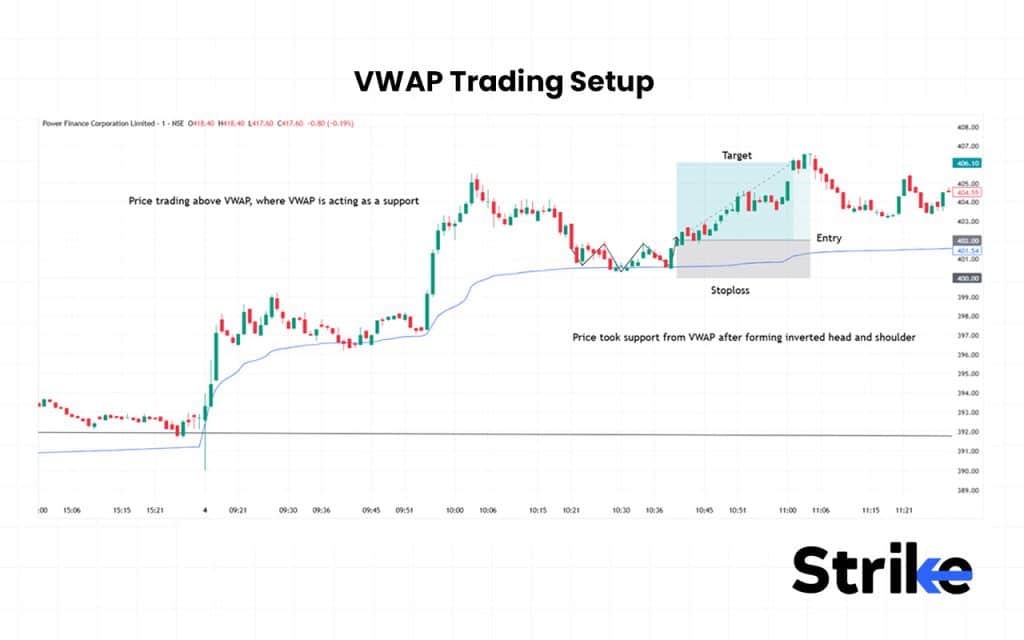
A chart above clearly demonstrates how a VWAP acted like a support for a stock in an uptrend. Stock retraced back to VWAP, formed a kind of inverted head and shoulder pattern and continued its trend taking support from VWAP.
Pros and Cons of VWAP Trading Setup
| Pros | Cons |
|---|---|
| Widely used by institutions and professionals | Less effective in strong trending markets |
| Provides objective, volume-based reference | Intraday VWAP resets daily |
| Works well for intraday and scalping trades | False signals during low liquidity |
| Acts as dynamic support and resistance | Not suitable for long-term trading |
| Simple to combine with price action | Needs volume for reliability |
2. Breakout Setup
The breakout setup is a trading approach in which traders buy and sell the asset once price breaks decisively beyond a support, resistance, or chart pattern. The logic behind the breakout setup that once price breaks a key level, it often gives a trending move. The breakout trading setup is popularised by Richard Donchian which is later refined by trend-following and momentum traders.
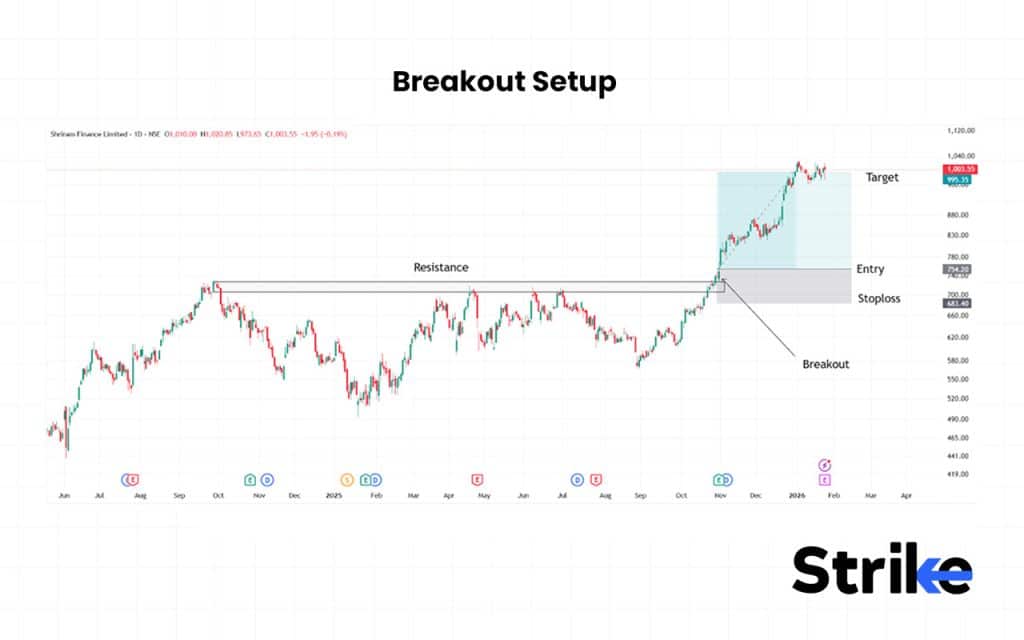
Above is the chart of stock Shriram Finance Limited which was facing resistance multiple times at price range of 720 to 730. Stock moved more than 30% after breaking the resistance level. A trader can trade such breakouts to catch momentum.
Pros and Cons of Breakout Trading Setup
| Pros | Cons |
|---|---|
| Captures strong momentum moves | High chance of false breakouts |
| Clear entry and stop-loss levels | Requires patience and discipline |
| Works across all markets and timeframes | Poor performance in choppy markets |
| Favorable risk–reward potential | Slippage during fast moves |
| Easy to combine with volume and VWAP | Emotional stress during retests |
3. Reversal Setup
The reversal setup is a trading approach where the trader identifies the point of trend reversal of an existing trend. In reversal trading, traders look for exhaustion in price movement, loss of momentum, or a strong rejection from key level to capture a move from turning point.
The reversal setup has been in use since the origin of classical market theory, where traders noticed that the market moves in a cycle of contraction and expansion.
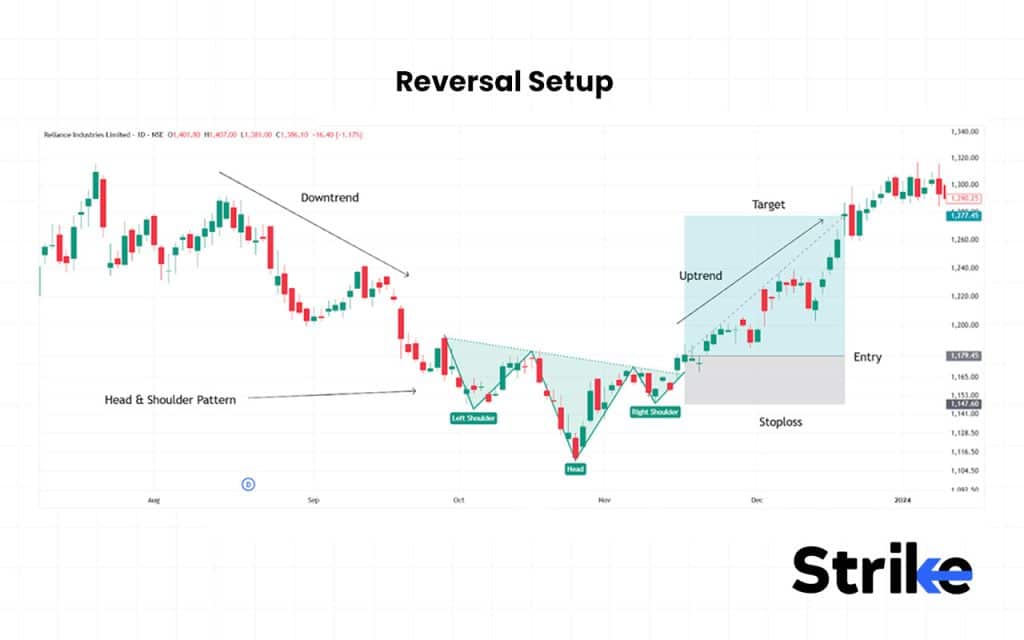
The chart above clearly shows how a Reliance Industries stock changed its trend from bearish to bullish after forming an inverse head and shoulder reversal chart pattern. A trader can catch such trend reversals to catch a new trend.
Pros and Cons of Reversal Trading Setup
| Pros | Cons |
|---|---|
| Entry near market extremes | High probability of false signals |
| Large reward potential | Requires strong confirmation |
| Small stop-loss when timed well | Emotionally challenging |
| Works well at key support/resistance | Poor performance in strong trends |
| Excellent for swing and positional trades | Demands experience and patience |
4. Pullback Setup
The pullback setup in trading involves buying or selling of the asset in the prevailing trend after a temporary price retracement. Instead of catching momentum, traders wait for price to get to a value area, such as support area or moving average to enter a trade.
The concept of pullbacks are formalized through concepts such as Dow Theory, moving averages, and retracement techniques.
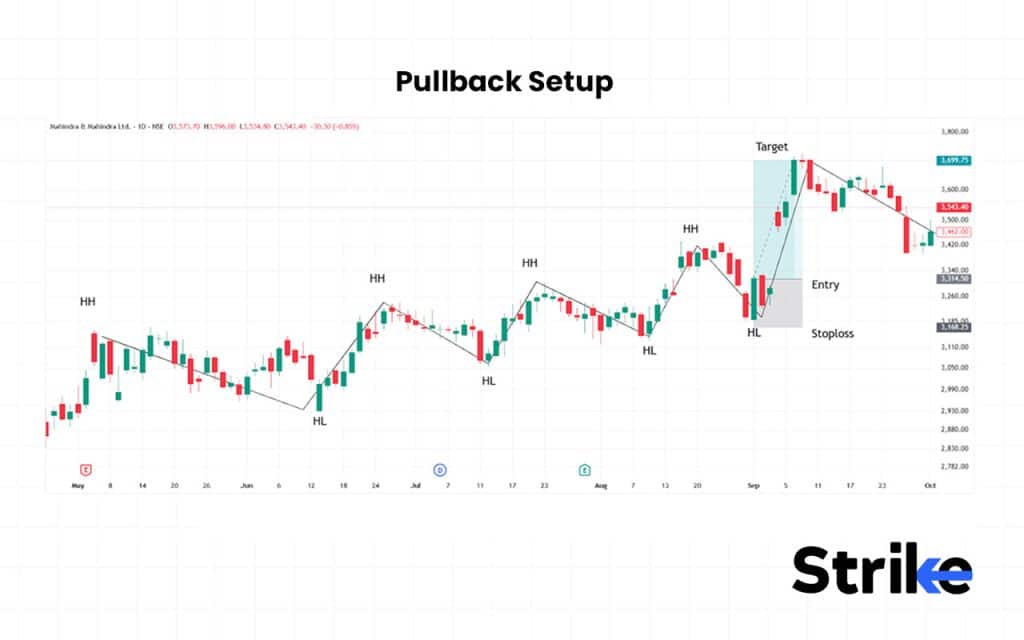
The above chart of Mahindra & Mahindra clearly shows that the stock is in uptrend, making higher highs and higher lows. When a stock takes a pullback in an uptrend, traders buy these stocks at a discounted price, anticipating the stock will continue its move to upward again. Such steps help traders to stay in the market direction and increase the probability of winning.
Pros and Cons of Trend Following Setup
| Pros | Cons |
|---|---|
| Trades in the direction of the trend | Requires patience |
| Better entry price than breakouts | Missed trades if pullback is shallow |
| Lower risk compared to reversal trades | Pullback may turn into consolidation |
| Works well across timeframes | False signals in weak trends |
| Easy to combine with moving averages & RSI | Overtrading during choppy markets |
5. Trend Following Setup
Trend following trading approach where trader identifies the established trend and enters the trade in the same direction in order to ride the trend until it changes. Trend following setup primarily focuses on price structure such as higher highs – higher lows or lower highs – lower lows, and staying in the trend until the trend shows exhaustion.
Trend following is one of the oldest trading methods used since Dow Theory. Later this concept was systematized by traders like Richsrd Donchian and the famous Turtle Trader.
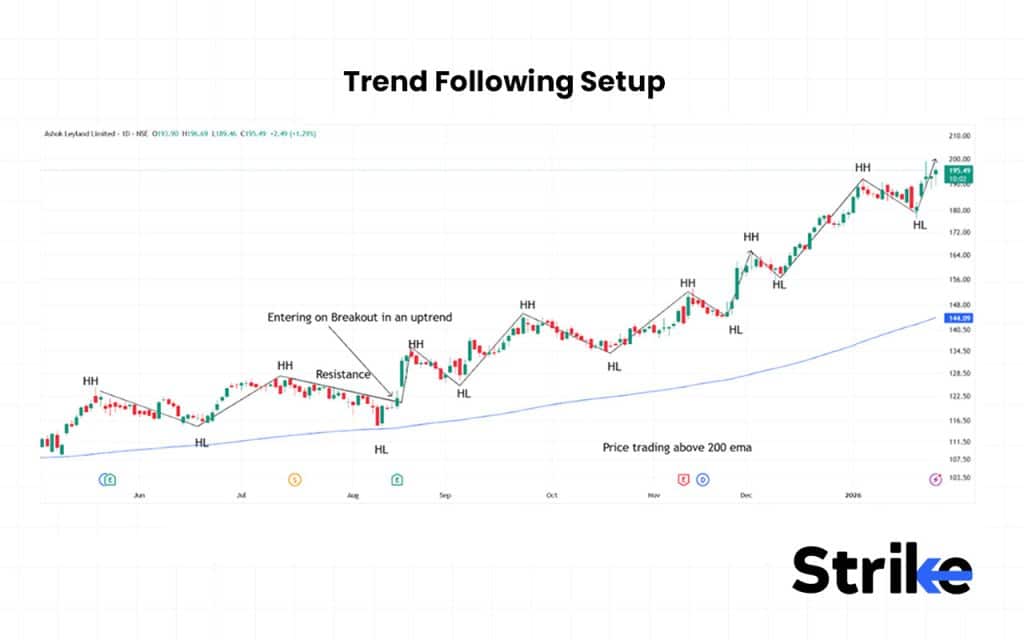
As we can clearly see in the above chart, the stock is in uptrend, trading above 200 EMA by making higher highs and higher lows. If a trader would have entered long after the break of consolidation, he would have still been in this trade as there is no sign of trend reversal and exit.
Pros and Cons of Trend Following Setup
| Pros | Cons |
|---|---|
| Captures large directional moves | Underperforms in range-bound markets |
| Simple and rule-based | Late entries after trend confirmation |
| Works across all asset classes | Multiple small losing trades |
| Emotionally less stressful | Requires patience and discipline |
| Highly scalable strategy | Drawdowns can test confidence |
6. Chart Pattern Setup
The Chart Pattern setup is a trading approach which involves recognizing recurring structures formed due to market psychology. This pattern helps to anticipate the next move of the market based on current psychological behaviour of buyers and sellers. In this setup, entry is typically formed after a breakout or breakdown.
Use of chart patterns in trading has originated from classical technical analysis. This concept was later formalized by Charles Dow and later documented by Edwards and Magee in the mid-20th century.
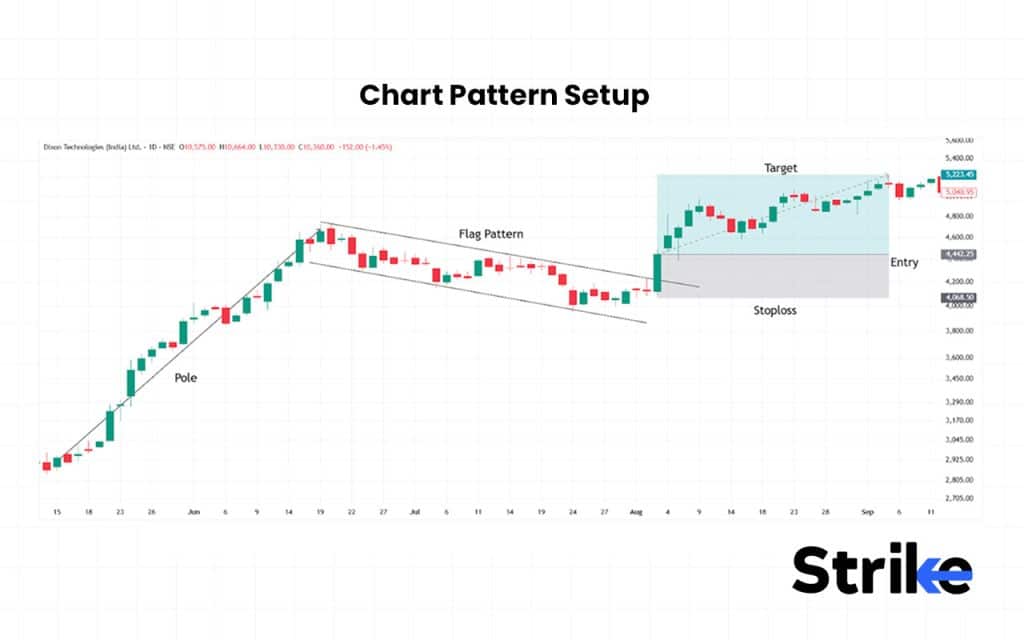
The above given chart shows the trading of flag and pole chart patterns as a Chart Pattern Setup. A Dixon Tech stock was in strong uptrend and consolidated to form a flag pattern before continuing the trend. Traders could have entered a long position after the breakout pattern with the target of 1:2 or the length of the pole.
Pros and Cons of Chart Pattern Trading Setup
| Pros | Cons |
|---|---|
| Visual and easy to understand | Subjective interpretation |
| Clear entry, stop, and target levels | False breakouts are common |
| Works in all markets and timeframes | Requires experience to master |
| Reflects market psychology | Pattern failure in low volume |
| Can be combined with indicators | Overconfidence in pattern symmetry |
7. Break of Structure (BOS) Setup
Break of Structure (BOS) setup is a price-action-based setup which involves identifying a decisive break of a previous market structure, such as previous high or low. This BOS signals a shift in control from buyers to sellers or vice versa, helping traders to confirm the trend of the market.
The BOS concept is purely originated by price action and market structure used by traders way before the introduction of indicators. In recent years, BOS is widely recognised through institutional trading models and smart money concepts (SMC).
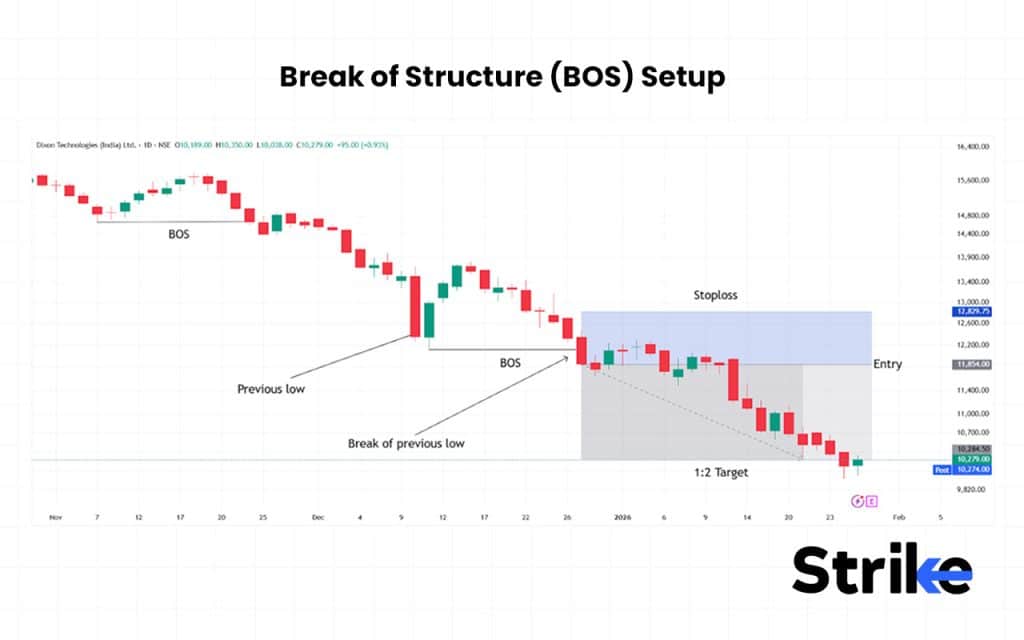
The above chart clearly shows how sellers dominated after breaking the previous low. Traders would have entered a short position once the previous low of the stocks is broken by sellers. This would have given us a profit of 1:2.
Pros and Cons of BOS Trading Setup
| Pros | Cons |
|---|---|
| Objective, price-based signals | Requires strong structure identification |
| Clear confirmation of trend direction | False breaks in ranging markets |
| Precise stop-loss placement | Late entries if chased |
| Works well with order blocks & liquidity | Needs multi-timeframe analysis |
| Effective across all markets | Overuse leads to overtrading |
8. Order Block Setup
Order block setup is also a price action based trading setup, which involves focusing on key price zones where institutional buying and selling is believed to have occurred before a strong directional move. Traders consider these zones as a high probability area of interest, expecting price to react quickly after it revives this zone.
The concept of order block originates from Smart Money theory, which says large participants cannot enter or exit positions at a single price, hence creating a zone where institutions accumulate heavy positions. In recent years, order blocks gained popularity through Smart Money Concept (SMC) and advanced price action traders.
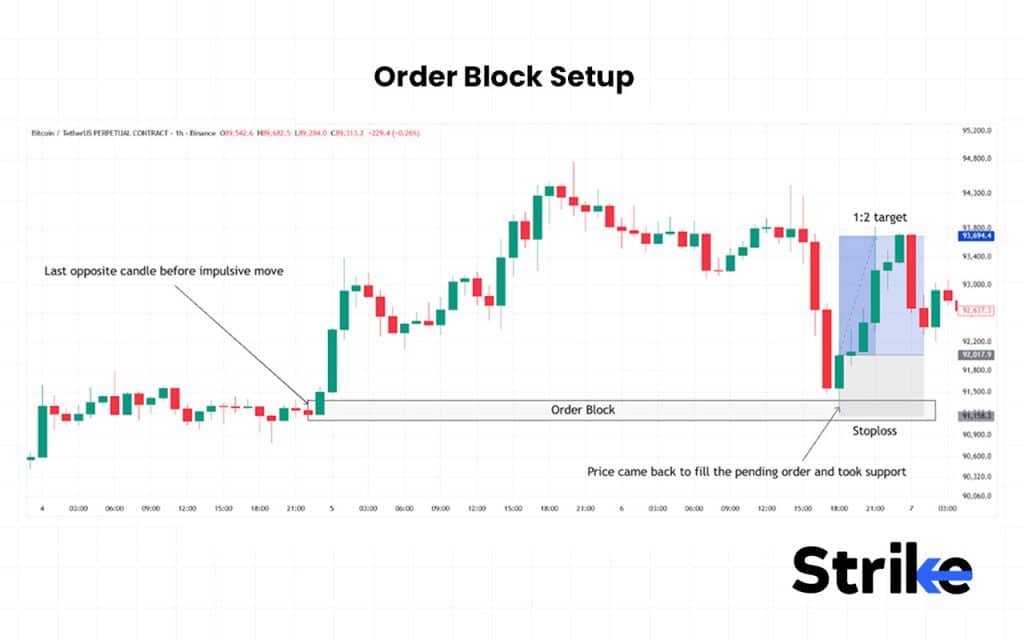
The above Bitcoin chart is clearly showing how a price is taking support from order blocks. A trader can identify such an order block and execute the trade on a lower timeframe for better risk to reward.
Pros and Cons of Order Block Trading Setup
| Pros | Cons |
|---|---|
| Aligns with institutional behavior | Subjective identification |
| High reward potential | Requires context and confirmation |
| Precise entries and stop-loss levels | Fails in choppy markets |
| Works well with BOS and liquidity | Over-marking reduces clarity |
| Effective across timeframes | Needs experience to master |
9. Moving Average Crossover Setup
Moving Average crossover setup is indicator based trend trading setup where trader enters or exits trade when short period moving average crosses above or below the long period moving average. When the short-term moving average crosses above long-term moving average, it suggests a buy signal. Whereas in bearish crossover, short-term moving average crosses below long-term moving average.
Moving averages crossover techniques gained popularity through mechanical trading systems in the mid-20th century and were later adopted by commodity traders, hedge funds, and algorithmic strategies due to their simplicity and adaptability across markets.
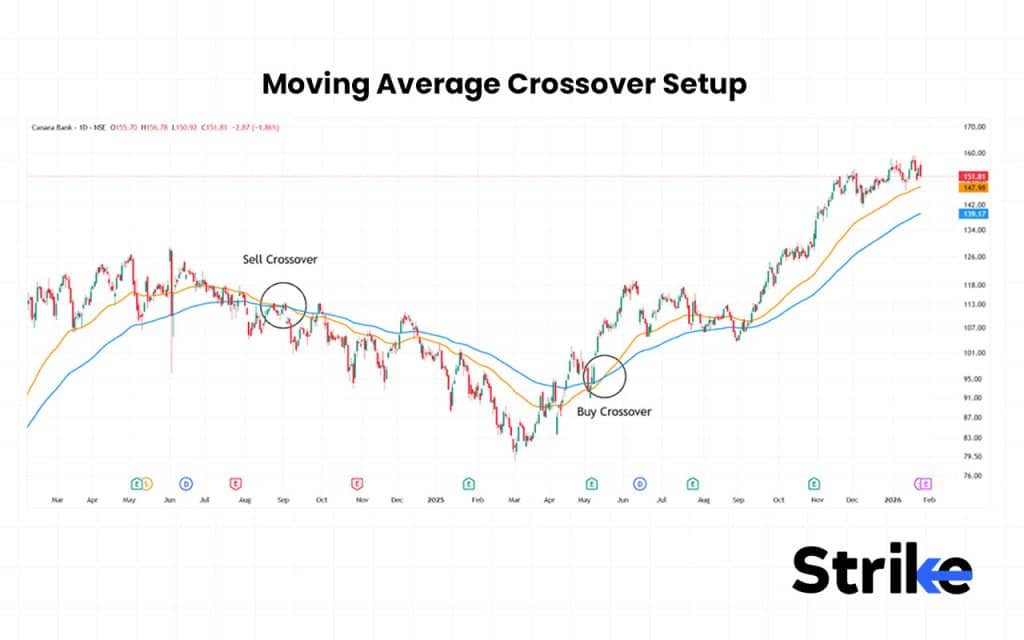
The chart above clearly shows a simple buy and sell signal generated by EMA cross. When short term EMA crossed long term EMA from above, trend shifted bearish, where traders could have shorted the market. Similarly, when short term EMA crossed above long term EMA, it gave a buy signal.
Pros and Cons of Moving Average Crossover Setup
| Pros | Cons |
|---|---|
| Simple and rule-based | Lagging indicator |
| Effective in trending markets | Frequent false signals in ranges |
| Easy to automate and backtest | Late entries and exits |
| Works across asset classes | Misses early part of the move |
| Reduces emotional decision-making | Drawdowns during consolidation |
10. Fair Value Gap (FVG) Refill Setup
Fair Value Gap (FVG) Refill Setup is a price action based setup which focuses on price inefficiencies created by aggressive buying or selling. FVG firms when prices move impulsively leaving a gap or imbalance between the consecutive candles. Trader expects price to revisit this imbalance zone to rebalance the liquidity before continuing the trend.
FVG became popular with the rise of institutional algorithmic trading in the early 2000s and got widespread among traders through Smart Money Concept after 2017.
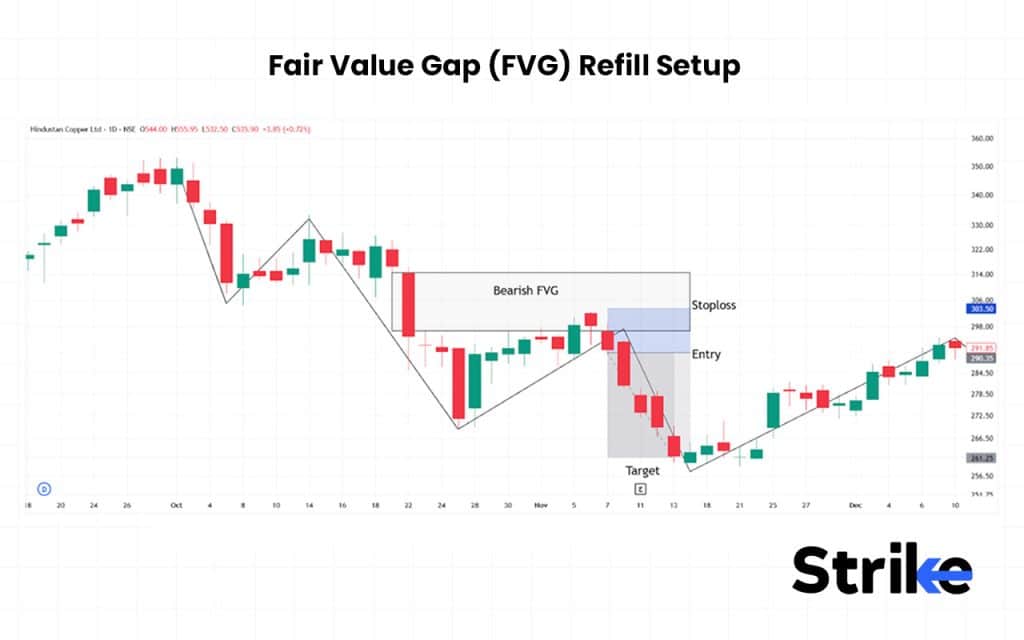
In this chart we can see Hindustan copper is in downtrend, making lower highs and lower lows. While making a lower lows, price fell sharply, leaving a FVG. As soon as stock retraced back to FVG, price fell sharply, giving 1:2 RR trade.
Pros and Cons of FVG Refill Trading Setup
| Pros | Cons |
|---|---|
| Clear imbalance-based zones | Not all FVGs get filled |
| Tight stop-loss placement | Requires market context |
| Strong institutional logic | Over-marking reduces accuracy |
| Works well with BOS & order blocks | Poor performance in low volatility |
| Effective across timeframes | Needs experience to refine |
11. Gap Trading Setup
The Gap Trading setup focuses on price gaps formed due to significant open of price higher or lower than the previous sessions close. These gaps represent the sudden change in market sentiment due to news, earnings, or global cause. Traders aim to profit from these gaps either by gap continuation or gap fill behaviour.
Gap trading became more common after the rise of electronic exchanges and overnight trading in the late 1990s to 2000s. This strategy saw massive retail adoption after 2010, where intraday traders started trading these gaps using volume and price action.
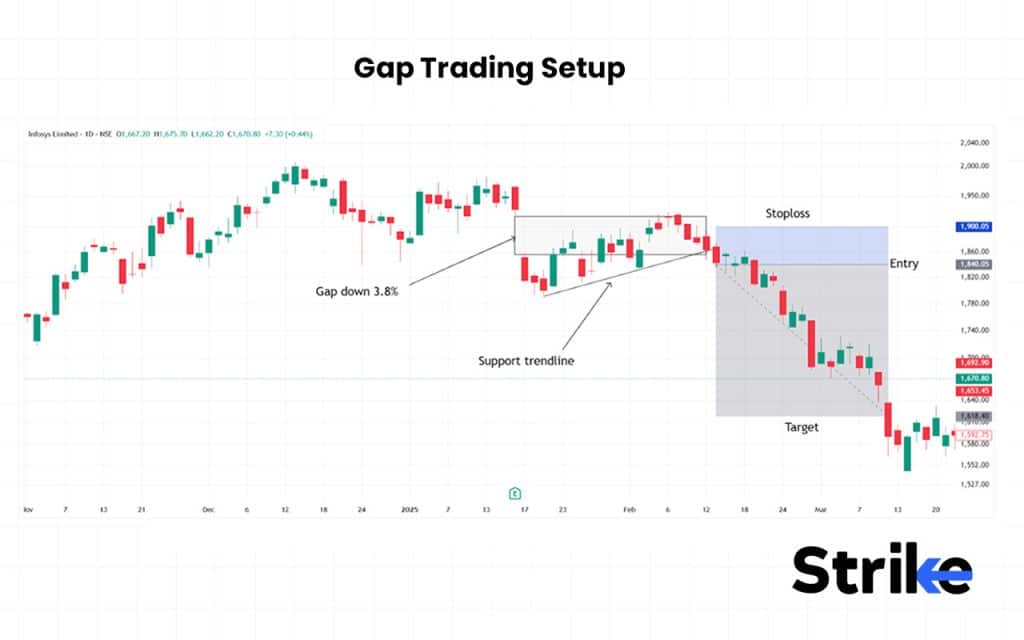
On Jan 17th 2025, Infosys opened 3.8% gap down, after which the stock slowly rose to fill the gap before continuing its downtrend. After filling the gap, stock fell more than 18%. Traders could have planned for short trade after gap fill and break of support trendline.
Pros and Cons of Gap Trading Setup
| Pros | Cons |
|---|---|
| Quick intraday opportunities | Highly volatile |
| Clear bias from market open | Prone to slippage |
| Works well with volume analysis | False moves in first minutes |
| High momentum potential | Requires fast execution |
| Popular in equities & indices | Emotionally demanding |
12. Divergence Setup
The divergence setup involves identifying the mismatch or disagreement between price movement and momentum indicators. When prices make new highs or lows, the indicator moves opposite to price, suggesting weakening of momentum and potential trend pause or reversal. Traders use this setup to identify possible trend reversals.
The concept of divergence trading developed alongside momentum indicators like RSI and MACD in the late 1970s-1980s. Its practical application increased significantly after 2010, where traders started combining divergence with price action and structure for higher accuracy.
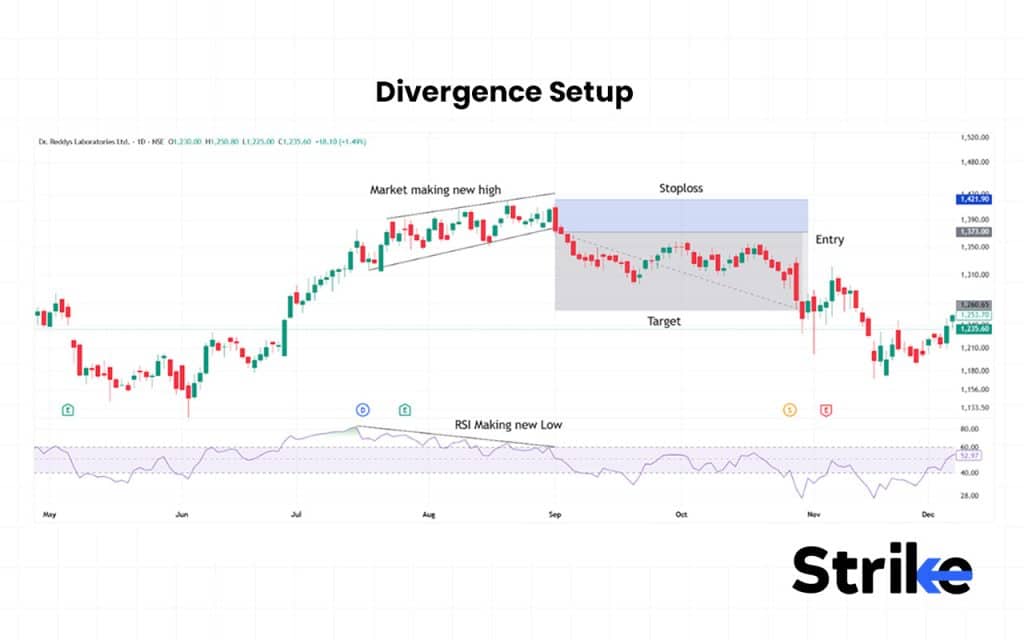
As we can see in the above chart, the stock of Dr Reddy was moving upward by making new higher highs. Although the stock was moving up, the strength was missing, because the RSI was moving down, suggesting low strength in the stock’s move. This divergence lead to correction in stock after stock broke lower support. A trader can find such setups for trend reversal trade.
Pros and Cons of Divergence Trading Setup
| Pros | Cons |
|---|---|
| Early signal of momentum weakness | Not a timing tool by itself |
| Works well in reversals and pullbacks | Many false signals in strong trends |
| Combines well with RSI, MACD | Requires confirmation |
| Clear visual identification | Subjective interpretation |
| Effective across timeframes | Overuse leads to overtrading |
13. Volume Spike Setup
Volume spike setup focuses on sudden and abrupt change in volume compared to recent average volume. A spike in volume suggests strong participation or institutional activity, which often appears near breakouts, reversal, or key support and resistance levels. Traders use volume spikes for confirmation after price action.
Volume spike setup gained popularity with the rise of the electronic market in the late 1990s–early 2000s. After 2010, real-time volume data and intraday platforms made identifying abnormal volume easier for retail traders.
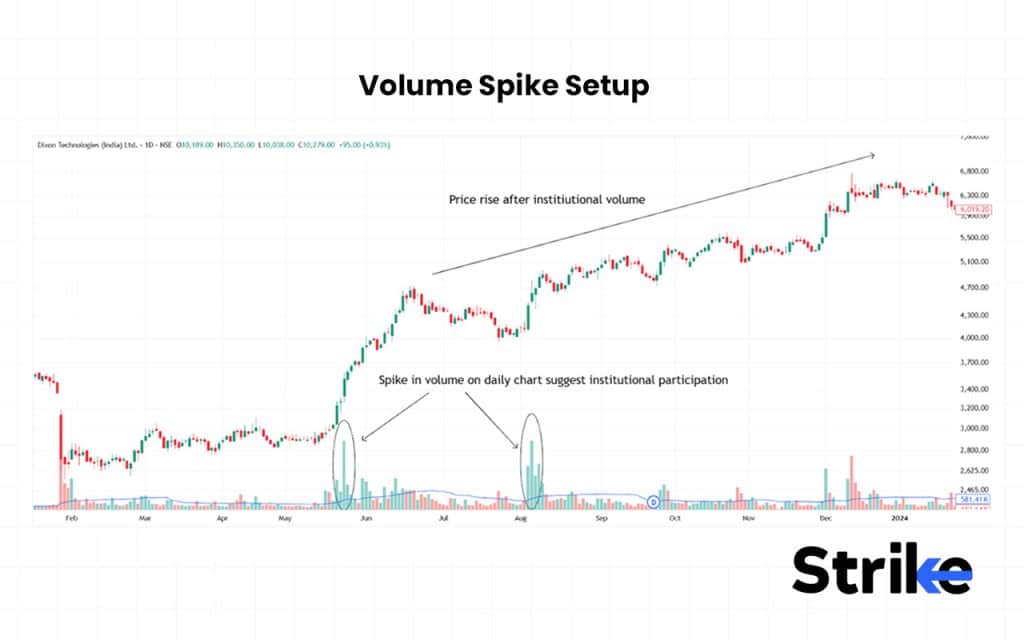
As we can see in the chart above, there is a huge spike in volume, surpassing the average 30 days volume. This suggests the participation of institutions leading to massive moves to the upside. Traders can capture such moves by analysing volume and price structure.
Pros and Cons of Volume Spike Trading Setup
| Pros | Cons |
|---|---|
| Confirms genuine market interest | Not a standalone entry signal |
| Helps avoid false breakouts | Can be misleading near news |
| Works well with price action | Requires context and experience |
| Useful across all timeframes | Late confirmation at times |
| Highlights institutional activity | Overreaction to single candles |
14. Mean Reversion Setup
Mean Reversion Setup is a trading strategy which is based on the idea that the price has a tendency to revert back to its average value after moving too far in one direction. Traders seek overextended price action where they anticipate a reversal or correction back to an average like VWAP, moving averages or statistical bands. Traders look for a buy trade after the price sharply falls down and is expected to reverse back to its mean. Whereas, traders plan to sell when price rises sharply.
The concepts of mean reversion were developed during some statistical and financial investigations in the 1960s – 1970s, and found extensive application in the 1990s, particularly by quantitative and proprietary trading desks. Its use by discretionary traders has grown since 2010, as other pointers such as Bollinger Bands and VWAP have become easier to use to spot overextension.
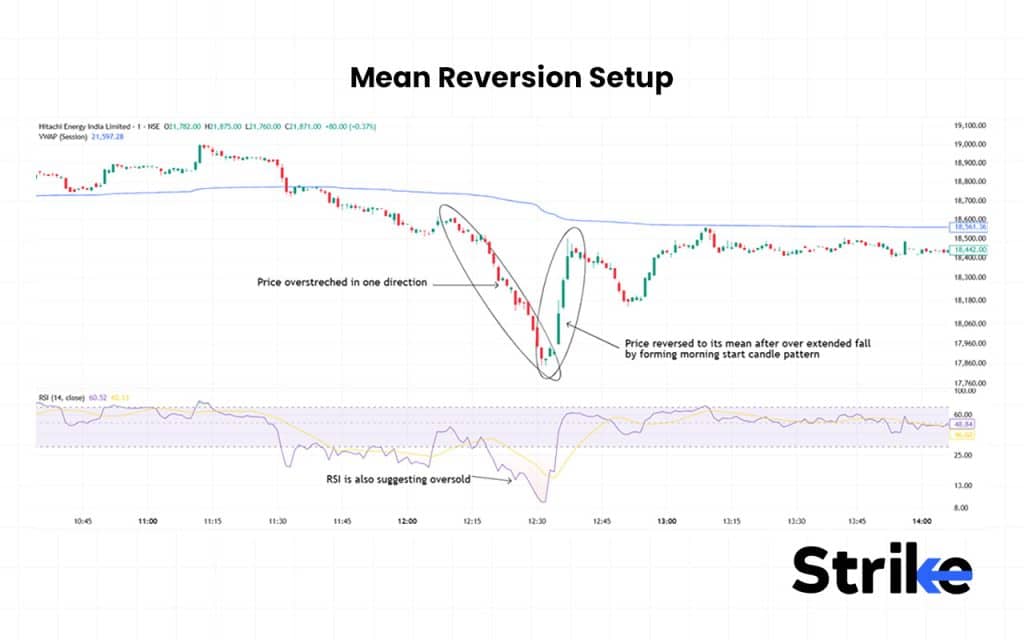
The above chart shows how the price reversed to its mean value which was VWAP after an over-extended fall in one direction. The RSI below 30 suggests the over-extended drop in price, where traders would have planned for a reversal trade after a bullish candle.
Pros and Cons of Mean Reversion Trading Setup
| Pros | Cons |
|---|---|
| Clear logic and objective targets | Performs poorly in strong trends |
| Works well in range-bound markets | Requires precise timing |
| Tight stop-loss placement | Frequent small losses |
| Easy to combine with VWAP & BB | Emotionally challenging |
| Favored by professional desks | Needs strict risk management |
15. Supply & Demand Zone Setup
Supply and demand Zone setup involves identifying the price area where strong buying and selling has accrued previously, causing a sharp directional move. Supply & Demand zones represent imbalance between buyers and sellers, where traders anticipate prices to revisit the zone , making them useful for entries, exits, and risk placement.
Supply and demand has evolved from the classical price action theory, but zone-based trading gained popularity in the early 2000s. Its adoption accelerated post-2010, as traders began marking zones instead of single price levels to reflect institutional order execution.
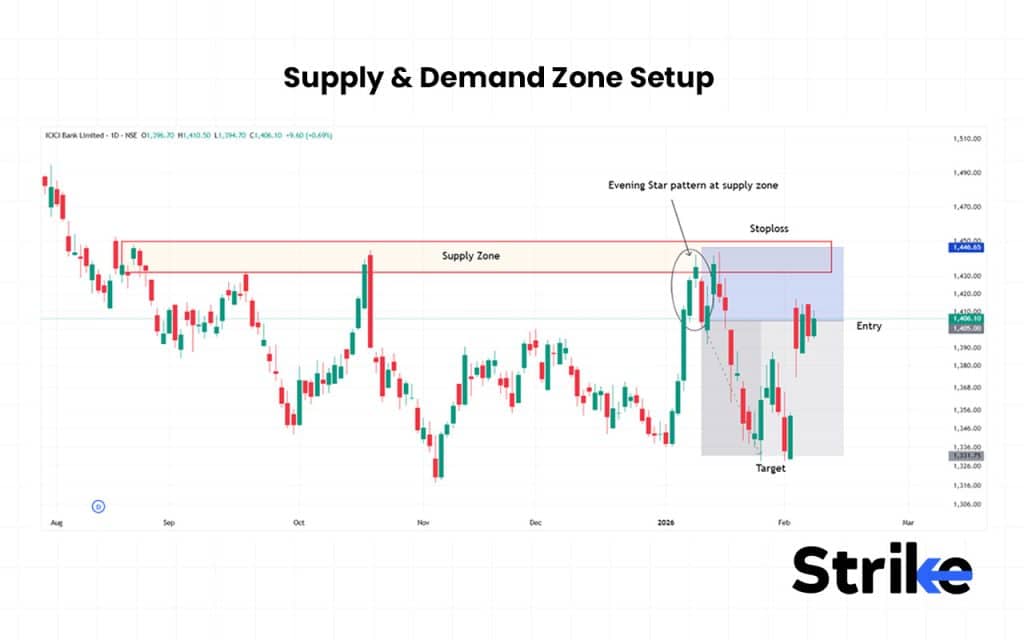
Pros and Cons of Supply & Demand Zone Setup
| Pros | Cons |
|---|---|
| Reflects real buyer–seller imbalance | Subjective zone marking |
| Clear entry and stop-loss areas | Weak zones after multiple tests |
| Works well with trend and structure | Needs multi-timeframe analysis |
| High reward potential | Fails in low-volume markets |
| Effective across asset classes | Requires experience to master |
16. Pivot Point Setup
Pivot Point setup is mostly used by short-term or intraday traders, where they use the mathematically calculated support and resistance using previous session’s price action. In this setup, the central pivot acts as a mean level, Support (S1, S2), and Resistance (R1, R2). Traders enter trade once price breaks or rebound from these support or resistance levels.
Pivot points were introduced by floor traders in 1970s-1980 to quickly identify support and resistance levels. It gained even more popularity after 2010 with the rise of electronic platforms.
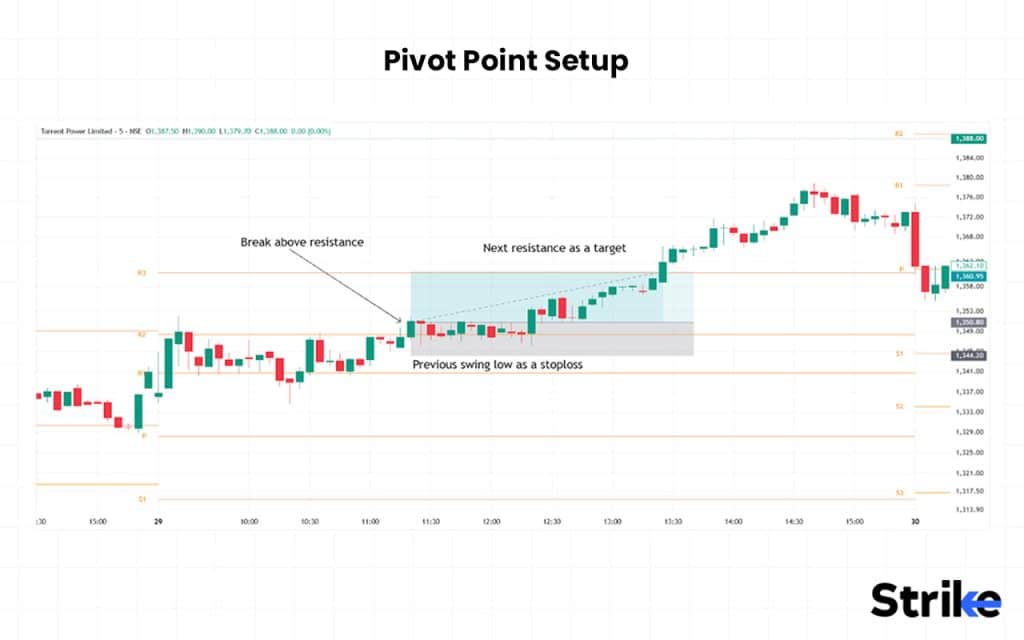
In the above chart we can see stock breaking the resistance (R2), which means stock is in uptrend. A long trade is planned after candle closes above resistance (R2) with the next resistance (R3) as a target and previous swing low as a stoploss.
Pros and Cons of Pivot Point Bounce Setup
| Pros | Cons |
|---|---|
| Objective, pre-defined levels | Weak during trending sessions |
| Popular among intraday traders | False bounces near news |
| Easy to plan trades before market opens | Needs confirmation |
| Works well with volume & RSI | Overtrading multiple pivots |
| Clear targets and stops | Limited profit potential |
17. Multi-Timeframe Confluence Setup
Multi-Timeframe Confluence Setup is a trading strategy in which traders use two or more different timeframes to identify congruent signals at the same price area. When higher timeframe trend, structure, and key levels align with lower-timeframe entry signals, the chances of success increases significantly.
The concept of multi-timeframe emerged from the classical technical analysis in 1980s-1990s and widely practised after 2000 with the advancement in charting platform.
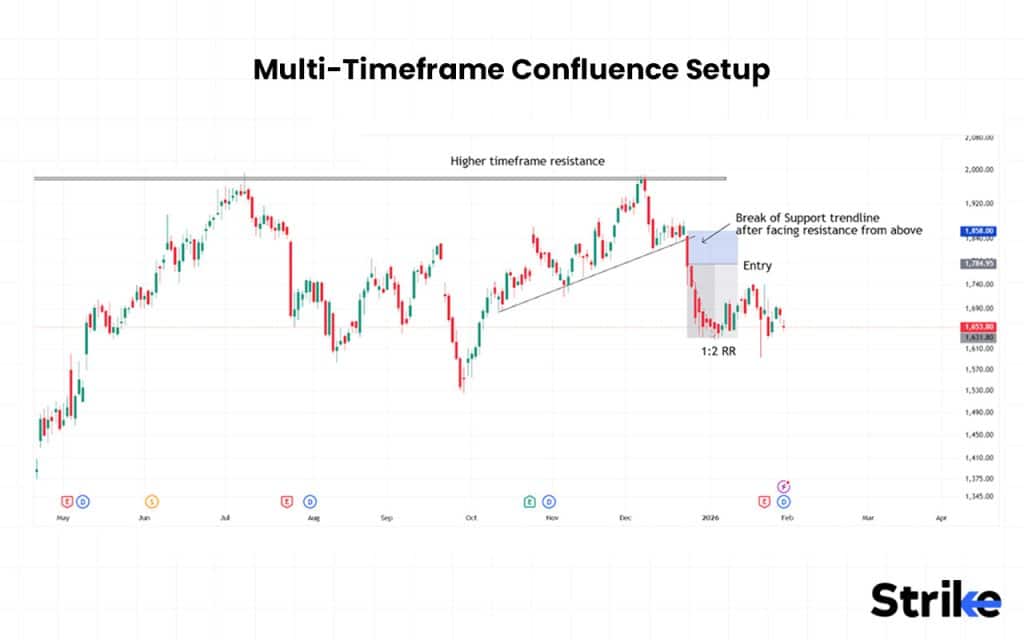
The trade taken in the above chart used two different timeframes, weekly and daily. On the weekly chart, the stock was facing a major resistance which is marked as “Higher timeframe resistance” in the image. A short trade is planned on a lower timeframe after stock broke the short-term support level. Similarly, traders can identify major levels on higher timeframe and execute trades on lower time frames.
Pros and Cons of Multi-Timeframe Confluence Setup
| Pros | Cons |
|---|---|
| Higher probability trades | Requires deeper analysis |
| Aligns with institutional perspective | Time-consuming |
| Precise entries with HTF bias | Can lead to analysis paralysis |
| Works with any strategy | Not suitable for impulsive trading |
| Improves risk–reward consistency | Requires experience and discipline |
18. Bollinger Squeeze Setup
The Bollinger squeeze is a volatility based trading setup where traders identify the period of low volatility and high volatility using Bollinger Bands. When bands contract, it signals low volatility where price is preparing for a strong directional move. Once price breaks this contraction, it gives strong directional expansion with expanding bands.
Bollinger Bands were introduced in the early 1980s by John Bolliner, while the squeeze concept gained practical popularity in the 1990s. Its use among retailers increased after 2005, with a rise in digitalization.
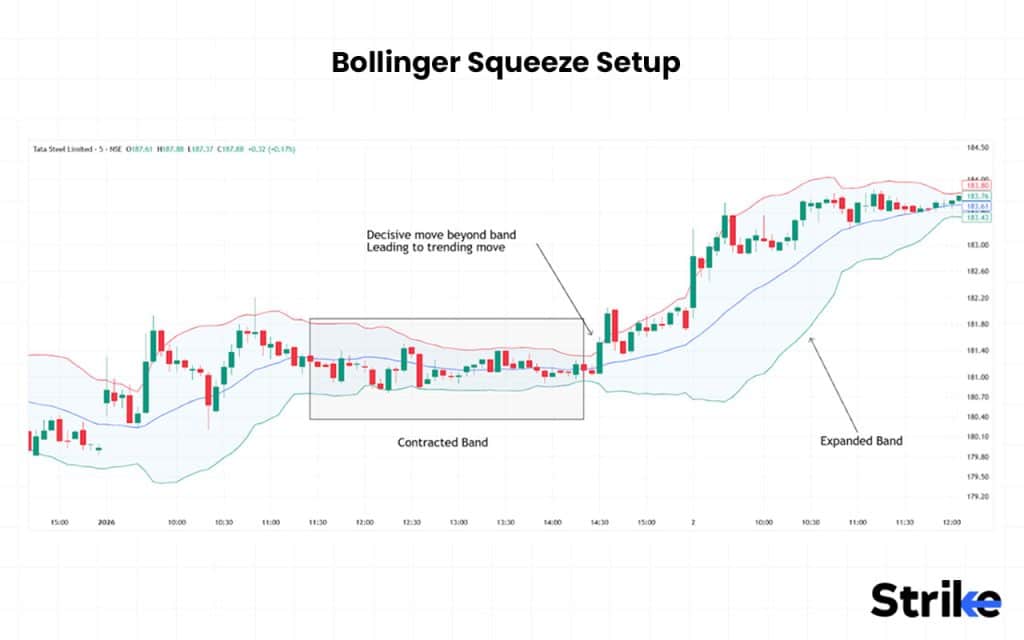
As we can clearly see in the above chart chart of Tata Steel, the stock is sideways and the bollinger band is contracted due to low volatility. Once price broke the upper range of the Bollinger Band with a strong candle, it gave a trending move with the expanding bollinger band. This indicates the rise in volatility and momentum suitable for directional traders.
Pros and Cons of Bollinger Squeeze Setup
| Pros | Cons |
|---|---|
| Identifies volatility expansion early | Direction not known in advance |
| Works well in consolidation phases | False breakouts possible |
| Clear visual structure | Needs confirmation |
| Effective across timeframes | Underperforms in choppy markets |
| Combines well with volume & trend | Requires patience |
Which Trading Setup is Best for Beginners?
Moving Average crossover setups are best for beginners and are among the most beginner-friendly Stock Market Terms to learn early. This setup allows ease of execution and trend following. The simplicity of the set-up allows new entrants to focus on discipline and risk management, avoid being overwhelmed, and establish a solid base towards trend and momentum awareness.
Which Trading Setup is Best for Day Trading?
VWAP Trading Setup is best for day trading. In intraday trading, VWAP acts as a benchmark for price value. An increase in price above VWAP accompanied by volume spike is an indication of momentum and institutional buying.
This setup provides clear entry and exit guidelines with narrow stops that are ideal during the high-frequency sessions, particularly when using a 5 to 15 minutes chart—making it a practical choice for Day Traders. It reduces the guesswork and emotions when markets move quickly.
Which Trading Setup is Best for Forex Trading?
Multi-Timeframe Confluence Setup is best for forex trading. This setup creates a high probability edge in a noisy forex market by aligning trends across multiple timeframes.
This strategy makes sure that trades are made in the direction of the strong trend, provides momentum confirmation, and enables accurate placement of the stop losses on the lower timeframe while targeting the higher timeframe movement—something a Forex Trader can use to enhance risk-reward ratios.
Which Trading Setup is Best for Stock Trading?
Pullback setup is best for stock trading, because stocks often retrace before continuing the trend, making pullbacks ideal for structured entries.
This setup allows traders to buy with a specific amount of risk—using the retracement low as the stop loss—while targeting the continuation of the trend, which is how many Best Stock Traders structure their entries. It is effective in both swing trading as well as short-term trading.
Which Trading Setup is Best for Crypto Trading?
Multi-Timeframe Confluence Setup is best for crypto trading because crypto markets are very volatile with frequent false signals. Multi-timeframe confluency helps to avoid traps and aligns trades with the larger trend, and increases the chance of winning. Both the swing and intraday crypto traders will be comfortable with this setup due to its clarity during volatility.
What Type of Instruments Needed to Build a Trading Setup?
Building a trading setup requires a combination of different instruments which includes hardware, software, data, and risk infrastructure.This helps traders to improve decision quality, execution speed, and risk control.
- Hardware Instrument: A solid trading setup requires reliable hardware, such as computers with sufficient RAM and SSD for execution, multiple screens for checking multiple data simultaneously and stable high speed internet with backup and a UPS.
- Market Access Instruments: To participate in the market, a broker with fast execution and stable platforms is required and a Demat account is required to hold the shares.
- Analytical Instruments: An instrument which helps analyse the market to make informed decisions. This includes charting platforms which allows you to draw patterns and indicators, Screeners, sector strength tools, and Open Interest data assist in identifying high-probability setups
- Risk Management Instruments: These instruments help protect capital and ensure long-term survival. Position sizing calculator helps traders to calculate risk per trade according to their positions, minimizing large losses and drawdowns. Maintaining a journal allows traders to analyze performance, identify mistakes, and improve consistency.
- Psychological & Strategic Instruments: Every professional set up has a core trading plan. It must define the rules of entry, exit and risk parameters. A pre-market preparation routine and post-market review process will enhance discipline and limit emotional decision-making.
- Advanced Instruments: Advanced traders use tools like order flow analysis, market profile, volume profile, algorithmic backtesting software or API-based execution systems. These tools allow deeper market understanding, narrowing down strategy accuracy to more professional trading activities.
A trading setup works best when every tool supports your strategy and risk control. Consistency comes from structure, not from having more tools.
Computers for Trading Setup
A proper computer for trading setup should focus on performance, stability, and screen space instead of fancy specifications. A computer should run the softwares such as trading platforms, multiple charts, scanners, Excel sheets, and browsers simultaneously and smoothly.
Given below in the table are the recommended specifications for computers to build trading setup.
| Component | Minimum Requirement | Professional Recommendation |
|---|---|---|
| Processor (CPU) | Intel Core i7 or AMD Ryzen 7 | Intel Core i9 or AMD Ryzen 9 |
| Memory (RAM) | 16 GB DDR5 | 32 GB to 64 GB |
| Storage (SSD) | 512 GB NVMe SSD | 1 TB+ PCIe Gen 5 SSD |
| Graphics (GPU) | 2 GB VRAM (Supports 2 Screens) | 8 GB+ VRAM (NVIDIA RTX 4060 or higher) |
| Internet | 10 Mbps (Wired Ethernet) | 100 Mbps+ (Hardwired Connection Preferred) |
Based on above mentioned specifications, here are some top computer models for trading setup.
| Computer / Model | Category | Key Specs | Best For Trading Setup |
|---|---|---|---|
| Dell Precision T3680 | Workstation (Maximum Power) | Intel Core i9-14900K, 32 GB DDR5 RAM, 1 TB SSD | Heavy multitasking, multiple trading platforms, advanced analytics |
| Lenovo Legion Tower 7 | Workstation (Maximum Power) | Intel Core Ultra 9 285K, Supports NVIDIA Blackwell GPUs | Ultra-powerful for multi-monitor charts, AI tools, and data feeds |
| Apple MacBook Pro M5 (2025/2026) | Laptop (Portability) | Apple M5, Long battery life, Liquid Retina XDR display | Mobile trading, premium display & performance |
| Asus ProArt P16 | Laptop (Portability) | AMD Ryzen AI 9, 64 GB RAM | High-end Windows laptop for intensive trading setups |
| CHIST Trading PC | Budget/Value Trading PC | 14-core Xeon, 4 HDMI ports | Cost-effective multi-monitor trading station |
Modern systems with discrete GPUs are useful if you run attachments, heavy overlays, or voluminous dashboards, but integrated graphics with good CPUs suffice for most trading software.
Monitors for Trading Setup
Monitors for trading setup should have high resolutions for data clarity, blue light protection for long sessions, and specialized connectivity like daisy-chaining to simplify multi-screen setups.
Given below in the tables are some best monitors to build a professional trading setup.
| Top 4K & Professional Monitors | ||||
|---|---|---|---|---|
| Model | Size | Resolution | Key Features | Best For |
| Dell UltraSharp U2725QE | 27″ | 4K (3840×2160) | 120Hz, IPS Black (3000:1 contrast), Thunderbolt 4, Daisy-chain support | High-clarity 4K trading with dual-monitor single cable setup |
| BenQ RD320U | 31.5″ | 4K | Nano Matte Panel, IPS Black, Advanced eye-care tech | Long trading hours with reduced glare & eye strain |
| Dell UltraSharp 43 (72mtc) | 42.5″ | 4K | Multi-client display (up to 4 PCs), USB-C Hub | Large workstation setup replacing 3–4 monitors |
| Ultrawide & Dual-QHD Monitors | ||||
|---|---|---|---|---|
| Model | Size | Resolution | Key Features | Best For |
| LG 49WQ95C | 49″ Curved | Dual QHD (5120×1440) | 144Hz, Built-in KVM, Type-C | Two 27” screens in one — seamless multi-chart view |
| Samsung ViewFinity S65TC | 34″ Curved | 4K UHD | 1000R curve, Thunderbolt 4 (90W), 21:9 aspect ratio | Immersive wide trading view with reduced neck strain |
| LG 38WR85QC | 38″ Curved | WQHD+ (3840×1600) | 144Hz, Extra vertical space | Viewing deep order books & multi-timeframe analysis |
| Monitor Arms & Mounting Solutions | ||||
|---|---|---|---|---|
| Model | Type | Screen Support | Key Features | Best For |
| UNIQ Mounts Quad Mount | 2×2 Stack Mount | 4 screens (13–27″) | Heavy-duty stacked layout | 4-screen professional trading desk |
| BenQ Ergo Arm BDH01 | Single Gas Spring Arm | Up to 35″ / 20kg | Reinforced plate, flexible positioning | Large single monitor setups |
| ARES WING Dual Monitor Arm | Dual Heavy-Duty Arm | 17–49″ Ultrawide | Vertical stacking, Built-in USB ports | Ultrawide or dual-monitor curved setups |
The right monitor system is not about the screen, it’s also about the readability, comfort and efficiency. With high resolution, a proper workspace and an ergonomic positioning, concentration is enhanced, fatigue is lessened and decision-making is quicker.
Softwares for Trading Setup
Trading setups rely on reliable software for charting, backtesting, and execution. The most popular softwares are mentioned below.
- Charting Platforms: TradingView is the best charting software which offers multi-timeframe analysis and Pine Script for custom indicators. The free tier is sufficient initially. A paid version unlocks more advanced features with real time NSE data.
- Backtesting Software: Amibroker, Tradetron, AlgoBulls, and TradingView Strategy Tester are some powerful backtesting softwares helps in building and backtesting strategies.
- Analytical Platforms: Strike Money, Screener, and charting are popular data providers for technical and fundamental analysis, which helps traders to make informed decisions based on data.
- Execution Platforms: Zerodha, Upstox, Fyers, Angel One, and Groww are famous discount brokers in India, with fast order execution with minimal latency and reliable performance during high‑volume trades.
Using the right combination of charting, backtesting, analytical, and execution software helps traders to plan, test, and execute setups efficiently, improving consistency, decision-making, and overall trading performance.
What is the Cost of Building a Trade Setup?
The cost of building a trading setup totally depends on whether you are a beginner, intermediate trader, or a professional. The table given below is the budget breakdowns of components required to build all kinds of trading setup.
| Tier | Components Included | Total Cost (₹) | Best For |
|---|---|---|---|
| Budget Setup | i3 PC with 16GB RAM, 1× 24″ monitor, basic desk, stable internet connection | ₹45,000 – ₹80,000 | Entry-level traders, basic screening and chart analysis |
| Mid-Range Setup | Ryzen 5 / i5 PC with 32GB RAM, 2–3× 27″ QHD monitors, ergonomic chair, UPS backup | ₹80,000 – ₹1.5 Lakh | Technical analysis, Smart Money Concepts, backtesting |
| Pro Setup | i7 / Ryzen 7 with 32GB+ RAM, 4× monitors with mounts, custom trading desk | ₹1.5 Lakh – ₹3 Lakh+ | Quant trading, Python backtesting, multi-asset trading |
A peripheral expense or ongoing expense includes Desk/chair about ₹10k–30k; UPS about ₹5k–10k and ergonomic keyboard/mouse about ₹2k–5k.
How to find the Best Trading Setup for You?
Finding the best trading setup for you is less about copying others’ setup and more about matching the setup to your psychology, capital, and time. Following are the three major steps to follow for finding the best trading setup for you.
- Assess Your Profile: You need to know how much time you can give to the market (intraday or swing), your capital base (small capital is better in swing or option buying), and risk tolerance.
- Match the Trading Style: Select the type of style that best suits your personality, choosing intraday if you have time to follow the market closely using a specific Intraday Trading Indicator. While mastering an Intraday Trading Indicator is essential for fast-paced markets, you might prefer swing trading or buying options when you have less time or less capital.
- Test and Refine: Experiment with setups on paper or small positions, monitor results, and change rules. The most optimal arrangement conforms to your mindset, resources, and way of life and offers a reproducible competitive advantage in the market.
By following these steps, you can develop a trading setup that fits your strengths, manages risk effectively, and provides a consistent, repeatable edge in the markets.
Do You Need a Trading Setup to Start Trading?
Yes, you require a trading setup to start trading. Without a setup, trading becomes emotional and arbitrary because of either fear, greed, or market noise. The trading setup provides you with definite entry, exit, stop loss and risk reward rules, and can help you to take control of the losses and trade continuously.
Even a basic system that is constructed on price action, trend, and one or two indicators suffices to start with since structure is more important when starting than complexity.
Why do Traders Need a Trading Setup?
Traders need a trading setup to remove the emotional guesses with structured and repeatable rules which increases consistency and gives high probability trades.
- Removes Emotions: Rules keep out the fear/greed-induced entries/exits requiring discipline in making uniform decisions.
- Defines Risk-Reward: A clear entry/stop/target (e.g. 1:2 ratio) will guard capital, you want to win more than 55 percent in your backtest interests.
- Filters High-Probability Trades: Stationary High-Probability Trades: Trend + volume + momentum crossovers + RSI divergence increases the likelihood of success.
- Enables Backtesting: Backtest configurations using historical data (e.g. TradingView Nifty 15M) to test edge with live trading.
A well-defined trading setup turns trading into a disciplined, data-driven process, reduces emotional errors, and increases the chances of consistent, high-probability profits over the long term.
What Are the Key Components of a Good Trading Setup?
There are five major key components of a good trading setup. The key components are market context, defined entry logic, stoploss and risk management.
- Clear market context: A good trading setup has a clearly defined market structure, indicating market trends such as uptrend, downtrend or range bound market. Trading without setup is just a reaction not a planning.
- Defined Entry Logic: There should be repeatable reasons behind entering every trade, which could be break of structure, pullback in trend, liquidity sweep, support and resistance. If you don’t have clear logic behind the entry, it’s not a perfect setup.
- Logical Stoploss and Risk-Reward: Stoploss should not be random, a good setup has a well defined logical stoploss and favorable risk-reward. A stoploss should be placed beyond structural level or key level.
- Confluence and Risk Management: Along with good analysis and perfect stoploss, position sizing and discipline plays an important role in capital protection.
A good trading setup is not about finding more trade, it is about executing high probability trades with clear market structure, proper entry and exit, and market confluence.
Which Indicators Works Best for Trade Setups
No single indicator works best for all trade setups because the effectiveness of indicators depends on the style of trading such as intraday, swing, or options. Usually traders combine the different indicators like EMA for trend, RSI and MACD for momentum and volume for confirmation to increase the reliability of indicator based trading.
Here are top 5 indicators commonly used in trading setup
| Indicator | Best For | Why Effective |
|---|---|---|
| EMA (9 / 20 / 50) | Trend setups, crossovers | Acts as dynamic support & resistance. The 9–20–50–200 EMA combination reliably filters trend direction and improves entry timing in trending markets. |
| RSI (14) | Momentum, divergences | Identifies momentum, strength and exhaustion. Highly effective in patterns like Double Tops/Bottoms. |
| MACD (12, 26, 9) | Crossovers, reversals | Confirms momentum shifts and breakout strength. Works best when aligned with EMA trends, especially useful for lower-circuit and early reversal detection. |
| Volume | Breakouts, confirmation | Validates price moves by measuring participation. Breakouts with volume above 150% of average significantly reduce false signals and improve reliability. |
| Bollinger Bands | Volatility breakouts | Identifies volatility contraction and expansion. Narrow bands followed by MACD confirmation often precede strong directional moves, especially in indices and midcaps. |
Traders use the above-mentioned indicators in combination to filter high-probability setups, confirm trends and momentum, validate breakouts, and improve timing, making their trades more reliable and consistent.
What makes a Trading Setup High Probability?
There are six major factors of high probability setup. The factors are market context, confluence, clear risk to reward, volume, alignment with higher timeframe, and statistical validation.
- Market Context: A setup is most powerful when it aligns with the prevailing market trend, range, or volatility expansion. Trading against the trend increases the probability of failure.
- Confluence: High-probability trades types are the ones that combine various conditions, e.g., price activity at the support/resistance with indicators like EMA, RSI, or VWAP.
- Clear Risk–Reward: Each trade should have a specified reward which is 1.5 to 2 times the risk. This makes it profitable even where the win rates are moderate.
- Volume & Participation: High volume is an indicator of institutional participation. The absence of volume breakouts or reversals usually catches traders off guard.
- Higher-Timeframe Alignment: The entries made on lower timeframes are more successful when the entries are in the trend or the key levels of the higher timeframe.
- Statistical Validation: An arrangement must be supported with data- 50 percent or more win rate or profit ratio more than 1.5 on a significant sample number.
When these elements consistently work together and are validated by data, the setup delivers repeatable results and long-term trading consistency.
Do Trade Setups work on All Timeframes?
Yes, the core principle of trading setup and technical analysis works across all the timeframes due to the fractal nature of the market. However, the effectiveness and reliability of trade setup do not work equally across all the timeframes due to noise, volatility and liquidity differences.
The table below shows that the lower timeframe trading setup has low winrate due to market noise, whereas higher timeframe trading setup has a higher winrate.
| Timeframe | Typical Win Rate | Trades / Month | Best For |
|---|---|---|---|
| 1–5 min | 40–50% | 200+ | Scalping (high volatility) |
| 15 min – 1H | 50–60% | 50–100 | Day trading |
| 4H – Daily | 55–70% | 10–30 | Swing & positional trading |
While trade setups fundamentally work on all timeframes, they are most effective when applied within the context of the broader market trend seen on higher timeframes.
How Do You Build a Trading Setup from Scratch?
Building a trading setup from scratch requires defining clear rules across entry, exit, risk management, and filters based on your timeframe and market (e.g., Nifty futures). Here are three major steps to follow to build trading setups from scratch.
Choose Core Concept
Choose the trading style you like, such as trend-following (EMA crossovers), mean reversion (RSI extremes), or breakouts (support/resistance).
Define Components
After selecting your trading style, define how you will enter, exit, stop loss and target.
- Entry: Define exact entry condition, such as entering a long after a engulfing candle post pullback or price closes above 20EMA and RSI is greater than 50.
- Stop Loss: Manage a downside risk using a stop below a recent swing low. The maintenance of risk at 0.5-1R means that the loss is minimal and is specified in case of a failed trade.
- Target: Pre-sets the profit target. A preset 2R target will ensure favorable risk-to-reward, whereas a trailing stop of the 50 EMA will enable profits to be collected in good trends.
- Filters: Prevent poor conditions of trade. A participation of higher than average volume is confirmation and ADX at above 25 is guarantee of taking trades in trending markets.
Backtest & Refine
Apply manual or automated backtesting on 5-10 years data, tracking 100+ trades minimum. Refine based on metrics like profit factor >1.5 and drawdown <20%.
A well-built trading setup provides clarity, controls risk, and creates a repeatable edge, helping traders achieve consistency and long-term sustainability in the markets.
How to Backtest a Trading Setup
There are five major steps to backtest the trading setups. The steps involve defining a trading setup, collecting historical data, doing backtesting using either manual or automated way, analyzing the key metrics, and optimization.
- Define trading setup: Start with defining the trading rules, such as instrument, entry/exit criteria, risk per trade, timeframe, and position sizing.
- Collect Historical Data: Collect the historical data of the last 5-10 years from the authentic sites, such as TradingView or NSE. Make sure to adjust the corporate actions on stocks.
- Manual Backtesting: It involves backtesting the setup by scrolling chart candle by candle, ideal for visual setups, such as order block or gaps. It is a slower process but builds a deep market understanding.
- Automated Backtesting: It involves use of programming languages such as pinscript or python. It is ideal for rule based trading setups and is a faster way for backtesting. The common platforms used involve Excel, Amibroker, TradingView, Python, etc.
- Analyze Key Metrics: Analyze the key metrics mentioned below in the table.
| Metric | Description | Ideal Target |
|---|---|---|
| Win Rate | Percentage of profitable trades | > 50% with favorable risk–reward |
| Profit Factor | Total gross profit ÷ total gross loss | > 1.5 |
| Maximum Drawdown | Largest peak-to-trough equity decline | < 20% |
| Sharpe Ratio | Risk-adjusted return per unit of volatility | > 1.0 |
| Expectancy | (Average Win × Win %) − (Average Loss × Loss %) | Positive |
A good trading strategy follows all the key metrics mentioned above in the table.
- Optimization: Tweak the parameters in your setup if the setup does not follow the above given key metrics. It is important not to do curve fitting and excessive parameter tweaking.
Proper backtesting validates a trading setup with data, builds trader confidence, and ensures decisions are based on logic rather than assumptions, forming the foundation for consistent and disciplined trading.

 21 mins