




Technical analysis is a discipline used in the financial market to evaluate a stock by studying its price and volume.. Technical analysis is used as a method for evaluating price movements and identifying an edge in financial instruments like stocks, bonds, currencies, and commodities. Technical analysis believes that all the fundamental information about a company is factored into the price itself. Fundamental analysis differs from technical analysis. In technical analysis, price movements within a stock act as a valuable indicator which helps in predicting the stock’s future price movements. Technical analysis helps analysts find opportunities by identifying repetitive price patterns. Technical analysts use price charts and technical indicators to make their trading decisions.
Technical analysis originated in the late 17th century in Japan.. Japanese traders used it to evaluate the price movements of rice in the rice market. The modern form of technical analysis that we know today was first introduced by Charles Dow in the late 18th century.
Technical analysis can potentially predict the future price movements of any instrument that is influenced by the forces of demand and supply. It is based on the assumption that market trends and price patterns occur in a repetitive cycle. Technical analysts use the information along with technical indicators to identify trading opportunities.
Firstly, a trader will have to choose a type of price chart he is familiar with. Here, we are using a candlestick chart since it is the most popular chart in technical analysis. A trader can then use a Hundreds Of technical patterns and indicators such as trend lines, volume, and RSI (Relative Strength Index) to identify an edge in the markets.
What is a Technical Analysis Explain?
Technical analysis is a method used for evaluating and identifying potential trading opportunities by analysing previous price data. Technical analysis studies a trading instrument with the combination of a price chart and technical indicators. It can be used to analyse any tradable security that has been traded previously or has a trading history.
Technical analysts believe that previous price data for stock plays a crucial role in predicting its future price movements. Following are three of the basics of technical analysis every trader should know:
- Price – Technical analysts believe that the movement of the price reveals all the fundamental information about the stock and the overall sentiment of market participants. Analysts also use price charts to identify repetitive patterns in a stock. Price is the leading indicator of technical analysis, and everything else is dependent on it.
- Technical indicators – Technical indicators are mathematical models based on data such as the price, momentum, and volume of a stock. Analysts use these indicators to analyse current market mood, support and resistance levels, and the overall strength of the market.
- Trading timeframe – A trading timeframe is the time period in which a trader analyses a stock and makes trading decisions. Trading time frames range from 1 minute to 1 year. Short-term traders use intraday time frames such as 5-or 15-minute charts, while long-term traders can use an hourly or daily chart.
Technical analysts believe that market movements are not random and that the price moves in a repetitive fashion. Technical analysis can provide valuable insights into the market with the help of charts and technical indicators. It helps readers identify repetitive price patterns and make informed trading decisions.
What is the background History of Technical Analysis?
The history of technical analysis dates back to the late 17th century. The history of technical analysis begins with the country of Japan. Japanese traders started using price charts and patterns for analysing the price of rise in the late 1700s. In the late 1700s, Japanese traders found a method for analysing the price of rice using price charts and patterns.
Charles Dow published editorials which analyzed the stock markets based on just price movements on the wall street journal in the late 18th century. It included identifying market trends and using price patterns to buy and sell securities. People like Ralph Nelson Elliot and Richard Wyckoff further developed Dow’s methodology. Analysts in the Western world started accepting and using technical analysis broadly in the 1940s and 1950s.
In Asia, Homma Munehisa is said to be the father of technical analysis who developed this method of analyzing the capital markets in the early 18th century. His method later evolved into the use of candlestick techniques, which we all use today. In the late 18th century, Charles Dow started publishing editorials that analysed the stock markets based on just price movements on the Wall Street Journal. It included identifying market trends and using price patterns to buy and sell securities.
Later, another list of pioneers who gained popularity for their methods includes the name of people like William Delbert Gann, a popular analyst who co-related astrology with the repetitive patterns of the market in the early 20th century.
People like Ralph Nelson Elliot and Richard Wyckoff further developed Dow’s methodology. Analysts in the Western world started accepting and using technical analysis broadly in the 1940s and 1950s.
How does Technical Analysis function?
Technical analysis functions by filtering the behaviour of market participants into predictable price patterns. filters the behaviour of market participants into predictable price patterns. Technical analysis works by forecasting the future price movement of any tradable asset, which is influenced by the forces of demand and supply. Technical analysts often use it with a combination of chart patterns and technical indicators to find tradable opportunities in the market.
Technical analysis has gained much popularity in recent decades and now plays a huge role in terms of trading the markets in the short-term as well as the mid-term. It is important for traders because it lets them analyse and understand the collective psychology of market participants. Technical analysis also helps traders manage their risk by providing clear entry and exit signals. It provides a huge set of price data, which lets traders make informed trading decisions.
Technical analysts use tools like price charts, chart patterns and technical indicators to analyze the stock markets. These tools help them analyze critical price levels and open up potential trade opportunities.
The sole purpose of technical analysis is to analyse past price and volume data of stock to identify future trading opportunities. Technical analysts aim to make profit from the repetitive price patterns of a stock by analysing previous price and volume data.By analysing previous price and volume data, technical analysts aim to make a profit from the repetitive price patterns of a stock.
How to use Technical Analysis in the Stock Market?
Technical analysis is used in the stock market to analyse the historical data of a stock to identify any tradable opportunities in the future. Technical analysis of the stock market requires analysing a stock’s price chart with technical indicators. Here’s how you can use technical analysis to analyse a stock in 5 simple steps –
- Choose a stock – The first step in using technical analysis in the stock market is to choose the stock you want to trade. It is recommended to choose a stock that has high liquidity.
- Choose one type of price chart – There are multiple options when it comes to the types of price charts traders use for analysing the market.For example, charting platforms include price charts such as bar chart, candlestick chart, line chart, etc. Select any type of price chart that you understand well.
- Choose your trading timeframe – Choose intraday trading time frames like a 5-minute chart or a 15-minute chart if you want to enter and exit from a stock on the same day. You can also choose hourly or daily time frames if you want to hold the stock for multiple days.If you want to enter and exit from a stock on the same day, then choose intraday trading time frames like a 5-minute chart or a 15-minute chart. If you want to hold the stock for multiple days, you can also choose hourly or daily timeframes.
- Analyse the price chart – Start analysing the historical price patterns of the stock with the help of technical indicators like Volume, RSI or MACD. Identify and mark the support and resistance levels of the stock.
- Identify any potential trading opportunities – Observe and see if the indicators you are using are generating any trading signals or if the price is trying to break the support or resistance level you have marked. You can start placing a trade and set your take profit and stop loss levels once the price breaks a crucial level on the price chart.If the price is breaking a crucial level on the chart, you can start placing a trade as well as set your take profit and stop loss levels.
One must note that to improve the accuracy of your analysis, you must take 2-3 factors into consideration before placing a trade. This can be a signal from a technical indicator when the price is breaking a crucial level on the chart. You should also have a stop-loss in place in order to manage your risk effectively.
What are the Different Types of Charts for Technical Analysis?
Charts are one of the most crucial parts of technical analysis. A chart helps a trader track the price of any security. It further helps them in analysing the movement of prices and identifying potential trading opportunities in the market. These 4 types of charts are the most commonly used price charts in technical analysis.
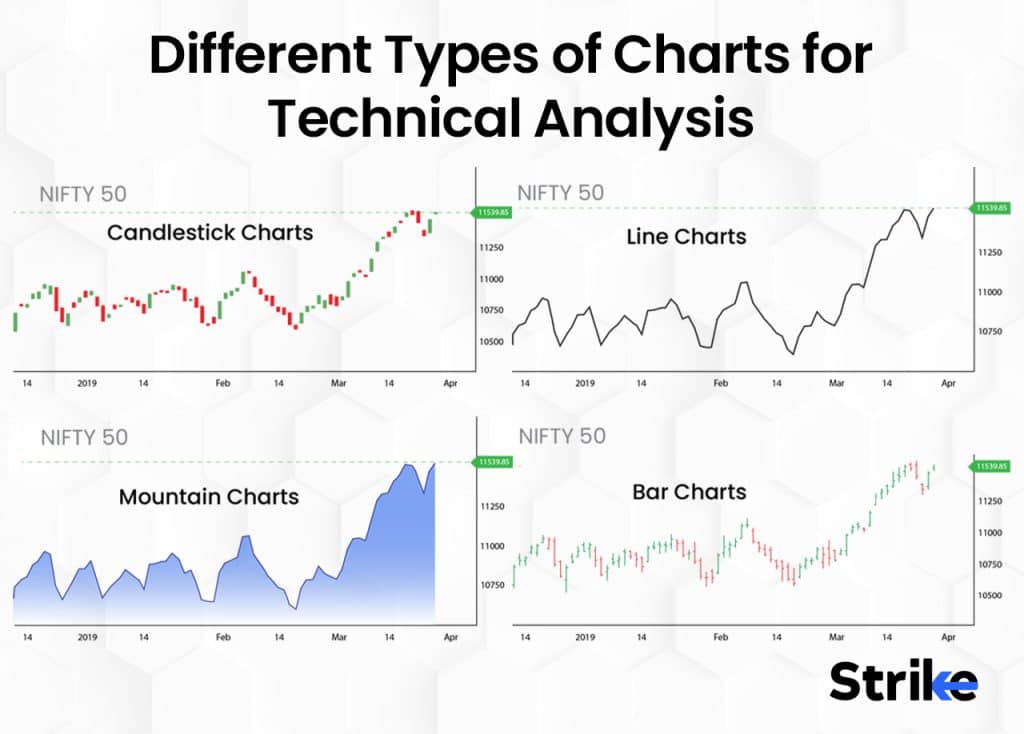
Following are the four types of charts that are most commonly used in technical analysis.
- Line Chart –
A line chart is the most basic chart pattern in technical analysis and has been used since the 18th century. A line chart only shows the closing price of a stock, future or commodity and is majorly used on a daily time frame. It represents the price of a stock with a single continuous line. It helps reduce the additional clutter from the chart and makes it easier for a trader to spot the market trend.
Line charts are fairly easy to read as they only plot the closing price of a stock. They clear out the short-term noise from the market and make it very easy for a trader to spot the crucial support and resistance levels on the chart.
You will have to choose a stock you want to trade and a trading time frame you are comfortable with in order to use line charts more effectively. In order to use line charts effectively, you will first have to choose a stock you want to trade and a trading time frame you are comfortable with. You can then use line charts to spot market trends and price patterns with ease. This chart is best suited for beginners because of its neatness.
- Candlestick chart –
Candlestick charts are the most popular types of price charts in technical analysis. A candlestick chart is made up of individual candles that shows the open, high, close, and low prices over a period of time. It was first used in the 18th century in Japan and later popularised in the Western world by Steve Nison’s book “Japanese Candlestick Charting Techniques,” which he wrote in 1991.
Candlestick charts are popular because they are easy to understand as well as easy to read. It is very simple to mark and identify support or resistance and spot market trends on this chart. A green candle shows that the price is rising, while a red candle shows that the price is falling. The opening price in this chart starts at the bottom of the candle’s body and closes at the top if the candle is green.
And the opening price starts at the top of the candle’s body and closes at the bottom if the candle is red. If the candle is green, the opening price starts at the bottom of the candle’s body and closes at the top. If the candle is red, the opening price starts at the top of the candle’s body and closes at the bottom.
The wicks or shadows at the top and bottom resemble the maximum price high and minimum price low of the stock, respectively. There are candlestick numerous multiple candlestick patterns, which indicates potential trading opportunities.
You can use candlestick charts by learning more about patterns. You can also use these patterns in combination with various technical indicators to enhance the accuracy of your analysis.
- Point and Figure Chart –
The point and figure charts show the price movements of an asset’s price, and unlike other charts, they are not bounded by time factors. The point and figure charts plot an X when the price rises by a set amount and an O when the price falls. This charting method was developed in the 18th century by Charles Dow. The point and figure chart has less noise and clutter compared to other charts, and hence, the chances of a fake breakout on this chart are very low.
A trader needs to set a box size limit that will determine the minimum price change in the asset require to add a new X or O in this price chart. In this chart, a trader needs to set a box size limit, which will determine the minimum price change in the asset required to add a new X or O in the chart. These X’s and O’s often form on each other, creating a full column of X’s or O’s. A trader will have to set a reversal amount on this chart for a reversal to happen. For a reversal to happen on this chart, a trader will first have to set a reversal amount. It is typically 3x of the box size.
For example, a reversal will occur when the price moves at least 30 rs or 3 box sizes against the established trend if the box size limit set up by the trader is rs 10.Meaning, if the box size limit set up by a trader is 10 rs, a reversal will occur when the price moves at least 30 rs or 3 box sizes against the established trend.
Traders can use point and figure charts to identify potential trend opportunities. They can also use this charting method for marking support and resistance and trading breakouts or reversals.
- Open-high-low-close Chart –
An OHLC chart is a type of bar chart that shows the open, high, low, and close of an asset’s price over a period of time. The OHLC chart is one of the oldest and most common price charts used in the market. Initially, traders drew this chart by hand. Initially, traders used to draw this chart by hand.
OHLC charts are used to analyse the momentum of a stock. It signals strong momentum when the open and close of a price bar is apart from each other. And signals weak momentum when the open and close of a price is close to each other. When the open and close of a price bar are apart from each other, it signals strong momentum. And when the open and close of a price are close to each other, the momentum in a stock is considered to be weak.
The price rise in this chart is shown in green, and the price fall is shown in red.
One bar in the OHLC chart is made up of a vertical line with two short horizontal lines on each of its sides. The horizontal line on the left represents the opening price of the bar, while the horizontal line on the right represents the closing price. This charting method can be applied to any trading timeframe just like candlestick charts. Just like candlestick charts, this charting method can be applied to any trading timeframe.
Traders can use this chart to take potential trades when they see patterns like inside bar and outside bar unfolding. They can also use this chart with a combination of technical indicators to enhance the accuracy of their analysis.
Which types of Chart are commonly used in Technical Analysis?
The type of chart which is most commonly used in technical analysis is candlestick price charts. Candlestick charts are the most popular type of technical chart analysis. The candlestick chart was first used by Japanese traders to analyse and evaluate the price of rice futures in the early 18th century. Later, Steve Nison’s book “Japanese Candlestick Charting Techniques” popularised the candlestick chart in the western world in 1991.
What are the different indicators used in Technical Analysis?
Technical analysts use a variety of different technical analysis indicators. Analysts use various types of technical indicators to gain insights of the markets. Different types of indicators help analysts analyse price trends and get insights into the market. Here are four of the most common types of indicators used in technical analysis:
- Breadth Indicators
A breadth indicator helps a trader analyse the overall health of the market or a market sector. Breadth indicators also help a trader identify the major market trend by measuring the total number of rising and declining stocks.
The reading of this indicator is based on the number of stocks moving in the same direction as the market versus the number of stocks that are moving against the market. Meaning, the breadth indicator will show a positive reading only when the majority of stocks are moving in the same direction as the overall market and vice versa.
Meaning, if the majority of stocks are moving in the same direction as the market, then the breadth indicator will show a positive reading, and vice versa. Here are the 3 examples of breadth indicators. Following are three examples of breadth indicators –
- Advance-Decline line: The advance-decline line is a breadth indicator that measures the total number of stocks rising or falling in a particular sector or the overall market. The value of this indicator is calculated by subtracting the total number of stocks falling from the total number of stocks rising.
- Percentage of stocks above the moving averages: This indicator is used to identify the percentage of stocks in a market or sector that are trading above the level of their moving averages.
- McClellan Oscillator: The McClellan oscillator uses the difference between moving averages to determine the buying and selling pressure on a stock. It is often used to identify overbought and oversold conditions.
Breadth indicators provide traders with insights into the overall strength of the market. However, one must also note that these types of indicators are effective when the markets are volatile and other types of indicators, such as price-based indicators, are not providing clear signals.
- Price-Based Indicators
Price-based indicators are technical tools that generate trading signals by analysing the price action of a stock. Price-based indicators are the most popular types of indicators in technical analysis. These indicators use historical price data for a stock to identify market trends and generate trading signals. Here following are 3three examples of price-based indicators .–
- Moving Average: Moving averages are used to identify the trend of a stock. They are calculated by taking the average price of a stock over a certain period. It generates buy or sell signals whenever the price crosses the moving average.
- RSI (Relative Strength Index): The RSI or Relative Strength Index, is a price-based indicator used to identify the overall strength of a trend by comparing the average gains and losses of a stock over a certain period. It is plotted between a range of 1-100. RSI above 70 indicates that the market is overbought, while RSI below 30 shows that the market is oversold.
- Bollinger Bands: Bollinger bands consist of a moving average and two standard deviations that create a band around the price on a chart. It is expected that the price will return to its mean whenever the price breaks above or below the Bollinger Band indicator. Whenever the price breaks above or below the Bollinger band, it is expected that the price will return to its mean, which is the moving average.
Price-based indicators are used by the majority of traders due to their effective and clear trading signals. However, it is important to use these indicators with a combination of other indicators to increase the overall accuracy of your analysis.
- Volume-Based Indicators
Volume-based indicators are the type of technical indicators that use the volume data of a stock to identify momentum and price reversals. Volume-based indicators help traders get a sense of the strength of conviction behind advances and declines in stocks. These indicators are widely used by traders to make informed trading decisions. Here are 3 examples of volume based-indicators. Following are three examples of volume-based indicators –
- On-Balance volume (OBV): On-balance volume determines whether the market is dominated by buyers or sellers by analysing the total volume of a stock. This helps a trader figure out the overall strength of a trend.
- Chaikin Money Flow (CMF): Chaikin money flow is a volume-based indicator that uses price as well as volume data to identify the total strength of a trend. CMF uses a proprietary formula to identify whether the market is dominated by buyers or sellers.
- Volume Weighted Average Price (VWAP): Volume-weighted average price calculates the average price of a stock over a certain period, weighted by the total volume for each price level. This indicator is also used by traders to identify support or resistance levels on a price chart.
Volume-based indicators are effective in identifying changes in momentum and potential price reversals in the market. Hence, these indicators are widely used by traders to make informed trading decisions.
- Trading with Mixing Indicators –
Trading with mixed indicators is a method traders use to increase the effectiveness of their analysis. Trading with mixed indicators lets a trader benefit from the strengths of different types of indicators and overcome their individual weaknesses.
For example, a trader can use volume-based indicators and combine them with price-based indicators. Volume-based indicators help a trader identify the strength of the market trend, while price-based indicators generate potential trading opportunities. Indicators such as on-balance volume can confirm the trend, while a price-based indicator such as MACD (Moving Average Convergence Divergence) can be used to spot price reversals.
A trader should not overload his/her price chart with a load of indicators while mixing indicators. While mixing indicators, a trader should not overload his or her price chart with multiple indicators. This can cause analytical paralysis. Instead, a trader should use a maximum of 2-3 effective technical tools that go well together.
It should be noted that every type of technical analysis indicator is liable to generate false signals and traders should be very careful while taking trades. Effective risk management with a profitable trading method is the most effective way to trade the markets.
Which Technical Indicators are commonly used for Technical Analysis?
Technical indicators are commonly used by the majority of traders to analyse and find better opportunities in the market. Technical indicators analyse historical price data of stock to generate trading signals. Following is a list of 3 of the most common technical indicators used in technical analysis. Following are 3 of the most common technical indicators used in technical analysis –
- Moving average: A moving average calculates the average price of a stock over a set period of time. Traders use this average price to determine support/resistance and breakout/breakdown levels. A moving average is plotted with the price.
Richard Wyckoff used the moving average for the first time in finance in the early 20th century. The formula used for calculating a simple moving average (SMA) is –
SMA = (Sum of closing prices over the last n periods) / n
- Relative strength index (RSI): A relative strength index is an oscillator that primarily tracks the momentum of a stock. The RSI oscillates between a range of 0 and 100. A stock is considered overbought when the RSI is above 70 and oversold when it is below 30.
J. Welles Wilder Jr. first introduced RSI in his 1978 book, “New Concepts in Technical Trading Systems.” The formula for calculating RSI is –
RSI = 100-(100/1+RS))
- Fibonacci retracement: The Fibonacci retracement is used to identify the potential support and resistance levels of stock. The retracement tool is based on the principle that the retracement of stock prices can be predicted. It is named after Leonardo Fibonacci, a famous Italian mathematician.
The Fibonacci retracement is drawn by selecting two extreme points on a price chart from bottom to top. The levels of Fibonacci that traders emphasise more are 38.2%, 50%, and 61.8%.
Technical analysis uses many tools to predict future price movements by analysing historical data. Indicators like Moving Average, RSI and Fibonacci Retracement are some of the most commonly used indicators used by traders worldwide.
What is Overlay in Technical Analysis?
An overlay indicator is a secondary indicator or an indicator that is overlaid on top of a price chart. An overlay indicator is used to identify market trends and support/resistance levels. Overlay indicators provide additional information to the traders for identifying potential trade opportunities from the market.
Overlay indicators are types of indicators that are plotted on the chart or overlay on the price chart. An overlay indicator is used to identify market trends and support/resistance levels. Traders also use these types of indicators for identifying potential buy or sell signals in the market.
Overlay indicators are often used in conjunction with additional technical tools to enhance the quality of analysis done on a price chart. Most common examples Some examples of overlay indicators are Moving Average, Bollinger Bands and Ichimoku Cloud.
What is an Oscillator in Technical Analysis?
Oscillators are the type of indicators that are used for identifying overbought and oversold zones of stock. Oscillators measure the momentum and strength of the trend in a stock. These indicators are located above or below the price chart.
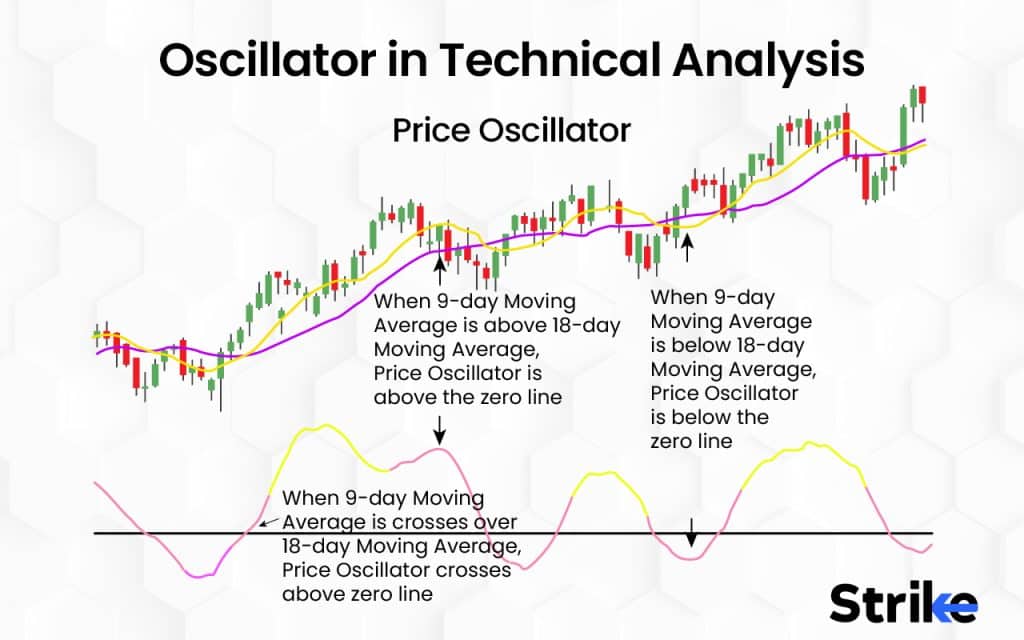
Oscillators move in ranges like 0 to 100 or -100 to 100. Higher oscillator readings suggest that the stock is overbought while lower readings suggest that the stock is oversold. Examples of oscillator indicators are Relative Strength Index (RSI) and Moving Average Convergence Divergence (MACD).
What are examples of Technical Analysis?
Performing technical analysis requires both theoretical knowledge and practical application. You will have to get your basics clear about technical knowledge and know a few things about price charts, technical indicators, price patterns, trendlines, etc. Following image shows a demonstration of how to do technical analysis on a price chart. Following is an example of how to do a technical analysis of a price chart –
Firstly, choose the chart type of your preference. We have chosen the candlestick chart as it is the most common price chart among traders.In the example above, we have chosen the candlestick chart as it is the most common price chart used among traders. Then you will have to select your trading timeframe.
Again, you can choose any time frame that suits your trading style. You can also plot a technical indicator of your choice for identifying trading signals. Now start by observing the price chart and asking yourself questions like, “ Do I see a familiar chart pattern or a trendline?” or “ Is the technical indicator generating any trading signals?”
Technical analysis can seem overwhelming at the start, but as you practice, you will get used to drawing patterns and identifying potential trading opportunities.
How do Investors use Technical Analysis in Investment?
Investors use technical analysis for investing for reasons such as better entry or exit or to identify the overall market trend. Traders and investors use technical analysis to analyse and evaluate stocks just by analysing their price charts. Technical analysis only requires the study of price and volume.
Unlike fundamental analysis, technical analysis only requires the study of price and volume. It believes that all the fundamental information about a company, such as earnings and sales, is already factored into the price chart of a stock. Here are 3 steps every investor should follow while using technical analysis.
Here are three steps investors should follow while using technical analysis for investing –
- Choose a stock: Investors choose companies that have better fundamentals compared to other companies in the market.
- Choose your timeframe: Investors hold their stocks for years. This is why most of them analyse the price chart of a stock on longer time frames, such as monthly or weekly charts.
- Make entry/exit plans: Investors use technical charts to make better entry or exit plans. They will use technical levels to set up their take-profit level as well as their stop-loss level.
One must note that investors do a lot of analysis and research before they invest their capital in the stock market. Investors consider a lot of parameters, and technical analysis is just one of them.
What are the methods of Technical Analysis?
Technical analysts use a variety of methods of technical analysis. These methods help traders get valuable insights and identify potential trading opportunities in the market. The following are 4 major methods that technical analysts use.
- Trend analysis: Trend analysis is the study of identifying the trend of a stock or the overall market. Charles Dow introduced the concept of trend analysis. He believed that the market has three trends – the primary trend, the secondary trend, and the minor trend. This method of technical analysis involves the use of multiple technical indicators to identify the direction of the overall market trend.
- Chart patterns: Chart patterns, or price patterns, are specific patterns that form on the chart and help a trader identify the future movement of the price. Charles Dow introduced the concept of chart patterns in the late 19th century. Chart patterns are of two types – continuation chart patterns and reversal chart patterns. Most common some examples of chart patterns are the Head and Shoulders pattern, the Double Top and the Double Bottom pattern.
- Technical indicators: Technical indicators are mathematical calculations used to analyse the historical and current price data of a stock to predict its future price movements. Traders believe past data on stock can give valuable insights about its future price movement. The origins of technical indicators can be traced back to the early 20th century when Charles Dow introduced the Dow theory. Most popular exmaplesSome of examples of technical indicators include the Relative Strength Index (RSI), Moving average, Moving Average Convergence Divergence (MACD) and Volume.
- Elliott wave analysis: Elliott wave analysis is a form of analysis that attempts to predict market price movements in waves. This theory believes that market movements are predictable and move in predictable waves. Ralph Nelson Elliot founded the Elliott wave theory in the 1930s. Elliott wave theory consists of 8 waves. The first 5 are called impulse waves which are followed by 3 corrective waves.
Technical analysts use the methods which suit best with their personal trading style. It is recommended to use two of these methods in combination to increase the accuracy of your analysis.
What are the advantages of Technical Analysis?
Technical analysis is a method used for identifying trading opportunities just by analysing the price charts of a stock. Technical analysis helps traders build their own trading strategies based on historical price data and volume. Following are 3three of the advantages of technical analysis.:
- Helps in identifying market trends: Technical analysts use price charts and technical tools to identify the trend of a particular stock or the overall market. These technical tools help them make informed trading decisions.
- Gives clear entry and exit signals: Technical analysis provides traders with clear entry and exit signals. Traders use chart patterns and technical tools to enter into a trade as well as to exit from a trade.
- Saves time: Technical analysis saves the time of traders as it simply requires the study of price and volume. Fundamental analysis, on the other hand, requires investors to put in hours of work studying the fundamentals of a company.
Technical analysis is a valuable tool for traders as it provides valuable insights into the market. It provides traders with a framework to analyse and make informed trading decisions.
What are the disadvantages of Technical Analysis?
Technical analysis has its own limitations. Technical analysis is also susceptible to generating false trading signals just like any other trading methodology. Like any other methodology, technical analysis is also susceptible to generating false trading signals. The following are 3three disadvantages of technical analysis. –
- Limited information: Technical analysis studies price and volume only. It does not take into consideration factors such as news, fundamental analysis, economic events, etc. These factors can also have an impact on stock prices.
- Historical data: The technical analysis predicts future price movements based on historical price data, and history does not always repeat itself. This means that technical analysis can sometimes generate false trading signals.
- Subjectivity: Technical analysis is highly subjective. Meaning, it differs from person to person. A beginner trader can end up trading on false setups as it takes time and practice to analyse the price charts accurately.
Technical analysis does generate false trading signals no matter how effective it is.No matter how effective, technical analysis does generate false signals sometimes. It is recommended to use technical analysis in combination with other factors, such as proper risk management and fundamental analysis.
Which Technical Analysis is Best for the Stock Market?
There is no single method of technical analysis considered the best for the stock market. Different analysts use different technical analysis methods for stock markets. You should learn and try multiple technical analysis methods and settle down on one or two that best suit your personal trading style.
What are the best tools for Technical Analysis?
Technical tools enhance the experience of a trader while analysing price charts and placing trade orders. These tools make it easier for even a beginner to understand the complexity of technical analysis. Following are 3 of the best tools for technical analysis in India. Following are three of the best tools for technical analysis in India –
- Zerodha Kite – Zerodha is the most popular online discount brokerage application in India and provides several additional technical tools for technical analysis. Zerodha’s creative user interface and advanced charting capabilities have attracted lakhs of traders every year in the last few years. They have also made it a lot easier for a trader to check his or her account statements and trade history.
- Fyers – Fyers has gained much popularity due to its focus on technology and user experience. Their features include real-time market data, which helps traders stay updated in real time. Their customizable indicators help traders make their own unique trading strategies to trade the markets.
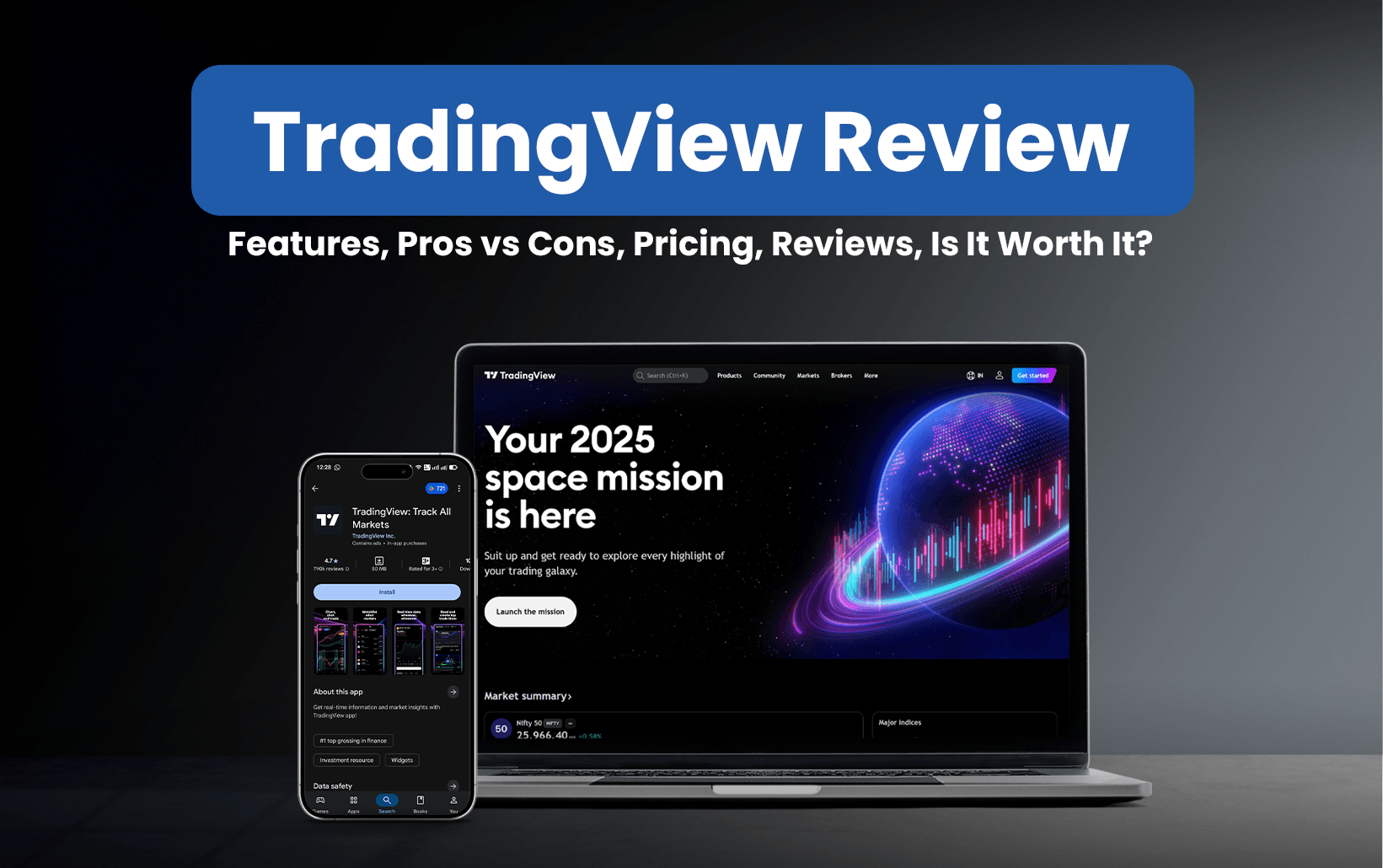
- TradingView – TradingView is both a web-based and mobile application charting platform that offers traders multiple technical tools for technical analysis. This platform allows traders to make custom indicators and trading strategies. Their community tab also has thousands of traders sharing their trade ideas every day.
These tools have transformed the trading interface into a much easier and simple to-understand platform for beginners and learn technical analysis. Traders can use all of these platforms to gather theoretical knowledge as well as practice at the same time.
What are the Best Books for Technical Analysis?
There are a lot multiple books on technical analysis that cover a lot of things, such as price patterns, technical tools, market psychology, etc. Most of the books are old and have become irrelevant in today’s market conditions. However, there are some books that will help you master technical analysis in no time. Following are three of the best books for learning technical analysis –
- “Technical Analysis of the Financial Markets” by John J. Murphy –

This book contains practical examples and case studies of other traders which will help other traders to understand the trading concepts better. Unlike other books, this book contains practical examples and case studies of other traders to help you understand the concepts better. This book contains a lot of information about technical tools such as chart patterns, moving averages, oscillators, etc. You must give this book a try if you have just started your trading journey.
- “Japanese Candlestick Charting Techniques” By Steve Nison –

This is the book that made candlestick charts popular in the Western world. This book offers a comprehensive guide to the various candlestick charting techniques. Nison’s book also includes real-world examples and advanced candlestick patterns to help its readers become expert candlestick chart readers quickly.
- “Technical Analysis Explained” by Martin Pring –

This book talks about concepts such as chart patterns, indicators, types of moving averages, and many more. This book also explains advanced technical analysis techniques such as market breadth analysis and Intermarket analysis.
Reading these books will help you enhance the accuracy of your technical analysis no matter if you are a beginner or an experienced trader.No matter if you are a beginner or an experienced trader, reading these books will help you enhance the accuracy of your technical analysis.
What are the Best Courses for Technical Analysis?
You can find many courses on technical analysis on the internet. But the best courses are always the ones that cover every topic minutely and are taught by expert professionals. Following are 3 three of the best courses for technical analysis. –
- Technical Analysis Certification by NSE Academy –
This course is offered by India’s National Stock Exchange for both beginners as well as advanced traders. This course includes interactive videos and online quizzes and covers topics such as candlestick patterns, chart patterns, technical indicators, and trading strategies. You will also receive a certificate from the National Stock Exchange of India upon successful completion of this course.
- Technical Analysis Course by Online Trading Academy –
This course will enhance your technical analysis skills to the next level. The course addresses topics such as trend analysis, chart patterns, Fibonacci patterns, and, most importantly, trading psychology. This course also includes live sessions and personalised coaching.
Courses are a great way to level up your technical analysis skills. Learning from the experts will help you understand complex concepts much easier and faster. All of these courses are a great way to learn more about technical analysis.
Is it hard to Learn Technical Analysis?
No, it is not hard to learn technical analysis. Technical analysis does feel overwhelming at first, but after gathering much theoretical knowledge, it will become much easier for you. You will also have to set aside time for your chart study. Set aside 30 minutes to an hour every day and analyse the price charts. This will ensure that you learn technical analysis in no time.
Is Technical Analysis for Beginners?
Yes, anyone can do technical analysis; it does not matter if you are a beginner or an expert. Your technical analysis skills will improve gradually as you learn and practise more. You can read books and buy courses on the internet to learn more about technical analysis in a much easier way.
Is Technical Analysis Effective?
Technical analysis is an effective way for analysing the stock markets. But, the effectiveness of technical analysis is subjective. Meaning, Meaning, it depends from trader to trader. The effectiveness of an analysis done by a beginner will always be low compared to the effectiveness of an analysis done by an expert. The effectiveness of technical analysis increases when a trader uses many multiple factors while analysing the price chart.
Is Technical Analysis Accurate?
No, any methodology cannot be accurate 100% of the time. The accuracy of the technical analysis depends on many factors, such as market condition, the experience of the technical analyst, the type of price chart or technical indicators used, etc.
What is the difference between Technical Analysis and Fundamental Analysis?
Technical and fundamental analysis both are used as methods for evaluating stocks, bonds, commodities, etc. Technical analysis only studies the price and volume data of a stock, while fundamental analysis takes things like industry trends, sales, and earnings of the company into consideration. Here are 3three major differences between technical analysis and fundamental analysis. –
- Outlook: The outlook of a trader using technical analysis is fairly shorter compared to that of an investor using fundamental analysis. Traders use technical analysis when they want to earn money by buying and selling a stock on the same day, while an investor uses fundamental analysis when he wants his capital to appreciate over a long time.
- Information sources: A technical analyst only uses price and volume data as his sole information source, while a fundamental analyst has to analyse a company’s financials and macroeconomic data.
- Tools and techniques: A technical analyst uses price charts and technical indicators to find trading opportunities in the market, while a fundamental analyst uses valuation models, financial ratios, and other fundamental metrics.
Both technical and fundamental analysis are useful when it comes to evaluating investment securities. The choice of which method to use depends on the investor’s goals, time period, and personal preference.
What is the difference between Technical Analysis and Quantitative Analysis?
Technical analysis and quantitative analysis are both used as methods for investing, but they differ in outlook and focus. Technical analysis is a method used for identifying trading opportunities just by analysing price charts and volume. Technical analysts use price charts and technical indicators to make informed trading decisions.
The quantitative analysis uses mathematical models and statistical analysis to identify potential investment opportunities in the market. On the other hand, the quantitative analysis used mathematical models and statistical analysis to identify potential investment opportunities in the market. This type of analysis requires a large set of data, such as a company’s financial performance, market trends, and other economic factors. Here are 3 major differences between technical analysis and quantitative analysis .–
- Focus: Technical analysis is more focused on analysing historical data to predict future price movements, while quantitative analysis focuses on mathematical models and statistical methods to analyse financial data.
- Outlook: Technical analysis is often used for identifying short-term trading opportunities, while quantitative analysis can be used for both short-term as well as long-term investing.
- Subjectivity: Technical analysis is subjective as the analysts can interpret the same data differently, whereas quantitative analysis is more objective and relies on statistical models to gain insights.
Even a beginner can use technical analysis but Quantitative analysis requires professional expertise. Overall, technical analysis can be used by even a beginner, while quantitative analysis requires professional expertise. Quantitative analysis is a more data-driven approach to investing.


 Previous Article







No Comments Yet.