




Market capitalization plays an important role in how investors evaluate companies and understand their position within the stock market. Market capitalization is widely used by traders, analysts, and institutional investors to categorize companies as large-cap, mid-cap, and small-cap to determine their stability, growth prospects, and risk levels.
It also serves as an important benchmark for portfolio allocation, sector comparison, and index construction, such as the Nifty 50 and BSE Sensex. By tracking changes in market capitalization over time, investors can better understand market leadership, capital flows across sectors, and how economic conditions influence company valuations.
What is market capitalization?
Market capitalization, often known as market cap, is the total market value of the company’s outstanding shares. Market capitalization is a key metric used by traders and investors to gauge company size and compare opportunities. More importantly, it represents what investors believe a company is worth, rather than its book value.
What is the importance of market cap?
Understanding market cap is important because it gives investors a quick way to compare the size and value of different companies. Market cap provides a snapshot of a company’s total market value and allows investors to gauge the relative worth of companies in the same industry. Having knowledge of market caps also helps investors determine if a stock is potentially overvalued or undervalued relative to its peers.
What is the formula to calculate market cap?
The formula to calculate market cap is given below.
Market Capitalization = Current Share Price × Total Outstanding Shares
In simple terms, multiply the company’s current stock price by the total number of shares available in the market.
How is market capitalization calculated?
Market capitalization is calculated by multiplying the company’s current share price by its total number of outstanding shares.
If a company, XYZ, has 10 crore outstanding shares with a current share price of ₹500.
Market Capitalization = 500 × 10 crore = ₹5,000 crore
This represents the total market value of a company’s publicly traded shares at the current price.
What are the types of market capitalization?
Market capitalization is commonly divided into several categories based on company size. While the Securities and Exchange Board of India (SEBI) officially classifies companies into large-cap, mid-cap, and small-cap, analysts often expand this into seven broader categories based on market value.
1. Large-cap
Large-cap companies are the top 100 companies in India based on full market capitalization per SEBI guidelines, with a market cap greater than ₹20,000 crore. These are well-established, financially strong, and industry-leading businesses with a long operating history.
Large-cap company stocks typically account for 70–80% of the total market capitalization in the Indian equity market, making them the backbone of major indices like the NIFTY 50 and BSE Sensex.
The large-cap stocks generally show the following characteristics.
- Lower volatility compared to mid- and small-caps
- More stable earnings and predictable cash flows
- Strong analyst coverage and institutional ownership
- Better resilience during market corrections
However, their large size results in a slower potential growth percentage compared to mid- and small-cap companies, which can often capitalize on emerging market opportunities and innovate more rapidly due to their smaller operational scale.
2. Mid-cap
Mid-cap companies are those ranked 101 to 250 based on full market capitalization per SEBI guidelines, with market cap typically ranging between ₹5,000 and ₹20,000 crore. These companies are typically in the growth phase of their business cycle with scaling operations, increasing market share, and improving profitability.
Mid-cap company stocks represent 15–20% of the total market capitalization of the Indian equity market, making them a significant component of indices such as the NIFTY Midcap 100.
The mid-cap stocks generally show the following characteristics.
- Higher growth rates than large caps
- Moderate to high volatility
- Improving earnings trajectory
- Increasing institutional participation
During a bull market, mid-caps outperform large-caps due to faster earnings growth. However, during a bearish market, mid-caps fall more sharply because liquidity is lower compared to large caps, which can lead to greater volatility and risk for investors seeking stability during economic downturns.
3. Small-cap
Small-cap companies are those ranked 251 and below based on full market capitalization per SEBI guidelines, with a market cap below approximately ₹10,000 crore, although the exact threshold keeps changing with market conditions.
Small-cap companies’ stocks contribute roughly 5-10% of the total market capitalization of the Indian equity market. These companies are often in the early stages of growth, expanding operations, entering new markets, or building competitive advantages.
The small-cap stocks generally show the following characteristics.
- In terms of behavior, small-cap stocks generally show:
- High growth potential
- High volatility and sharp price swings
- Lower liquidity compared to large and mid-caps
- Greater sensitivity to market sentiment
During strong bull markets, small caps can significantly outperform due to faster earnings expansion and speculative interest. However, during market corrections, they tend to decline more sharply because of lower institutional support and liquidity. Small-cap stocks are therefore suitable for aggressive investors who can tolerate higher risk because of the possibility of higher long-term returns.
4. Megacap
Mega-cap companies are the companies with the largest market capitalization in the market, with the market cap typically greater than ₹2 lakh crore. Although SEBI formally classifies companies only into large-, mid-, and small-cap categories, the term “mega-cap” is commonly used in the financial market to describe top giants within the large-cap.
These mega-cap companies dominate the benchmark index, like NIFTY 50 and BSE Sensex. The mega-cap stocks generally show the following characteristics.
- Extremely high liquidity
- Strong global presence
- Stable and diversified revenue streams
- Heavy institutional and FII participation
Mega-cap companies are best suited for conservative investors seeking steady compounding and capital preservation because of their high stability and lower volatility.
5. Microcap
Micro-cap companies are small listed companies with low market capitalization, typically below ₹1,000–₹2,000 crore, though there is no fixed threshold defined by the SEBI. The micro-cap is used to describe the companies that are much smaller than the small-cap category.
The micro-cap category contributes a tiny portion of the total market capitalization but forms a large number of the listed companies. Companies in these businesses are usually in early growth stages, niche industries, or emerging sectors.
The micro-cap stocks generally show the following characteristics.
- Very high growth potential
- Extremely high volatility
- Low liquidity and wide bid-ask spreads
- Higher business and governance risk
During a strong bull market, micro-caps deliver multi-bagger returns due to their small base. However, in a bear market, they can decline sharply because of limited institutional participation and weak liquidity; hence, they are suitable only for high-risk, aggressive investors.
6. Nano-Cap
Nano-cap companies are the smallest listed companies in the market, with extremely low market capitalization. Though there is no official threshold provided by SEBI, nano-caps typically have a market cap below ₹100–₹500 crore.
The financial market uses the term “nano-cap” to classify companies smaller than micro-cap. The micro-cap stocks generally show the following characteristics.
- Very low liquidity
- Minimal institutional participation
- High price manipulation risk
- Limited analyst coverage
Nano-cap stocks show very sharp upward and downward movement because of their tiny base. These companies offer exceptional growth potential if the business succeeds. However, they also carry very high business risk, governance risk, and volatility.
What factors affect a company’s market cap?
There are six main factors that affect a company’s market cap. These factors include company performance, investor sentiment, industry and sector trends, economic conditions, corporate actions, and global and geopolitical events.
- Company Performance: Company performance metrics like revenue growth, profit margins, earnings growth (EPS), and return ratios (ROE, ROCE) have a direct effect on determining its market cap. When performance improves, demand for stocks rises, which ultimately increases the market cap. Conversely, when performance drops, demand for stocks decreases, which ultimately lowers the market cap.
- Investor Sentiment: Investors’ sentiment about the company’s future heavily influences the market capitalization. A positive investor sentiment can increase demand for shares, whereas a negative investor sentiment can lead to selling pressure and reduce market value.
- Industry and Sector Trends: The overall performance of the sector in which the company operates directly affects its market cap. A company from a growing sector often sees its market cap rise. Conversely, sector slowdowns can reduce valuations.
- Economic Conditions: Economic factors such as GDP growth, inflation, interest rates, and liquidity influence the stock prices. A strong economic condition supports higher valuation, while high inflation or rising interest rates can put pressure on stock prices and reduce market cap.
- Corporate Actions: Corporate decisions such as stock splits, bonus issues, share buybacks, or issuing new shares can affect market cap. While stock splits and bonuses may not change overall value immediately, issuing new shares increases the total number of outstanding shares, which can impact valuation.
- Global and Geopolitical Events: Global events like war, global recessions, currency fluctuations, and commodity prices can significantly impact investor confidence and companies exposed to this.
A company’s market cap constantly changes based on performance, sentiment, economic conditions, and global events. It reflects how the market values the company at a given time, not just its financial size.
How to find marketcap of a company?
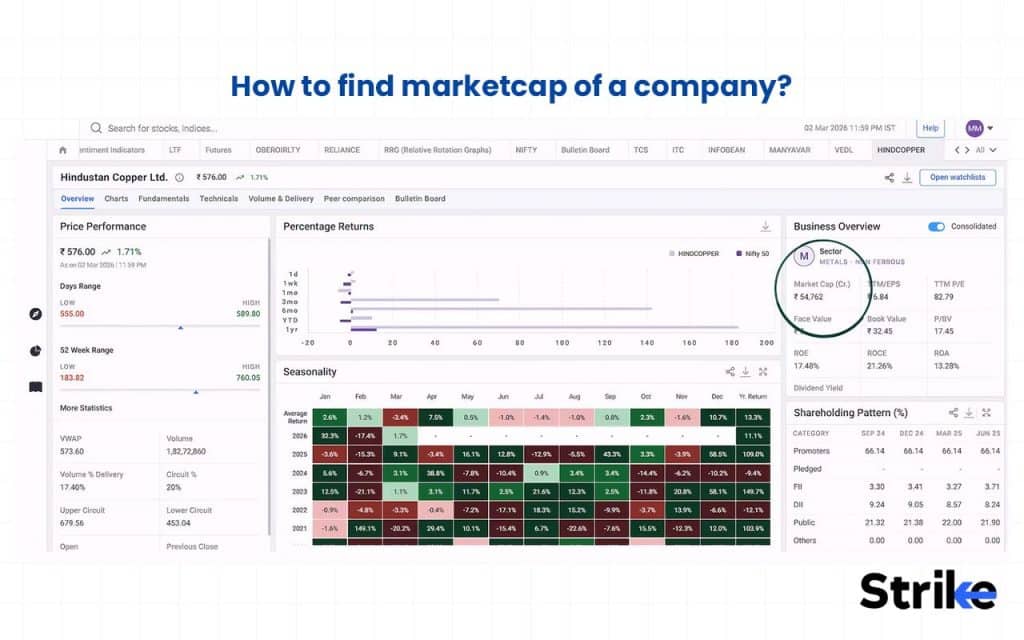
You can find the market cap of a company through official exchange websites like NSE and BSE or by using different financial websites like Strike Money, Moneycontrol, Screener, Yahoo Finance etc.
Simply search for the company’s name and navigate to the stocks overview page to view the market cap. For instance, we searched for the stock “Hindustan Copper Ltd.” on Strike Money; the market cap was clearly displayed on the stock’s overview dashboard along with other key metrics. This makes it quick and convenient to check a company’s total market value without doing manual calculations.
Does a company’s market cap affect its stock price?
No, a company’s market cap does not directly affect the stock price, because the stock price itself determines the market capitalization. However, market cap does influence the behavior of stocks indirectly.
The stock price of large-cap stocks in the stock market tends to be more stable, liquid, and institutionally owned. In contrast, smaller-cap stocks can move much faster because less capital is required to shift their price, resulting in sharper rallies and deeper corrections.
How investors should use marketcap?
Investors should use market capitalization to understand risk, allocate a portfolio, and align investment goals, liquidity, and peer comparison.
- Understanding Risk Portfolio: Market cap helps traders or investors to assess the volatility. Large-cap companies are generally stable and less volatile. Whereas, mid-cap offers a moderate growth with balanced risk, while small-caps move sharply, which makes them high-risk and high-reward opportunities.
- Portfolio Allocation Strategy: Investors use market capitalization to create balanced portfolios by commonly allocating 50–60% in large caps for stability, 20–30% in mid caps for growth, and 10–20% in small caps for aggressive returns. This market-cap-based diversification reduces overall risk while maintaining growth potential.
- Aligning with Investment Goals: Long-term wealth creators combine large and mid caps for steady compounding. Investors seeking aggressive short-term gains focus more on small caps. For retirement or capital preservation, investors select large-cap stocks due to their stability and strong fundamentals.
- Liquidity & Ease of Entry/Exit: Large-cap stocks have higher trading volume, liquidity, and lower impact costs, making entry and exit easier. However, small-cap stocks often have lower liquidity, meaning prices can move sharply with relatively small buying or selling pressure.
- Comparing Companies Properly: Market cap allows investors to compare businesses accurately instead of relying on stock price alone.
Market capitalization helps investors manage risk, balance portfolios, and choose stocks that align with their financial goals and investment style, which is why different types of investors often use market cap to decide whether to invest in large-cap, mid-cap, or small-cap stocks.
What is the historic world market capitalization?
The historic world market capitalization represents the total value of all publicly listed companies worldwide at various historical points. The table below presents the historical progression of global market capitalization, showing how the total value of all publicly listed companies worldwide has evolved.
| Year | Approx. Total Market Cap (US$) |
| 1975 | ~$1.15 trillion |
| 1980 | ~$2.5 trillion |
| 1990 | ~$9.5 trillion |
| 2000 | ~$30.9 trillion |
| 2007 (pre-GFC) | ~$60.5 trillion |
| 2008 (GFC dip) | ~$32.4 trillion |
| 2010 | ~$54.3 trillion |
| 2015 | ~$62.3 trillion |
| 2020 | ~$93.7 trillion |
| 2021 | ~$111 trillion |
| 2022 | ~$93.7 trillion |
| 2024 | ~$114–128 trillion estimates |
Despite periodic crashes and corrections, global market capitalization has shown strong long-term growth, reflecting the expansion of the global economy and financial markets.
What is India’s market cap?
India’s total market, including NSE- and BSE-listed companies, is approximately equal to ₹479 lakh crore (US$5.00 trillion) as of early 2026, and the NSE hit its record of ₹479.03 lakh crore on January 2, 2026. This figure is a minor fall to the equivalent of approximately US $5.30 trillion in December 2025 during the world’s volatility. India ranks 5th in the world market, after the United States (~US $62 trillion), China (~US $16 trillion), and the other significant markets.
Which companies have the highest market cap?
The table below lists the companies with the highest market cap.
| Rank | Company | Approx. Market Cap (₹ crore) |
| 1 | Reliance Industries Ltd | ~₹19,62,000+ cr |
| 2 | HDFC Bank Ltd | ~₹14,16,000+ cr |
| 3 | Bharti Airtel Ltd | ~₹12,28,000+ cr |
| 4 | State Bank of India | ~₹11,00,000+ cr |
| 5 | ICICI Bank Ltd | ~₹10,23,000+ cr |
| 6 | Tata Consultancy Services Ltd | ~₹9,95,000+ cr |
| 7 | Bajaj Finance Ltd | ~₹6,22,000+ cr |
| 8 | Larsen & Toubro Ltd | ~₹5,75,000+ cr |
| 9 | Hindustan Unilever Ltd | ~₹5,66,000+ cr |
| 10 | Infosys Ltd | ~₹5,62,000+ cr |
| 11 | Life Insurance Corporation of India | ~₹5,75,000+ cr |
| 12 | ITC Ltd | ~₹5,10,000+ cr |
| 13 | Maruti Suzuki India Ltd | ~₹4,92,000+ cr |
| 14 | Mahindra & Mahindra Ltd | ~₹4,59,000+ cr |
| 15 | HCL Technologies Ltd | ~₹4,32,000+ cr |
| 16 | Sun Pharmaceutical Industries Ltd | ~₹4,21,000+ cr |
| 17 | Kotak Mahindra Bank Ltd | ~₹4,12,000+ cr |
| 18 | Axis Bank Ltd | ~₹3,85,000+ cr |
| 19 | UltraTech Cement Ltd | ~₹3,49,000+ cr |
| 20 | Titan Company Ltd | ~₹3,39,000+ cr |
These companies lead India’s stock market due to their size, strong fundamentals, and consistent investor confidence across key sectors.
How to increase market cap?
A company increases its market cap by boosting its stock price, which is often achieved by improving financial metrics like revenue and profit growth that build investor confidence in the future potential of the business. A company also increases its market cap by issuing new shares, although this causes dilution and only increases market cap if the share price remains stable or rises after the new share issuance.
How is market cap related to a company’s valuation?
Market capitalization is directly related to a company’s valuation because it is calculated by multiplying the total number of outstanding shares by the current market price of the stock, giving an indication of the market’s valuation of the company as a whole.
What are the limitations of market cap?
The limitations of using market caps are briefly discussed below.
- Reflects Price, Not True Value: Market cap is calculated based on current share price, which can be influenced by speculation or sentiment.
- Ignores Debt and Cash: Market cap only considers equity value. It does not account for cash holdings or debt. Two companies with the same market cap can have very different financial strength.
- Sensitive to Short-Term Volatility: Since the market cap is directly linked with the share price, any temporary market reaction can fluctuate the market cap sharply.
- Does Not Indicate Liquidity: A high market cap does not always mean high liquidity, especially in cases where promoter holding is high and free float is low.
- Not a Measure of Profitability: A company can have a large market cap but weak earnings or a high valuation.
Market capitalization is a helpful starting point for understanding company size, but it should always be analyzed along with fundamentals, debt levels, valuation ratios, and growth prospects for better investment decisions.
What is the difference between market cap and free float market cap?
The table below details the difference between market cap and free float market cap.
| Basis | Market Capitalization (Full Market Cap) | Free-Float Market Capitalization |
| Definition | Total value of all outstanding shares | Value of only publicly tradable shares |
| Shares Considered | Includes promoter, government, institutional, and public shares | Excludes promoter, government, and locked-in holdings |
| Formula | Price × Total Outstanding Shares | Price × Publicly Available Shares |
| Purpose | Shows total company size | Reflects actual tradable market value |
| Used By | General company valuation | Used by National Stock Exchange of India and BSE Limited for index calculation |
| Example Usage | Company valuation comparison | Calculation of indices like NIFTY 50 and BSE Sensex |
Full market cap shows the company’s total size, while free-float market cap shows how much of it is actually available for trading in the market.


 Previous Article





No Comments Yet.