Tax on Intraday Profits: Allowable Expense Deductions, Slab Rates, and the Speculative Loss Trap

 Author

 Editor
Intraday trading profits are not taxed like capital gains. Intraday trading profits are generally treated as speculative business income, making the tax calculation dependent on your total income, eligible expenses, losses and applicable tax rules. This might seem fun for beginners who are often unsure how profits, expenses, losses and turnover affect their tax liability.
This guide explains how intraday profits are taxed, which expenses may be deductible, how speculative losses can be set off and carried forward, and when tax audit requirements may apply, helping you understand your tax obligations before filing your ITR.
Is Intraday Trading Profit Taxed as Capital Gains?
No. intraday profits are not taxed as capital gains. Capital gain taxes are only applied when there is a change in an ownership of the assets according Section 45. Since intraday trades are squared off before market closes, transfer of ownership never occurs and hence profits are not taxed as capital gain.
Instead, intraday profits are taxed as a speculative business income under Section 43(5) of the Income-tax Act.
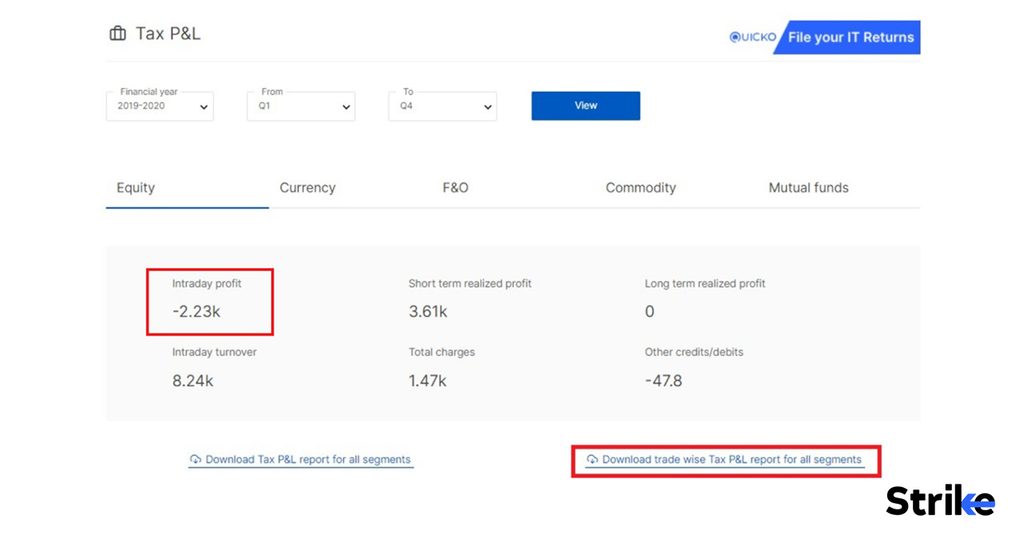
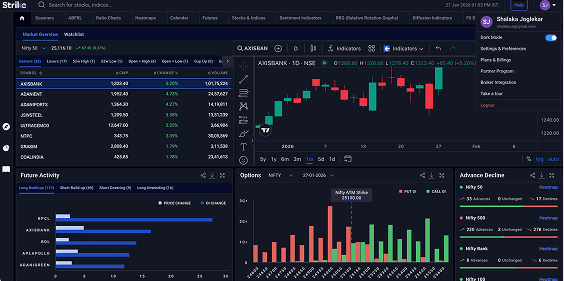
The above screenshot is Zerodha’s tax PnL report. We can clearly see that the intraday PnL is separated from short-term and long-term realized profits.
Why Does Intraday Count as Speculative Business Income?
Intraday is counted as a speculative business income because shares are bought and sold within the same trading day without any actual delivery. Such transactions where settlement happens without actual delivery, are counted as speculative business income under Section 43(5) of the Income Tax Act.
However, F&O trading is treated as non-speculative income, even though it is also cash-settled without delivery.
How Much Tax Do You Pay on Intraday Profit?
There is no flat rate to tax your intraday profits. Instead your intraday profits are added to your total income and taxed at whichever slab your combined income falls into.
So, if your salary is ₹8 lakh and your net intraday business income after eligible expenses is ₹1.3 lakh. You don’t have to calculate an “intraday tax” on ₹1.3 lakh separately. Just combine it with your salary income and pay tax according to the applicable rules.
As per New tax regime slab rates, FY 2025-26 (AY 2026-27)
| Income Slab | Tax Rate |
|---|---|
| Up to ₹4,00,000 | Nil |
| ₹4,00,001 – ₹8,00,000 | 5% |
| ₹8,00,001 – ₹12,00,000 | 10% |
| ₹12,00,001 – ₹16,00,000 | 15% |
| ₹16,00,001 – ₹20,00,000 | 20% |
| ₹20,00,001 – ₹24,00,000 | 25% |
| Above ₹24,00,000 | 30% |
There is also a Section 87A rebate that can make tax effectively nil for eligible taxpayers with total income up to ₹12 lakh, based on your total eligible income, not just your intraday profit. So if your salary and intraday profit together exceed the relevant limit, you may not qualify for the full rebate.
As per Old tax regime slab rates, FY 2025-26 (AY 2026-27)
| Income Slab | Tax Rate |
| Up to ₹2,50,000 | Nil |
| ₹2,50,001 – ₹5,00,000 | 5% |
| ₹5,00,001 – ₹10,00,000 | 20% |
| Above ₹10,00,000 | 30% |
These slabs apply to individuals below 60 years of age. A 4% Health and Education Cess is added to the calculated tax. Eligible deductions and exemptions can further reduce taxable income.
How You Can Pay Less Tax (Legally) on Intraday Profits
You cannot use a lower tax rate for intraday trading profits. However, you can legally reduce your taxable income by using the deductions and tax rules available to you.
- Claim eligible business expenses: Trading expenses such as brokerage, internet, software, and other allowable costs, can reduce your taxable profit. Also make sure that the mentioned expenses have a legitimate connection with the business and should be properly documented.
- Don’t confuse turnover with profit: Turnover and tax are two different numbers. You can have a turnover of ₹10,000 but ₹50,000 of actual profit.
- File on TIme: For traders carrying a loss, timely filing is particularly important because an eligible loss generally needs to be reported within the prescribed deadline to be carried forward.
Hence, there is no separate scheme that lets you reclassify intraday profit as capital gains or route it through presumptive taxation.
How Tax on Intraday Trading is Calculated?
Tax on intraday trading is calculated in 6 simple steps which are briefly discussed below.Suppose Trader A has the following income and trading results during FY 2025-26.
| Particulars | Amount |
|---|---|
| Salary income | ₹8,00,000 |
| Intraday profit from Broker A | ₹2,00,000 |
| Intraday loss from Broker B | ₹50,000 |
| Eligible trading expenses | ₹20,000 |
Step 1 (Add all your profit and loss)
This will give you a net intraday profit or loss before deducting any trading expenses. Suppose you have profit of ₹2,00,000 in broker A and loss of ₹50,000.
Net result = ₹2,00,000 − ₹50,000 = ₹1,50,000 profit
Now the business expenses will be deducted from ₹1,50,000 profit.
Step 2 (Subtract eligible business expenses)
Eligible business expenses include trading costs such as brokerage, STT, internet, subscriptions, etc. Suppose your eligible trading related business is ₹20,000.
Your speculative business income becomes ₹1,50,000 − ₹20,000 = ₹1,30,000.
Step 3 (Add the net figure to your other income)
Since your salary is ₹8,00,000, your total income becomes ₹8,00,000 + ₹1,30,000 = ₹9,30,000.
Step 5 (Apply slab rates)
Under the new tax regime, your tax will be applied in the following manner.
| Income portion | Tax rate | Tax |
|---|---|---|
| ₹0 – ₹4,00,000 | 0% | ₹0 |
| ₹4,00,001 – ₹8,00,000 | 5% | ₹20,000 |
| ₹8,00,001 – ₹9,30,000 | 10% | ₹13,000 |
| Total tax before rebate | ₹33,000 |
So the tax before rebate is ₹33,000 for your total income of ₹9,30,000. However, there’s an important point for FY 2025-26: eligible resident individuals under the new regime can claim Section 87A rebate of up to ₹60,000 when total income does not exceed ₹12 lakh. Therefore, if Trader A is eligible for the rebate, the ₹33,000 tax would be reduced to ₹0.
Download Intraday Trading Tax Calculator
A proper intraday tax calculator should let you enter your salary, other income, gross intraday profit or loss, and eligible expenses, then show your net speculative income, applicable slab tax, and whether you’re near the audit turnover threshold — under both tax regimes side by side.
If you’d like, I can build you an interactive calculator right here as a tool you can use directly in this chat — just say the word and I’ll set it up.
Which ITR Form and Schedule Do You Use?
Since profit from intraday trading comes under speculative business, you need to file ITR-3. Inside ITR-3, an intraday trader will use schedule BP, schedule TDS, schedule CFL and balance sheet.
- Schedule BP (Business & Profession): To report speculative business income separately from non-speculative business/F&O income.
- Schedule TDS: To claim credit for tax already deducted by your broker or bank.
- Schedule CFL: To carry forward unabsorbed speculative losses to future years.
Many traders also make a common mistake of reporting intraday profits under the “presumptive business” head (business code tagged 44AD) inside Schedule BP. Also make sure to crosscheck and compare the amount entered in the ITR with your broker’s Tax P&L.
Can You Offset Intraday Losses Against Other Income?
No, you can not offset intraday loss against other income. Under Section 73, a loss from a speculative business can only be offset against profit from speculative business in the same year.
| Loss | Can generally be set off against |
|---|---|
| Intraday/speculative loss | Speculative business income |
| F&O/non-speculative business loss | Subject to applicable rules, potentially income under other heads |
| Intraday loss against Salary | Can not be settled |
| Intraday loss against F&O profit | Can not be settled |
If you don’t have any other speculative income to offset the loss, you can carry forward the loss for 4 years.
Can an F&O Loss Offset an Intraday Profit?
Yes, you can offset an intraday profit with F&O loss because an F&O profit is non-speculative profit and under Section 71, and non-speculative business losses can be set off against income from any head, including speculative business income. So an F&O loss can reduce your taxable intraday profit.
However, a reverse does not work. You can not set off an intraday loss against F&O profit, because Section 73 blocks speculative losses from touching anything except speculative income.
How Long Can You Carry Forward an Intraday Loss?
You can carry forward your intraday loss for up to 4 assessment years immediately following the assessment year in which the loss was incurred.
So, if you have incurred a loss of ₹1 lakh during FY 2025-26 (AY 2026-27), the unadjusted loss can generally be carried forward through AY 2030-31.
| Year | Event |
| FY 2025-26 | Intraday loss of ₹1,00,000 |
| AY 2026-27 | Loss reported in ITR |
| AY 2027-28 | 1st year available for carry-forward |
| AY 2028-29 | 2nd year |
| AY 2029-30 | 3rd year |
| AY 2030-31 | 4th and final year |
However, you can carry forward your loss only when the loss return is filed within the prescribed due date. The predescribed due date under Section 139(1) of the Income Tax Act is given below.
| Category | Due Date for FY 2025-26 (AY 2026-27) |
| Individual, no tax audit required (most retail intraday traders) | 31 July 2026 |
| Individual/firm where tax audit under Section 44AB applies | 31 October 2026 |
| Cases involving transfer pricing report (Form 3CEB) | 30 November 2026 |
Hence, if you have a loss of ₹100000, don’t think of it as “just a loss for this year.” If loss is eligible for carry forward, it can potentially be used to setoff future speculative profits.
What Happens If You File Late?
If you file an ITR late (typically 31 July for non-audit cases, 31 October for audit cases) , you will still be allowed to file ITR, but it will cost you in four different ways.
- Late fee under Section 234F of ₹5,000 if total income exceeds ₹5 lakh, ₹1,000 if it’s below that, nil if income is under the basic exemption limit.
- Interest of 1% per month on unpaid tax under Section 234A.
- Permanent loss of carry-forward: your loss cannot be carried forward at all, making it often the consequence for active traders.
- Regime lock-in: a belated return for AY 2026-27 can generally only be filed under the new tax regime, even if you’d have preferred the old one.
Don’t wait until the last few days to collect your broker statements. If you trade through multiple brokers, reconcile all Tax P&L reports before starting the ITR.
Can You Use Presumptive Taxation for Intraday Trading?
No, intraday trading can not be taxed under presumptive taxations because it falls under speculative business income.
Under section 44AD(6) an eligible business can declare a fixed percentage (typically 6% to 8%) of their turnover as profit, instead of calculating their actual profit after expenses. Since intraday profits are treated as speculative business income, Section 44D(6) does not apply and you need to report the actual speculative business profit or loss rather than simply declaring 6% or 8% of turnover.
How Is Turnover Calculated for a Tax Audit on Intraday?
Intraday turnover for a tax audit is generally calculated by adding the absolute value (value without + and – sign) of every profit and loss from your trades.
Suppose you did three intraday trades, trade 1, trade 2, and trade 3. The turnover will be calculated as follows.
| Trade | Result |
|---|---|
| Trade 1 | ₹5,000 profit |
| Trade 2 | ₹3,000 loss |
| Trade 3 | ₹2,000 profit |
Your net profit becomes = ₹5,000 − ₹3,000 + ₹2,000 = ₹4,000
Your tax turnover becomes = ₹5,000 + ₹3,000 + ₹2,000 = ₹10,000
Hence, intraday trading is calculated by adding the absolute value of every profit and loss from your trades, not by the total value of shares you bought and sold.
Most brokers like Zerodha, Groww, Angel One, etc. provide a “Tax P&L” report that automatically calculates your trading profit, loss, and turnover.
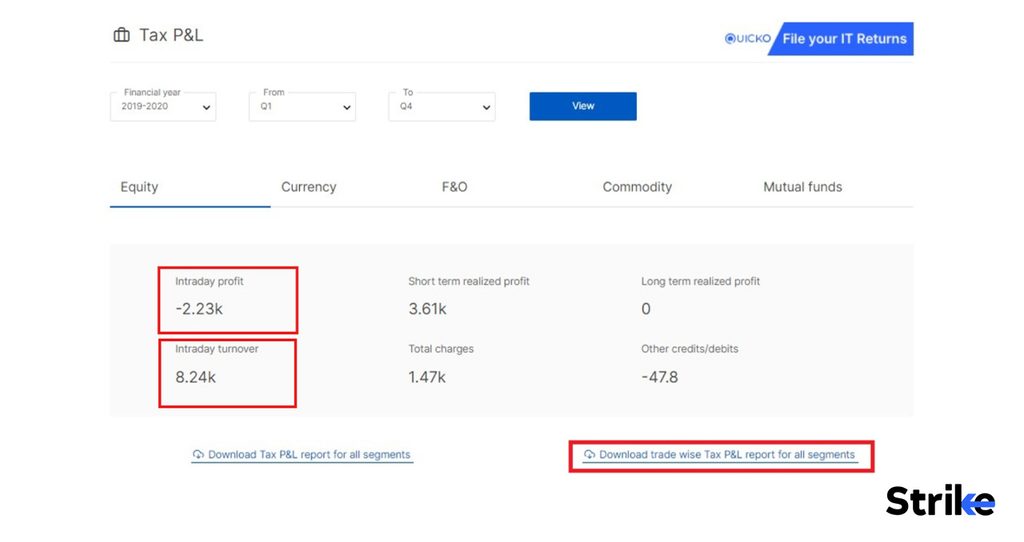
Broker → Tax P&L Report → Check turnover and profit/loss → Use these figures while filing your ITR.
It is recommended to crosscheck the broker’s report with your own records to avoid possible errors.
When Is a Tax Audit Mandatory for a Trader?
A tax audit is mandatory only for a trader when it falls under the audit conditions prescribed by the Income-tax Act. You don’t automatically need an audit just because you trade stocks.
You may need an audit when you meet certain conditions which are briefly discussed below in the table for FY 2025-26 (AY 2026-27), under Section 44AB of the Income-tax Act, 1961.
| Situation | Audit required? |
|---|---|
| Turnover up to ₹1 crore | No |
| Turnover ₹1 crore – ₹10 crore, with cash receipts and payments each under 5% of totals | No |
| Turnover above ₹10 crore | Yes, regardless of profit/loss |
| Any turnover, but you declare a loss (or profit below 6% of turnover) and total income exceeds the basic exemption limit | Yes |
If you are reporting a business loss, it can trigger an audit even though your turnover is small.
The New Rule From FY 2026-27: Audit Even Without Presumptive Taxation
From FY 2026–27, the Income-tax Act, 2025 replaces the old Income-tax Act, 1961. A new Section 63 deals with tax audits. This new rule has brought one important change, that is you may need a tax audit even if you never chose presumptive taxation. This new rule is mainly affecting F&O traders.
If you are a F&O trader and fall under the presumptive taxation rules, under new rule if Your F&O business is eligible for presumptive taxation, or you declare profit below 6% of eligible digital turnover or 8% of eligible cash turnover, and your total income is above the basic exemption limit, then tax audit can become mandatory.
An important point to note is, this can happen even if you never opted for presumptive taxation.
Does this new rule apply to intraday trading?
No, intraday trading is a speculative business income and hence it is not eligible for a presumptive taxation under Section 58. However, if you are into both, F&O and intraday, the audit generally applies to your books as a whole. That means your intraday trading records would also be covered by the audit.
Which Act and Section Numbers Apply to You This Year?
Which act and section number apply to your income depends on the year you earned it.
This is where traders most often mix up two different filing years.
| Trading income earned during | Applicable law | Tax-audit section |
| 1 Apr 2025 – 31 Mar 2026 | Income-tax Act, 1961 | Section 44AB |
| 1 Apr 2026 – 31 Mar 2027 | Income-tax Act, 2025 | Section 63 |
Hence, if income is earned during FY 2025-26, it will be governed by the 1961 Act, including Section 44AB. However, earning in FY 2026-27 and after will be governed by Income-tax Act, 2025, with Section 63.
Do You Need to Pay Advance Tax on Intraday Profits?
Yes, under Section 208, if your total estimated tax liability for the year exceeds ₹10,000, you will have to pay advance tax on your intraday profits. This threshold level easily gets crossed even for moderately active traders once intraday profit stacks on top of salary or other income.
However, you don’t need to pay this advance all at once, instead you pay them in installments.
The standard instalment schedule is mentioned in the table below.
| Due date | Cumulative advance tax payable |
|---|---|
| 15 June | 15% |
| 15 September | 45% |
| 15 December | 75% |
| 15 March | 100% |
Intraday profits can change a lot during the year. So, you may estimate your yearly profit and pay advance tax based on that estimate. If your actual profit later turns out to be higher, you can pay the additional tax in the later advance-tax installments.
If you pay less advance tax than required, you may have to pay interest under Sections 234B and 234C. This is different from Section 234A, which applies when you file your ITR late.
What Expenses Can You Deduct Against Intraday Income?
Since intraday trading is related to business activity, you can deduct the expenses that are directly related to earning your trading income.
These expenses are briefly discussed below in the table.
| Expense | Actual rate / value | Example on ₹10 lakh |
| Brokerage charges | Depends on broker; e.g. ₹20/order or 0.03%, whichever is lower | Up to ₹20 per executed order with a ₹20/order structure |
| STT | 0.025% on sell-side value | ₹250 |
| Exchange transaction charges | Depends on exchange/broker and applicable segment | Variable |
| SEBI turnover fees | ₹10 per ₹1 crore turnover (0.0001%) | ₹1 |
| GST | 18% on applicable brokerage/service charges | Depends on brokerage + charges |
| Internet & data charges | Actual amount paid; business portion only | E.g. ₹600/month × business-use % |
| Trading software/charting subscriptions | Actual subscription cost | E.g. ₹1,000/month = ₹12,000/year |
| Computer/laptop depreciation | Based on applicable depreciation rules and actual cost | Depends on computer cost and usage |
| Research/advisory subscriptions | Actual amount paid | E.g. ₹2,000/month = ₹24,000/year |
Stamp duty on trades is generally treated as non-deductible, and any expense not directly connected to the trading activity (general household internet with no trading nexus, personal equipment unrelated to trading) will typically be disallowed on scrutiny.
What I Would Keep Ready Before Filing Intraday Tax
Before filing your ITR for intraday trading, things that I keep ready are discussed below.
- Broker’s annual tax P&L statement to know your overall gains or loss.
- Intraday turnover statement needed to determine my tax and audit requirements.
- Contract notes/trade statements for my verifying individual transactions.
- Brokerage and other trading expenses such as transaction charges and other eligible expenses.
- Bank statements to reconcile deposits, withdrawals, and trading-related transactions.
- Details of other income such as salary, interest, dividends, or other business income.
- Previous-year loss details if you have any speculative or other eligible business losses to carry forward.
- Form 26AS and AIS to cross-check reported income, TDS, and other tax information.
- PAN and Aadhaar details to complete and verify your ITR.
Most importantly: Make sure the profit/loss and turnover figures in your tax filing match the figures in your broker’s tax reports.
What Mistakes Do Intraday Traders Make on Their Returns?
There are six major mistakes an intraday trader makes on their returns.
- Filing ITR-2 instead of ITR-3 by considering intraday trading as an investment.
- Reporting Intraday Profit as Short-term capital gains.
- Mixing intraday and futures trading tax treatment in a single feature. They both have different tax treatment, set-off rules and turnover calculations.
- Assuming intraday losses can offset salary or F&O profit, which is not possible. Only a speculative income can absorb these losses.
- Ignoring eligible business expenses. Sometimes, traders calculate business expense on gross profit without deducting expenses such as brokerage, trading-related subscriptions and internet expenses.
- Ignoring advance tax and audit requirements can result in interest under Sections 234B and 234C.
The above mentioned mistakes are the most common mistakes an intraday traders make.

 19 mins