STBT in Indian Stock Markets: Cash Ban Rules, F&O Workarounds, and How Auction Shortages Work


 Author

 Editor
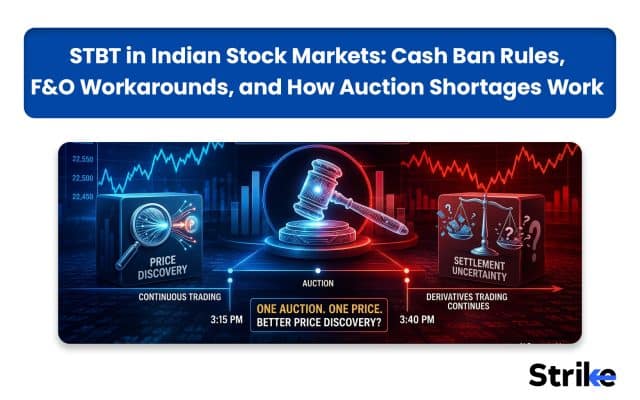
STBT trading which stands for sell today, buy tomorrow is a unique trading style where you sell the stock today and buy it tomorrow, expecting the price of stock to drop overnight. STBT is not a popular strategy because it is not allowed to do it directly in India. This strategy requires an alternative route for execution, where traders use futures contracts, options contracts, and SLB mechanism. In this blog, we will be covering how exactly STBT works, is it doable for retail traders, different ways of doing it, cost, margin and risks involved.
What Does STBT Mean?
STBT (Sell today, buy tomorrow) is a trading style where we sell a stock today and buy it back tomorrow, to make profit if the stock falls overnight. Unlike BTST, where we buy today, sell tomorrow, in STBT we sell today and buy tomorrow. Hence STBT is exactly opposite, or you can say the mirror image of BTST.
Is STBT Allowed in the Indian Cash Market?
No, STBT (Sell Today, Buy Tomorrow) is not allowed in the Indian cash market because Indian regulations prohibit short selling of shares you do not own without borrowing them first. According to SEBI (SEBI/HO/MRD/MRD-PoD-3/P/CIR/2024/1, dated January 5, 2024) framework and exchanges settlement rules, a seller should already have the shares or they must legally borrow the shares for a valid delivery on the settlement date.
However, as a retail trader you can still carry out the STBT trade in the cash market using SLB (Securities Lending and Borrowing) mechanism. SLB allows you to borrow the shares to sell short and return them later to the owner.
Why Can’t You Sell Shares You Don’t Own?
You can’t sell the shares you don’t own because once you sell the shares it will create a legal obligation to deliver those shares at the day of settlement. Which means you will have to deliver those shares to the exchange on the next day (T+1 day) so that exchange will deliver the shares to the buyer.
Therefore, if you don’t own any shares, you can not fulfill this obligation to deliver the shares to NSE on settlement day, hence you can not sell the shares that you don’t own. SEBI took this step to reduce settlement failures, market manipulation, and excessive speculation.
What Does SEBI’s Short-Selling Framework Actually Say?
A SEBI short selling framework says that all the traders and investors are allowed to short-sell the stocks, but you can’t sell the shares you don’t have. Which means, you can not do naked short selling as you need to deliver it when required.
Apart from this, SEBI framework also says the following.
- If you don’t own the shares, you can borrow them through the Securities Lending and Borrowing (SLB) mechanism and then sell them.
- Brokers and exchanges must have rules to deal with cases where a seller fails to deliver the shares.
- Brokers must also report which stocks are being short-sold.
The January 5, 2024 circular updated the framework but did not ban short selling. SEBI stated that the updated rules were in line with the earlier 2007 framework. To read a full detailed SEBI circular regarding short selling, click here.
What Is the Difference Between Naked and Covered Short Selling?
The difference between naked and covered short selling is briefly discussed below.
| Covered Short Selling | Naked Short Selling |
| You sell shares that you own or have borrowed. | You sell shares that you do not own or borrow. |
| You have the shares available to meet the delivery obligation. | You may not have the shares to deliver at settlement. |
| Example: You borrow 100 shares through SLB and sell them. | Example: You sell 100 shares without owning or borrowing them. |
| Allowed in India, subject to SEBI rules. | Prohibited in India. |
| Simple meaning: Shares are arranged before/for the sale. | Simple meaning: Shares are not arranged for the sale. |
For an Indian retail investor, this is also why STBT in the cash market isn’t as simple as selling a stock today and buying it tomorrow—you need a mechanism that lets you legitimately hold the short position and meet the settlement obligation.
Do Retail Traders Have to Disclose a Short Sale?
Yes, but not manually. According to SEBI’s short selling framework, institutional investors must disclose their short sale while placing the order, on the other hand, retail traders are allowed to disclose the short trade by the end of the same trading day, not instantly.
So when you place the short sell order, your broker’s system automatically identifies it, records the short position, and reports the required scrip-wise data to the stock exchange. The exchanges then publish consolidated short-sale data periodically.
Why Is BTST Allowed When STBT Isn’t?
The core reason why BTST is allowed and STBT isn’t is the ownership of the shares. In BTST trading, you first buy the shares, so you have the legal rights to receive those shares in the T+1 settlement process. Even though the shares have not been received yet in your demat account, your broker still allows you to sell.
Whereas in the case of STBT, you don’t own the shares, so there is nothing to deliver to the buyer. That’s why it isn’t allowed.
What Happens If You Try to Carry a Short Position Overnight?
If you try to carry a short position overnight in the cash market, your broker won’t allow it. Whereas if you try to short sell the stock intraday, your broker will automatically close the short trade at the end of the training session (commonly somewhere in the last 10–30 minutes of trading, though the exact cutoff varies by broker).
Hence there is no chance that you can hold or carry your short position overnight unless you have borrowed the shares through the Securities Lending and Borrowing (SLB) mechanism. Even if hypothetically you carried your short position overnight, you will fail to deliver those shares to exchange for settlement which will lead to short delivery risk.
How Does the Auction Process Work, and What Does It Cost?
Auction process is used when a seller fails to deliver the shares to the exchange or clearing corporation during the time of settlement, creating a short delivery risk. However, the exchange doesn’t just let the trade fail. To ensure that the buyer still receives the shares, the stock exchange conducts an auction and forcibly purchases the required shares from the market on your behalf.
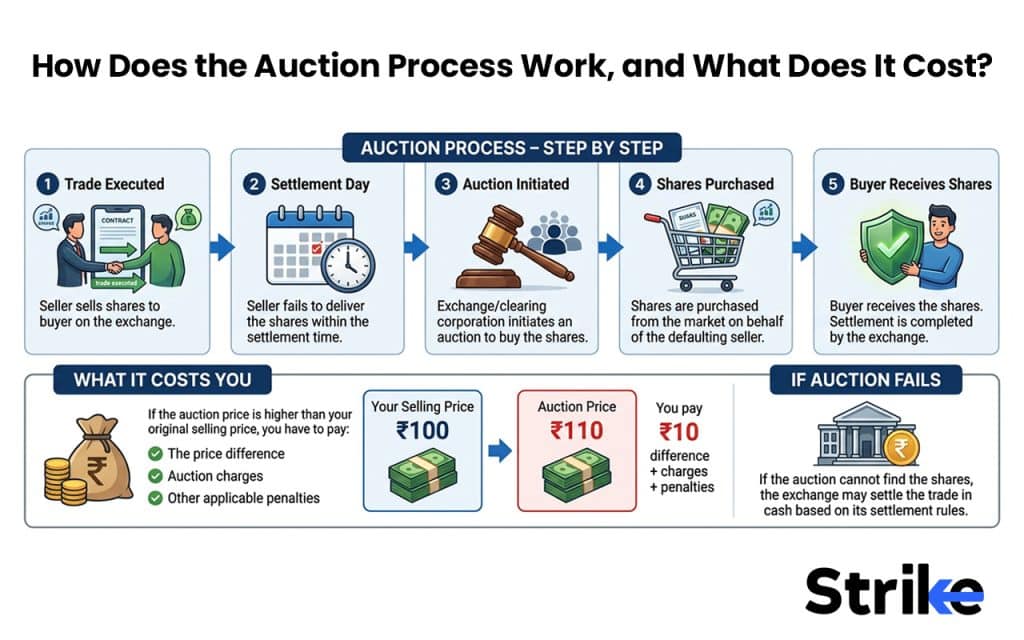
If the auction price is higher than the price at which you originally sold the shares, you will have to pay the difference, along with all the applicable auction charges and penalties. Let’s understand the process using one example.
- I short sold the share at ₹500, but failed to deliver during the settlement process.
- The exchange NSE or BSE will conduct an auction to buy the shares on behalf of me so that they can deliver the shares to the buyers.
- Here the exchange will buy the shares at whatever price is available in the market.
- Suppose the exchange bought the shares at ₹515.
- This extra ₹15 is now my loss along with all the applicable auction charges and penalties (usually 0.05% per day of shortage value).
Total cost = (Auction price difference OR close-out cost) + Shortage penalty (0.05%/day) + GST (18%) + Broker-specific charges
In case if the auction cannot find the shares, the exchange may settle the trade in cash based on its settlement rules.
When Does Your Broker Square Off an Unclosed Short?
Brokers will square off your unclosed short position before the end of the trading session. However the exact cut-off time varies among brokers, but it is typically 15–30 minutes before the market closes to avoid delivery-related issues.
However, after the introduction of Closing Auction Session (CAS) from 3 August 2026, auto square-off times were shifted significantly earlier for intraday (MIS) trades on all F&O-enabled cash stocks.
| Asset / Segment | Typical Post-CAS Auto-Square-Off Window | Asset / Segment |
| F&O Stocks (Cash Segment) | 3:05 PM–3:12 PM | F&O Stocks (Cash Segment) |
| Non-F&O Stocks | 3:20 PM–3:25 PM | Non-F&O Stocks |
Two major brokers in India, Zerodha auto square-off, hit exactly by 3:12 PM whereas sherkhan moved its cut-off notably early to 2:56 PM. I would suggest not to rely on auto square-off. Try to buy back the shares by yourself before the trading session ends to avoid unexpected costs or settlement issues.
Did Any Broker Ever Offer STBT?
No, no brokers in India have ever offered STBT trading, because Indian regulations do not allow to carry an overnight short position without borrowing first. However, before SEBI tightened its client securities segregation and pledge/re-pledge rules, few brokers informally allowed to carry overnight short positions by using shares lying in their client pool accounts.
Since this practice was very risky, regulators gradually stepped in and eliminated it through stricter custody and settlement rules. Today, no broker can use a client’s shares to settle another client’s trade.
How Can You Actually Go Short Overnight in India?
Although you can not go short overnight in the cash market in India, still you have five alternative methods that you can use to go short overnight in the Indian market, that to be legally. These methods are stock futures, index futures, buying put options, writing call options, and the Securities Lending and Borrowing (SLB) mechanism.
- Stock & Index Futures: This is the most popular way to short the market overnight, where you sell the futures contract of the desired stock or indices instead of selling the actual stock in cas market. Since you are using a derivatives contract, you don’t need to own actual shares.
- Options (Buy Put or Sell Call): Options is also a derivatives contract just like futures. Here you can either buy a put option or sell a call option to gain if stock or market falls.
- Securities Lending and Borrowing (SLB): This mechanism allows you to borrow a share from someone who already owns it and sell it into the market. Once price drop overnight, you can buy those shares back and return them to the lender and keep the price difference as your profit.
| Method | Capital Required | Risk Profile | Complexity | Stocks Covered | Best For |
| Stock Futures | High (margin required) | High (unlimited loss if price rises) | Medium | F&O stocks only | Experienced traders with a bearish view on a specific stock |
| Index Futures | High (margin required) | High (unlimited loss if index rises) | Medium | Market indices (Nifty, Bank Nifty, etc.) | Traders expecting the overall market to fall |
| Buying a Put Option | Low (premium only) | Low (loss limited to premium) | Easy | Stocks and indices with options | Beginners and traders seeking limited risk |
| Writing a Call Option | High (margin required) | Very High (potentially unlimited loss) | Advanced | Stocks and indices with options | Experienced option sellers |
| SLB (Borrow & Sell Shares) | Medium to High | High | Advanced | Selected SLB-eligible stocks | Traders who want to legally short stocks in the cash market |
Can You Do STBT With Stock Futures?
Yes, you can do STBT trading using stock futures and that’s actually the closest way to do BTST trade. Technically it isn’t called STBT but it still follows the core logic behind STBT trade. Here you sell a future contract today and buy it back tomorrow or on any later date before expiry.
Doing STBT using futures is possible because you are trading in derivatives contracts, not in the cash market. Unlike in the cash market, where you can not sell shares if you don’t own, in the derivatives market no shares are being delivered when you open the position, there is no restriction on carrying a short position overnight.
What Margin Do You Need to Hold a Short Future Overnight?
To carry the short future position overnight you need to have full SPAN margin plus Exposure margin, because holding a position overnight carries the risk of price movements after market hours.
The total margin consists of two parts, a SPAN margin and an Exposure Margin.
- SPAN Margin: SPAN (Standard Portfolio Analysis of Risk) is the primary risk margin calculated by the exchange. It is designed to cover the worst expected one-day loss under normal market conditions which changes daily based on the contract’s volatility.
- Exposure Margin: This is an additional safety buffer collected to protect against larger-than-expected price movements.
So to protect against this risk, SEBI asks brokers to collect the complete margin before allowing the position to be carried forward. In case of MIS or intraday trading the margins are comparatively less (2-3 times less) because it does not carry the overnight risk.
What Happens If You Hold a Short Stock Future to Expiry?
If you hold a short stock future position to expiry, you will have to settle the position by buying the physical shares. Since October 2019 all the stock futures in India have been physically settled, meaning if you don’t buy back the sold futures contract, you will first have to buy the physical shares from the market and then deliver it to the exchange. If you fail to do so, your broker will automatically square off your position before expiry to avoid settlement issues.
Can You Do STBT With Options?
Yes, you can do STBT with options even though it isn’t called STBT but it still follows the core logic behind STBT trade. You can do STBT with options using two different approaches.
- Buy a Put Option: You pay a premium to buy a put. If the stock price falls, the put option usually increases in value, allowing you to make a profit. Your maximum loss is limited to the premium you paid.
- Sell (Write) a Call Option: You receive a premium upfront. If the stock stays below the strike price or falls, you keep the premium. However, if the stock rises sharply, your losses can be very large, so this strategy is suitable only for experienced traders.
However, selling a naked call option carries an unlimited risk. Either hedge your short call position or buy a put option.
Is Buying a Put Safer Than Shorting a Future?
Yes, for most of the traders buying put options is a safer choice because maximum loss in buying put options is limited to the premium you pay. Even if the stock moves sharply against you, you cannot lose more than that amount. There are also no margin calls or daily mark-to-market (MTM) debits, unlike a short futures position. Unlike futures short selling, buying put options does not require SPAN or exposure margin, since your maximum loss is capped at what you paid, hence it is a capital efficient strategy as well.
Why Is Writing a Naked Call the Riskiest Route?
Writing (selling) a naked call is the riskiest way to bet on a falling market because selling naked options carries unlimited risk. Therefore, just like in the short future , writing a naked call requires margin. If stock moves against you, you will receive a margin call from the broker to add more funds. If you hold a stock call option until expiry and it finishes in the money, it can also result in physical settlement, creating delivery obligations.
Can You Do a Real STBT Using SLB?
Yes, legally you can. The Securities Lending and Borrowing (SLB) mechanism is the only way to do a true overnight short sale in the Indian cash market. However, SLB is not ideal for a one-day trade. You have to find shares available for borrowing, pay a borrowing fee, follow the loan period, and complete additional operational steps. For most retail traders, this is far less convenient than using stock futures or put options.
How Does Securities Lending and Borrowing Work?
The SLB (Securities Lending and Borrowing) works in four simple steps that allows you to legally borrow the shares and sell in the market for STBT. These steps are briefly discussed below.
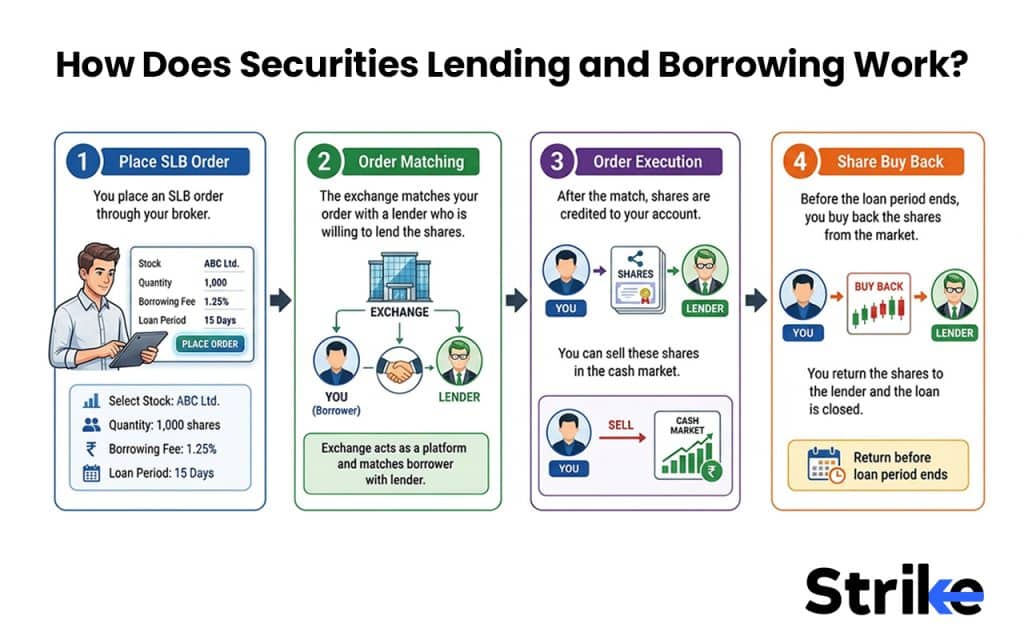
- Place SLB order: Select the stock, quantity, borrowing fee, and load period and place the SLB order through your broker.
- Order Matching: Exchange matches your order with a lender who is willing to lend the shares to you.
- Order Execution: After order matches, you will receive the shares from the lender that you can sell in the cash market.
- Share Buy Back: Before the loan period ends, you buy back the shares and return them to the lender.
Why Doesn’t SLB Suit a One-Day Trade?
SLB is meant for borrowing shares for a set period of time, not for buying and selling them the very next day. Although you can return the shares early in some cases, it isn’t as simple or quick as placing a normal buy or sell order. Besides your trading costs, you also pay several charges, which is why SLB is usually not economical for a one-day trade.
What Does Borrowing Shares Through SLB Cost?
| Cost Component | What It Is | Typical Cost |
| Borrowing Fee | Fee paid to the lender for borrowing the shares. Quoted on an annualized basis and varies by stock demand. | Varies (can range from a few basis points to several percent annually) |
| Clearing Corporation Charges | Fee charged by the clearing corporation for processing the SLB transaction. | Small exchange-prescribed charge |
| Broker Processing Fee | Fee charged by the broker for facilitating the SLB transaction. | Often 20% of the borrowing fee + GST (varies by broker) |
| DP Charges | Charged when shares are debited from the demat account during settlement. | Around ₹13 + GST per debit (varies by DP) |
| Brokerage & Taxes | Normal brokerage, GST, stamp duty, and other applicable charges on the buy/sell transactions. | As per your broker’s pricing |
Which Overnight Short Route Should You Choose?
There is no single best way to carry a short position overnight, but the futures are comparatively better because they provide direct bearish exposure without paying an SLB borrowing fee or dealing with option time decay.
However, you can use the options when you want to limit your maximum loss to the premium paid, while use SLB when you don’t have futures and options contracts available for selected stocks.
How Much Does an Overnight Short Actually Cost?
The cost of having an overnight short position depends on how you have created that position. In India, you mainly have three major ways to create overnight short positions, that is by using SLB, futures or options. So let’s break down the actual cost of overnight short for all three ways.
| Cost for overnight short using SLB | ||
| Charge | Rate | Actual cost |
| SLB borrowing fee | Variable | ₹10,000* |
| Broker processing fee | 20% of borrowing fee | ₹2,000 |
| GST on processing fee | 18% | ₹360 |
| NSE SLB transaction charge | Currently waived | ₹0 |
| STT on SLB borrowing transaction | Not applicable | ₹0 |
| Total SLB borrowing cost | — | ₹12,360 |
| Cost for overnight short using futures | ||
| Charge | Rate | Approx. cost |
| Brokerage | Broker-dependent | Varies |
| STT | 0.05% on sell value | ₹500 |
| Exchange transaction charge | Exchange-dependent | Small variable cost |
| SEBI turnover fee | 0.0001% of turnover | ~₹2 for ₹20 lakh total turnover |
| Stamp duty | 0.002% on buy side | ₹20 |
| GST | 18% of brokerage + applicable exchange charges | Varies |
| Total before brokerage/exchange charges | — | At least ~₹522 + GST on applicable charges |
| Cost for overnight short using put buying | ||
| Charge | Rate | Approx. cost |
| Option premium | Market price | ₹20,000 |
| Brokerage | Broker-dependent | Varies |
| STT on purchase | Nil for normal option purchase | ₹0 |
| Exchange transaction charge | Exchange-dependent | Based on premium turnover |
| SEBI turnover fee | 0.0001% of turnover | Small |
| Stamp duty | 0.003% on buy side | ₹0.60 on ₹20,000 premium |
| GST | 18% of brokerage + applicable exchange charges | Varies |
| Cost for overnight short using call selling | ||
| Charge | Rate | Approx. cost |
| STT | 0.15% of option premium | ₹30 |
| Brokerage | Broker-dependent | Varies |
| Exchange transaction charge | Exchange-dependent | Based on premium turnover |
| SEBI turnover fee | 0.0001% of turnover | Small |
| GST | 18% of brokerage + applicable exchange charges | Varies |
| Margin | Required | Depends on position |
For an overnight short, futures have predictable transaction costs, SLB has highly variable borrowing costs, and options have lower direct transaction taxes relative to notional exposure but introduce premium decay or strategy-specific risk.
Has SEBI Changed the Short-Selling Rules Recently?
No, SEBI’s current short selling framework is still working on the same framework issued on January 5, 2024 according to which a short selling for both retail and institutions is still allowed, while naked short selling is still not allowed.
In December 2025, SEBI specifically clarified that there had been no change in the existing short-selling framework, after reports suggested new rules were coming into effect.
How Have the 2024–26 F&O Changes Affected STBT?
The 2024-26 F&O changes have increased the cost, capital requirement, and execution environment for traders using stock or index futures and options for STBT-style overnight short positions.
- Fewer weekly expiries: Fewer short-term expiry contracts have reduced some very short-term STBT opportunities.
- Larger lot sizes: Larger lot size requires more capital and carries a larger risk.
- Higher expiry-day margin requirements: Short index-option positions face an additional 2% ELM on expiry day, making expiry-focused short strategies more expensive.
- Higher transaction costs: Changes in STT from 0.10% to 0.15% have increased the cost of derivative trades, reducing the profitability of very small STBT moves.
STBT is still possible, but the newer F&O rules have made short-term overnight strategies more capital-intensive, with fewer expiry choices and higher costs.
What Are the Risks of Holding a Short Overnight?
There are five major risks of holding a short overnight. THe risks are gap-up risk, overnight news risk, margin risk, borrowing cost, and liquidity risk.
- Gap-up risk: A stock can open much higher than your selling price because of overnight news.
- Overnight news risk: Results, government announcements, global events or company news can cause a large positive move before the market opens.
- Margin risk: A sharp move against you can increase your margin requirement due to increasing risk. If you fail to do so, the broker might ask you to close the position.
- Borrowing cost: If you use SLB to hold a cash-market short, you also pay a borrowing/lending fee. The cost can increase when demand for borrowing the stock is high.
- Liquidity risk: If the stock opens with very few buyers or sellers, you may struggle to exit your position at your expected price.
Can NRIs Do STBT or Short Selling?
No, NRIs generally cannot do STBT or short selling in the Indian cash market, because for NRIs, there is an additional restriction under the NRI investment rules, which says NRIs cash market transaction is required to be delivery-based. Since STBT involves selling shares today and buying them back later without taking delivery, NRIs cannot use this route in the cash market. So, the difference is not that SEBI bans short selling for everyone. The extra restriction on NRIs comes from the rules governing NRI investments.
Is STBT Allowed in Commodity and Currency Markets?
Yes, you can trade STBT in commodity and currency and it is comparatively less complex than trading STBT in stocks because commodity and currency are derivative markets, so selling first and buying later (an overnight short position) is completely allowed.
| Market | Can You Hold a Short Overnight? | How It Settles | Best For |
| Equity Cash | No | Share delivery (T+1) | Delivery-based investing |
| Stock Futures | Yes | Physical settlement at expiry | Shorting individual stocks |
| Commodity Futures (MCX) | Yes | Cash-settled or delivery-settled (depends on the contract) | Trading gold, crude oil, silver, etc. |
| Currency Futures (NSE) | Yes | Cash settled | Trading USD/INR, EUR/INR, GBP/INR, JPY/INR |
STBT in the stock market needs a workaround because you cannot normally sell shares you don’t own overnight. But in commodity and currency derivatives, you can simply take a short position and hold it overnight—this is a normal feature of these markets.
How Is Profit From an Overnight Short Taxed?
The taxes on overnight short profit depends on how you took a trade. Since you can not do STBT trade in the cash market in India, you do it by selling futures, buying puts and using SLB mechanism. Therefore, how your overnight profits are being taxed, totally depends on what method you have used for STBT.
The table below shows how your overnight profits are getting taxed based on method of trading.
| Route | Tax head | Rate | ITR form | Loss carry-forward |
| Futures short | Non-speculative business income | Your income slab rate | ITR-3 | 8 years, vs. non-speculative income |
| Options (put buy / call write) | Non-speculative business income | Your income slab rate | ITR-3 | 8 years, vs. non-speculative income |
| SLB-based cash short | STCG (if occasional) / business income (if frequent) | 20% (STCG) or slab rate (business) | ITR-2 or ITR-3 | Varies by classification |
Profits from SLB are generally treated as capital gains for investors. However, if you frequently use SLB as part of a trading business, the Income Tax Department may treat the profits as business income.
What Is the Difference Between STBT, BTST, Intraday Shorting and Short Selling?
The difference between STBT, BTST, Intraday Shorting and Short Selling is briefly discussed below in the table.
| Aspect | Intraday Shorting | STBT (Sell Today, Buy Tomorrow) | BTST (Buy Today, Sell Tomorrow) | Short Selling (General) |
| Full Form | Sell & buy back same day | Sell Today, Buy Tomorrow | Buy Today, Sell Tomorrow | N/A — umbrella term |
| First Action | Sell (without owning) | Sell (without owning) | Buy | Sell (without owning) |
| Second Action | Buy back | Buy back | Sell | Buy back |
| Holding Period | Same trading day only | Overnight / multi-day | Overnight (1 day, before delivery) | Any duration |
| Segment Used | Cash/Equity (most common) | Mostly Futures & Options (F&O); not standard in cash | Cash/Equity | Any (Cash, F&O) |
| Ownership at Time of Sale | Don’t own shares | Don’t own shares | Don’t own shares yet (bought but not settled) | Don’t own shares |
| Settlement Risk | None — squared off same day | Low if via F&O; requires borrowing in cash segment | Auction penalty risk if delivery fails | Depends on method used |
| Auto Square-off | Yes, by broker near market close if not closed | Not applicable (F&O carries forward) | Not applicable | Depends on segment/method |
| Retail Availability in India | Widely available | Limited (mainly via F&O or broker-specific products) | Widely available | Depends on execution method |
| Risk Level | Moderate (single-day volatility) | Higher (overnight risk + margin) | Moderate (settlement/auction risk) | Varies |
| Best Suited For | Traders confident of same-day reversal | Traders wanting to short beyond 1 day | Traders wanting quick profit before delivery | General short-term bearish bets |
What Mistakes Do Traders Make When Trying STBT?
There are five common mistakes traders make when trying to do STBT. These mistakes are briefly discussed below.
- Assuming STBT Is Allowed in the Cash Market: Indian exchanges don’t allow short selling of stock overnight. However, you can do it through the SLB mechanism.
- Confusing Intraday Short Selling With STBT: Since you can short sell the stock intraday, but you can;t carry that short position overnight. The short position must be squared off on the same day.
- Selecting MIS instead of NRML on futures/options: MIS order type is for intraday. Even though you use futures or options for STBT, selecting MIS order type will square off your position on the same day. Hence, carefully select the NRML order type.
- Ignoring the unlimited-loss risk of a naked short: One positive news can move stock significantly up the next day, where your short future or short call option can give you significant risk. Consider hedging or buying a put option instead.
- Holding a short stock future too close to expiry: Indian stock futures are physically settled, which means if you hold your short future position till expiry, you will have to deliver those shares, plus margin requirements spike right before that date.
Almost every mistake stems from treating STBT as one simple trade idea, when it actually forces traders into a different product (F&O or SLB), each with its own separate rules for order type, margin, risk, and expiry that need to be respected on their own terms.
What Should You Take Away About STBT?
There are four major points that you should take away from STBT. These points are briefly discussed below.
- STBT is not allowed in the Indian cash market, but you can do it through the SLB mechanism.
- Stock futures, index futures, and options are alternatives to carry the position overnight for SLB trading.
- Stock futures are physically settled at expiry, which means you may have to deliver the shares if not exited or rolled over the position.
- Overnight short selling carries a significant risk.
Overall, STBT is not banned in India, it’s just disguised as something else. Whether you call it a short future, a long put, or a borrowed share, the goal is the same: profit from tomorrow’s price being lower than today’s.

 5 mins