CNC, MIS and NRML: Full Form, Meaning, Differences, Which One to Choose & When


 Author

 Editor
MIS, CNC, and NRML are three main product or order types that often confuses beginner traders on which one to choose and how it works. MIS, CNC, and NRML are very important concepts to understand as they decide whether your trade is meant for intraday, delivery, or carry-forward positions. Along with this, they also affect your margin requirement, costs, and risk.
| Segment | Leverage | Auto Square-off | Holding Period | Typical User |
| CNC | None, full value required | No | Unlimited (1 day to years) | Investors, long-term holders |
| MIS | High (5x–20x, broker-dependent) | Yes, forced near market close | Same day only | Active intraday traders |
| NRML | None, full SPAN + exposure margin | No | Till expiry (F&O) | Overnight/positional F&O traders |
In the Thai blog we are going to learn about MIS, CNC, and NRML in detail to understand what they are, how they differ, when to use each one, and which product type is best for different trading styles.
What Is CNC (Cash and Carry)?
CNC stands for Cash and Carry is a product type provided by your broker that allows you to buy and hold the shares for a longer period of time (days, weeks, months, or years).
Unlike intraday trading, where you get 4-5X leverage and have to square-off the positions on the same day. CNC does not allow leverage and allows you to hold the position until you choose to sell. Use CNC order type when you’re investing or doing swing trading.
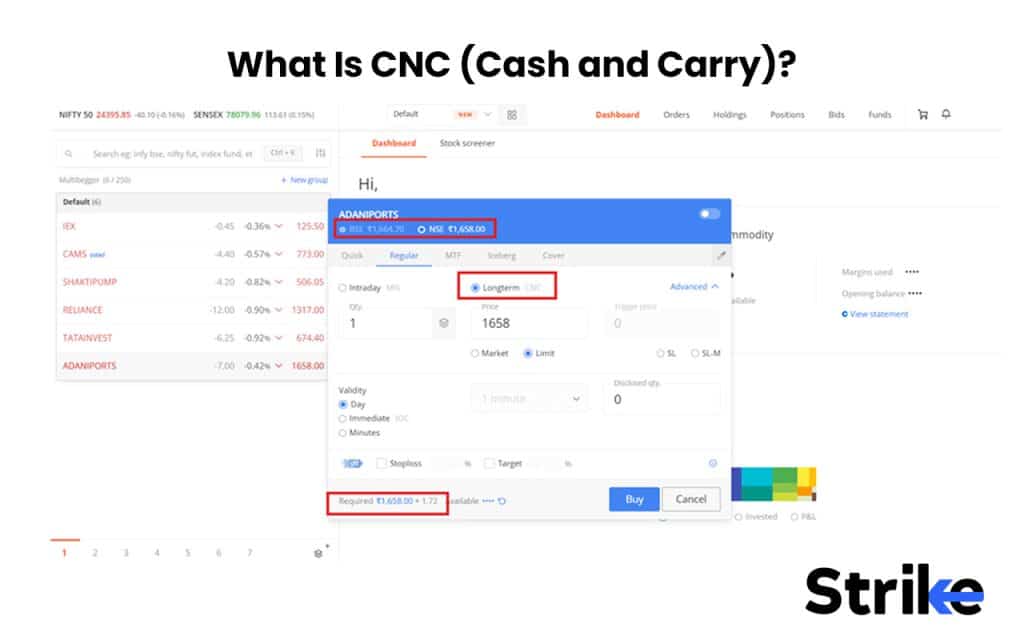
As you can see in the above screenshot, we are trying to invest in ADANIPORTS stock using CNC/Longterm product type. The share is currently trading at ₹1658 and the margin we require for the stock using CNC is also ₹1658. This means we are not getting any leverage here.
What Is MIS (Margin Intraday Square-off)?
MIS stands for Margin Intraday Square-off is a product or order type specifically designed for intraday trades which allows traders to execute trades using leverage.
Since it is designed for intraday trades, positions must be opened and closed within the same trading session. If not, the broker will automatically square-off your MIS order. Along with equity, you can also use MIS order type on futures, options, and currency segments.
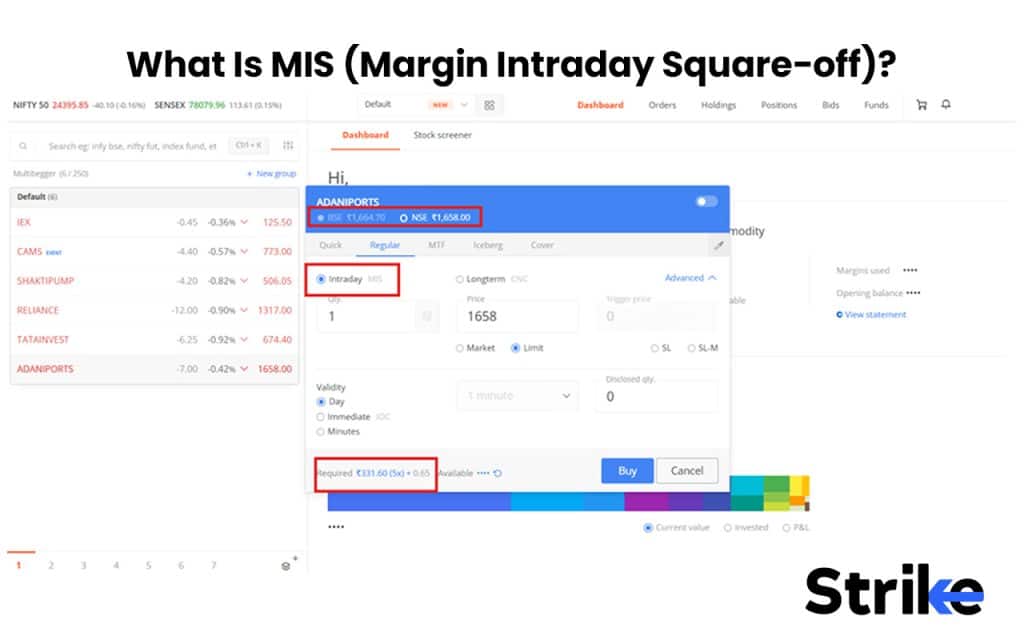
As you can see in the above screenshot, we again tried buying ADANIPORTS stock, but this time we tried to buy it for intraday trading. We used the Intraday/MIS order type to buy the share. The share is currently trading at ₹1658 but the margin we require to buy is only ₹331.60. This means, here we are getting 5X leverage.
What Is NRML (Normal)?
NRML stands for Normal, is an order type that traders use exclusively for carrying futures and options (and currency derivatives) positions beyond the trading day, up to expiry. While placing an NRML order, you pay the exchange-mandated margin (SPAN + exposure margin) to the broker.
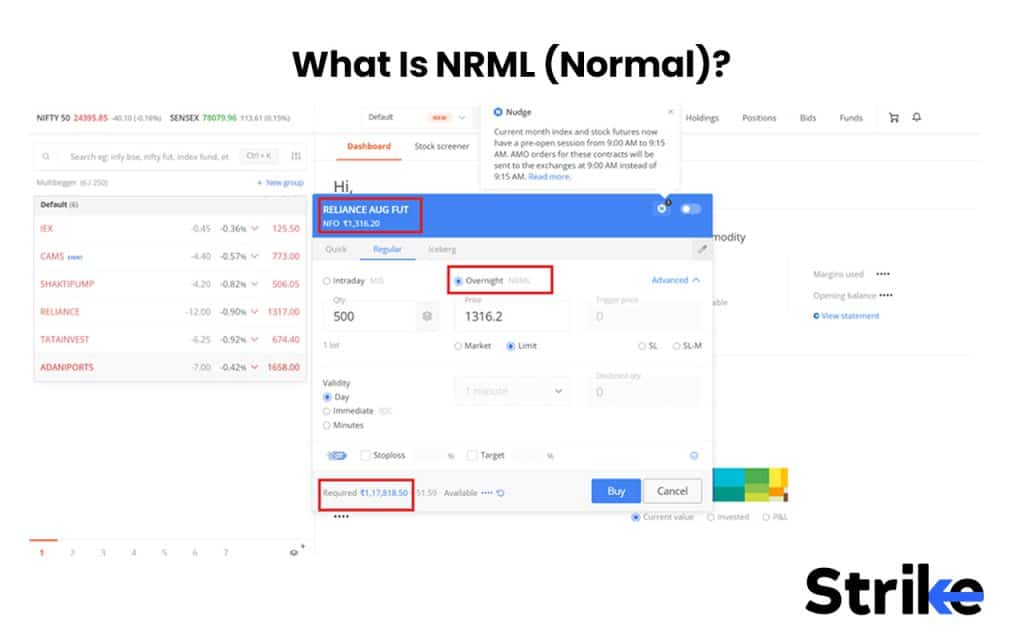
As you can see in the above screenshoot, its return overnight / NRML means if you want to carry the futures position overnight, you should select NRML.
What’s the Difference Between CNC, MIS and NRML?
The difference between CNC, MIS and NRML is briefly discussed below in the table.
| CNC | MIS | NRML | |
| Full form | Cash and Carry | Margin Intraday Square-off | Normal |
| Used for | Equity delivery | Intraday equity/F&O/currency | F&O/currency carry-forward |
| Leverage | None | High (varies by stock) | Exchange-mandated margin only |
| Auto square-off | Never | Yes, before session close | No |
| Holding period | Unlimited | Same day only | Until expiry |
| Need existing holdings to sell? | Yes | No | No |
| Best For | Delivery/Swing | Intraday | Positional F&O |
Hence, the main difference is not the leverage, but the difference in holding period. CNC, MIS, and NRML are designed to carry your trade for different time periods.
Which Product Type Should You Use?
The right product type to use while executing your order depends on how long you plan to hold the trade and which market segment you’re trading in. The table below simply explains the best product type to use in different scenarios.
| Purpose | Product Type | Best For |
| For holding stocks for days, months, or years | CNC (Cash and Carry) | Long-term investing and swing trading |
| For buying or selling stocks only for the same trading day using intraday margin | MIS (Margin Intraday Square-off) | Intraday trading |
| For carrying futures or options positions overnight | NRML (Normal) | Positional F&O trading |
| To trade futures or options only for the same day (if supported by your broker) | MIS | Intraday F&O trading |
This is general product-type mechanics, not investment advice — how much leverage or which segment suits your situation depends on your own risk appetite and capital, so weigh that separately.
How Much Leverage Do You Actually Get With MIS?
There is no fixed percentage or number for how much leverage you actually get with MIS, but it usually stays around 3x to 5x. The leverage on MIS depends on the specific stock’s volatility and liquidity. Based on these factors your broker decides the leverage for a particular stock. You can check the available leverage using your broker’s margin calculator.
Earlier, brokers used to offer very high leverage, sometimes more than 20 times of the actual capital. However, after SEBI introduced intraday peak margin regulations in July 2020, give leverage beyond the VaR (Value at Risk) + ELM (Extreme Loss Margin) required for a stock. As a result, today’s intraday leverage is usually around 3x to 5x, depending on the stock.
What Is MTF, and How Is It Different From CNC and MIS?
MTF stands for Margin Trading Facility. It is a facility provided by a broker that lets you buy the shares for delivery using leverage. MTF is basically a combination of CNC and MIS. CNC gives you delivery without leverage, MIS gives you leverage without delivery, where MTF gives you both leverage and delivery.
In MTF you only pay a fraction of the amount (often around 20–25% margin), and the broker pays the rest by pledging your shares, typically giving up to 4x exposure on eligible stocks.
However, the broker charges daily interest on the amount he funded to you for buying shares, which commonly ranges from 9-15% per annum. Along with this you also pay pledge/unpledge fees and DP charges when you sell.
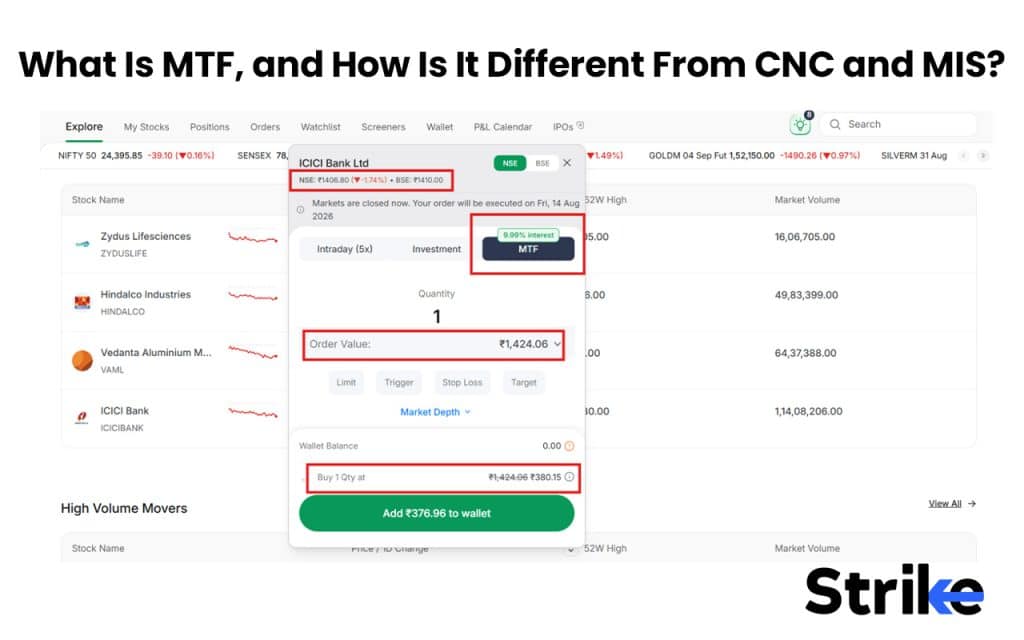
As you can see in the above screenshot, I tried buying ICICI Bank stock using MTF. The current market price of ICICI Bank stock is ₹1406 but I am getting the share only at ₹380.15. Here the remaining money is paid by the broker where he will charge 9.99% interest from me.
What Happened to Bracket and Cover Orders?
Bracket order and cover order were the popular intraday order types that used to allow traders to take high leverage entry with a mandatory stop-loss and target. However, these order types are discontinued from March 2020 after SEBI’s introduced a peak-margin rule.
According to the peak margin rule, brokers must collect and maintain the required margin for a trader’s position throughout the trading day, not just at the time the trade is placed. As a result, the biggest advantage of BO and CO, the extra leverage for trades with a mandatory stop-loss largely disappeared.
Hence, the bracket order (BO) and cover order (CO) are discontinued and traders now use MIS order type for intraday trading.
When Are Intraday Positions Auto Squared Off?
Intraday positions auto square off before exchange closes, typically 10 to 15 minutes before market close.
Earlier the auto square-off time for most of the brokers was around 3:15 PM and 3:25PM, but after the introduction of Closing Auction Session (CAS) from 3 August 2026, auto square-off time are shifted significantly earlier for intraday (MIS) trades on all F&O-enabled cash stocks.
Since CAS eligible stocks are allowed to trade till 3:15 PM, the brokers have moved their Risk Management System (RMS) engines ahead to clear out positions between 2:56 PM and 3:12 PM.
| Asset / Segment | Typical Post-CAS Auto-Square-Off Window | Asset / Segment |
| F&O Stocks (Cash Segment) | 3:05 PM–3:12 PM | F&O Stocks (Cash Segment) |
| Non-F&O Stocks | 3:20 PM–3:25 PM | Non-F&O Stocks |
Two major brokers in India, Zerodha auto square-off, hit exactly by 3:12 PM whereas sherkhan moved its cut-off notably early to 2:56 PM. Also, don’t plan your trade based on brokers auto-square off time, consider it as a risk management tool only.
What Does an Auto Square-off Cost You?
An auto square-off costs you a flat penalty charge and a worse execution price.
- A flat penalty charge: Brokers charge an extra fee per auto-squared-off order apart from normal brokerage. In India this charge ranges from ₹20 to ₹50 per auto square-off order with + 18% GST.
- A worse execution price. Auto square-off order doesn’t wait for your ideal exit, it exits the trade (often at market price) the moment the cut-off hits, which can mean slippage against you, especially in a fast-moving stock.
Therefore always close MIS trades yourself before the deadline rather than relying on the auto square-off as your exit plan.
Why Else Might Your Broker Square Off Your Position?
There are four scenarios where your broker can square off your position without waiting for the daily intraday deadline. These scenarios are briefly discussed below.
- Losses eat into a large chunk of your margin; brokers have a threshold (sometimes cited around 50% of margin used) beyond which their risk management system (RMS) intervenes automatically.
- You have a margin shortfall and don’t top up in time.
- The stock hits a circuit limit or enters an exchange-imposed restriction.
- A corporate action (like an ex-date event) forces early closure of certain leveraged positions, including some MTF holdings.
How Do You Convert MIS to CNC or NRML?
You can convert the product type from the Positions tab next to the open position. Look for the convert option, then select the target product type (CNC or NRML). However, the conversion will only happen if you have sufficient margin/funds to support the new product type, since CNC requires full payment and NRML requires exchange margin rather than intraday leverage.
By When Must You Convert?
You will have to convert the MIS to CNC or NRML before the intraday auto square-off cut-off time. Once you miss this, the system will treat it as a normal MIS order and square it off automatically rather than let it carry forward.
What Happens If You Don’t Have the Funds?
If you don’t have enough funds during the time of conversion, the conversion process will fail and position remains MIS and will get squared off automatically.
Can You Short Sell Using CNC?
No, you can not short sell using CNC, because the concept of CNC is built around already owning the shares in your demat account. If you want to sell using CNC, you should first have real shares in your demat account. If you try to create a fresh short position using CNC, it won’t get executed.
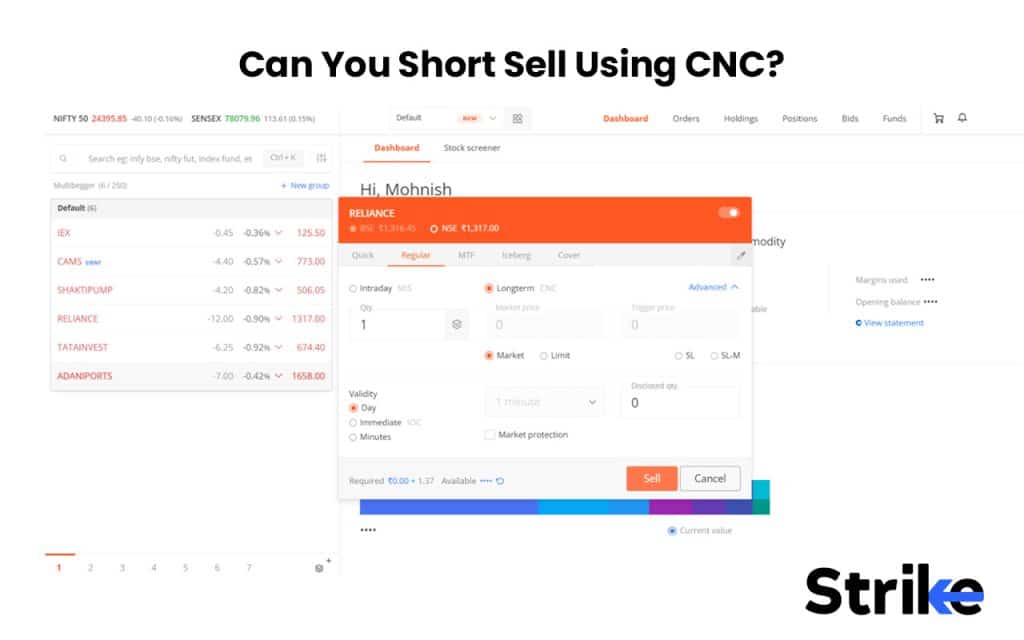
As you can see in the screenshot above, an error message popped after I tried placing a short sell order using CNC. The message is telling insufficient stock holding, means i dont already own the stock to sell it. Therefore, a pure short selling for equity is only possible intraday, using MIS, any short position must be squared off (bought back) the same day.
Which Product Type Costs You More?
CNC (delivery) traders generally cost you more compared to MIS (Intraday) and NRML, because of two specific reasons, STT and DP charges.
- DP charges: When you buy the shares using CNC, the actual shares get credited in your demat account. Once you sell those shares, you pay a depository participant (DP) charge, which is typically ₹13–20+ GST at most brokers, regardless of quantity or value. Whereas in MIS and NRML positions never touch your demat and nothing is credited, so there’s nothing to debit, so this charge simply doesn’t exist for MIS and NRML.
- STT: It is the biggest reason why CNC is more costly. CNC orders have a higher Securities Transaction Tax (STT) than MIS or NRML.
| Order Type | STT Rate | Charged On |
| CNC (Delivery) | 0.1% | Buy and Sell |
| MIS (Intraday) | 0.025% | Sell only |
| NRML (Futures) | 0.02% | Sell only |
| NRML (Options) | 0.1% of premium (on option sale) | Sell only |
So if you buy and sell shares worth ₹1,00,000, the STT charges will defer based on order type.
- For CNC (Delivery) order type: ₹100 STT on buy + ₹100 on sell = ₹200 total
- For MIS (Intraday) order type: ₹0 on buy + ₹25 on sell = ₹25 total
That’s an 8x STT difference for the identical trade value, purely because delivery gets taxed on both legs while intraday only gets taxed once, at a quarter of the rate. This is why a delivery trade usually costs more than an intraday trade, even if the brokerage is the same.
Why Is STT Higher on a CNC Sell?
STT is higher on CNC because in CNC trade you become the actual owner of the shares and those shares get delivered or transferred to your demat account. Since a delivery trade involves a complete transfer of ownership, the government levies a higher STT.
| Order Type | STT Rate | Charged On |
| CNC (Delivery) | 0.1% | Buy and Sell |
| MIS (Intraday) | 0.025% | Sell only |
| NRML (Futures) | 0.02% | Sell only |
| NRML (Options) | 0.1% of premium (on option sale) | Sell only |
Whereas in MIS or NRML, no real shares hit your demat account and hence there is no transfer of ownership, the STT charged on intraday equity trades is much lower.
When Do DP Charges Apply?
Dp (Depository Participation) charges apply when you sell your shares that you were holding in your demat account. Once your share leaves your demat account, a DP charge is applied, which is typically ₹13–20+ GST at most brokers regardless of quantity. .
How Is Each Product Type Taxed?
CNC, MIS, and NRML are taxed differently. CNC profits are taxed as capital gain, MIS profits are taxed as speculative business income, and NRML (F&O) profits are taxed as a non-speculative income. The difference in the taxing system among these products directly affects how much tax you pay, which ITR form you file and how losses can be adjusted.
| Product | Income head | Section | Tax rate |
| CNC – If held more than 12 months | Long-Term Capital Gains (LTCG) | 112A | 12.5% on gains exceeding ₹1.25 lakh per year, with no indexation benefit. |
| CNC – If held less than 12 months | Short-Term Capital Gains (STCG) | 111A | Flat 20%, with no deductions or basic exemption available against it. |
| MIS (intraday equity) | Speculative business income | Section 43(5) | Taxed at your income slab rate, up to 30%. |
| NRML (F&O) | Non-speculative business income | Section 43(5) proviso (d) | Business income, taxed at slab rate, not the 20%/12.5% capital gains rates |
If you trade CNC frequently with the intention of earning short-term profits, the Income Tax Department may classify your gains as business income instead of capital gains.
Why Can’t You Use MIS on Some Stocks?
There are three major reasons why you can’t use MIS on some stocks. The reasons are briefly discussed below.
- The stock is in the exchange’s F&O ban period (relevant if you’re trading derivatives on it).
- It’s under a trade-to-trade (T2T) or surveillance segment, where exchanges restrict intraday trading to curb speculation, you can only trade these for delivery.
- Your broker’s own risk management system has flagged the stock as too illiquid or volatile to offer intraday leverage on.
What Do Other Brokers Call CNC, MIS and NRML?
CNC/MIS/NRML are the standard terms popularized by zerodha’s Kite platform, where several other popular brokers also use the same terminology. However some brokers use a bit different terminology for the same underlying mechanics, like “Delivery” for CNC, “Intraday” for MIS, and “Margin”/”Carryforward” for NRML.
If you’re not sure what your broker calls each product type, the safest way to confirm is to check your broker’s own order-placement help page, since exact naming isn’t standardized across the industry.
Which Product Type Do You Use for BTST?
We typically use CNC order to carry out the BTST (Buy Today, Sell Tomorrow) trade because it is a delivery based trading style. We buy shares today using CNC and sell it on the next day (T+1 day) before the full settlement cycle completes. If you’re using MTF instead of CNC, you can still do BTST, but interest on the borrowed amount starts accruing from day one.
Why Was Your Order Rejected?
There are five common reasons for why your order gets rejected.
- Insufficient margin or funds for the product type you selected.
- Selecting the wrong product type. For instance, trying to sell under CNC without owning the shares.
- Stock might be under exchange restriction (T2T, ASM/GSM surveillance, F&O ban) blocking the product type you chose.
- Price outside the circuit or exchange range, or a temporary trading halt on that stock.
- RMS block from your broker due to volatility, low liquidity, or account-specific risk flags.
If your order ever gets rejected, check for the above mentioned problems.
What Mistakes Do Traders Make With Product Types?
There are five common mistakes a trader makes while selecting a product type.
- Ignoring auto square-off charges which is around ₹50 per order in most indian brokers.
- Assuming that the MIS and CNC will be taxed the same way. MIS are taxed as speculative business income, while CNC profits are taxed as capital gains.
- Getting confused between MTF and CNC. MTF is a leveraged based delivery, where you pay daily interest, whereas CNC is not a leveraged product.
- Not checking the required margin before converting from MIS to CNC. This leads to failure of conversion and position to be squared off.
- Shorting under the CNC instead of MIS, which the platform won’t allow.
Choosing the right product type helps you avoid unnecessary charges, margin issues, and unexpected square-offs.

 5 mins