LTCG Tax on Shares in India: Rates, the ₹1.25 Lakh Exemption, and Step-by-Step Calculation


 Author

 Editor
LTCG, or Long-Term Capital Gains, is the profit you make when you sell listed shares after holding them for more than 12 months. LTCG tax is currently 12.5% on gains exceeding ₹1.25 lakh in a financial year, subject to applicable conditions.
But the 12.5% rate is not the whole story. Surcharge, cess, capital losses, and your total income can also affect your final tax. So, how much LTCG tax do you actually pay? Let’s understand the rules with simple examples.
What Is Long Term Capital Gain(LTCG) Tax on Shares?
Long Term Capital Gain (LTCG) tax on shares is a tax that you pay on profit you make after selling your shares that you have held for more than 12 months. So, if you hold stock for more than 1 year, and sell them at a profit, you will have to pay 12.5% tax on the profit amount.
However, profit up-to ₹1.25 lakhs is tax free. 12.5% LTCG tax only applies on profit above ₹1.25 lakhs.
What Is the Current LTCG Rate in India Right Now?
As of 2026, the Long Term Capital Gain (LTCG) tax on eligible listed equity shares covered under Section 112A is 12.5%, only on gains above ₹1.25 lakh in a financial year, which means, you don’t have to pay any tax on profit less than ₹1.25 lakh in a single financial year.
However, if profit exceeds ₹1.25 lakh, you will need to pay LTCG of 12.5% on profit above ₹1.25 lakh.
Let me explain with a simple example. Suppose you have made a profit of ₹5,00,000 in a single financial year.
- Total LTCG: ₹5,00,000
- Exempt amount: ₹1,25,000
- Taxable LTCG: ₹3,75,000
- LTCG tax at 12.5%: ₹46,875
Here we have paid a LTCG tax on ₹3,75,000 instead of ₹5,00,000, as ₹1,25,000 got exempted. It is also important to note, ₹1.25 lakh exemption is from total LTCG not for each stock gain.
Which Act and Section Applies to You Now?
Earlier it was the Income-tax Act, 1961, which used to govern the LTCG tax, but from 1 April 2026, the old act got replaced by the Income-tax Act, 2025.
However, the basic tax rule is largely the same, but many section numbers have changed.
| Type of Gain | Earlier: Income-tax Act, 1961 | From 1 April 2026: Income-tax Act, 2025 |
| LTCG on eligible listed shares | Section 112A | Section 198 |
| STCG on eligible listed shares | Section 111A | Section 196 |
Now the question is which one of these acts applies to you?
- If you have gained your LTCG before 1 April 2026, the old act (Income-tax Act, 1961) will be applied.
- If you have gained your LTCG from 1 April 2026 onwards, the new act ( Income-tax Act, 2025) will be applied.
So, if you are reading older tax information, you may still see references to Section 112A and Section 111A. For transactions covered by the new Act, you need to use the corresponding provisions under the Income-tax Act, 2025.
How Do We Calculate LTCG on Shares?
There are three simple steps to follow for calculating LTCG tax. Let’s calculate the LTCG tax for one of the best trades we captured in Tata Power. We bought 1000 stocks of Tata Power at ₹204 on 3 May 2023 after stock broke the falling wedge pattern. We held the stock for almost two years (542 days) and exited at ₹414 after it broke the support trendline.
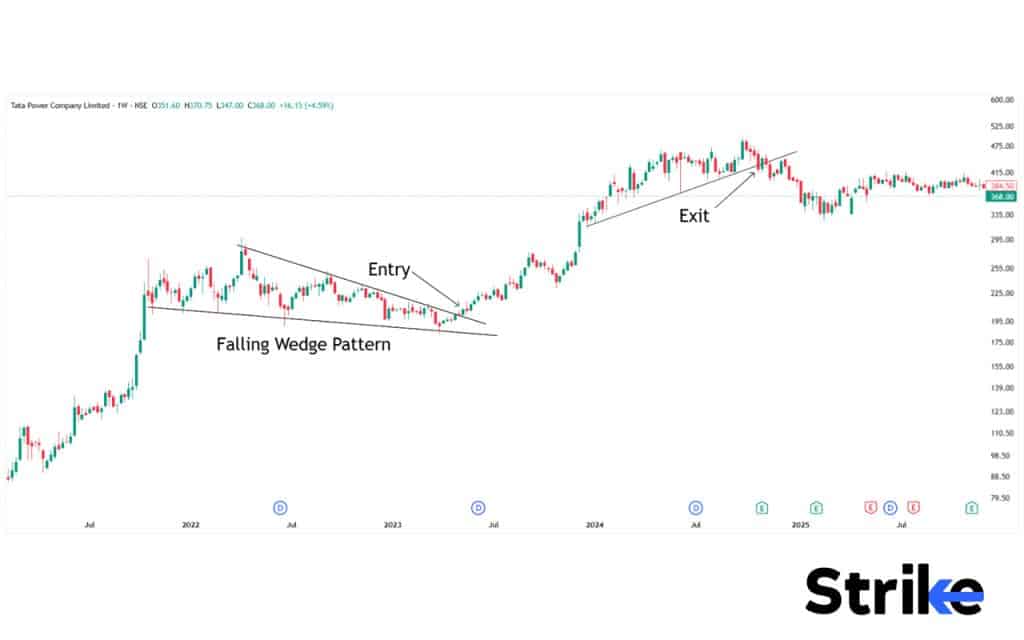
Step 1: Calculate the LTCG (Long Term Capital Gain) by subtracting buying amount from and charges from selling amount.
LTCG = Sale Price − Cost of Acquisition − Eligible Transfer Expenses
| Item | Value |
| Buying cost | 1,000 × ₹204 = ₹2,04,000 |
| Selling cost | 1,000 × ₹414 = ₹4,14,000 |
| Gross profit | ₹2,10,000 |
Step 2: Deduct the eligible transfer expenses (Zerodha)
| Charge | Amount |
| Brokerage | ₹0 |
| STT (0.1% buy + 0.1% sell) | ₹618.00 |
| Exchange transaction charge (NSE) | ₹19.89 |
| SEBI charges | ₹0.62 |
| GST (on SEBI + txn charges) | ₹3.69 |
| Stamp duty (buy side, 0.015%) | ₹30.60 |
| DP charge (on sell) | ₹15.93 |
| Total charges | ≈ ₹688.73 |
Note that, DP charges vary across brokers between ₹15 – ₹20.
Step 3: Calculate LTCG tax
Under Section 112A LTCG on listed shares (STT paid) is exempt up to ₹1,25,000 per financial year and gains above that are taxed at a flat 12.5% (no indexation benefit).
As before, STT is excluded from the cost calculation, only non-STT charges are netted off.
Taxable gain (before exemption) = Gross profit − Non-STT charges
= ₹2,10,000 − ₹70.73
= ₹2,09,929
Now from this taxable gain we will subtract the LTCG exemption amount of ₹1,25,000 to get net taxable LTCG.
Net taxable LTCG = ₹2,09,929 – ₹1,25,000 = ₹84,929
Lets now tax the net taxable income at 12.5% which comes nearly ₹10,616. This is your tax before cess. After adding 4% cess charge (₹425), our total LTCG tax comes to ₹11,041.
| Summary of LTCG tax | |
| Gross profit | ₹2,10,000 |
| Less: Zerodha charges | ₹689 |
| Less: LTCG tax (12.5% + cess, after ₹1.25L exemption) | ₹11,041 |
| Net take-home profit | ≈ ₹1,98,270 |
So out of your ₹2,10,000 gross gain on Tata Power, you’d keep roughly ₹1,98,300. The ₹1.25 lakh annual exemption does a lot of heavy lifting here compared to the STCG case, where every rupee of profit gets taxed.
How Long Must You Hold Shares to Qualify?
You must hold shares for more than 12 months to qualify for a long-term capital gains (LTCG) tax. If you sell your holdings before 12 months, you will be taxed a short term capital gain (STCG) tax instead at 20%.
How Do You Reduce LTCG on Shares Legally?
There are four different methods to reduce the LTCG tax on shares legally. These methods are briefly discussed below.
Annual exemption harvesting
In this method, we try to book tax free gains up to ₹1.25 lakh every year by selling the shares and immediately buying the shares back.
Let me explain this using an example. For instance, you have bought shares for ₹5 lakh. After one year, they are worth ₹6.25 lakh.
Total profit = ₹6.25 lakh – ₹5 lakh = ₹1.25 lakh
Since there is no LTCG tax on profit up-to ₹1.25 lakh, you sell the shares and book ₹1.25 lakh as a tax free profit and immediately buy the shares. Now your new purchase price is ₹6.25 lakh.
Now, after one year of your new purchase, your new ₹6.25 lakh invested amount becomes ₹8 lakh.
Total profit = ₹8 lakh – ₹6.25 lakh = ₹1.75 lakh new gain
Again book the tax free profit of 1.25 lakhs and immediately buy the sold shares. Repeating this process realizes your gain and resets your cost base higher every time.
If you would not have sold the shares after one year with ₹1.25 lakh, your gain would have been ₹3 lakh.
Total profit without harvesting = ₹8 lakh (investment amount after two years) − ₹5 lakh (Initial invested amount) = ₹3 lakh.
You would have been taxed on ₹1.75 lakhs(₹3 lakhs – ₹1.25 lakhs). However, these immediate buying and selling will also charge you a brokerage, STT, and other transaction cost.
Tax-loss harvesting
In tax-loss harvesting, the aim is to reduce the net profit by booking loss in losing investment along with booking profit. This reduces your net gain and eventually your LTCG tax.
Suppose, you have two investments; Reliance Industries and HDFC Bank. Currently Reliance Industry is giving you a profit of ₹3 lakh and HDFC is giving you a loss of ₹1lakh. Now you have simultaneously sold them both.
| Particulars | Amount |
| Profit from Share A | ₹3 lakh |
| Loss from Share B | −₹1 lakh |
| Net Capital Gain | ₹2 lakh |
Now you will be taxed LTCG on ₹2 lakh instead of ₹3 lakh. However, you can buy the losing stock again after using it to reduce the net profit, if you have a long term bullish view.
Using family exemptions
This method involves the use of LTCG exemption of your family members (known as HUF – Hindu United Family) along with your own to divide the profit and reduce the LTCG tax.
- You have an LTCG exemption of ₹1.25 lakh.
- An HUF independently has an eligible LTCG of ₹1.25 lakh.
So, indirectly you get a total of ₹2.5 lakh of LTCG exemption. However, it is not simple to transfer the shares to your spouse to create an extra exemption, because income-clubbing rules may apply. So this strategy needs to be structured carefully.
Grandfathering for pre-2018 holdings
If you have held certain stocks before 31 January 2018, you don’t have to pay tax on profit you have made before 31 January 2018. Only the gain after the protected value is generally considered under the newer LTCG rules.
Suppose you have invested ₹1 lakh in Tata Steel stock before January 2018. By January 2018 it becomes ₹4 lakh and after 2018, it becomes ₹6 lakhs. Now your total gain is ₹5 lakhs, but you will pay LTCG tax only on ₹2 lakhs rupee, because that’s the profit you have earned after 31 January 2018.
How does the Security Transaction Tax affect LTCG?
STT (security transaction tax) does not directly increase or decrease LTCG tax, instead STT acts as an entry ticket to LTCG tax, which means, whether you will be charged LTCG tax depends on whether you have paid STT to satisfy Section 112A condition.
- STT paid: Once you pay the STT, on your purchase and sale of shares, the gain is routed into Section 112A and your profit is taxed at flat 12.5% above the ₹1.25 lakh annual exemption with no indexation, no Chapter VI-A deductions.
- STT not paid: If you do off-market deals where you don’t pay STT, the gain falls under the general section 112 regime where you lose the 112A exemption and flat concessional rate. Here you will be taxed LTCG at different rates depending on asset type.
However, don’t think that you are paying STT just to get the benefit of LTCG under Section 112A. It is a part of an eligible securities transaction.
Which Shares Do Not Get the ₹1.25 Lakh Exemption?
Any shares or assets that do not meet the section 112A condition do not get the ₹1.25 lakh exemption.
- Unlisted shares: Shares of private companies or unlisted entities are taxed LTCG tax under section 112 instead of section 112A. The LTCG tax rate under section 112 is around 20% with indexation but no ₹1.25 lakh exemption.
- Shares where STT is not paid: Paying STT is a criteria to get qualify for section 112A. If STT is not paid due to off-market transaction or bulk deals, the gain does not fall under section 112A and you won’t get the ₹1.25 lakh exemption even if the shares are listed.
- Shares held short-term: If you sell the shares within the 12 months of its purchase, a short term gain (STCG) tax is applied under section 111A instead of LTCG. The STCG tax rate under section 111A is 20% with no ₹1.25 lakh exemption.
- Shares held as stock-in-trade, not capital assets: If you are a trader and trade the stocks regularly, that becomes a part of your regular business activity. During such conditions, securities are then treated as business stock rather than capital assets and gains are taxed as business income, not capital gains.
- Foreign Institutional Investors (FIIs) holding securities as capital assets: For FIIs the capital gains are governed by special provisions for FIIs, mainly Section 115AD.
- Securities listed on IFSC exchanges: IFSC exchanges like GIFT CITY are not subjected to STT, hence they fall outside 112A by definition. However, they get their own concessional treatment via separate provisions (not the same ₹1.25 lakh exemption).
In short: the ₹1.25 lakh exemption is a perk reserved for long-term, STT-paid, listed-equity investors — not traders, not short-term sellers, and not unlisted/private shareholders.
How Does the ₹1.25 Lakh Exemption Work?
The ₹1.25 Lakh exemption works under the action 112A which says, if a stock is sold in profit after one year, the first ₹1.25 lakh of your profit (Long-Term Capital Gains) is exempt from tax, meaning you don’t have to pay tax on profit up-to ₹1.25 lakh. If your gains are higher than ₹1.25 lakh, tax is charged at 12.5% only on the amount above ₹1.25 lakh.
Let’s understand it using an example. Suppose in FY26, you made a profit of ₹3 lakhs.
- Total LTCG (Longterm Capital Gain) = ₹3,00,000
- Remove: ₹1,25,000 exemption
- Remaining Taxable LTCG = ₹1,75,000
- Tax on Remaining LTCG at 12.5% = ₹21,875 (before applicable cess and surcharge)
Hence you have paid tax only on an amount above ₹1.25 lakh.
Can You Use Your Basic Exemption Limit Against These Gains?
Yes, you can use your basic exemption limit against LTCG but only under specific circumstances. Let me explain how.
If your basic income such as salary, business income, interest, etc is less than your basic exemption limit, which is typically ₹4 lakh under the new tax regime and ₹2,50,000 under the old tax regime, you can use the remaining exemption limit against your STCG.
Suppose your basic exemption limit is ₹4 lakh and your salary and other income is ₹3 lakh, your unused basic exemption limit becomes ₹1 lakh. Now you can use this ₹1 lakh exemption limit against your STCG to reduce tax.
So, if your STCG is ₹2 lakh, you can use your ₹1 lakh exemption limit after which the tax 20% will be only applied to the remaining ₹1 lakh profit.
Do Surcharge, Cess and the Rebate Apply?
Surcharge and cess do apply after LTCG tax but the rebate charge does not apply. Let’s understand how surcharge and cess applies, using an example where we have booked ₹3 lakhs LTCG.
- Surcharge: Surcharge is an extra tax charged once your total income (Salary + business income + interest + capital gains + other taxable income) exceeds the threshold limit, which is typically ₹50 lakhs. If our total income is less than ₹50 lakhs including ₹3 lakhs LTCG, surcharge does not apply. If, total income exceeds ₹50 lakhs including ₹3 lakhs LTCG, a surcharge will apply. However, for LTCG under Section 112A, the surcharge on the tax payable on those gains is limited to 15%.
- Cess: Cess is another additional 4% tax on your total income tax plus surcharge (if any). Unlike surcharge, cess does not have any minimum threshold level, it generally applies.
Let’s do a final calculation of surcharge and cess on our profit of ₹3 lakhs.
| Step | Without Surcharge(Total income up to ₹50 lakh) | With 10% Surcharge(Example: total income above ₹50 lakh) |
| LTCG Tax @ 12.5% | ₹21,875 | ₹21,875 |
| Surcharge | ₹0 | ₹2,188 |
| Tax + Surcharge | ₹21,875 | ₹24,063 |
| Cess @ 4% | ₹875 | ₹963 |
| Total Tax Payable | ₹22,750 | ₹25,026 |
Whereas, the Section 87A rebate does not apply to LTCG tax under Section 112A because rebate is meant to reduce tax on normal slab-rate income, while LTCG under Section 112A is taxed at a special rate of 12.5%.
What If You Bought Your Shares Before February 2018?
If you have bought the shares before February 20218 and are still holding it today, a special rule called grandfathering may apply. This is because the concept of LTCG was introduced on 1st February 2018. Before this system was introduced there was no tax on the capital gain.
According to the grandfathering rule, you won’t be taxed LTCG on the gain you made before February 2018. Any gains after that will be taxed at 12.5% LTCG tax.
What is grandfathering clause for LTCG budget 2018?
A grandfathering clause is a special rule designed to protect the gains that investors had already earned before a new tax rule was introduced. The grandfathering clause was introduced on 1st February 2018. According to the grandfathering rule, you won’t be taxed LTCG on the gain you made before February 2018. Any gains after that will be taxed at 12.5% LTCG tax.
What is FMV calculation for older stock holdings?
FMV (Fair Market Value) is a price of a share on any specific day. Since the government does not charge LTCG tax on gains before February 2018, the government wants a way to find out what your stock was “worth” on that specific date, typically 31 January 2018.
Now there are three cases to find out the FMV for a stock.
- If your stock was actively traded on 31st jan 2018, the FMV would be the highest price stock has hit that day on NSE and BSE.
- If your stock didn’t trade on that exact day due to holiday or no buyers, the FMV would be the highest price on the closest earlier day it did trade.
- If it’s the mutual funds, the FMV would be its NAV (Net Asset Value) on 31 Jan 2018.
What Happens to Your Cost Base After a Bonus, Split, Rights or Buyback?
Stock Split: Your cost base just gets divided because your total money spent on stock doesn’t change, only spread over more shares.
Bonus Shares: Here you have zero cost bases because bonus shares are free. Wherever you sell them, you will be charged for full 100% gain, as initial cost is zero.
Rights shares: Your cost is what you pay to buy the right shares. If you buy 10 rights shares at ₹80 each, your cost is ₹800.
Buyback Shares: Here, you have no cost base impact on you. If you don’t participate, nothing changes, your holding stays as it is. However, if you do participate, the company handles the tax and the money you receive is generally taxed based on the applicable rules/date.
In these corporate actions, the holding period starts fresh from the bonus allotment date, not your original purchase date.
How Are ESOPs and RSUs Taxed?
ESOPs and RSUs are taxed at two different stages. First when you acquire them (vest your RSU (Restricted Stock Unit) or exercise your ESOPs) and second when you sell them.
- First Tax: When you acquire shares through ESOPs and RSUs, the government treats it as a part of salary, where it gets taxed according to your income-tax slab. Suppose, the company gave you 100 shares for free at ₹1000. This means you got ₹1,00,000 worth of shares. The government will treat this ₹1,00,000 benefit like part of your salary and will be taxed according to your income-tax slab.
- Second Tax: When you eventually sell your ESOPs and RUSs after increases in their value, the gains are taxed as a LTCG.
The holding period for ESOP/sweat-equity shares generally starts from the date of allotment or transfer of the shares, not the date the option was originally granted. The tax rate for ESOPs and RUSs is the same; 20% for short-term and 12.5% for long-term.
How Do You Set Off and Carry Forward LTCG Losses?
You can set off your capital gains by simultaneously booking a capital loss in other stocks to reduce the overall gain and taxable capital gains. The capital losses are of two types and both of them can be used to set off the capital gain differently.
| Loss Type | Meaning | Can Reduce |
| STCL | Loss from selling shares within 12 months | STCG and LTCG |
| LTCL | Loss from selling shares after 12 months | LTCG only |
This means, a short-term capital loss can be used to offset the short-term capital gain and long-term capital gain, but the long-term capital loss can be used only to offset the long-term capital gains.
Sometimes, your capital loss is greater than the capital gain. During such conditions, you have two options.
- Either sell only the loss needed to offset the gain.
- Sell the entire losing position and carry forward the remaining loss to offset the capital gains in future years.
Suppose, your capital gain after 1 year is ₹3 lakhs but your capital loss is ₹5 lakhs.
- LTCG (Long Term Capital Gain) = ₹3 lakh
- LTCL (Long Term Capital Loss) = ₹5 lakh
- Loss remaining after set-off = ₹2 lakh
Hence, you can carry forward this ₹2 lakhs loss and use it against eligible capital gains in future years, subject to the applicable rules. However, you are only eligible to carry forward the losses for next 8 years.
A loss can sometimes help you save tax—but you shouldn’t make investment decisions only to save tax. Worth flagging separately: losses from Virtual Digital Assets (cryptocurrency/NFTs) cannot be set off or carried forward at all, not even against other VDA gains — a much stricter rule than equity.
How to offset capital losses against long-term capital gains
You can set off your long-term capital gains by simultaneously booking a capital loss in other stocks to reduce the overall gain and taxable capital gains.
You can use either short-term capital loss or long-term capital loss to offset the long-term capital gains.
| Offsetting a long-term capital gain with long-term capital loss | |
| Particulars | Amount |
| Long-term capital gain from Stock A | ₹4,00,000 |
| Less: Long-term capital loss from Stock B | ₹1,00,000 |
| Net LTCG | ₹3,00,000 |
| Less: Section 112A annual threshold | ₹1,25,000 |
| Taxable LTCG | ₹1,75,000 |
| LTCG tax @ 12.5% | ₹21,875 |
| 4% Health & Education Cess | ₹875 |
| Total tax | ₹22,750 |
| Offsetting a long-term capital gain with short-term capital loss | |
| Particulars | Amount |
| Long-term capital gain from Stock A | ₹4,00,000 |
| Less: Short-term capital loss from Stock B | ₹1,00,000 |
| Net LTCG | ₹3,00,000 |
| Less: Section 112A annual threshold | ₹1,25,000 |
| Taxable LTCG | ₹1,75,000 |
| LTCG tax @ 12.5% | ₹21,875 |
| 4% Health & Education Cess | ₹875 |
| Total tax | ₹22,750 |
What is tax loss harvesting and how does it reduce LTCG liability?
Tax loss harvesting is a strategy to reduce the tax on your LTCG by offsetting the LTCG with LTCL.
Suppose, you have a ₹4 lakhs of LTCG in FY 2026, instead of paying LTCG tax on the entire ₹4 lakhs, you can reduce the overall gain by selling your losing investment simultaneously.
| Particulars | Without Tax Loss Harvesting | With Tax Loss Harvesting |
| LTCG from Stock A | ₹4,00,000 | ₹4,00,000 |
| Less: LTCL from Stock B | — | ₹1,00,000 |
| Net LTCG | ₹4,00,000 | ₹3,00,000 |
| Less: Section 112A exemption | ₹1,25,000 | ₹1,25,000 |
| Taxable LTCG | ₹2,75,000 | ₹1,75,000 |
| LTCG Tax @ 12.5% | ₹34,375 | ₹21,875 |
| Cess @ 4% | ₹1,375 | ₹875 |
| Total Tax Payable | ₹35,750 | ₹22,750 |
How Do You Harvest Gains to Reset Your Cost Base?
You can reset your cost base by booking ₹1.25 lakhs profit every year even if you don’t need them and investing the exited amount again. This way you can keep getting the advantage of tax on ₹1.25 and gradually increase your cost base.
Suppose you bought a stock at ₹1,00,000. It’s now worth ₹2,25,000.
Sell it → profit = ₹1,25,000 → tax = ₹0
Buy it back same day → your new cost is now ₹2,25,000
Later, if it grows to ₹3,00,000 and you sell:
Without harvesting: gain = ₹2,00,000 (taxed on ₹75,000 after exemption)
With harvesting: gain = ₹75,000 (fully tax-free, since it’s under the limit)
When Do You Pay, and Where Does It Go in Your Return?
You pay the LTCG tax in the next fiscal year also known as assessment year only when you have sold your holdings. Until it’s not sold, it is considered as profit on paper.
Suppose you have sold your stocks on 15 March 2026, it means that the sale has happened during FY 2025–26. The income tax return for that income will be filed in AY 2026–27.
Now there are two different mechanisms to pay LTCG tax; Advance Tax and Self-assessment tax.
- Advance Tax: If your total estimated tax liability (after TDS) exceeds ₹10,000, you may need to pay tax in advance during the fiscal year instead of paying it in assessment year. When you pay advance tax, you pay them in installments.
- Self-assessment Tax: The left-over tax that you pay by yourself after preparing your ITR.
Even if you haven’t filed your ITR yet, you may still be required to pay advance tax if your estimated tax liability crosses the applicable limit. So, don’t assume that you can always wait until the assessment year to pay tax on a large capital gain.
 5 mins