


Fundamental analysis is an investing technique that looks at economic, industry, and company-specific aspects in order to discover assets with high growth potential. Fundamental analysis is a way of determining the worth of a security, such as a stock, based on its underlying fundamentals, such as financial statements, economic indicators, and market movements. Fundamental analysis seeks to find firms with appealing prices and examine their lifespan, profitability, and prospective returns.
Fundamental analysis is a technique for studying a company’s financial performance by examining its financial statements, such as the balance sheet, income statement, and cash flow statement. Fundamental analysis is used by investors to assess a company’s financial health, competitive advantages, and future prospects.
Fundamental analysis is the process of studying a company’s financial statements in order to evaluate the value of its shares. This examination usually includes examining the company’s revenue and costs, as well as its assets and liabilities. Investors also look at the firm’s competitive advantage, goods and services, management team, and competitive climate.
Fundamental analysis is classified into two types: quantitative and qualitative. Quantitative analysis is the study of a company’s financial performance via the use of statistics and ratios such as the price-to-earnings (PE) ratio, debt-to-equity ratio, and return on equity (ROE). The qualitative study examines the management team, goods and services, competitive environment, and industry developments of the organisation.
Investors often employ a range of instruments to undertake fundamental research, such as a financial calculator, stock screener, and stock analysis software. A financial calculator may assist investors in calculating crucial ratios such as the PE ratio and ROE, whilst a stock screener can uncover stocks that meet specified criteria. Stock analysis software can assist investors in assessing the facts they need to make an informed investment choice by providing insights into a company’s financial performance.
What is the meaning of Fundamental Analysis?
Fundamental analysis is a technique used by investors and traders to assess a company’s value and forecast its future price movements. This research examines the financial accounts, management team, market share, competitive position, and other variables of the organization. By analyzing the data gathered by the research, investors evaluate if a firm is cheap or overpriced and make an informed choice about whether or not to invest.
Investors decide if a firm is a viable investment by evaluating its entire financial health. Furthermore, Fundamental Analysis assists investors in determining how well the firm is performing in comparison to its industry peers, as well as forecasting future stock price changes.
Fundamental Analysis, when done correctly, is a reliable method for forecasting future market changes. However, investors should be aware that it is not a foolproof strategy, as the stock market is continuously changing and the conclusions of Fundamental Analysis occasionally are incorrect. Additionally, when making investment selections, investors should consider macroeconomic trends, industry news, and political happenings.
What is the background History of Fundamental Analysis?
“Astute observers of corporate balance sheets are often the first to see business deterioration”
– Benjamin Graham, Security Analysis.
The history of fundamental analysis dates back to 1928 with Benjamin Graham. Benjamin Graham and David Dodd established fundamental analysis in the 1920s. They aimed to develop an investing strategy based on fundamental economic and financial concepts rather than speculation and market movements. Graham had also published a book called the security analysis in the year 1934. It laid out the framework for value investment.
Graham and Dodd researched current stock analysis and financial forecasting procedures to build this strategy. They offered a new method to stock research that included both quantitative indicators such as earnings and dividend yields, as well as qualitative factors such as management quality and product quality.
The goal of fundamental analysis is to determine a security’s inherent worth rather than its market price. Investors can use this to uncover possible assets that are cheap or overpriced.
Fundamental analysis has benefited investors because it gives a sound method of investing based on fundamental principles rather than market movements or guesswork. It also allows investors to examine the possible risks connected with security and determine if that asset is a viable investment.
One of the major tools used in fundamental analysis is financial ratio analysis. It is a ratio used to get a snapshot of the level in a company’s key areas. It was only in 1920’s that ratio analysis was given importance. Universities and individuals seeking analysis used the industry data to figure out the ratio.
How does Fundamental Analysis function?
Fundamental Analysis focuses on examining a company’s financial statements to find its intrinsic value as well as other crucial indications such as management and competitive advantages. This data is then used to calculate a fundamental value or an estimate of the security’s underlying worth.
Fundamental analysis is used to assist investors in determining whether an investment is undervalued or overpriced. It is accomplished by comparing the fundamental value to the market price of the investment. The security is undervalued and represents a potential investment opportunity, if the market price is less than the underlying value. The investment is overpriced and will not be the greatest selection for an investor if the market price is more than the underlying value.
An investor has a better knowledge of security and makes more educated judgments by taking the time to research its financials and competitive advantages. Fundamental Analysis assists an investor in identifying stocks that are undervalued and grow in price over time in terms of stock price movement. Although Fundamental Analysis cannot foretell the stock market’s direction, it assists them in identifying chances for possible long-term gains.
How to determine the fundamental analysis of a company?
The 5 broad steps that are used by value investors to do fundamental analysis are as given below.
- Study the company and research on its market position.
- Find information about the financial standings of the company.
- Use financial ratios and other analysis methods to do an initial screening.
- Do a market analysis and check out their competitors and rivals.
- Gauge whether they have potential for the future by making value based judgements.
A fundamental analysis of a firm assists you in making educated judgments regarding stocks, investments, and other financial decisions that could be made on the firm. Fundamental analysis includes analyzing a company’s core financial and economic parameters. This might entail checking the company’s financial accounts, analyzing its management team, assessing the company’s competitive environment, and comprehending its strategic goals.
The first step to analyze a company is by gathering information which includes their media presence as well as their income statements and financial documents that are available. This will enable the investor to come to a decision whether to invest or not. Media presence would also include how the firm is faring in the industry as a whole and the general perspective of the company is also taken. The latter steps would include researching the management and the history of the company. This will help the investors understand whether the company is transparent enough and if it has had a good track record.
A fundamental analysis should be performed at least once a year by the firm. This enables companies to monitor their financial performance and make sound decisions regarding their future. Furthermore, before making a large financial move, such as issuing new shares, a corporation should do an in-depth research of the organization. This will guarantee that they have a thorough grasp of the company’s financial situation and can make sound decisions regarding its future.
What are the Types of Fundamental Analysis?
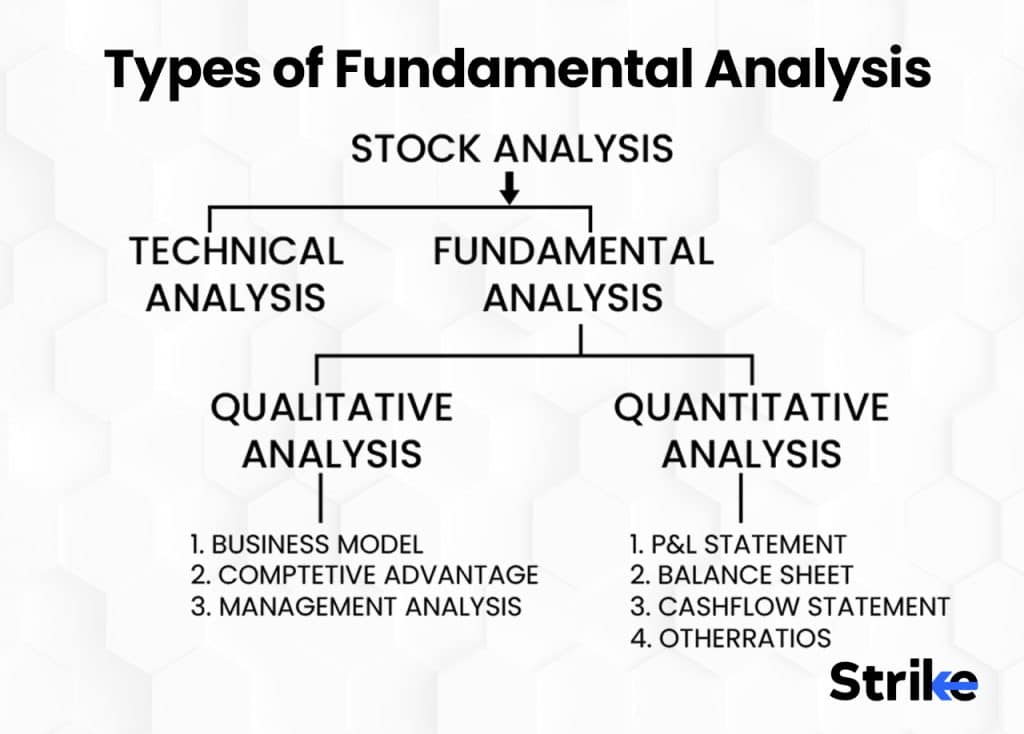
Fundamental analysis is classified into two types: quantitative and qualitative. Quantitative analysis is the study of a company’s financial performance via the use of statistics and ratios such as the price-to-earnings (PE) ratio, debt-to-equity ratio, and return on equity (ROE). The qualitative study examines the management team, goods and services, competitive environment, and industry developments of the organisation.
1. Quantitative Fundamental Analysis
The method of studying a stock’s performance using numerical measurements, the findings of which is utilized to make educated judgments about whether to buy or sell a particular stock, is known as quantitative fundamental analysis. These measurements consider a number of elements, such as the company’s financials, economic indicators, and market trends. This research is intended to determine how a stock will perform over time, helping investors to make better educated selections about which equities to invest in.
Among the tools that are used in fundamental analysis are earnings per share (EPS), price-to-earnings ratio (P/E), price-to-sales ratio (P/S), debt-to-equity ratio (D/E), and return on equity (ROE). These measures can give investors a full overview of the company’s performance and assist them in deciding whether or not to acquire the shares.
Quantitative fundamental research is crucial in stock market investing since it provides investors a sense of a company’s overall performance as well as its potential for development. This study can assist investors in making better educated decisions about which stocks to buy and when to sell them. Investors better analyze a company’s financial health and boost their chances of success in the stock market by using quantitative measurements.
The primary distinction between qualitative and quantitative fundamental analysis is that qualitative analysis focuses on a firm’s qualitative features, such as its management team, corporate culture, and strategic vision, whereas quantitative analysis focuses on a company’s financial indicators. In general, qualitative research is used to assess a company’s overall potential, whereas quantitative analysis may offer a thorough look at a company’s performance and assist investors to decide whether or not to acquire the stock.
2) Qualitative analysis
Qualitative analysis entails the examination of non-numerical data. This information contains things like management practices, competitive advantages, and long-term ambitions among others. It is used to evaluate the quality of the company’s operations and management, as well as its capacity to compete in the market.
Qualitative analysis is done when the investors want to know information other than technical and numbers. Qualitative factors like, industry, business model as a whole, and its corporate governance would go a long way to help the investors in making predictions and forecasts.
The significance of both quantitative and qualitative analysis cannot be overstated. Quantitative analysis offers investors an objective perspective of a company’s financials, whereas qualitative analysis aids in determining the company’s overall orientation. Together, these two components give investors a full perspective of a company’s activities, allowing them to make better educated investment decisions.
What are the three Layers of Fundamental Analysis?
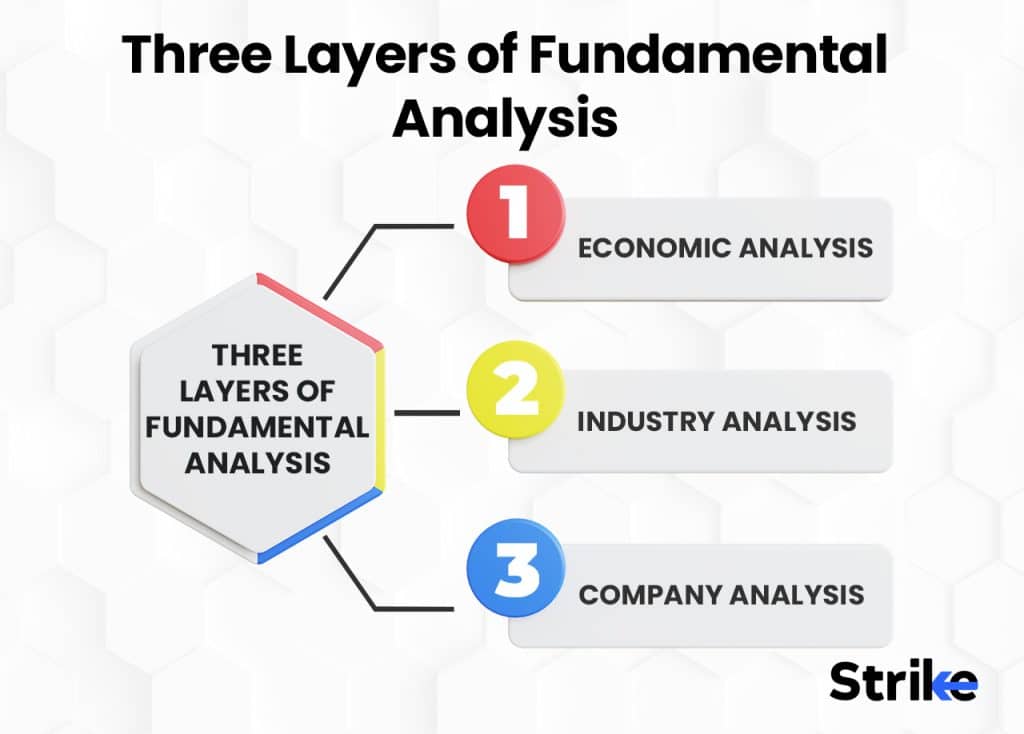
Economic analysis, industry analysis, and corporate analysis are the three layers of fundamental analysis. More details of each are given below.
1. Economic Analysis
Economic analysis is a key concept in fundamental analysis, which is used to assess the entire financial health of an organization. Understanding macroeconomic issues such as inflation, unemployment, and GDP growth is required for economic analysis. Analysts examine the state of the economy to forecast how it will affect the stock market. This involves assessing the prospective influence on a company’s financial performance by looking at macroeconomic trends, economic indicators, and other factors.
Economic analysis is used by firms to uncover investment possibilities as well as possible areas of danger. Investors make educated investment decisions by knowing the economic context in which a firm works. Economic research also shed light on how various economic trends and events impact a company’s profitability and cash flow.
For example, A corporation must evaluate how this affects its costs, such as boosting the pricing of its products and services, if it works in a high-inflation climate. Similarly, It will profit from taking out loans to support its operations if the corporation operates in a low-interest-rate environment. A corporation makes educated judgments regarding its investments and operations if it understands the economic environment in which it works.
2. Industry Analysis
Industry analysis is a more specialized approach to stock evaluation that looks at the sector’s performance, competitive environment, and predicted growth prospects. It necessitates a thorough awareness of the sector’s performance, competitive landscape, and predicted growth prospects. Investors utilize this form of study to acquire insight into a company’s operations, competitive dynamics, and overall prospects. Investors will better evaluate the prospects of individual firms within an industry by understanding these aspects.
Industry analysis is a sort of financial study used to examine an industry’s health and desirability. It evaluates the industry’s previous performance and future prospects by taking into account aspects such as the economic and political climate, competitive pressures, technology, and laws.
For example, an investor decides to undertake an automobile sector study. An examination of global economic trends, such as the growth of electric cars, as well as local and regional policies that affect the business, will be part of such an examination. Furthermore, the investors examine industry leaders and assess their competitive advantages and limitations. The investor will be able to better estimate the prospects of individual firms in the sector by studying the industry and its main players.
3. Company Analysis
The process of analyzing a firm’s financial health, competitive advantages, and long-term prospects for success is known as company analysis. It entails investigating the company’s financial statements, management, goods and services, competitive environment, and other aspects in order to assess the company’s potential for development and profitability.
Firm analysis is essential because it enables investors and other stakeholders to make educated decisions about investing in or doing business with a certain company. It also assists businesses in understanding how they compare to their competitors and identifying opportunities for development. Management teams design plans to compete in the market by recognising a company’s strengths and shortcomings.
Examining the economic environment of a certain firm is one example of a company analysis. This would entail investigating its industry, examining the market for its products and services, evaluating its competitors, and reviewing its finances. This study would aid in determining the company’s strengths and shortcomings, as well as its potential for growth and profitability.
What are the two Approaches Investors can use for Fundamental Analysis?
Fundamental analysis is conducted in two ways by investors: top-down and bottom-up.
Top-down analysis begins with a study at the macroeconomic environment, such as the economy’s performance, interest rates, and commodity prices. Investors then choose specific industries to invest in and individual stocks to include in their portfolios.
Bottom-up analysis is the inverse of top-down analysis. It begins with an examination of individual stocks before moving on to the performance of the wider economy and industry. This strategy focuses on identifying specific stocks with appealing fundamentals and the ability to beat the market. Investors examine a company’s financial statements and compare them to the industry average to discover firms with solid fundamentals. They consider a company’s market share, competitive advantage, and managerial performance, among other things.
Both techniques have advantages and disadvantages, so investors should assess which one is best suited to their investing plan.
1. Top Down
The top-down approach to fundamental analysis entails looking into the industry and market at a high level, then diving down to the company’s financials to determine how it compares to its peers. The top-down method seeks to identify organizations with the greatest potential for long-term growth.
The top-down strategy begins with identifying the industry and sector in which the organisation works. This aids in gaining an understanding of the sector’s broad trends as well as prospective possibilities and threats. After studying the industry, investors may examine the company’s financial documents, such as its income statement, balance sheet, and cash flow statement, to have a better picture of its financial health.
The following stage is to compare the company’s performance to that of its competitors. This aids in identifying organisations with the greatest potential for development as well as those that are underperforming. Investors might then examine the management team, strategic decisions, products, and competitors of the firm. This contributes to a more complete view of the company’s future prospects.
Finally, financial measures such as the price-to-earnings ratio and the price-to-book ratio can be used by investors to discover firms that are undervalued or overpriced in comparison to their rivals. This aids in identifying stocks with the greatest potential for development.
2. Bottom-up
Bottom-up fundamental analysis is a way for determining the entire stock market forecast. This technique entails examining individual stocks at the most fundamental level, such as business and industry performance, before making a judgement on the stock market as a whole.
Beginning with individual equities, the bottom-up strategy examines aspects such as the company’s financials, management, and other industry-related issues. Analysts will evaluate each stock in light of the present market situation before determining the overall market forecast.
The bottom-up method begins with the macro level and then moves on to individual equities. By studying at the macro level, analysts may obtain a better knowledge of market sentiment and utilise it to predict where individual stocks will go.
Analysts then utilise this market knowledge to make stock selection recommendations. Before making a choice, this method considers the entire market circumstances, which might assist to decrease risk.
Before making an investment, investors can utilise the bottom-up strategy to get insights into the larger market as well as the potential of particular stocks. When making judgements, investors should employ a range of strategies, and the bottom-up approach may be quite beneficial in comprehending the entire market perspective.
What are the Uses of Fundamental Analysis?
Fundamental Analysis is a method used to assess the intrinsic value of an asset. It involves analyzing the economic, financial and qualitative data about the asset, and then predicting the future performance of the asset based on those data. It is typically used by investors, market analysts, and financial advisors to assess the current market value of an asset and make sound investment decisions.
The most common use of Fundamental Analysis is to determine the value of a company in order to assess whether it is undervalued or overvalued. This is done by considering such financial metrics as earnings, debt levels, dividends and cash flow. These financial metrics are then compared to the current market price of the company’s stock to determine if it is undervalued or overvalued.
Finally, Fundamental Analysis is also used to understand the macroeconomic environment in which a company operates. By examining such macroeconomic indicators as inflation, interest rates, and GDP growth, investors can identify which companies are likely to benefit from the current macroeconomic environment.
Overall, Fundamental Analysis is a powerful tool that can be used by investors, analysts, and financial advisors to assess the intrinsic value of assets and make sound investment decisions.
How do Traders use Fundamental Analysis in the Stock Market?
Fundamental analysis is a valuable tool that traders use to determine their next move in the stock market. Traders may make better-educated judgements about what stocks to purchase and when to buy them by looking at a company’s fundamental economic and financial situations, as well as its industry and market.
Fundamental analysis includes reviewing financial documents such as balance sheets, income statements, and cash flow statements to gain a better understanding of a company’s financial health. Traders will also consider the firm’s management as well as the status of the larger economy to determine how the company will fare in the future.
Fundamental research considers stock market mood and investor psychology. This can assist traders in determining if a particular stock’s prospective trend will continue in the same direction or reverse.
Fundamental research is often used by traders to analyse equities and uncover fresh possibilities. They might examine the financials of other firms in the same industry to determine which are more appealing investments. They can also look at the overall market to see whether individual stocks are overpriced or underpriced.
Fundamental analysis, in the end, is a strong tool that traders can use to make better judgements about which stocks to purchase and when to buy them. Traders may more properly analyse the potential of a company and make decisions that will lead to more lucrative trades by evaluating the financials, management, and broader market circumstances.
What are the methods of doing Fundamental Analysis of Stocks?
Fundamental analysis of stocks involves five main methods, including:
- Analyzing financial statements: This includes examining the balance sheet, income statement, and cash flow statement to determine a company’s financial health.
- Analyzing the company’s competitive position: This includes studying the company’s competitive advantages, potential risks, and current business strategies.
- Analyzing the company’s management team: This includes evaluating the team’s experience, skills, and track record.
- Analyzing macroeconomic factors: This includes understanding how economic conditions in the company’s market can affect its performance.
- Analyzing technical indicators: This includes looking at stock price charts to identify patterns that may be predictive of future performance.
The culmination of the above methods is often what results in a successful fundamental analysis of stocks.
What are the different Tools Investors use in Fundamental Analysis?
Fundamental analysts often utilise a combination of methods to make educated stock selection selections. Beta, return on equity, dividend payout ratio, dividend yield ratio, price-to-sales ratio, anticipated earnings growth, price-to-earnings (P/E) ratio, price-to-book (P/B) ratio, and earnings per share or EPS are the most prevalent of these instruments.
1. Beta
Beta is a metric that compares the volatility of a stock to the volatility of the whole market. Beta will assist you in identifying hazardous stocks if you consider risk to be the likelihood of a stock price decline. The whole stock market has a beta of one, and a stock’s beta coefficient represents how risky the stock has been in recent years in comparison to the general market.
A stock’s beta level shows its systemic risk. A high-beta stock has a beta greater than 1.0 and is more volatile than the market over time. Stocks with a high beta are riskier, but also have the potential for bigger profits. If a stock swings less than the general market volatility, it is classified as a low-beta stock with a beta value less than 1.0. Low-beta stocks are less risky, but they may provide lesser returns.
A negative beta, or beta smaller than zero, is theoretically feasible but exceedingly improbable. A negative beta indicates that a stock reacts inversely to the market: when the market returns are positive, the stock price falls; when the market returns are negative, the stock price rises.
2. Return on Equity
Return on equity, or ROE, is an important metric for gathering information about a firm. It assists investors in understanding how a company distributes cash and creates a profit.
For example, ROE demonstrates how corporations spend their shareholders’ money. It is calculated by multiplying a company’s net profit by its net worth. ROE varies based on the industry in which the firm works.
ROE assesses a company’s operational efficiency. It demonstrates how the corporation leverages its assets and financial leverage to produce income.
Profit After Tax (PAT) / Net Worth = ROE
Net worth is calculated as the sum of equity capital plus reserves and surplus.
ROE may be divided into three parts known as Dupont Analysis.
(PAT/Net Sales) * (Net Sales / Total Assets) * (Total Assets / Net Worth)
ROE equals net profit margin multiplied by total asset turnover ratio multiplied by equity multiplier.
3. Dividend payout ratio
The dividend payout ratio, also known as the payout ratio, is a financial term that explains the total amount of dividends given to shareholders in relation to the company’s net income. In other terms, it is the percentage of a company’s earnings distributed to shareholders in the form of dividends. In general, money that is not paid out in dividends is reinvested back into the firm to either pay down debt or reinvest in core activities.
The dividend payout ratio is used by investors to determine which companies are most suited to their objectives. Firms having a high average dividend payout ratio are generally preferred by investors because they are more likely to generate a consistent source of income.
Furthermore, before determining whether to invest, investors are likely to examine the trend in a company’s dividend payment ratio. A declining trend in payments might be reason for concern, but a company that has regularly distributed 20% of its profits to shareholders could be viewed as a strong bet for constant and sustainable income.
Simply put, the dividend payout ratio may help you understand what kind of returns a firm is expected to provide and whether it is a suitable fit for an investor’s portfolio.
4. Dividend Yield Ratio
The dividend yield ratio compares the proportion of dividends paid by a firm to the market price of its shares. Thus, the dividend yield ratio represents an investor’s return on investment if the stock was purchased at the market price on the measurement date. Investors use the ratio to determine the amount to which a company has committed to paying dividends.
Divide the annual dividends paid per share of stock by the stock’s market price at the conclusion of the measurement period to obtain the ratio. This is because the stock’s market price is recorded on a single date and will not be reflective of the stock price during the measurement period, consider utilizing an average stock price instead.
5. Price-to-sales Ratio
A P/S (or price-to-sales) ratio is a valuation metric that investors use to analyse how the share price of a business relates to its yearly revenue.
The P/S ratio of a corporation may also be defined as how much investors are prepared to pay for a stock per dollar of the underlying company’s yearly sales. It is one of several criteria that investors use to compare companies and determine whether a stock is cheap or overpriced.
P/S ratios that are considered average or “normal” vary by sector. The lower a company’s P/S ratio, the greater its sales relative to its share price. The greater a company’s share price in relation to its sales, the greater its P/S ratio. In the absence of other considerations, some investors believe that equities with lower P/S ratios than comparable businesses in the same industry are cheap (and stocks with higher ratios overvalued).
The P/S ratio, like the somewhat better-known P/E (price-to-earnings) ratio, is a statistic that helps investors to estimate the worth of a stock by comparing its share price (decided by the market) to something that truly shows how successful the company is—in this example, its yearly revenue (sales, not profit).
The P/S ratio compares a company’s stock price to its yearly profits (profit), whereas the P/E ratio compares it to its annual revenue (sales). Not all businesses earn a profit every year, especially newer businesses in growth or businesses whose income is heavily influenced by economic ups and downs, and this is not always a bad thing.
A company’s lack of earnings does not make it a bad investment. That is why the P/S ratio is so valuable. It may be used to value and compare firms based on revenue even if they have yet to make a profit (or have not made a profit in the previous 12 months). As a result, it’s one of the most commonly employed foundations in evaluating startups and other young or fast-developing businesses.
6. Projected earnings growth
Projected Earnings Growth is the expected rise in a company’s earnings over a specific time period. It is frequently estimated by analysts and used to forecast a company’s future financial success. The metric is generally given as a percentage and shows the predicted increase in profits per share (EPS) over a specific time period, such as a quarter or a year. Projected Earnings Growth is seen as an essential measure of a company’s financial health and is frequently monitored by investors.
7. Price-to-earnings (P/E) Ratio
The P/E ratio, or price-to-earnings ratio, is a simple approach to determine if a company is cheap or overpriced. In general, the lower the P/E ratio, the better it is for both the company and potential investors. The statistic is a company’s stock price divided by its earnings per share. P/E ratios of various types of firms, such as a tech company and a consumer staple company, should not be compared.
To put it another way, the measure is only helpful for comparing apples to apples. Consider engaging with a financial professional if you need assistance with using P/E ratios to invest your money.
You do not need to compute each company’s P/E ratio. After all, you could simply Google it. However, the ratio is the share price divided by earnings per share. The resultant value indicates how much you are spending per dollar earned by the firm. Here’s how it works:
Earnings Per Share x Share Price Equals P/E Ratio
A ratio of 15, for example, indicates that investors are ready to pay $15 for every dollar of firm earnings. This is why the P/E ratio is often known as the “earnings multiple” or simply “multiple.”
The P/E ratio is often used by comparing it to other P/E ratios of firms in the same industry or to previous P/E ratios of the same company. When comparing firms in the same industry, the one with the lower P/E ratio may be undervalued. A larger figure might indicate that it’s no longer a good deal if you’re looking at historical data for one firm.
Finally, there is no hard and fast criteria for determining a decent P/E ratio. However, many value investors believe that a lower P/E ratio is preferable. Again, these ratios are frequently employed in a comparative sense, so what’s good or poor is frequently determined by what you’re comparing it to.
To give you an idea of what the market average is, many value investors consider 20 to 25 to be the average P/E ratio range. And, like with golf, the lower a company’s P/E ratio, the better an investment the statistic says it is.
However, when looking at the market, the preceding implies a value attitude. You will have to be ready to pay a higher P/E ratio for a more expensive investment if you want to invest in larger, less volatile firm stocks.
8. Price-to-book (P/B) Ratio
The price-to-book (P/B) ratio is a financial measure that compares the current market price of a firm to its book value. It is computed by dividing the stock’s current closing price by the most recent book value per share.
The P/B ratio may be used to identify whether a firm is over or undervalued, as well as to compare it to other companies in the same industry. It might be a useful tool when considering long-term investments.
The current market price of the stock, which is obtained on any public stock exchange, and the book value per share, which is normally accessible in the company’s financial records, are required to compute the P/B ratio.
Once you have these values, divide the stock’s current market price by its book value per share. The P/B ratio will be the end outcome. As an example, current stock price of $50 / book value per share of $10 = P/B ratio of 5.
9. Earnings Per Share or EPS
Earnings Per Share (EPS) is a key measure of a company’s profitability, as it indicates the amount of money each share of stock earns. Calculating EPS is a simple process that requires a few key pieces of information.
In order to accurately calculate EPS, you’ll need to know the following:
The company’s net income
The number of common shares outstanding
To calculate EPS, use the following formula:
EPS = (Net Income – Preferred Dividends) / Average Outstanding Shares
Where:
Net Income = the company’s total earnings from all sources
Preferred Dividends = any dividends paid to preferred shareholders
Average Outstanding Shares = the average number of common stock outstanding during the period
How do Fundamental Analysis used in Finance?
Fundamental analysis is a useful technique in finance for making educated judgements about stocks, bonds, and other instruments. It is a way of determining the value of an asset by considering economic, financial, and other qualitative and quantitative aspects. Fundamental analysis considers a security’s inherent value rather than its market price to discover the asset’s genuine worth. This enables an investor to make judgements based on the security’s core fundamentals rather than guesswork.
Fundamental analysis in finance can benefit investors by allowing them to make decisions based on the underlying worth of the asset rather than merely what the market is doing. Investors can assess if a security is a viable investment by considering aspects such as the company’s financial health and future prospects. In addition, by studying a security’s underlying fundamentals, an investor may decide whether it is cheap or overpriced, allowing them to purchase or sell accordingly. Finally, fundamental research can help investors make better selections, increasing their chances of success.
How do Investors use Fundamental Analysis in Investment?
Investors can use fundamental analysis to assess if a firm is cheap or overpriced. It also assists investors in identifying firms that have the potential to offer large profits. Fundamental analysis is used by investors to evaluate a company’s financial performance, such as profits, revenue, and financial situation.
Fundamental analysis is also used by investors to evaluate a company’s competitive position in the market, as well as its management team, business plans, and strategy. They utilise this data to forecast the company’s success in the future. Fundamental research also allows investors to compare stocks to their counterparts in order to identify the most appealing investment possibilities.
What is an example of Fundamental Analysis?
Evaluating Reliance Industries’ financial and economic health is an example of Fundamental Analysis. Fundamental analysis is examining the company’s financial accounts in order to assess the company’s value. This form of research include examining the firm’s cash flows, profitability, balance sheets, debt, and other aspects in order to evaluate the total worth of the organisation.
Furthermore, Fundamental Analysis entails examining the company’s competitive advantages, such as its industry position, market share, and client base. This gives insight into the company’s future prospects and enables more educated investment decisions.
Does Fundamental Analysis work for Stocks?
Yes. Fundamental analysis a valuable tool for stock investors since it gives insight into a company’s financial health and can assist them in identifying companies that may deliver strong returns. It should, however, be used in combination with technical analysis, which examines a stock’s price movement and patterns. When applying both tactics together, investors may make more educated stock selection judgements.
Does Fundamental Analysis work in Forex?
Yes, fundamental analysis works well in forex trading by making use of analyzing economic, social and political factors. This will lead to changes in the currency prices. Fundamental analysis examines the economic and political elements that impact currency prices. Economic statistics such as GDP growth and unemployment figures are used by analysts to forecast how a currency will move in the future. They also include monetary policy and political developments that have an impact on the value of a currency. Traders make educated forecasts about the way a currency pair will go in the future by taking these considerations into account.
Does Fundamental Analysis even matter anymore?
Yes. Fundamental analysis does matter a lot and has long been a cornerstone of stock market investing in which value based investing has also taken a center stage. While it is true that the techniques of fundamental analysis have evolved over time and become more complex, it is still an important tool for investors. It allows investors to identify stocks that are undervalued, understand company performance, and anticipate future stock performance.
At the same time, investors must also consider other factors, such as economic trends and technological developments, when making investment decisions. Fundamental analysis can provide a good basis for making decisions, but it must be supplemented with other sources of information.
Fundamental analysis is not a perfect science, and there will always be some degree of risk involved in stock market investing. However, it is still an invaluable tool for investors who are looking to make informed decisions about their investments. As long as investors understand the risks involved and are willing to do the necessary research, fundamental analysis can be a powerful tool in their stock market toolbox.
What is the difference between Fundamental Analysis and Technical Analysis?
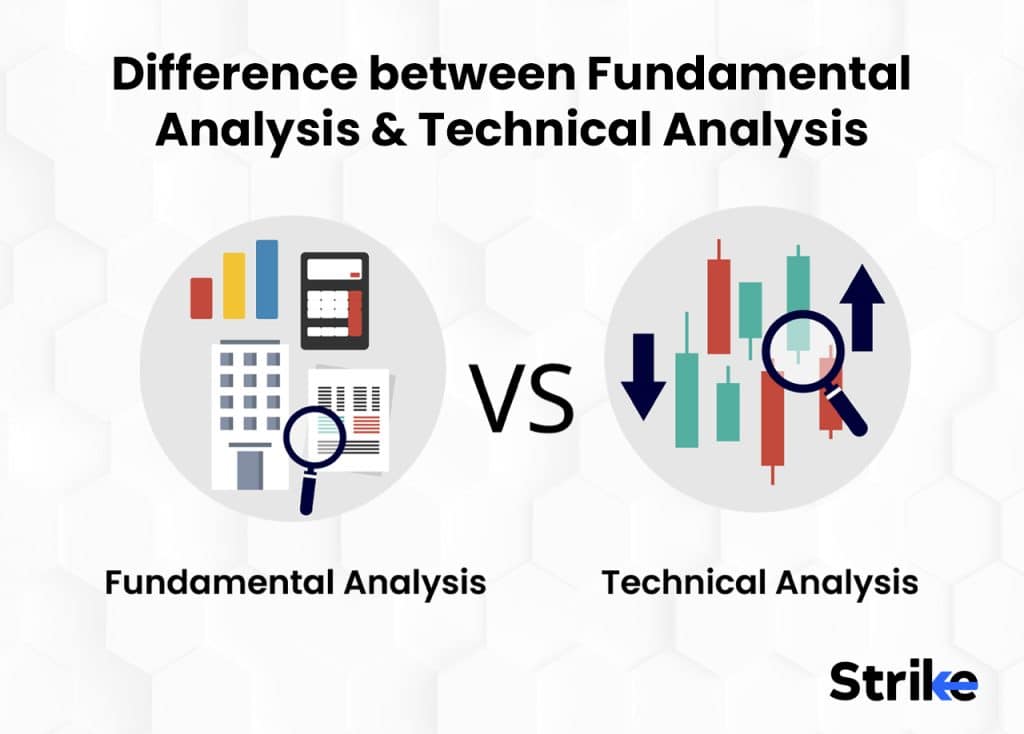
Investors employ two forms of analysis to analyse stocks and other investments: fundamental analysis and technical analysis. Both methods of analysis have advantages and disadvantages, and each investor must choose which method to adopt based on their own objectives.
The following four are the points related to fundamental analysis.
- Fundamental analysis is a stock analysis that examines a company’s financial condition. It is predicated on the idea that a company’s stock price should represent its entire financial success.
- Financial documents, such as income statements, balance sheets, and cash flow statements, are used by fundamental analysts to analyze a company’s financial health. They concentrate on the company’s revenue, costs, earnings, assets, liabilities, and other financial data.
- Investors use fundamental research to find firms with high revenue, minimal costs, and healthy profitability. They also examine the company’s overall financial health by looking at its debt burden and other criteria.
- The financial health of a corporation is assessed in terms of its present status and future possibilities.
The following are the points relating to technical analysis.
- Technical analysis is a study that examines how a stock’s price and volume vary over time. It is predicated on the notion that the stock’s present and historical price movements are utilized to forecast future price changes.
- Charts and other technical indicators are used by technical analysts to uncover patterns that are utilized to anticipate future price changes.
- Investors use technical analysis to spot trends and patterns in the stock’s historical price and volume data. They search for patterns that indicate the stock will move in a specific direction.
- Moving averages, support and resistance levels, and momentum indicators are frequently used by technical analysts to anticipate future market moves.
The two major differences between fundamental analysis and technical analysis are as follows.
- Fundamental analysis evaluates a stock’s current and future prospects using financial data. Technical analysis makes forecasts about future price movements by analyzing previous price and volume data.
- Fundamental analysis often takes a longer-term perspective, whereas technical analysis offers a shorter-term one.
To summarize, fundamental analysis and technical analysis are two distinct forms of analysis used by investors to analyze securities. The primary distinctions between fundamental and technical analysis are the sorts of data examined, the time limits for analysis, and the types of forecasts produced.


 Previous Article




![85 Common Stock Market Terminologies for Dummies [Updated List for 2025]](https://www.strike.money/wp-content/uploads/2025/04/Popular-Stock-Market-Terms-for-Beginners-Banner.png "85 Common Stock Market Terminologies for Dummies [Updated List for 2025] 22")









No Comments Yet.